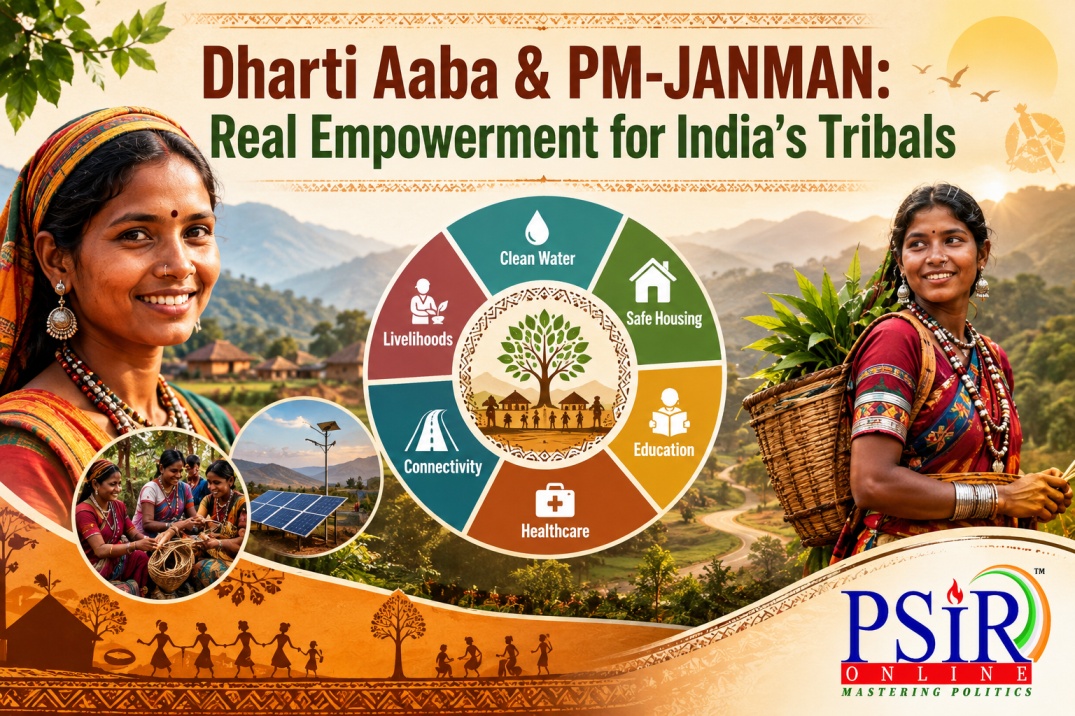
India’s tribal communities, the custodians of the nation’s rich cultural and ecological heritage, have long faced marginalization and limited access to basic services. Launched to bridge this gap, Dharti Aaba Janjatiya Gram Utkarsh Abhiyan (DAJGUA) and Pradhan Mantri Janjati Adivasi Nyaya Maha Abhiyan (PM-JANMAN) stand as transformative flagship initiatives of the Ministry of Tribal Affairs. Through convergence of schemes, saturation of entitlements, and targeted interventions, these programs are delivering real empowerment — economically, socially, and educationally — to over five crore tribals, especially the most vulnerable Particularly Vulnerable Tribal Groups (PVTGs).
Dharti Aaba Janjatiya Gram Utkarsh Abhiyan (DAJGUA) and Pradhan Mantri Janjati Adivasi Nyaya Maha Abhiyan (PM-JANMAN) are two flagship initiatives by India's Ministry of Tribal Affairs for the holistic development of tribal communities. They complement each other, with DAJGUA providing broader coverage for tribal-majority villages and PM-JANMAN focusing on the most vulnerable groups (PVTGs). They are frequently implemented together through convergence, awareness campaigns, and benefit saturation drives.
DHARTI AABA JANJATIYA GRAM UTKARSH ABHIYAN (DAJGUA / PM-JUGA)
Launch: 2 October 2024 by Prime Minister Narendra Modi from Hazaribagh, Jharkhand (named after Birsa Munda, known as "Dharti Aaba" or Father of the Earth).
Scope: Targets 63,843 tribal-majority villages (population 500+, with ≥50% tribal residents, plus villages in Aspirational Districts) across 549 districts, 2,911 blocks, and 30 States/UTs. Aims to benefit over 5 crore tribal people.
Duration: 5 years (FY 2024-25 to 2028-29).
Key Features:
· 25 interventions by 17 line Ministries through convergence of existing schemes (e.g., infrastructure, health, education, Anganwadi, livelihoods).
· Focuses on saturating gaps in social infrastructure, healthcare, education, and economic opportunities.
· Multi-sectoral approach using funds like DAPST (Development Action Plan for Scheduled Tribes) for maximum impact.
Objectives: Holistic and sustainable development of tribal villages via saturation, outreach, and real-time monitoring (e.g., via PM Gati Shakti and KPIs).
PM-JANMAN (PRADHAN MANTRI JANJATI ADIVASI NYAYA MAHA ABHIYAN)
Launch: 15 November 2023 on Janjatiya Gaurav Divas from Khunti, Jharkhand.
Scope: Focuses on 75 Particularly Vulnerable Tribal Groups (PVTGs) in 18 States + 1 UT. Covers PVTG habitations/villages and families (around 29,000+ habitations in broader campaigns).
Duration: Initially 3 years (2023-24 to 2025-26), with extensions and integration into broader efforts.
Key Features:
· 11 critical interventions by 9 line Ministries, emphasizing basic services: safe housing, clean drinking water, education, health & nutrition, road/telecom connectivity, electrification (e.g., solar), and sustainable livelihoods.
· Door-to-door surveys, entitlement saturation, and targeted support for the most marginalized tribal groups.
Objectives: Improve socio-economic conditions of PVTGs by bridging critical gaps and ensuring "Nyaya" (justice) through inclusive development.
KEY DIFFERENCES AND COMPLEMENTARITY
|
Aspect |
DAJGUA (Dharti Aaba) |
PM-JANMAN |
|
Focus |
Broader tribal-majority villages |
Specifically PVTGs (most vulnerable) |
|
Scale |
~63,843 villages, 5+ crore people |
PVTG habitations/families |
|
Interventions |
25 by 17 Ministries |
11 by 9 Ministries |
|
Approach |
Convergence & saturation in villages |
Targeted basic facilities & outreach |
|
Launch Year |
2024 |
2023 |
Together: DAJGUA builds on the PM-JANMAN model for wider tribal areas. Both emphasize convergence, real-time dashboards, and community involvement. Joint awareness campaigns (e.g., Dharti Aaba Janbhagidari Abhiyan, Janjatiya Garima Utsav) run from mid-2025, with benefit camps for schemes like housing, Ayushman Bharat, Ujjwala, etc.
INTENDED CONSEQUENCES (OBJECTIVES & EXPECTED OUTCOMES)
Dharti Aaba Janjatiya Gram Utkarsh Abhiyan (DAJGUA) and PM-JANMAN focus on holistic, sustainable development of tribal communities through saturation (ensuring every eligible beneficiary/household/village gets covered) via scheme convergence, outreach, and last-mile delivery.
Core Intended Goals (Shared Vision)
· Bridge critical development gaps in remote/forest/tribal areas: infrastructure (housing, roads, water, electricity), health & nutrition, education, livelihoods, and connectivity.
· Improve socio-economic conditions and quality of life for tribal populations, reducing inequalities between tribal and non-tribal regions.
· Empower communities through rights awareness, entitlement delivery, skill development, and economic opportunities.
· Promote inclusive growth aligned with Viksit Bharat (Developed India), preserving tribal culture while ensuring "Nyaya" (justice) and mainstream integration.
DAJGUA (Dharti Aaba) – Intended Outcomes
· Holistic village saturation in ~63,843 tribal-majority villages (≥500 population + ≥50% tribal or in Aspirational Districts), benefiting 5+ crore tribal people over 5 years (2024-29).
· 25 interventions via 17 Ministries (₹79,156 Cr outlay) for:
o Basic amenities: Pucca housing, all-weather roads, tap water, electricity, telecom.
o Health & nutrition: Mobile Medical Units, Anganwadi strengthening, immunization.
o Education: Hostels, schools, digital access.
o Livelihoods: Skill development, MFP (minor forest produce) processing, agriculture, animal husbandry, self-help groups.
· Expected Impacts:
o Enhanced quality of life and better health/education outcomes.
o Economic empowerment, poverty reduction, and sustainable livelihoods.
o Stronger social inclusion and participatory governance (e.g., via Janbhagidari campaigns, Digital Warriors).
o Real-time monitoring through dashboards and KPIs for measurable progress.
PM-JANMAN – Intended Outcomes
· Targeted at 75 Particularly Vulnerable Tribal Groups (PVTGs) in ~22,000–30,000 habitations across 18 States + 1 UT, reaching lakhs of the most marginalized families.
· 11 critical interventions by 9 Ministries (initial ₹24,104 Cr) for basic facilities in 3 years (extendable):
o Safe pucca housing (PM Awas Yojana).
o Clean drinking water & sanitation.
o Education access and hostels.
o Health, nutrition (Anganwadis, Mobile Medical Units).
o Road/telecom connectivity, electrification (grid + solar).
o Sustainable livelihoods.
· Expected Impacts:
o Transformational change: From kutcha homes to secure housing, unelectrified to powered habitations, isolated to connected communities.
o Improved health indicators, reduced malnutrition, higher literacy.
o Economic self-reliance and protection of vulnerable groups.
o Model for broader tribal development (DAJGUA builds directly on its learnings).
Key Intended Broader Consequences
|
Area |
Intended Positive Outcomes |
|
Social |
Reduced inequality, better inclusion, rights awareness |
|
Economic |
Livelihood diversification, income rise, skill uplift |
|
Health & Education |
Lower disease burden, higher enrollment & outcomes |
|
Infrastructure |
Saturation of basic services in remote areas |
|
Governance |
Convergence model, community participation, data-driven implementation |
These schemes emphasize non-disruptive development that respects tribal identity while delivering tangible benefits. Early reports highlight progress in house construction, water connections, medical units, and outreach camps. Success depends on effective convergence, state participation, and community involvement.
HOW DAJGUA AND PM-JANMAN HELP TRIBAL EMPOWERMENT
These two schemes represent a multi-dimensional empowerment strategy for India's tribal communities. They go beyond basic welfare by focusing on rights awareness, economic self-reliance, social inclusion, skill-building, and participatory governance. Together, they aim to transform remote tribal areas into self-sustaining hubs while respecting tribal identity and culture.
1. Economic Empowerment
· Livelihood Opportunities: Support for agriculture, animal husbandry, fisheries, minor forest produce (MFP) processing, Van Dhan Vikas Kendras, and self-help groups. This helps tribals monetize traditional knowledge and resources.
· Skill Development & Entrepreneurship: Training and market linkages reduce dependency on subsistence living and migration.
· Financial Inclusion: Jan Dhan accounts, PM-KISAN, direct benefit transfers, and access to credit empower families financially.
· Expected Impact: Higher household incomes, reduced poverty, and sustainable economic growth for over 5 crore tribals (DAJGUA) and lakhs of PVTG families (PM-JANMAN).
2. Social & Health Empowerment
· Basic Services Saturation: Pucca housing (PM Awas), clean tap water, sanitation, electricity (including solar), and all-weather roads break isolation.
· Health & Nutrition: Anganwadi strengthening, Mobile Medical Units, Ayushman Bharat cards, immunization, and Sickle Cell Disease screening/counseling.
· Rights Awareness: Doorstep delivery of documents (Aadhaar, forest rights under FRA) ensures access to entitlements and legal protection.
· Outcome: Better health indicators, reduced malnutrition, and dignity through secure living conditions.
3. Educational & Human Capital Empowerment
· Access to Quality Education: Schools, hostels (including Eklavya Model Residential Schools), digital connectivity, and scholarships.
· Youth Leadership: Tribal youth trained as Digital Warriors for community mobilization, awareness campaigns, and last-mile delivery.
· Long-term Effect: Higher literacy, skills, and leadership pipeline for future tribal leaders and innovators.
4. Political & Participatory Empowerment
· Community Involvement: Gram Sabha certification, Jan Sunwai (public hearings), benefit saturation camps, and Janbhagidari (people's participation) campaigns.
· Participatory Governance: Tribals become active stakeholders rather than passive beneficiaries.
· Cultural Pride: Aligned with Janjatiya Gaurav Varsh (Tribal Pride Year), celebrating heritage while promoting development.
5. Targeted Focus on the Most Vulnerable (PM-JANMAN)
· Special emphasis on 75 PVTGs — the "most marginalized among the marginalized" — through 11 critical interventions. This addresses intersecting discrimination and brings them into the mainstream without cultural erosion.
Real-World Delivery Mechanism
Massive outreach campaigns (e.g., Dharti Aaba Janbhagidari Abhiyan) organize village-level camps for direct benefit delivery: Aadhaar, health cards, gas connections, scholarships, etc. In early phases, thousands of camps have already reached lakhs of tribals.
Summary of Empowerment Dimensions
|
Dimension |
How Schemes Help |
Key Tools/Interventions |
|
Economic |
Income generation & financial access |
Livelihoods, MFP, SHGs, Jan Dhan |
|
Social/Health |
Basic needs & rights awareness |
Housing, water, Ayushman, FRA |
|
Educational |
Access + skills for youth |
Schools, hostels, Digital Warriors |
|
Political |
Voice & participation |
Gram Sabha, camps, Janbhagidari |
|
Cultural |
Development with identity preservation |
Janjatiya Gaurav events |
These programs follow a "Saturation + Convergence" model (using funds from 17+ Ministries) for holistic, measurable impact. Success relies on effective implementation, state coordination, and active community participation. Early results show progress in service delivery and awareness, positioning tribals as key contributors to Viksit Bharat.
CONCLUSION
Dharti Aaba and PM-JANMAN represent more than government schemes; they embody a sincere commitment to tribal justice and inclusive development. By focusing on basic infrastructure, livelihoods, health, education, and rights awareness, these initiatives are steadily moving tribal communities from the margins to the mainstream. Their success lies in community participation and last-mile delivery. As India marches towards Viksit Bharat, these programs ensure that no tribal is left behind, fostering a stronger, self-reliant, and culturally proud tribal India.
PRACTICE QUESTIONS FOR GS 2 MAINS
1. “The real challenge in tribal development lies not merely in welfare delivery but in ensuring saturation and last-mile inclusion.” In the light of this statement, critically examine the significance of the convergence approach adopted under Dharti Aaba Janjatiya Gram Utkarsh Abhiyan (DAJGUA) and PM-JANMAN.
2. Discuss how PM-JANMAN seeks to address the historical marginalization of Particularly Vulnerable Tribal Groups (PVTGs) in India. Evaluate its potential in ensuring social justice and inclusive governance.
3. Compare and contrast Dharti Aaba Janjatiya Gram Utkarsh Abhiyan (DAJGUA) and PM-JANMAN in terms of objectives, scope, implementation strategy, and target beneficiaries. How do these schemes complement each other in tribal empowerment?
4. “Economic empowerment, cultural preservation, and participatory governance must go hand in hand for meaningful tribal development.” Examine this statement with reference to the measures undertaken under DAJGUA and PM-JANMAN.