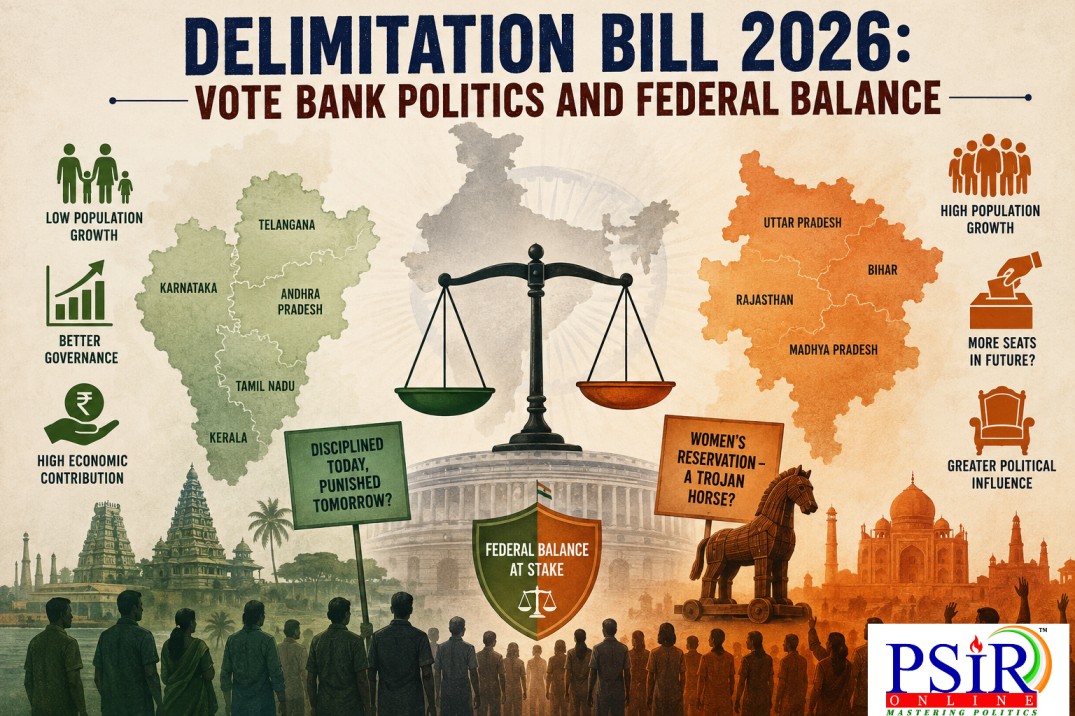
The introduction of the Delimitation Bill, 2026, alongside the Constitution (131st Amendment) Bill, 2026, in April 2026, was framed as a landmark effort to modernize Indian democracy. By seeking to end the decades-long freeze on interstate seat allocation and raise the Lok Sabha strength to approximately 850 seats, the government aimed to fulfill the principle of "one person, one vote" while fast-tracking 33% women’s reservation. However, what was presented as a progressive reform quickly transformed into a high-stakes battle over the future of Indian federalism.
While the Union government justified the use of the 2011 Census as a necessary measure to avoid further delays in gender-inclusive representation, southern states viewed the package with deep skepticism. To these high-performing regions, the bill appeared less like a reform and more like a "Trojan horse" designed to dilute the political weight of states that have successfully implemented population control. This clash between demographic reality and constitutional rewards ultimately led to a legislative stalemate, as the 131st Amendment failed to secure a two-thirds majority on 17 April 2026, rendering the ambitious project "infructuous" for the present time.
WHAT THE DELIMITATION BILL 2026 PROPOSED
The Union government introduced the Delimitation Bill, 2026, alongside the Constitution (131st Amendment) Bill, 2026, in April 2026, aiming to:
· End the long‑standing freeze on inter‑state seat allocation (in place since the 42nd and later 84th/87th Amendments based on 1971 Census).
· Reconstitute the Delimitation Commission and empower it to redraw parliamentary and assembly constituencies using the 2011 Census as the latest published data.
· Raise the Lok Sabha strength from 543 to about 850 seats (roughly a 50% increase per state/UT), while nominally maintaining each state’s existing proportion of seats.
· Fast‑track implementation of 33% women’s reservation (Nari Shakti Vandan Adhiniyam / 106th Amendment, 2023) by earmarking one‑third of the expanded seats for women, without altering any state’s current share.
Despite this, the Constitution (131st) Amendment Bill failed to secure the required two‑thirds majority in the Lok Sabha on 17 April 2026, and the allied Delimitation Bill and Union Territories (Amendment) Bill were subsequently withdrawn, rendering the project “infructuous” for the time being.
WHY EFFECTIVE‑FAMILY‑PLANNING STATES FELT “PUNISHED”
Several southern states—especially Tamil Nadu, Kerala, Andhra Pradesh/Telangana, and Karnataka—have long championed low fertility and effective family‑planning policies, which lowered their population growth compared with fast‑growing northern states such as Uttar Pradesh, Bihar, Rajasthan, and Madhya Pradesh.
Because of the 1976 freeze, these South Indian states retained relatively higher Lok Sabha representation than their current population share would justify:
· For example, an MP in Tamil Nadu represented about 18 lakh voters under existing boundaries, versus roughly 25 lakh voters per MP in Uttar Pradesh, creating a visible imbalance in “one person, one vote”.
When the government proposed delimitation plus women’s reservation using the 2011 Census, southern leaders interpreted the package as follows:
· Once the delimitation freeze ended, future full‑population‑based readjustments (after the post‑2027 Census) would automatically shrink their share of seats, even if the 2026 Bill only “expanded all seats equally”.
· They argued that states which had “disciplined” their population growth were being treated as if they would be the “losers” in the long‑run electoral arithmetic, while high‑fertility states would gain more seats.
This led to the core perception that their demographic success would be penalised, both in terms of parliamentary clout and, indirectly, their influence over national policy and resource allocation.
HOW STATES CRITICISED THE GOVERNMENT: “FAKING WOMEN’S RESERVATION AS A TOOL”
Southern ruling parties and regional leaders launched a multi‑pronged critique, accusing the Centre of using women’s reservation as a Trojan horse for broader electoral and federal redesign.
Main lines of criticism:
· Instrumentalisation of women’s reservation:
o Parties like the DMK (Tamil Nadu), Congress‑led regimes and opposition fronts in Kerala, Karnataka, and Andhra/Telangana argued that the government was hiding a federal‑restructuring exercise behind gender‑justice rhetoric.
o They contended that women’s reservation should be implemented within the existing 543‑seat framework, without necessarily tying it to a big delimitation and seat expansion that would alter the federal balance.
· Unfairness of “pure population‑based” delimitation:
o Southern leaders objected that population alone cannot be the sole metric for representation, since it undervalues economic contribution, governance quality, and fiscal capacity.
o Telangana Chief Minister Revanth Reddy argued explicitly that a formula splitting 50% seats by population and 50% by economic contribution / governance performance would be fairer and would not penalise states that controlled population growth.
· Constitutional and procedural grievances:
o Southern parties accused the Centre of violating cooperative federalism by deciding delimitation and seat‑expansion without a nationally negotiated consensus, and by rushing ahead without a fresh census.
o Some leaders, including Tamil Nadu CM M.K. Stalin, described the move as “unconstitutional” and alleged that the South was being treated as “second‑class citizens” compared to the Hindi‑heartland demographically dominant states.
· Fear of long‑term political marginalisation:
o Regional leaders worried that even if the immediate 2026 Bill kept their proportionate share unchanged, the institutionalised shift to population‑based delimitation would steadily erode their influence in the Lok Sabha and, by extension, in national policy‑making on language, culture, and resource distribution.
In short, the narrative from these states was that effective family‑planning had been a public‑good policy, but the Centre’s electoral‑engineering package risked turning it into a self‑inflicted political liability.
GOVERNMENT’S ASSURANCE ON SEAT RATIOS AND FEDERAL BALANCE
The Union government, especially through the Home and Parliamentary Affairs ministries, tried to reassure states that the federal balance would not be destabilised overnight.
· No change in inter‑state ratio of parliamentary seats:
o The official line was that the Delimitation Bill, 2026 proposed a roughly uniform 50% increase in seats per state and UT, so that their share of total Lok Sabha seats would remain the same or very close to current levels.
o For example, Tamil Nadu’s 39 seats would rise to about 58–59, Kerala’s 20 to about 30, Karnataka’s 28 to about 42, and Uttar Pradesh’s 80 to 120, preserving the existing inter‑state proportionality while enabling women’s reservation.
· Why the 2011 Census was chosen:
o The government justified using the 2011 Census by pointing to the delay of the 2021 Census (which had been postponed, and whose final data‑publication schedule was uncertain).
o Officials argued that waiting for the post‑2027 Census would push women’s reservation to around 2030–2034, which they claimed would be an undue delay in implementing a constitutional guarantee.
· Promise to keep federal structure intact:
o The Centre insisted that the exercise was not about redistributing political power from South to North, but about normalising representation in line with already‑published demographic data and enabling women’s reservation earlier.
However, southern states remained sceptical because they saw the legal and institutional precedent being set: once the freeze was lifted, future delimitation could be based on even newer, more favourable‑to‑the‑North censuses, locking in a structural shift.
GOVERNMENT’S ACCUSATION OF “PLAYING POLITICS” AHEAD OF ELECTIONS
In the run‑up to the vote on the Constitution (131st) Amendment and the Delimitation Bill, the government portrayed the opposition‑led resistance as instrumental politics around the 2026 state‑election calendar rather than a principled federal‑equity debate.
Key aspects of this narrative included:
· Stalling of a “pro‑women” and “pro‑democracy” reform:
o Government spokespeople argued that major national parties, including the Congress‑led opposition bloc and regional allies in the South, were using the federal‑balance argument to delay or block women’s reservation, which they framed as a regressive, election‑centric calculation.
· Timing‑based rhetoric:
o The Centre highlighted that the Bill was introduced during a special parliamentary session to ensure that the 2029 elections could see the first round of women’s reservation in an expanded Lok Sabha.
o Officials accused the opposition of prioritising short‑term electoral calculations in southern states over the larger goal of gender‑inclusive representation, presenting the resistance as politically motivated “posturing” ahead of state‑level elections.
· Differentiation between “good governance” and “vote‑bank politics”:
o Union ministers suggested that some southern states were invoking family‑planning achievements rhetorically while simultaneously blocking a reform that would benefit women pan‑India, including in those same states.
Nevertheless, opposition leaders rejected this framing, arguing that accepting a delimitation‑linked package that entrenches “population‑only” representation would set a long‑term precedent that undermines the federal compact, regardless of the immediate electoral‑cycle optics
CONCLUSION: THE FUTURE OF THE FEDERAL COMPACT
The withdrawal of the Delimitation Bill, 2026, after failing to secure a two-thirds majority, marks a significant pause in India’s electoral redesign. While the "one person, one vote" principle remains a democratic ideal, the intense resistance from high-performing states underscores that population cannot be the sole metric of representation in a diverse federation.
Moving forward, the challenge for any future administration will be to decouple gender-justice initiatives like women’s reservation from contentious seat-expansion exercises. For the federal balance to remain intact, a national consensus must be reached that rewards governance excellence and demographic discipline rather than penalizing it
PRACTICE QUESTIONS FOR GS 2 MAINS
1. “The debate over delimitation reflects the deeper tension between democratic equality and federal balance in India.” Critically examine.
2. Discuss the constitutional and political challenges involved in implementing women’s reservation in legislatures in India.
3. “Cooperative federalism requires political consultation, not merely constitutional procedure.” Analyse in the context of Centre–State relations in recent years.
4. Examine how demographic change and regional disparities influence electoral representation and public policy in India.
PRACTICE QUESTIONS FOR PSIR OPTIONAL
1. “Federalism in multicultural societies requires balancing numerical democracy with regional autonomy.” Discuss with suitable theoretical perspectives.
2. Critically analyse the relationship between representation and legitimacy in democratic political systems.
3. “Electoral reforms often become instruments of political restructuring.” Examine with reference to contemporary Indian politics.
4. Compare liberal and communitarian approaches to representation and political equality in democratic states.