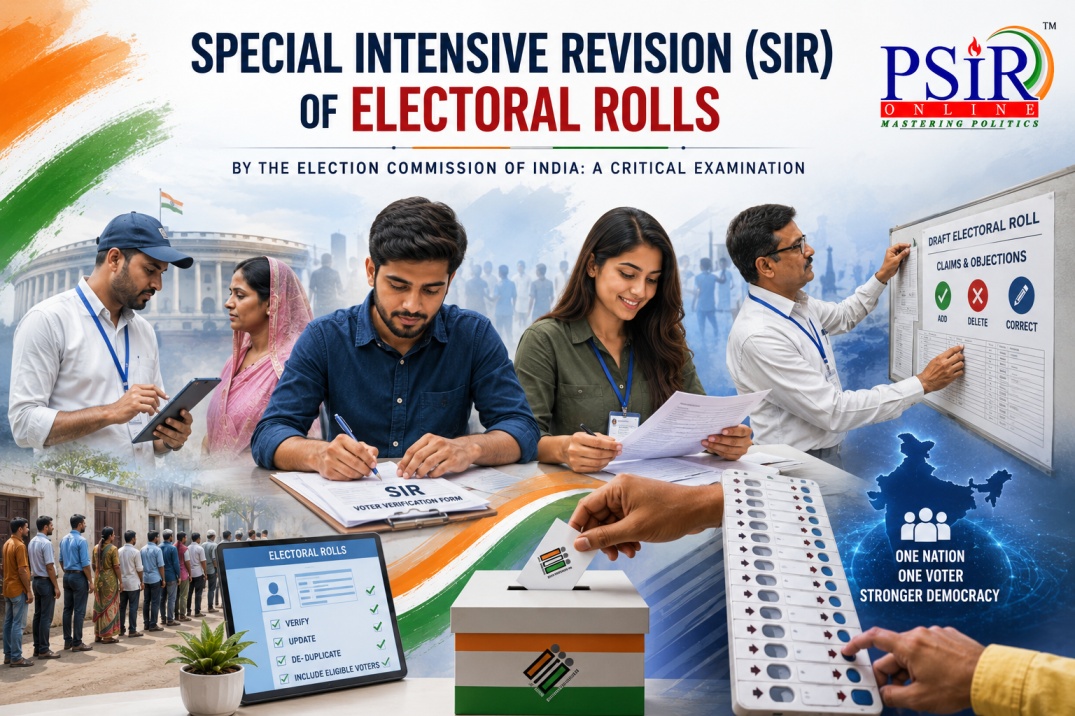
The Special Intensive Revision (SIR) of electoral rolls has become one of the most debated electoral reform exercises in recent years. It reflects a basic democratic dilemma: how does a constitutional democracy keep electoral rolls accurate without making voter registration harder for genuine citizens? For students and aspirants, SIR is important because it connects Polity, Governance, Electoral Reforms, and Current Affairs in a single issue.
At its core, SIR is an intensified revision exercise in which the Election Commission of India (ECI) conducts door-to-door verification, checks existing entries, and updates the rolls through additions, deletions, and corrections. The Commission has explained that the purpose is to ensure that every eligible citizen is included and no ineligible name remains on the list. At the same time, critics argue that the design and timing of the exercise can create exclusion risks, especially for migrants, the poor, and those with weak documentation.
CONSTITUTIONAL AND LEGAL BASIS
The ECI derives its broad authority from Article 324 of the Constitution, which vests it with superintendence, direction, and control over elections. The more specific legal basis for revision of electoral rolls lies in the Representation of the People Act, 1950, particularly Section 21(3), which empowers the Commission to order a special revision of rolls. The Commission has also relied on Section 23 for enrolment-related verification and Section 24 for appeal against orders of the Electoral Registration Officer.
This legal framework matters because SIR is not merely an administrative cleanup. It directly affects the exercise of the right to vote under Article 326, which protects universal adult franchise subject to citizenship, age, and ordinary residence. Therefore, any revision method must balance two constitutional values: electoral integrity and inclusive access.
WHY THE ECI PURSUED SIR
The ECI’s official justification is straightforward. It pointed to rapid urbanisation, frequent migration, non-reporting of deaths, and the possibility of duplicate or ineligible entries, including foreign nationals where relevant. In a country with a huge and mobile electorate, a stale roll can lead to both under-inclusion and over-inclusion.
The Commission also argued that older intensive revisions had not been conducted for many years in some states, making a fresh exercise necessary. From this perspective, SIR is an attempt to restore administrative credibility to the rolls, improve transparency, and reduce disputes on polling day. It is also consistent with the ECI’s broader responsibility to maintain an error-free electoral process.
HOW SIR WORKS
In Bihar, the ECI instructed Booth Level Officers to conduct house-to-house visits during the intensive revision. Existing electors were given pre-filled forms, and the process included verification of eligibility, residence, and identity. The Commission also said that documents used to satisfy the Electoral Registration Officer would be uploaded in ECINET, with access restricted to authorised officials to address privacy concerns.
The process is not supposed to end with deletions. It includes claims, objections, hearings, and appeals so that eligible voters are not wrongly excluded. The ECI also urged the active participation of Booth Level Agents appointed by political parties, arguing that their presence can help resolve discrepancies at the preparation stage itself. In principle, this makes SIR a participatory verification exercise rather than a one-sided cleansing drive.
THE BIHAR EXPERIENCE
Bihar was the first major test case of SIR in 2025. The ECI initiated the exercise in the state on 30 June 2025, and later reported the outcome of the revision after the process concluded. According to the Commission, the final Bihar roll after SIR showed about 7.42 crore electors, compared with 7.89 crore electors as on 24 June 2025, and 65 lakh names had been removed from the draft list.
That said, numbers need careful interpretation. A draft deletion figure is not the same as final disenfranchisement, because some removed electors may be restored during claims and objections, while others may fail to establish eligibility. Similarly, a large removal figure may include deceased persons, shifted voters, duplicates, and other ineligible entries.
WHY PROTESTS GREW
The protests against SIR were driven less by the idea of electoral purification and more by fear of exclusion. Critics argued that the documentary burden was too heavy for poor citizens, migrant workers, slum residents, and people lacking complete legacy records. The requirement to connect present enrolment to earlier records also raised anxiety among younger voters and families whose documents were incomplete.
There was also a political dimension. Opposition parties alleged that the timing of the exercise, especially in election-bound states, could disproportionately affect regions where anti-incumbency was strong. In public debate, phrases such as “vote theft” and “disenfranchisement” gained traction, while the Commission defended the process as a neutral administrative duty. This clash of perceptions became central to the controversy.
STAKEHOLDERS AND CONCERNS
The first stakeholder group was the ordinary voter, especially those from vulnerable or mobile populations. Migrant labourers, daily wage workers, students, and people living away from their native districts were more likely to miss deadlines or struggle with document availability. This created a real risk that administrative inconvenience could translate into democratic exclusion.
The second group was political parties. For ruling parties, SIR was often defended as necessary institutional housekeeping. For opposition parties, the concern was that selective or uneven implementation could alter the voter base before crucial elections. Civil society actors, meanwhile, focused on process transparency, notice quality, and the need for clearer disclosure of deletions and reasons.
JUDICIAL SCRUTINY
The Supreme Court’s early approach showed that the issue was legally serious but not automatically unconstitutional. During hearings on the Bihar exercise, the Court did not stop the revision, but it questioned timing and asked the Commission to consider additional safeguards. In related proceedings, the Court directed the ECI to disclose names deleted from the draft roll along with reasons, reflecting a concern for transparency and procedural fairness.
This judicial response is significant because it highlights the Court’s balancing role. The judiciary did not deny the Commission’s authority, but it insisted that the power be exercised with accountability and fairness. In other words, the real constitutional question was not whether revision can be done, but how it should be done.
WAS THE PROCESS FAIR?
The strongest argument in favour of SIR is that a democracy must not tolerate stale rolls. Dead voters, duplicates, shifted entries, and ineligible names can damage trust in elections. If done carefully, SIR can strengthen the credibility of the franchise and improve election management.
The strongest argument against it is that poor implementation can produce the opposite result. When documentation is difficult, notice is weak, or time is short, the burden falls unevenly on citizens with low literacy, weak mobility, or limited state access. Thus, the fairness of SIR depends less on the idea itself and more on the quality of implementation, grievance redressal, and transparency.
IMPACT ON ELECTIONS
It is too early and too simplistic to claim that SIR alone determined election outcomes. Electoral results are shaped by alliances, leadership, caste coalitions, welfare delivery, turnout patterns, campaign strategy, and local issues. So even if roll cleaning changes the electorate numerically, it does not automatically prove partisan manipulation.
At the same time, electoral revision can matter in close contests. If large numbers of genuine voters are removed, even temporarily, the effect may be visible in low-margin seats. That is why the issue triggered such intense political reaction. The safer conclusion is that SIR can influence the competitive environment of elections, but its direct causal effect on results cannot be assumed without constituency-level evidence.
CONCLUSION
SIR is best understood as a case study in democratic administration. It shows the tension between institutional autonomy and public trust, between accuracy and accessibility, and between legality and legitimacy. It also raises important governance questions about migrant-friendly documentation, digital transparency, and the protection of vulnerable voters.
A balanced reform agenda would include wider use of pre-filled forms, stronger local assistance, better publication of deletion reasons, longer claims-and-objections windows, and independent audits of exclusions. The state also needs broader civil registration and easier access to identity documents so that voter verification does not become a barrier for the poor.
PRACTICE QUESTIONS FOR PSIR OPTIONAL
1. “The Special Intensive Revision (SIR) of electoral rolls reflects the tension between electoral integrity and democratic inclusion.” Critically examine in the context of recent electoral reforms in India.
2. Discuss the constitutional and legal foundations of the Election Commission of India’s power to conduct Special Intensive Revision (SIR) of electoral rolls. Do these powers require stronger procedural safeguards?
3. “Administrative neutrality alone is insufficient to ensure democratic legitimacy in electoral governance.” Analyse this statement with reference to the Bihar SIR experience and the protests surrounding it.
4. Examine the role of the judiciary in balancing institutional autonomy and citizens’ voting rights in India. Illustrate your answer with reference to the Supreme Court’s scrutiny of the Special Intensive Revision (SIR) process.