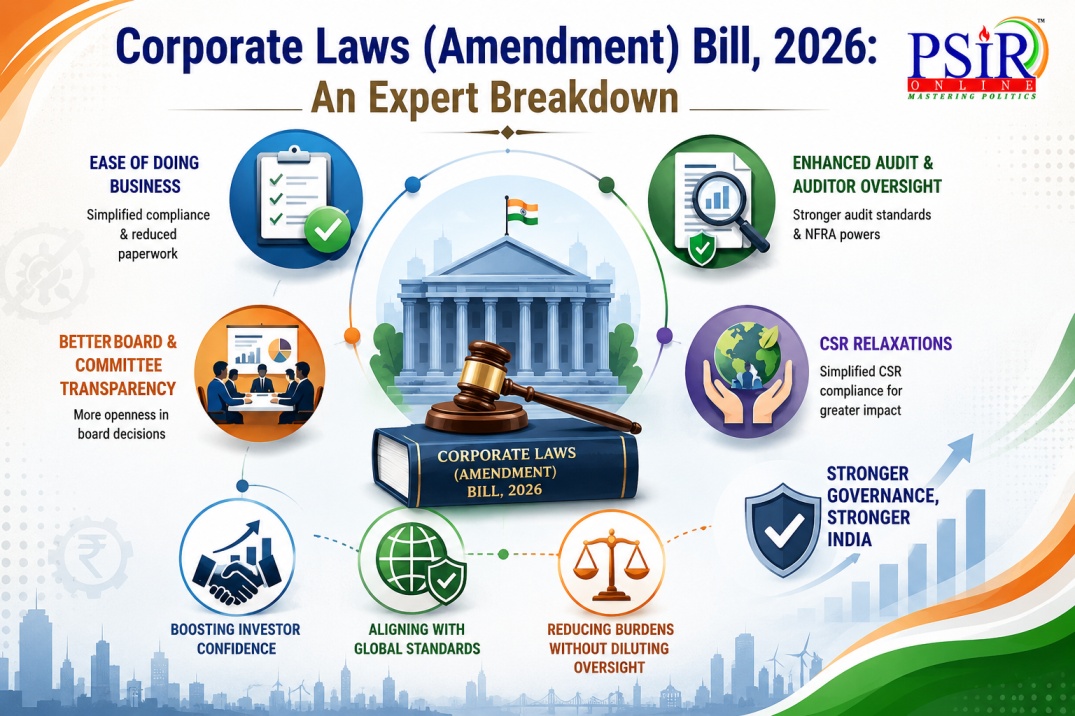
The Corporate Laws (Amendment) Bill, 2026 is a major piece of legislation aimed at updating how businesses operate and are regulated in India. Introduced by Finance Minister Nirmala Sitharaman and sent to a Joint Parliamentary Committee (JPC) for detailed review, the Bill focuses on balancing two major needs: making it easier to run a business while ensuring corporations remain honest and accountable.
CORE CHANGES: WHAT IS BEING MODIFIED?
The Bill updates two foundational pillars of Indian business law:
· The Companies Act, 2013: The main rulebook governing how corporations, public companies, and private firms operate in India.
· The Limited Liability Partnership (LLP) Act, 2008: The law governing LLPs, which are popular among professional services, startups, and smaller business partnerships because they combine the flexibility of a partnership with the legal protections of a corporation.
DETAILED BREAKDOWN OF THE BILL'S FOCUS AREAS
Ease of Doing Business & Simplified Compliance
The Bill aims to cut through red tape, particularly for smaller enterprises and LLPs.
· In Simple Terms: For small businesses, paperwork and strict legal deadlines can be exhausting and expensive. The Bill reduces the volume of filings and relaxes certain complicated procedures. This allows business owners to focus on growth and day-to-day operations rather than spending all their time managing regulatory forms.
Enhanced Audit & Auditor Oversight
To protect the financial system from corporate fraud, the Bill increases supervision over corporate auditors (the independent professionals who verify a company's financial records).
· In Simple Terms: If an auditor notices something suspicious or messy in a company's financial books, they must now provide a clear, detailed explanation for their remarks. Additionally, the National Financial Reporting Authority (NFRA)—India’s independent accounting regulator—is given stronger powers to penalize bad behavior and investigate audit failures.
Better Board and Committee Transparency
A company's Board of Directors makes the ultimate decisions for the firm, but sometimes these decisions happen behind closed doors with minimal outside visibility.
· In Simple Terms: The Bill introduces rules that force boards and internal corporate committees to be much more open about how they make decisions. This gives shareholders, investors, and regulators a clearer look into who is calling the shots and why.
Corporate Social Responsibility (CSR) Relaxations
Under Indian law, certain large companies are legally required to spend 2% of their average net profits on social and environmental causes (CSR).
· In Simple Terms: The Bill provides "relaxations" in how this is managed. Rather than abolishing the rule, it simplifies the compliance process and reduces rigid penalties for administrative errors regarding CSR funds, making it less painful for companies to do good deeds.
WHAT THE EXPERTS THINK: THE BIG PICTURE JUDGEMENT
Experts view this Amendment Bill as a smart step toward modernizing business regulation without losing control. Here is why the overall sentiment is positive:
|
Goal |
How the Bill Achieves It |
|
Boosting Investor Confidence |
International and domestic investors are more likely to put money into Indian companies if they know the accounting is honest, the boards are transparent, and regulators have teeth. |
|
Aligning with Global Standards |
By empowering the NFRA and enforcing stricter audit rules, India aligns itself with the corporate governance standards seen in major economies like the US and the UK. |
|
Reducing Burdens without Diluting Oversight |
This is the crucial balance. The government is essentially saying: "We will make your life easier by cutting paperwork (reducing burdens), but we will watch you much closer where it matters, like fraud and accountability (maintaining oversight)." |
HOW THIS WILL IMPROVE INDIAN GOVERNANCE ARCHITECTURE?
The Corporate Laws (Amendment) Bill, 2026 is designed to fundamentally shift how India regulates its business sector. Rather than just changing a few rules, it reshapes the broader Indian governance landscape by moving away from heavy-handed, bureaucratic micromanagement toward a more modern, risk-based, and trust-driven regulatory system.
The Bill improves India's governance architecture in several key ways:
1. Shifting from "Criminalization" to "Civil Penalty"
Historically, Indian corporate law treated many minor, technical, or procedural errors—like failing to file a specific form on time or administrative lapses in maintaining books—as criminal offenses that could technically lead to jail time.
· The Governance Shift: The Bill decriminalizes multiple procedural defaults, replacing prison threats with structured financial penalties.
· Why it improves governance: It removes the "inspector raj" fear factor for honest business owners. By separating minor, administrative mistakes from deliberate fraud, criminal courts can focus on actual economic crimes, drastically reducing judicial backlogs.
2. Empowering Independent Institutional Regulators
A major weakness in older governance models was that the government had to step in directly to police corporate accounting, which was slow and highly bureaucratic.
· The Governance Shift: The Bill vastly expands the powers of the National Financial Reporting Authority (NFRA), allowing it to issue formal warnings, censures, and clear guidelines on investigations. It also officially designates the Insolvency and Bankruptcy Board of India (IBBI) as the central Valuation Authority to regulate corporate asset valuations.
· Why it improves governance: It transitions India toward a model of independent, expert-led institutional oversight (similar to the SEC in the United States). Instead of politicians or general bureaucrats policing complex corporate finance, specialized, independent bodies are given the teeth to enforce accountability.
3. Institutionalizing "Trust-Based Governance"
For a long time, the regulatory assumption was that every business needed to be aggressively monitored to prevent wrongdoing. This resulted in overwhelming paperwork for small entities.
· The Governance Shift: The Bill expands the legal definition of a "small company" (raising thresholds for capital up to ₹20 crore and turnover up to ₹200 crore) and replaces several traditional, notarized affidavits with self-declarations. It also introduces fast-track merger rules, dropping the required shareholder approval threshold from 90% to 75% for certain entities.
· Why it improves governance: It embeds the philosophy of "minimum government, maximum governance." By relying on self-declarations and trust for small players, the state conserves its regulatory energy. It stops wasting resources policing low-risk startups and diverts those enforcement resources toward high-risk, multi-million dollar corporations.
4. Driving Modernization via Digital Governance
Traditional governance required physical corporate actions, creating massive paper trails, slower processing times, and opportunities for low-level corruption.
· The Governance Shift: The Bill codifies and expands digital compliance, officially embedding provisions for the electronic service of documents and allowing Annual General Meetings (AGMs) to be held via video conferencing or audio-visual means (requiring a physical meeting only once every three years).
· Why it improves governance: It institutionalizes digital-first transparency. Digital records are harder to retroactively alter, easier for regulators to audit remotely, and significantly lower the transaction costs of doing business in India.
5. Elevating Board-Level Accountability
Good governance cannot just be forced from the outside by the government; it has to start inside the company's boardroom.
· The Governance Shift: By requiring auditors to provide explicit, detailed explanations for any adverse remarks or qualifications in their reports, and by mandating greater transparency in board committee operations, the Bill strips away corporate opacity.
· Why it improves governance: It strengthens internal checks and balances. Board directors can no longer hide behind vague jargon or claim ignorance if things go wrong. It forces a culture of proactive compliance within corporate boards, shifting the burden of honesty from state regulators to corporate leadership.
|
HOW THIS IS DIFFERENT FROM JAN VISWAS ACT?
While both the Jan Vishwas (Amendment of Provisions) Act and the Corporate Laws (Amendment) Bill, 2026 share the overarching philosophical goal of "trust-based governance" and improving the ease of doing business, they are fundamentally different in their scope, depth, and mechanism. The simplest way to distinguish them is: Jan Vishwas was an umbrella "cleanup" drive across multiple ministries, whereas the Corporate Laws Bill is a deep, structural engineering of specific financial and corporate statutes.
1. Scope: Umbrella vs. Vertical Deep-Dive · The Jan Vishwas Act: This was a massive, horizontal omnibus legislation that cut across 42 different Central Acts managed by dozens of distinct ministries (ranging from the Drugs and Cosmetics Act and Environment Protection Act to the Motor Vehicles Act and Post Office Act). It was designed to remove thousands of minor, legacy "inspector raj" hurdles for ordinary citizens and small businesses simultaneously. · The Corporate Laws (Amendment) Bill, 2026: This is a vertical, sector-specific deep-dive targeting only two highly specialized economic legislations administered by the Ministry of Corporate Affairs: the Companies Act, 2013 and the LLP Act, 2008. It does not concern itself with municipal, transport, or environmental laws.
2. Objective: "Decriminalization Only" vs. "Regulatory Restructuring" · The Jan Vishwas Act: Focused almost exclusively on decriminalizing minor procedural lapses—converting imprisonment clauses into civil penalties and introducing mechanisms like "improvement notices" or warnings for first-time offenders (e.g., standardizing property tax models or removing jail time for minor violations like driving with a newly expired license). It was about removing unnecessary fear. · The Corporate Laws (Amendment) Bill, 2026: Decriminalization of minor filings is just a tiny subset of this bill. Its broader, institutional objective is strengthening financial infrastructure and governance oversight. It actively empowers independent regulatory structures (like the National Financial Reporting Authority - NFRA) to clamp down on financial malpractice and elevates corporate board transparency. It builds new accountability protocols rather than just erasing old punishments.
3. Direction of Oversight: Deregulation vs. "Smart Regulation" · The Jan Vishwas Act: Operates purely on a deregulatory vector. It dials back state intervention, replacing judicial enforcement with softer, administrative mechanisms to reduce the overall burden on courts and ordinary citizens ("Ease of Living"). · The Corporate Laws (Amendment) Bill, 2026: Operates on a bifurcated vector ("Smart Regulation"). It splits corporate India into two categories: o For Small Businesses/LLPs: It mirrors the Jan Vishwas logic by offering relaxations, self-declarations, and faster merger routes. o For Large/Systemic Entities: It actually tightens the screws. It demands stricter accountability from corporate auditors, mandates deeper corporate committee transparency, and equips regulatory watchdogs with sharper investigative powers to match global financial standards.
|
INTENDED CONSEQUENCES

The intended consequences of the Corporate Laws (Amendment) Bill, 2026 operate on a dual-track strategy. It does not choose between expanding domestic entrepreneurship or attracting Foreign Direct Investment (FDI); instead, it bifurcates its approach to achieve both simultaneously.
By restructuring the regulatory ecosystem, the Bill aims to lower the barrier to entry for local founders while systematically reducing risks for global capital.
1. Impact on Domestic Entrepreneurship: "De-risking the Startup Lifecycle"
The Bill acts as a strong catalyst for domestic entrepreneurship, especially for micro, small, and medium enterprises (MSMEs) and tech startups, by targeting their two greatest pain points: compliance fatigue and structural rigidity.
· Massive Expansion of the "Small Company" Safety Net: By dramatically raising the thresholds for a "Small Company" (Paid-up capital up to ₹20 crore and turnover up to ₹200 crore), a vast universe of mid-sized startups now qualify for regulatory leniency. This gives growing businesses breathing room from intense regulatory burdens just as they begin to scale.
· Removal of Criminal Anguish: For a founder, the threat of criminal prosecution over an administrative delay (like an un-filed form or a delayed AGM) is a major deterrent. Shifting these to simple, capped civil penalties removes the systemic fear of doing business.
· Enabling Leaner Capital Structures: The Bill simplifies the conversion of specified trusts into LLPs and streamlines fast-track mergers (lowering the shareholder/creditor approval threshold from 90% to 75%). For entrepreneurs, this means restructuring, absorbing, or pivoting a business becomes faster and significantly less expensive.
2. Impact on Foreign Direct Investment (FDI): "Institutional Predictability"
Foreign institutional investors and sovereign wealth funds do not just look at growth potential; they look at regulatory predictability and corporate governance standards. The Bill strengthens these areas to make India a more attractive destination for global capital.
· Mitigating Accounting and Governance Risk: Major foreign investors are deeply risk-averse regarding corporate fraud. By expanding the enforcement and investigative teeth of the National Financial Reporting Authority (NFRA) and introducing a statutory "fit and proper" matrix for directors, the Bill assures global investors that Indian boardrooms and financial statements are heavily policed by independent, world-class regulators.
· Global Alignment via the GIFT City/IFSC Corridor: The Bill introduces explicit provisions allowing Limited Liability Partnerships (LLPs) set up in International Financial Services Centres (like GIFT City) to convert their monetary contributions from Indian Rupees to permitted foreign currencies. This directly courts foreign private equity and venture capital funds by matching international treasury flexibilities.
· Streamlining M&A Exit Routes: Clean exit options are vital for attracting FDI. The relaxation of corporate buy-back caps and the simplification of amalgamation rules make it easier for foreign investors to enter, consolidate, and smoothly exit their Indian portfolios.
3. Macroeconomic Consequence: Formalization of the Economy
Beyond FDI and entrepreneurship, the ultimate intended consequence of the Bill is to accelerate the orderly formalization of the Indian business sector.
By lowering compliance barriers, the government encourages unregistered or loosely organized partnerships to transition into formal LLPs and private limited companies. Concurrently, by tightening audit oversight for large enterprises, it builds a cleaner, transparent, and resilient economic framework.
MAJOR CRITICISMS
While the Corporate Laws (Amendment) Bill, 2026 has been broadly welcomed for its focus on modernization, it has triggered sharp debate among legal experts, opposition lawmakers, and professional bodies. The government's decision to bypass the standard Standing Committee on Finance and refer the Bill directly to a Joint Parliamentary Committee (JPC) underscores that several of its clauses are highly contentious.
The major criticisms and structural concerns center on the following areas:
1. The "Lag" Factor: Outdated Recommendations
A primary structural critique raised by corporate legal experts is that the Bill is built on relatively old foundations.
· The Issue: The Bill draws its core provisions primarily from the Company Law Committee (CLC) Report of 2022.
· The Criticism: Because the data and recommendations are nearly four years old, critics argue the Bill suffers from a regulatory time lag. It fails to adequately address rapid, contemporary shifts that have emerged since 2022, such as advanced AI governance in corporations, complex cross-border digital data compliance, and evolved ESG (Environmental, Social, and Governance) global metrics.
2. Regulatory Overreach & Discretionary Powers of NFRA
While empowering the National Financial Reporting Authority (NFRA) is meant to curb fraud, the specific manner in which it is being done has raised alarm bells within the accounting and auditing professions.
· The Issue: The Bill grants NFRA the unilateral power to look into the "manner of investigation" and directly issue advisories, censures, or warnings to professionals.
· The Criticism: Critics argue this creates a parallel, highly punitive regulatory layer that risks over-regulating the auditing profession. There are fears that broad discretionary powers could lead to inconsistent implementation, harassment of honest auditors, and an atmosphere of defensive auditing, where professionals become too intimidated to work effectively.
3. Fear of Reduced Deterrence via Decriminalization
The shift from criminal imprisonment to civil penalties for multiple compliance lapses is the cornerstone of the Bill’s "ease of doing business" push, but it has met with pushback from governance purists.
· The Issue: Major compliance areas—including violations regarding books of accounts, failure to submit required documents to the Registrar of Companies (RoC), and lapses in Producer Companies—have been stripped of criminal liability.
· The Criticism: Skeptics and opposition members argue that treating serious record-keeping lapses merely as "financial costs" (civil penalties) reduces the fear of law. For wealthy, systemic violators, paying a capped monetary penalty can simply be written off as a cost of doing business, potentially weakening the overall deterrence against sophisticated corporate fraud.
4. Blanket Exemptions from Statutory Audits
To ease the burden on micro-enterprises, the Bill empowers the Central Government to exempt certain classes of companies from mandatory statutory audits altogether.
· The Issue: Small or newly defined entities meeting prescribed thresholds can bypass independent annual financial audits.
· The Criticism: Financial analysts and professional bodies argue that statutory audits are the ultimate baseline defense against tax evasion, money laundering, and minority shareholder exploitation. Exempting a vast blanket of companies—especially after expanding the definition of "Small Companies" up to a ₹200 crore turnover—could create massive regulatory blind spots where financial manipulation goes unnoticed for years.
5. Dilution of Minority Shareholder Rights in Mergers
To speed up corporate consolidation, the Bill slashes the required approval thresholds for fast-track mergers and acquisitions.
· The Issue: The approval threshold required from shareholders and creditors for specific mergers (like between small companies or holding-subsidiary structures) has been aggressively cut from 90% to a simple 75% of members present and voting.
· The Criticism: While this prevents a tiny minority from stalling a beneficial corporate restructuring, critics point out that it strips away vital protections for minority shareholders. A dominant promoter group holding 75% can now easily push through structural changes or asset transfers, leaving the remaining 25% of minority investors with effectively zero veto power or leverage.
6. Dilution of CSR Strictness
The Bill relaxes the timelines for handling unspent Corporate Social Responsibility (CSR) funds for ongoing projects (extending the transfer window from 30 days to 90 days) and raises the net profit applicability threshold from ₹5 crore to ₹10 crore.
· The Issue: Fewer companies will fall under the mandatory CSR net, and those that do have more relaxed operational timelines.
· The Criticism: Social sector advocates and policy analysts argue that at a time when private capital is desperately needed to meet sustainable development goals, raising the thresholds effectively lets a significant tier of profitable corporate entities off the hook, reducing the overall pool of corporate funds flowing into rural development, education, and healthcare.
CONCLUSION
The Corporate Laws (Amendment) Bill, 2026, marks a pivotal moment in the evolution of India's economic regulatory framework. By decoupling procedural compliance from criminal liability, the legislation injects much-needed flexibility into the domestic entrepreneurship ecosystem, giving small entities and LLPs the room to innovate without administrative fear. Concurrently, by weaponizing the investigative powers of independent oversight bodies like the NFRA, it sends a clear signal to global investors that India is deeply committed to maintaining a transparent, fraud-resistant, and world-class financial architecture.
However, the legislative journey ahead is critical. As the Bill undergoes scrutiny by the Joint Parliamentary Committee (JPC), the government must carefully address the valid concerns raised by experts regarding regulatory time-lags, potential NFRA overreach, and the dilution of minority shareholder protections. The ultimate success of this reform will not be measured merely by fewer compliance filings or a rising rank in the ease of doing business index; it will be judged by how effectively India walks this regulatory tightrope—fostering an environment that is gentle on honest mistakes, yet unyielding against systemic corporate malpractice.
PRACTISE QUESTIONS FOR GS 2 MAINS
1. The Corporate Laws (Amendment) Bill, 2026 seeks to balance “ease of doing business” with stronger corporate accountability. Critically examine.
2. “India is shifting from ‘inspector raj’ to ‘trust-based governance’ in corporate regulation.” Discuss in the context of the Corporate Laws (Amendment) Bill, 2026.
3. Analyze how the Corporate Laws (Amendment) Bill, 2026 may influence domestic entrepreneurship, FDI inflows, and the formalization of the Indian economy.
4. The decriminalization of procedural corporate offences can improve business confidence but may weaken deterrence against corporate misconduct. Evaluate.