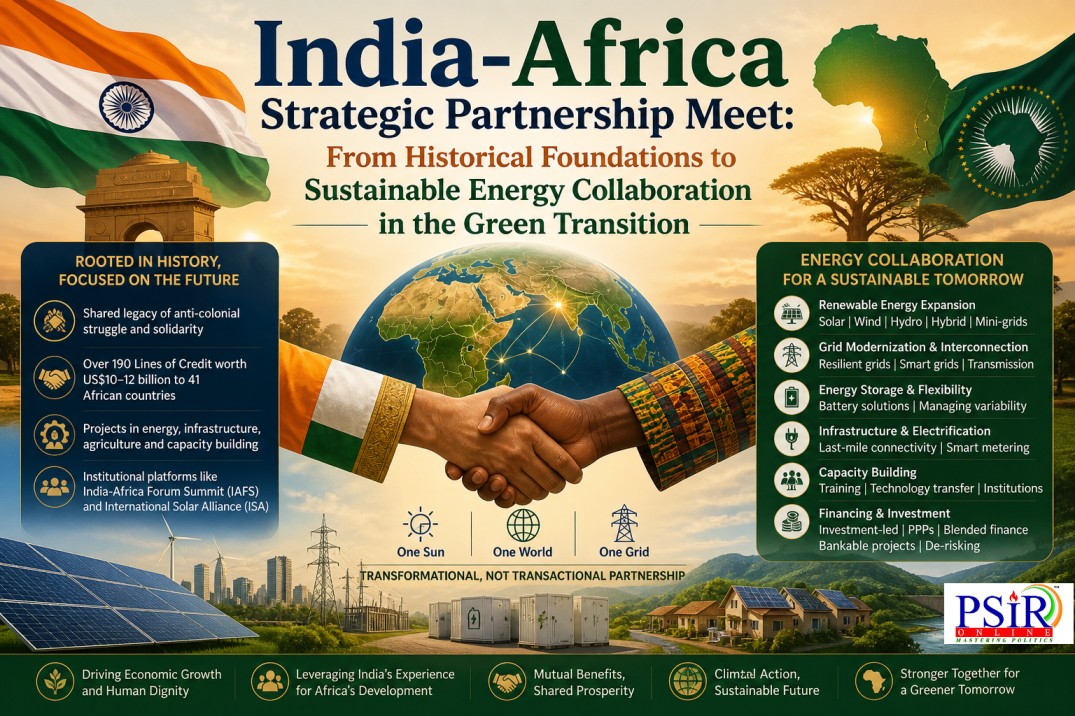
The India-Africa Strategic Partnership Meet was a high-level diplomatic and business engagement held on March 21, 2026 (Day 3 of the Bharat Electricity Summit 2026) in New Delhi, India. It took place at Yashobhoomi and focused on deepening energy cooperation between India and African nations.
Key Details of the Event
Chairperson: Union Minister for Power Shri Manohar Lal (also handles Housing and Urban Affairs).
Prominent Attendees:
· Shri Shripad Naik (Minister of State for Power and New & Renewable Energy).
· Shri Nayab Singh Saini (Chief Minister of Haryana).
· Dr. Jean Mathanga (Minister of Energy and Mining, Malawi).
· Alain Ebobissé (CEO, Africa50 — an African investment platform for infrastructure).
· Ministers and representatives from several African countries.
· African Union leaders, ambassadors, high commissioners, power utilities, financial institutions, development partners, and industry leaders.
This meet occurred on the sidelines of the larger Bharat Electricity Summit 2026 (March 19–22, 2026), a major global event showcasing India's power sector advancements, innovations, and international collaborations.
MAIN FOCUS AREAS
Discussions centered on practical, action-oriented collaboration in the energy sector, leveraging India's experience (from energy deficit to surplus, rapid renewable scaling) to support Africa's needs. Key themes included:
· Renewable Energy Expansion — Scaling solar, wind, and hybrid projects (e.g., low-cost solar for rural areas, rooftop solar, hydro-solar integration, mini-grids, and decentralized systems). Reference to the International Solar Alliance (ISA).
· Grid Modernization and Interconnection — Developing resilient transmission infrastructure, smart grids, microgrids, and system integration for better renewable evacuation and reliability. Example: Africa50 and Power Grid Corporation of India Ltd. (PGCIL) collaboration on the Kenya transmission project.
· Energy Storage and Flexibility — Solutions for managing variable renewables, including batteries and other flexibility mechanisms.
· Infrastructure and Electrification — Last-mile connectivity, transmission development, smart metering, and expanding access in underserved areas.
· Capacity Building and Institutional Strengthening — Training, technology transfer, policy frameworks, and human resource development.
· Financing and Investment Models — Shift toward investment-led (not aid), public-private partnerships (PPPs), blended finance, bankable projects, and de-risking mechanisms to attract private capital. Emphasis on execution, grid-first planning, and aggregation of projects.
KEY STATEMENTS AND HIGHLIGHTS
· Manohar Lal stressed that energy drives economic growth and dignity. He highlighted the "One Sun, One World, One Grid" vision for global connectivity and positioned India as a trusted, transformational partner (not transactional). He shared India's scalable models and cited successful Africa50-PGCIL projects.
· Alain Ebobissé (Africa50) emphasized: "It is not aid that we are seeking, we are seeking investment for impact and return." Focus on bankable projects, transmission, and private capital mobilization.
· Dr. Jean Mathanga (Malawi) called for low-cost renewables, electrification, transmission, smart grids, and microgrids. She noted mutual benefits: affordable tech/infrastructure for Africa and resource/market access complementing India's strengths.
· Other speakers (e.g., from NTPC and REC Ltd.) stressed moving from ambition to execution, grid planning, and blended finance.
BROADER CONTEXT AND SIGNIFICANCE OF THE INDIA-AFRICA STRATEGIC PARTNERSHIP MEET ON ENERGY
The India-Africa Strategic Partnership Meet held on March 21, 2026, at the Bharat Electricity Summit in New Delhi represents far more than a one-off diplomatic gathering. It embodies a deepening convergence of interests between two major regions of the Global South, rooted in decades of shared history and a forward-looking vision for sustainable development.
This collaboration leverages India’s proven expertise in scaling affordable energy solutions while addressing Africa’s urgent needs for electrification and green growth. Framed as a “transformational, not transactional” partnership, it aligns with broader geopolitical shifts toward South-South cooperation, resilient supply chains, and equitable climate action.
Historical Foundations of India-Africa Engagement
India’s engagement with Africa dates back to the anti-colonial era, with shared struggles for independence fostering enduring political solidarity. Post-independence, economic and technical cooperation became central. India has extended more than 190 Lines of Credit (LoCs) worth over US$10–12 billion to 41 African countries, funding infrastructure, energy projects, agriculture, and capacity building. These include transmission lines in Ethiopia, solar initiatives, and rural electrification schemes supported through technical cooperation programs.
Key multilateral platforms like the India-Africa Forum Summit (IAFS) have institutionalized this relationship. The upcoming fourth IAFS (2026) builds on previous summits that emphasized energy security, infrastructure, and human resource development. Energy cooperation has evolved from basic aid to strategic partnerships, incorporating forums such as the International Solar Alliance (ISA), co-founded by India and France, where over 30 African nations collaborate on solar deployment, financing, and technology transfer.
This historical base—combining concessional finance, grants, training programs, and people-to-people ties—provides a solid foundation for the 2026 meet. Unlike traditional donor-recipient models, India positions itself as an equal partner sharing scalable, cost-effective solutions honed through its own development journey.
AFRICA’S ENERGY LANDSCAPE: CHALLENGES AND IMMENSE OPPORTUNITIES
Sub-Saharan Africa faces one of the world’s most acute energy access crises. As of recent estimates, approximately 600 million Africans—primarily in rural areas—lack reliable electricity, hindering economic growth, education, healthcare, and industrial development. Progress toward universal access lags behind targets, with electrification rates in many countries still below 50 percent.
Yet the continent holds extraordinary renewable energy potential. Africa possesses about 60 percent of the world’s untapped solar resources, alongside significant wind, hydro, geothermal, and biomass capacity. Harnessing just a fraction of this could meet domestic needs and support regional integration through interconnected grids. Off-grid and mini-grid solutions have already connected millions, but investment remains critically low—Africa attracts less than 3 percent of global clean energy investment despite its potential.
Key challenges include:
· Fragmented grids and poor transmission infrastructure, leading to high losses and inability to evacuate renewable power.
· Financing gaps: High perceived risks deter private capital; projects often rely on concessional loans.
· Capacity constraints: Limited technical expertise and institutional frameworks slow project execution.
· Intermittency management: Without adequate storage and grid modernization, scaling variable renewables remains difficult.
These gaps create a compelling case for external partnerships. Africa’s young population, urbanization, and industrial ambitions demand rapid, affordable energy expansion—precisely where India’s experience aligns.
INDIA’S ENERGY TRANSFORMATION: LESSONS LEARNED AND EXPORTABLE EXPERTISE
India has undergone a remarkable shift from chronic power deficits to energy surplus in less than two decades. Installed renewable energy capacity surged from around 17 GW in 2010 to over 190 GW by 2025, with solar alone reaching approximately 150 GW (including ground-mounted, rooftop, and hybrid projects). Wind capacity stands at over 56 GW, supported by biomass, small hydro, and emerging green hydrogen initiatives.
Notable achievements include:
· Meeting record peak demand (over 256 GW in April 2026) with renewables contributing nearly one-third.
· Successful rural electrification programs like Saubhagya and Deen Dayal Upadhyaya Gram Jyoti Yojana, bringing power to millions of villages.
· Grid modernization through smart metering, high-voltage transmission, and integration of variable renewables.
· Cost reductions in solar tariffs to among the world’s lowest, driven by competitive bidding and domestic manufacturing push.
India’s journey—from fuel imports and blackouts to a leader in the International Solar Alliance—offers replicable models: decentralized solar mini-grids, rooftop programs, public-private partnerships (PPPs) for transmission, and blended finance mechanisms. Indian utilities like Power Grid Corporation of India Ltd. (PGCIL) have demonstrated expertise in large-scale evacuation and system integration, directly relevant to African needs.
Mutually beneficial and transformational partnership
The partnership is explicitly designed for win-win outcomes:
For Africa:
· Faster, affordable access to clean energy via low-cost solar, wind, hybrid systems, and mini-grids.
· Grid modernization and interconnection for reliable supply and regional power trade.
· Job creation, skills development, and local industrialization through technology transfer and capacity building.
· Economic growth and regional integration, supporting goals like the African Union’s Agenda 2063 and Mission 300 (energy access initiative).
For India:
· New export markets for renewable technologies, equipment, and engineering services.
· Investment opportunities in bankable projects with attractive returns.
· Strategic access to critical minerals (copper, cobalt, lithium) essential for batteries, solar panels, and EVs—Africa holds vast reserves.
· Strengthened diplomatic ties and supply chain resilience amid global geopolitical tensions.
This framing moves beyond aid to investment-led collaboration, emphasizing execution, de-risking, and private capital mobilization.
Key existing initiatives and collaborative mechanisms
The 2026 meet builds directly on ongoing efforts:
· International Solar Alliance (ISA): Joint solar projects, training, and financing for African members.
· Africa50-PGCIL Partnership: Landmark PPP for Kenya’s transmission lines (e.g., Lessos-Loosuk and Kisumu-Musaga projects worth hundreds of millions), pioneering private investment in African grids.
· Lines of Credit and Grants: Funding for power infrastructure in multiple countries.
· Technical Cooperation: Training programs for African engineers in grid management, renewable integration, and policy design.
· Private Sector Engagement: Indian firms (NTPC, REC, SECI) exploring hybrid projects, energy storage, and smart metering.
These initiatives demonstrate a shift toward “grid-first” planning, blended finance, and project aggregation for scale.
STRATEGIC DIMENSIONS: CRITICAL MINERALS, GEOPOLITICS, AND SOUTH-SOUTH LEADERSHIP
Energy cooperation intersects with critical minerals security. Africa supplies key inputs for India’s green transition, while India offers processing technology, governance expertise, and alternative financing models free from over-dependence on single players. Recent policy papers emphasize value-added partnerships—technology transfer, local refining, and ESG-compliant mining—rather than raw extraction.
Geopolitically, this aligns with India’s vision of multipolar world order and “One Sun, One World, One Grid.” It counters fragmented global supply chains and supports climate justice, with both regions advocating for equitable transitions at forums like COP and G20.
The Bharat Electricity Summit 2026 as a Catalyst
The larger Summit (March 19–22, 2026) provided the ideal platform, attracting over 35,000 attendees, global delegations, and actionable roadmaps for resilient power sectors. Bilateral discussions with African nations, Africa50, and others translated into concrete commitments on grid planning, storage, and financing—setting the stage for follow-up projects and policy alignment.
Potential Outcomes, Challenges, and the Road Ahead
Anticipated outcomes include:
· New joint projects in transmission, storage, and mini-grids.
· Enhanced capacity-building programs and policy exchanges.
· Innovative financing instruments (blended funds, green bonds).
· Long-term frameworks for critical minerals value chains.
Challenges remain—regulatory harmonization, currency risks, project bankability, and climate vulnerabilities. Success will require African-led ownership, transparent contracts, and sustained political will.
A Model for Global South Collaboration
The India-Africa energy partnership, crystallized at the 2026 Strategic Meet, offers a blueprint for equitable, sustainable development. By combining Africa’s resources and ambition with India’s execution prowess, it promises not only electrification and growth but also stronger South-South solidarity in an uncertain world. As both regions navigate the green transition, this collaboration could redefine how developing nations power their futures—together.
PRACTICE QUESTIONS FOR GS 2 MAINS
1. “India–Africa relations are transitioning from a donor–recipient model to a partnership of equals.” Examine this statement in the context of recent developments in energy cooperation.
2. Discuss the significance of South–South cooperation in addressing global energy inequities. Illustrate your answer with reference to India–Africa collaboration.
3. How does India’s experience in renewable energy and electrification contribute to its role as a global development partner? Evaluate in the context of Africa.
4. Energy diplomacy is emerging as a key pillar of India’s foreign policy. Analyze with special reference to the India–Africa Strategic Partnership Meet 2026.
PRACTICE QUESTIONS FOR PSIR OPTIONAL
1. Critically examine India–Africa relations as an example of Global South solidarity in a multipolar world order.
2. “Development partnerships are redefining the contours of contemporary diplomacy.” Discuss with reference to India’s engagement with Africa in the energy sector.
3. Analyze the role of institutions like the International Solar Alliance in strengthening India’s strategic presence in Africa.
4. Evaluate the geopolitical and economic implications of India’s engagement with Africa in the context of critical minerals and supply chain resilience.