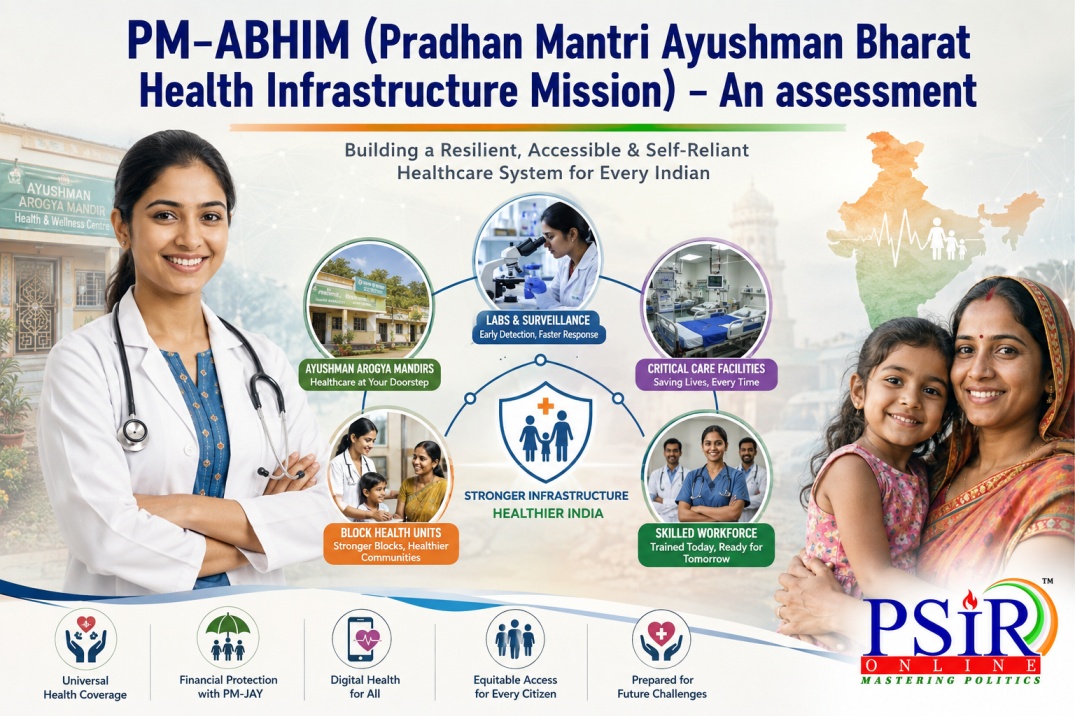
PM-ABHIM (Pradhan Mantri Ayushman Bharat Health Infrastructure Mission) is one of India's flagship national health initiatives, launched by Prime Minister Narendra Modi on 25 October 2021. It was announced in the Union Budget 2021-22 as part of the Atmanirbhar Bharat package, drawing lessons from the COVID-19 pandemic.
|
TOTAL OUTLAY AND DURATION · ₹64,180 crore (approximately US$7.3 billion) over six years (FY 2021-22 to 2025-26). · It is a Centrally Sponsored Scheme (CSS) with some Central Sector (CS) components. · Implemented under the National Health Mission (NHM) framework, in addition to existing NHM funding.
|
MAIN OBJECTIVES
The mission aims to create a resilient, accessible, and self-reliant public health system by addressing critical gaps in infrastructure, surveillance, diagnostics, research, and emergency response. Key goals include:
· Strengthening healthcare across primary, secondary, and tertiary levels.
· Better preparation for future pandemics, outbreaks, and disasters.
· Advancing Universal Health Coverage (UHC) through equitable access, especially in rural and underserved urban areas.
· Building a robust disease surveillance and laboratory network for early detection and response.
· Enhancing human resources, training, and research capabilities.
KEY COMPONENTS
PM-ABHIM focuses on a continuum of care with targeted infrastructure at every level:
1. Primary Healthcare (Grassroots Level)
· Ayushman Arogya Mandirs (AAMs) — formerly Health and Wellness Centres (HWCs).
o Support for 17,788 rural AAMs (especially building-less Sub-Health Centres in high-focus states).
o 11,024 Urban AAMs (focus on slums and vulnerable urban populations).
· These provide comprehensive primary care: preventive, promotive, curative, and diagnostic services (e.g., for NCDs, maternal/child health, etc.).
2. Secondary Level – Block Public Health Units (BPHUs)
· Establishment/strengthening of 2,151+ BPHUs at the block level (especially in high-focus/EAG states).
· These act as intermediate public health management units for better coordination, surveillance, and response.
3. Diagnostics and Surveillance
· Integrated District Public Health Laboratories (IPHLs) — One in every district (744+ approved).
· Real-time, IT-enabled disease surveillance network.
· Strengthens labs for testing emerging/re-emerging diseases.
4. Tertiary/Critical Care
· Critical Care Hospital Blocks (CCBs) — 621 approved (mostly 100-bedded) at district hospitals and medical colleges.
· 12 central institutions as training/mentoring sites with dedicated CCBs (e.g., select AIIMS, PGI Chandigarh, JIPMER, etc.).
5. Central Sector Components (National Level)
· Strengthening National Centre for Disease Control (NCDC) + new regional NCDCs.
· Public Health Units at points of entry (airports, seaports, land borders).
· Health Emergency Operation Centres.
· Bio-safety Level III labs, virology institutes, One Health initiatives, and research platforms.
Progress (as of early 2026)
· Administrative approvals worth ₹32,928.82 crore issued to States/UTs.
· Significant approvals for: 9,519 rural AAMs, 5,456 Urban AAMs, 2,151 BPHUs, 744 IPHLs, and 621 CCBs.
· Implementation involves States with some delays due to land availability, tenders, etc., but steady progress is reported.
|
HOW IT FITS INTO AYUSHMAN BHARAT Ayushman Bharat has multiple pillars: · Ayushman Arogya Mandirs (Comprehensive Primary Healthcare). · PM-JAY (health insurance up to ₹5 lakh per family). · Ayushman Bharat Digital Mission (ABDM). · PM-ABHIM (infrastructure backbone). Together, they aim for seamless care from prevention to advanced treatment. |
|
AYUSHMAN BHARAT
Ayushman Bharat (meaning "Long Live India") is India's flagship national health programme launched by Prime Minister Narendra Modi on 23 September 2018. It aims to achieve Universal Health Coverage (UHC) by providing comprehensive, affordable, and quality healthcare to all citizens, especially the poor and vulnerable.
It is often called the world's largest government-funded healthcare programme, targeting over 50 crore (500 million) people — roughly the bottom 40-50% of India's population.
Two Main Pillars (Interrelated Components) Ayushman Bharat has a continuum-of-care approach covering primary, secondary, and tertiary healthcare: 1. Ayushman Arogya Mandirs (AAMs) — formerly known as Health & Wellness Centres (HWCs) a. Focus: Comprehensive Primary Healthcare (preventive, promotive, curative, and rehabilitative). b. Target: Create 1.5 lakh (150,000) centres by upgrading existing Sub-Centres and Primary Health Centres. c. Current Status (as of mid-2025): Over 1.78 lakh AAMs are operational. d. Services Provided (free of cost): i. Maternal & child health, family planning. ii. Management of Non-Communicable Diseases (Diabetes, Hypertension, Cancer screening). iii. Infectious disease treatment. iv. Free essential drugs and diagnostics. v. Teleconsultation via eSanjeevani. vi. Wellness activities (Yoga, etc.). e. These bring basic healthcare closer to homes, especially in rural and urban slum areas. 2. Pradhan Mantri Jan Arogya Yojana (PM-JAY) — also called Ayushman Bharat PM-JAY or "Modicare" a. Focus: Secondary and Tertiary Hospitalisation (cashless health insurance). b. Coverage: Up to ₹5 lakh per family per year (on a family floater basis — no limit on family size, age, or gender). c. Beneficiaries: Around 12 crore vulnerable families identified via Socio-Economic Caste Census (SECC) 2011 data. d. Additional benefit: All senior citizens (70+ years) are now covered irrespective of income. e. Key Features: i. Cashless & paperless treatment at empanelled public and private hospitals. ii. Covers 1,393+ medical procedures (surgeries, medicines, diagnostics, pre & post-hospitalisation). iii. All pre-existing conditions covered from day one. iv. Portable across India (you can get treated anywhere in the country).
Other Supporting Pillars under Ayushman Bharat · Ayushman Bharat Digital Mission (ABDM): Creates a digital health ecosystem with Ayushman Bharat Health Account (ABHA) — a unique health ID for every citizen to store and share medical records securely. · PM-ABHIM (Pradhan Mantri Ayushman Bharat Health Infrastructure Mission): Builds stronger health infrastructure (labs, critical care blocks, surveillance systems) — which you asked about earlier.
Major Achievements (as of early 2026) · Over 42 crore Ayushman Cards issued. · Nearly 11–12 crore hospital admissions authorized worth more than ₹1.73 lakh crore. · Millions of people, especially women and the poor, have received free or highly subsidised treatment for serious illnesses.
How to Avail Benefits?
|
PROGRESS AND ACHIEVEMENTS
PM-ABHIM has made notable strides in approving and initiating infrastructure projects, particularly in primary healthcare and surveillance, though the scheme is still in its active implementation phase (ending FY 2025-26). Here is a more detailed, data-backed overview:
Financial and Administrative Approvals
· ₹32,928.82 crore approved under the Centrally Sponsored Scheme (CSS) component to States/UTs (as of March 2026). This covers a significant portion of the total ₹64,180 crore outlay.
· Earlier reports (mid-2025) mentioned approvals nearing ₹33,081 crore, reflecting minor adjustments in project costs or inclusions.
Physical Approvals (Key Targets Achieved on Paper):
· 9,519 building-less rural Ayushman Arogya Mandirs (AAMs) — focused on high-priority states like Bihar (2,546), Uttar Pradesh (1,670), Rajasthan (1,112), etc.
· 5,456 Urban Ayushman Arogya Mandirs (U-AAMs) — strong approvals in Delhi (1,139), Karnataka (817), Tamil Nadu (708), Uttar Pradesh (674).
· 2,151 Block Public Health Units (BPHUs) — concentrated in high-focus states (Uttar Pradesh 515, Jammu & Kashmir 287, etc.).
· 744 Integrated District Public Health Laboratories (IPHLs) — aiming for one per district.
· 621 Critical Care Hospital Blocks (CCBs) — mostly 50–100 bedded units at district hospitals and medical colleges (plus 12 larger blocks in central institutions like select AIIMS).
State-wise annexures (PIB, March 2026) show targeted focus on EAG (Empowered Action Group) and high-burden states for equity.
On-Ground Implementation and Operational Progress
· Ayushman Arogya Mandirs (Broader Ecosystem): While PM-ABHIM specifically funds new/upgraded facilities, the overall Ayushman Arogya Mandir network (including pre-existing NHM efforts) crossed 1.86 lakh functional centres as of May 2026. This includes thousands of new rural and urban units supported under the mission. These centres have delivered massive screenings (hypertension, diabetes, cancers) and teleconsultations.
· Surveillance and Labs: IPHLs have strengthened district-level diagnostics and real-time disease monitoring, contributing to improved outbreak response capabilities (e.g., better handling of seasonal or emerging infections).
· Critical Care: Many CCBs are under construction. Some states report partial completions or near-completion (e.g., targets for finishing several by March 2026). Full operationalization with staffing and equipment is ongoing.
· High-Focus Areas:
o Rural/High-Burden States (Bihar, UP, Rajasthan, Jharkhand, etc.): Major gains in building-less sub-centres.
o Urban (Delhi, Tamil Nadu, Karnataka): Progress in slum/vulnerable population coverage.
Additional Supporting Achievements
· World Bank Support: A $1 billion (≈ ₹8,200 crore) programme approved in 2023 specifically to bolster PM-ABHIM components for pandemic preparedness, infrastructure, and service delivery. Funds have supported implementation in select states.
· Qualitative Assessments: The Development Monitoring and Evaluation Office (DMEO), NITI Aayog, has described PM-ABHIM as a "highly relevant and equity-oriented intervention" that addresses critical gaps in public health infrastructure. It is viewed as a transformative step toward resilient systems.
· Convergence Benefits: Enhanced primary care infrastructure supports broader Ayushman Bharat goals (e.g., integration with PM-JAY, ABDM, and National Health Mission). Improved lab and surveillance capacity aids national disease tracking.
Overall Impact So Far: The mission has visibly expanded physical infrastructure in underserved rural and urban areas, laying a stronger foundation for primary healthcare, emergency response, and pandemic preparedness. It has accelerated the shift from reactive to proactive public health management.
Note on Utilization: While approvals are strong, actual fund release and on-ground completion have been slower (around 47% release in some periods), due to typical challenges like land acquisition, tenders, and state capacity. Many projects are in advanced construction stages as the scheme nears its closing year.
This progress positions India better for future health emergencies, though full benefits will depend on timely completion and sustained operations post-2026.
CHALLENGES AND CRITICISMS
While PM-ABHIM is an ambitious and strategically important scheme, its implementation has encountered several systemic hurdles common to large-scale centrally sponsored infrastructure programmes in India. As of early 2026, progress on approvals has been solid, but actual execution, fund absorption, and operational readiness lag behind targets.
1. Slow Fund Utilization
· Average utilization around 32% of allocations in recent years. Parliamentary analyses (PRS India) note consistently low spending, with funds often revised downward mid-year due to poor initial uptake.
· In FY 2024-25, out of ₹3,200 crore budgeted, only about ₹2,007 crore (≈67%) was utilized by February 2025. Similar patterns in previous years led to repeated cuts in Revised Estimates.
· Overall, between 2022-23 and 2025-26, only around 47% of total budget allocation was released to states in some periods. This mirrors broader NHM utilization issues (often 60-65%).
· Parliamentary Standing Committee on Health has repeatedly flagged this “recurring pattern of delays in spending, especially in the initial months of each financial year.”
2. Implementation Bottlenecks
Official government statements (March 2026) acknowledge multiple on-ground challenges:
· Land availability delays — particularly acute in urban areas and densely populated districts.
· Prolonged tendering and procurement processes.
· Coordination issues with project executing agencies (e.g., state construction departments, CPWD).
· Incomplete Detailed Project Reports (DPRs) and pending approvals at the start.
· Variations in state capacity — high-focus/EAG states often face greater administrative and technical constraints.
These have slowed construction of Critical Care Blocks (CCBs), Block Public Health Units (BPHUs), and laboratories.
3. Capital vs. Operational Focus (Sustainability Concerns)
· The scheme is heavily CAPEX-oriented (construction of buildings, labs, blocks). Post-2025-26, states will have to bear significant recurring costs (staff salaries, equipment maintenance, reagents, utilities).
· Human Resource shortages are a major risk: Many new facilities risk remaining under-utilized or “ghost infrastructure” due to lack of doctors, nurses, lab technicians, and paramedics. This is a long-standing issue across the public health system.
· Power supply, especially reliable electricity for labs and critical care equipment, remains patchy in several states.
4. Missed Synergies and Convergence Issues
· Limited full integration with other components of Ayushman Bharat (e.g., PM-JAY, ABDM digital health) or parallel initiatives like 15th Finance Commission health grants in some states.
· Overlap or duplication risks between different funding streams (NHM, PM-ABHIM, FC-XV) have sometimes caused confusion.
· Broader ecosystem gaps — such as reliable diagnostics supply chains, biomedical waste management, and IT connectivity — affect functionality of new infrastructure.
5. Equity and Access Gaps
· Progress is highly uneven across states. High-focus states (Bihar, UP, Rajasthan) have high approvals for rural AAMs, but completion and staffing rates vary widely.
· Functionality lags approvals: Many sanctioned Ayushman Arogya Mandirs, IPHLs, and CCBs are still under construction or partially operational.
· Broader evaluations of Ayushman Bharat show that mere infrastructure creation does not automatically translate into higher service uptake or reduced out-of-pocket expenditure if quality and staffing remain weak.
Audit and Oversight Context
· No standalone comprehensive CAG performance audit of PM-ABHIM has been prominently published yet (unlike detailed audits of PM-JAY). However, general health sector CAG reports and parliamentary committees consistently highlight under-spending, procurement delays, and weak monitoring in similar schemes.
· NITI Aayog’s DMEO has called the scheme “highly relevant,” but independent assessments also stress the need for stronger implementation monitoring and outcome focus.
Overall Assessment on Challenges: These issues are not unique to PM-ABHIM but reflect deeper structural weaknesses in India’s public health governance — fragmented implementation, state capacity variations, and the difficulty of shifting from “building” to “sustaining and staffing” facilities. The government has responded with increased monitoring, standard designs, technical support, and streamlined fund release mechanisms. As the scheme enters its final year (2025-26), accelerating completion and prioritizing human resources and maintenance will be critical to realizing its full potential.
WAY FORWARD FOR PM-ABHIM
As the original scheme period (2021-22 to 2025-26) concludes, PM-ABHIM stands at a critical juncture. The Union Budget 2026-27 has provided enhanced allocations (₹4,200 crore or higher in recent indications), signalling government intent to continue and accelerate the mission, likely through extension, integration into the National Health Mission (NHM), or a successor programme. Here is a balanced, actionable way forward based on official assessments, parliamentary observations, and expert recommendations.
1. Accelerate Completion and Operationalization (Short-term Priority: 2026-27)
· Fast-track pending construction of the remaining Ayushman Arogya Mandirs, BPHUs, IPHLs, and Critical Care Blocks through time-bound targets and high-level monitoring (e.g., via PRAGATI platform and PMG).
· Shift focus from approvals to full functionality: Ensure every new facility has adequate staffing, equipment, power backup, and essential drugs/diagnostics within 3–6 months of physical completion.
· Streamline fund release mechanisms and reduce bureaucratic delays in tenders and land acquisition.
2. Address Human Resource Gaps (Critical for Sustainability)
· Prioritise recruitment and multi-skilling of doctors, nurses, lab technicians, and public health managers, especially in high-focus and rural areas.
· Introduce incentives for rural/hardship postings, bridge courses, and continuous training in critical care, diagnostics, and surveillance.
· Leverage new Allied Health Professional institutions announced in Budget 2026-27 to build a stronger workforce pipeline.
3. Ensure Financial and Operational Sustainability (Post-2026)
· Plan for a seamless transition: Integrate successful components into NHM or create a follow-on scheme with dedicated recurring (revenue) expenditure support.
· States must commit to bearing O&M (operations & maintenance) costs; the Centre could provide performance-linked incentives for high-utilization states.
· Improve overall fund utilization (currently averaging ~32%) through better planning, capacity building for states, and outcome-based monitoring.
4. Strengthen Convergence and Digital Integration
· Fully link PM-ABHIM infrastructure with Ayushman Bharat Digital Mission (ABDM) for seamless health records, teleconsultation (eSanjeevani), and real-time surveillance.
· Better convergence with PM-JAY (insurance), NPCDCS (NCDs), and other vertical programmes to avoid duplication and create a true continuum of care.
· Adopt the One Health approach more aggressively by integrating human, animal, and environmental surveillance.
5. Promote Equity, Quality, and Public-Private Partnerships
· Targeted support for lagging states and urban slums to reduce inter-state and rural-urban disparities.
· Introduce robust quality assurance frameworks, standard treatment protocols, and patient feedback mechanisms in all new facilities.
· Encourage PPP models for diagnostics, specialized equipment, and maintenance in under-served areas, while the government retains oversight.
6. Community Engagement and Monitoring
· Involve Panchayati Raj Institutions, community health volunteers (ASHAs, ANMs), and local bodies in planning, monitoring, and demand generation.
· Strengthen independent evaluation by DMEO/NITI Aayog and periodic parliamentary oversight.
· Focus on measurable outcomes: reduction in out-of-pocket expenditure, improved early detection of outbreaks, higher utilization rates of new facilities, and better pandemic preparedness metrics.
Overall Outlook PM-ABHIM has laid a strong foundation for resilient health infrastructure. Its long-term success will depend on moving beyond “building” to “sustaining and utilizing” these assets effectively. With continued political priority (evident in the 2026-27 budget boost), focused implementation reforms, and adequate investment in human resources and digital systems, the mission can significantly advance India’s journey toward Universal Health Coverage and self-reliant public health.
PRACTICE QUESTIONS FOR GS 2 MAINS
1. “PM-ABHIM marks a shift in India’s healthcare approach from curative care to resilient public health preparedness.” Critically examine the significance of PM-ABHIM in strengthening India’s health infrastructure after the COVID-19 pandemic. (15 Marks)
2. Discuss the role of PM-ABHIM in achieving Universal Health Coverage (UHC) in India. How does it complement other pillars of Ayushman Bharat? (15 Marks)
3. Despite ambitious targets, PM-ABHIM faces structural and administrative challenges in implementation. Analyse the major bottlenecks and suggest measures to improve the effectiveness of the scheme. (20 Marks)
4. Evaluate the contribution of Ayushman Bharat and PM-ABHIM towards reducing regional and socio-economic inequalities in healthcare access in India. (20 Marks)