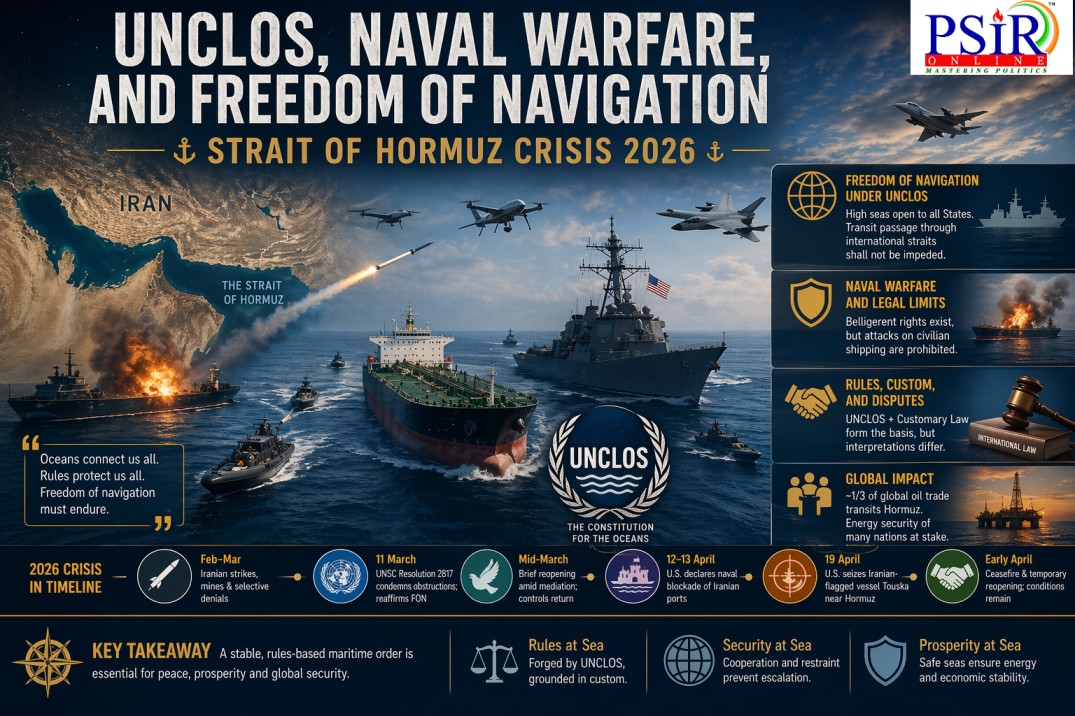
The March 2026 escalation in the Strait of Hormuz—marked by Iranian missile and drone strikes on commercial tankers, selective denials of passage, deployment of naval mines, and the subsequent U.S. naval blockade of Iranian ports—has thrust the United Nations Convention on the Law of the Sea (UNCLOS) into the center of a high-stakes international relations (IR) debate.
What began as a U.S.-Israeli military campaign (Operation Epic Fury, launched 28 February 2026) rapidly transformed a critical global chokepoint into a live laboratory for the tension between peacetime navigational freedoms and wartime belligerent rights. As of 21 April 2026, with a fragile ceasefire in place since early April but Iran threatening renewed closure unless the U.S. lifts its blockade, the crisis underscores fundamental questions:
· How durable are UNCLOS’s rules on freedom of navigation (FON) when an international armed conflict erupts?
· Can customary international law bridge the gap for non-parties like the United States and Iran?
· And what does this reveal about the resilience of the rules-based maritime order in an era of great-power competition and hybrid threats?
I. FOUNDATIONS OF UNCLOS AND FREEDOM OF NAVIGATION
Adopted in 1982 and entering into force in 1994, UNCLOS is widely regarded as the “Constitution for the Oceans.” It codifies a comprehensive zonal architecture that balances coastal-state sovereignty with international freedoms. Freedom of navigation stands as one of its bedrock principles, rooted in the historical mare liberum doctrine articulated by Hugo Grotius in 1609 and later enshrined in customary law.

Under UNCLOS, FON operates differently across maritime zones:
· High seas (beyond 200 nautical miles): Article 87 declares the high seas “open to all States” and lists “freedom of navigation” first among enumerated rights. This includes military vessels and aircraft, subject only to “due regard” for the rights of others.
· Exclusive Economic Zone (EEZ): Article 58 extends FON and overflight to EEZs, provided states exercise “due regard” to the coastal state’s resource rights. Military activities remain permissible absent specific prohibition.
· Territorial sea (up to 12 nautical miles): The more restrictive regime of innocent passage (Articles 17–19) applies. Passage must be “continuous and expeditious” and not “prejudicial to the peace, good order or security” of the coastal state.
· Internal waters: Full sovereignty; no automatic right of passage.
Crucially, UNCLOS is not universally ratified. The United States signed but never ratified the treaty, citing concerns over Part XI (deep-seabed mining) and compulsory dispute settlement. Iran signed in 1982 but has not ratified, objecting to the “package deal” nature of transit passage rights. Both states nevertheless accept large portions of UNCLOS as reflective of customary international law—particularly FON provisions—creating a hybrid regime of treaty obligation and custom.
This duality fuels ongoing IR debates. Proponents of a rules-based order argue that customary status binds all states; critics (including some Iranian scholars) invoke the persistent objector doctrine, claiming Iran never consented to transit passage and is therefore bound only by the older innocent-passage standard from the 1958 Geneva Conventions.
II. INTERNATIONAL STRAITS AND THE TRANSIT PASSAGE REGIME
Part III of UNCLOS (Articles 34–45) establishes a distinct regime for “straits used for international navigation.” The Strait of Hormuz—21 nautical miles wide at its narrowest, connecting the Persian Gulf (EEZ/high seas) to the Gulf of Oman—unquestionably qualifies. Unlike innocent passage, transit passage (Article 38) grants ships and aircraft the right of “continuous and expeditious transit” that “shall not be impeded.” Coastal states may not suspend passage, impose tolls, or selectively deny vessels except for narrowly defined safety or pollution reasons (Article 42). Article 44 is unequivocal: “There shall be no suspension of transit passage.”
Key distinctions from innocent passage:
· Transit passage applies to straits connecting one part of the high seas/EEZ to another.
· Submarines may transit submerged.
· Overflight rights are included.
· Coastal-state regulatory powers are strictly limited (no requirement of “innocence”).
· Applies equally to warships and merchant vessels.
These rules were a negotiated compromise during UNCLOS III: broader navigation rights in exchange for coastal-state resource sovereignty elsewhere. In peacetime, they have proven robust, underpinning roughly one-third of global seaborne oil trade through Hormuz. Yet the regime’s application in armed conflict remains contested, precisely the issue crystallized by the 2026 crisis.
III. NAVAL WARFARE AND THE LIMITS OF PEACETIME LAW
When armed conflict erupts, UNCLOS does not vanish, but the lex specialis of international humanitarian law (IHL) applicable to naval operations takes precedence on specific issues. The primary modern restatement is the 1994 San Remo Manual on International Law Applicable to Armed Conflicts at Sea, widely accepted as an authoritative (though non-binding) codification of customary rules.
Core principles from San Remo relevant to Hormuz:
· Belligerent warships retain rights of passage through neutral international straits (Rule 23).
· Neutral states’ sovereignty over straits is not jeopardized by belligerent transit (Rule 24).
· Blockades are lawful if formally declared, effectively enforced, and non-discriminatory against neutral shipping (Rules 93–98).
· Merchant vessels may be visited, searched, or captured if they breach a blockade or carry contraband.
· Attacks on civilian vessels are prohibited unless they make an “effective contribution to military action” and offer a definite military advantage (Rules 40–41).
The Manual explicitly addresses the interaction with UNCLOS: peacetime navigational rights continue unless overridden by specific wartime necessities. However, the Hormuz crisis illustrates the interpretive grey zones—does transit passage remain “unsuspendable” when one coastal state is a belligerent?
|
Can a coastal state invoke self-defense under UN Charter Article 51 to regulate passage? Legal scholars remain divided, with Western analyses emphasizing continuity of custom and Iranian positions stressing sovereign security prerogatives in wartime.
|
IV. THE 2026 STRAIT OF HORMUZ CRISIS: A CASE STUDY
The conflict’s maritime dimension erupted immediately after U.S.-Israeli strikes on 28 February 2026. Iran responded by declaring the strait “closed to hostile shipping,” deploying mines, attacking tankers, and imposing coordinated routing and fees. By mid-March, shipping traffic had plummeted, triggering the largest monthly oil-price spike since the 1970s.
Key timeline (March–April 2026):

This legal deadlock over the Strait of Hormuz is essentially a clash between two different interpretations of international law. One side argues that sovereign safety and wartime necessity come first, while the other argues that universal freedom of navigation is a right that cannot be turned off.
Iran’s Legal Position: The "Wartime Exception"
Iran argues that the standard peacetime rules of UNCLOS do not apply in the current 2026 crisis. Their legal strategy rests on three main pillars:
· The "Persistent Objector" Rule: Iran contends that it is not bound by the "transit passage" rules of UNCLOS because it has never accepted them as mandatory for itself. In international law, a "persistent objector" is a nation that clearly and consistently disagrees with a developing rule of law from the start, effectively saying, "I never agreed to these house rules, so they don't apply to me."
· International Humanitarian Law (IHL) Precedence: Iran argues that once an armed conflict begins, the law of war (IHL) takes over. They believe that if national security is at risk, they have the right to prioritize military necessity over the peacetime navigational rights found in UNCLOS.
· San Remo Critique: Iran argues that the U.S. and its allies are not following the San Remo Manual (a widely accepted guide for the law of armed conflict at sea). They claim that any blockade the U.S. is enforcing is "excessive" or ineffective, and therefore illegal under the very rules the U.S. claims to be defending.
The U.S. and Allied Position: The "Universal Right"
The U.S. and its partners reject Iran's arguments, maintaining that the rights to navigate these waters are non-negotiable and apply to everyone, regardless of the current state of conflict.
· Customary International Law: The U.S. argues that transit passage is not just a treaty rule—it is "customary international law." This means that because almost every nation in the world has followed these practices for decades, the rules have become binding on all nations, even those that didn't sign the treaty or those who claim to be "objectors."
· The Legitimacy of Belligerent Rights: The U.S. argues that a naval blockade is a recognized tool of warfare under the San Remo guidelines. They contend that as long as the blockade is limited to military/enemy targets and does not hinder innocent merchant traffic, it is a legal exercise of their rights in an active conflict.
· Sovereign Immunity: The U.S. asserts that their warships are an extension of the U.S. state. Under the principle of "sovereign immunity," these ships are essentially floating territory that cannot be searched, detained, or regulated by coastal authorities, no matter how close they are to Iran’s coast.
The Point of Friction: Warships and the EEZ
The tension is exacerbated by a long-standing disagreement over what warships are actually allowed to do in a country’s Exclusive Economic Zone (EEZ)—the area of sea extending 200 nautical miles from a country's coast.
· The U.S. View: The U.S. views the EEZ as international water where they have the freedom to conduct surveillance, military exercises, and "Freedom of Navigation" (FON) operations. They argue these activities are completely legal and protected.
· The Iranian View: Iran (along with several other nations) views the presence of foreign warships in their EEZ as an inherently provocative and non-innocent act. They argue that foreign military surveillance or maneuvers in their backyard threaten their national security and should require prior permission—a claim the U.S. refuses to recognize.
This creates a dangerous loop: The U.S. sends ships to prove they have the right to be there, and Iran attempts to restrict them, citing national security, which further escalates the crisis.
V. BROADER IMPLICATIONS FOR INTERNATIONAL RELATIONS AND MARITIME GOVERNANCE
The Hormuz events carry profound IR implications.
· First, they expose the fragility of the “rules-based international order” when major non-parties clash.
· Second, they risk normalizing hybrid maritime tactics—mines, selective denial, economic coercion—that blur peace/war thresholds.
· Third, they accelerate debates on UNCLOS reform or supplementary agreements (e.g., updating the San Remo Manual for drone and cyber threats).
For middle powers and emerging economies reliant on Hormuz (India, China, Japan, Europe), the crisis reinforces the need for diversified energy routes and multilateral enforcement mechanisms. UNSC involvement remains limited by veto dynamics, underscoring institutional weaknesses. Finally, the episode may influence other chokepoints (South China Sea, Bab el-Mandeb, Taiwan Strait), where similar legal ambiguities persist.
In conclusion, the 2026 US-Iran war has not rewritten UNCLOS but has dramatically illuminated its fault lines. Freedom of navigation remains a vital global public good, yet its enforcement in armed conflict depends on state practice, customary evolution, and political will. As diplomats negotiate in Islamabad and legal scholars dissect precedents, the Hormuz crisis serves as a stark reminder: in the maritime domain, law and power are inextricably linked. Sustaining the “Constitution for the Oceans” will require not only fidelity to its text but creative adaptation to the realities of 21st-century naval warfare.
PRACTISE QUESTIONS FOR GS 2 MAINS
1. “Freedom of Navigation under UNCLOS reflects a balance between coastal state sovereignty and global commons.” Examine in the context of recent developments in the Strait of Hormuz.
2. Discuss the legal and institutional challenges faced by the international community in enforcing maritime rules under United Nations Convention on the Law of the Sea during armed conflicts.
3. Evaluate the role of the United Nations Security Council in maintaining maritime security in strategic chokepoints like the Strait of Hormuz. Why has its response remained limited?
4. “India’s energy security is deeply intertwined with stability in global maritime chokepoints.” Analyze with reference to the 2026 Hormuz crisis and suggest policy measures.
PRACTISE QUESTIONS FOR PSIR OPTIONAL
1. Critically examine the tension between treaty law and customary international law in regulating Freedom of Navigation, with reference to UNCLOS and non-signatory states.
2. “The Strait of Hormuz crisis illustrates the limits of the rules-based international order.” Discuss using competing legal positions of Iran and the United States.
3. Analyze the relevance of the San Remo Manual on International Law Applicable to Armed Conflicts at Sea in governing naval warfare in contemporary conflicts. Is it adequate for modern hybrid threats?
4. Examine the concept of “persistent objector” in international law. To what extent can states like Iran use it to challenge universally accepted norms such as transit passage?