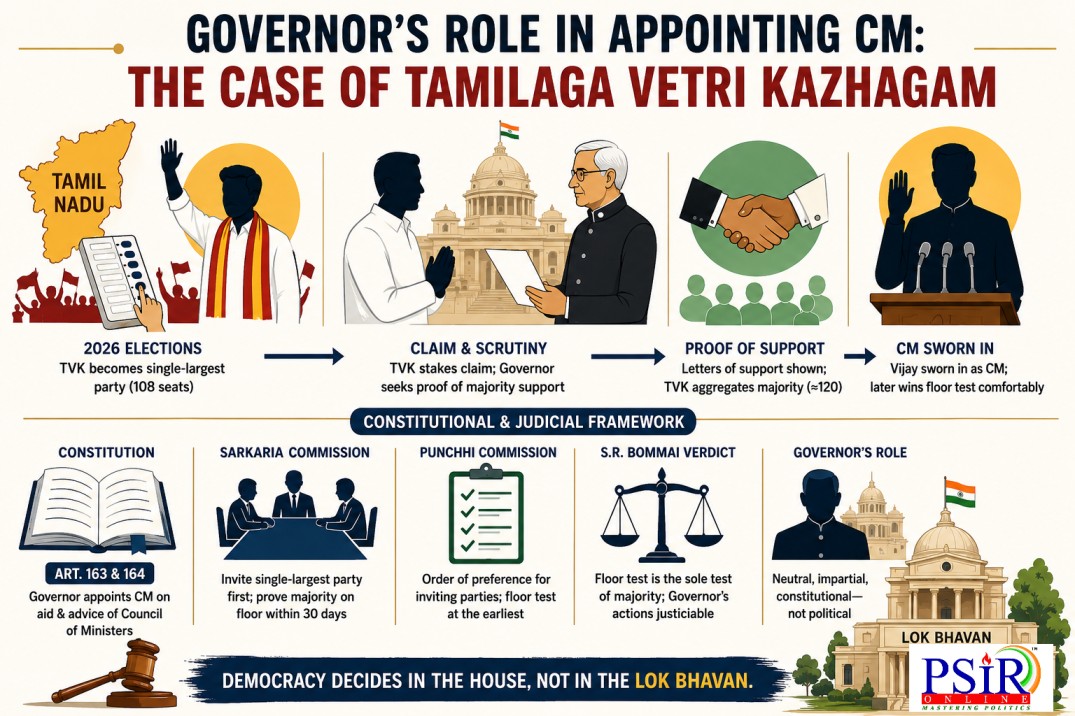
The Governor's role in government formation in Indian states (under Article 164 of the Constitution) came under sharp focus in Tamil Nadu after the 2026 Assembly elections due to TVK chief C. Joseph Vijay's claim and Governor Rajendra Vishwanath Arlekar's insistence on proof of majority support.
WHAT HAPPENED IN TAMIL NADU (2026)
· TVK (Tamilaga Vettri Kazhagam), led by actor-politician Vijay, emerged as the single-largest party with 108 seats in the May 2026 elections (DMK ~59, AIADMK ~47, others smaller). No pre-poll alliance had a clear majority.
· Vijay staked claim to form the government and met Governor Arlekar multiple times (starting ~May 6).
· The Governor asked for physical letters of support from at least 118 MLAs before inviting him, citing the need to verify a stable post-poll alliance (TVK needed ~10 more seats). This led to negotiations with Congress (5 seats), VCK, IUML, Left parties (outside support), and some cross-voting/AIADMK rebels.
· Once TVK demonstrated ~120 letters of support, the Governor invited Vijay, who was sworn in as CM (around May 10) and later proved majority on the floor (passed trust vote comfortably with coalition + rebels).
This process — the Governor's repeated demands for proof, delays, and public scrutiny — highlighted longstanding debates about Governors' discretion, potential political bias (many Governors are seen as Centre-aligned), and whether they should invite the single-largest party first or insist on pre-invitation proof. Critics called it overreach or delay tactics; defenders said it was constitutional to ensure stability.
CONSTITUTIONAL PROVISIONS FOR APPOINTING CM
The Indian Constitution provides minimal and straightforward provisions on the appointment of the Chief Minister:
· Article 164(1): “The Chief Minister shall be appointed by the Governor and the other Ministers shall be appointed by the Governor on the advice of the Chief Minister…”
· Article 163(1): There shall be a Council of Ministers with the Chief Minister at the head to aid and advise the Governor in the exercise of his functions, except in so far as he is by or under this Constitution required to exercise his functions or any of them in his discretion.
The Constitution does not specify any detailed procedure, priority order (e.g., single-largest party), or requirement for letters of support. It grants the Governor limited discretionary power under Article 163 in situations like a hung Assembly, but this discretion is not absolute and must be exercised in a bona fide (good faith) manner. The Council of Ministers is collectively responsible to the Legislative Assembly (Article 164(2)), meaning the ultimate test of majority is on the floor of the House.
SARKARIA COMMISSION REPORT FOR APPOINTING CM (1988)
The Sarkaria Commission on Centre-State Relations provided the first major set of guidelines for the Governor’s role in government formation, especially in hung Assemblies:
· The Governor should first invite the leader of the party or group that commands a clear majority in the Assembly.
· In a hung situation (no clear majority):
1. Invite the leader of the single-largest party (even if short of majority) to form the government and prove majority on the floor.
2. Only if that fails, explore post-poll combinations.
· The Governor must act impartially and avoid horse-trading or political bias.
· Once appointed, the CM should seek a vote of confidence in the Assembly within 30 days (or as early as possible).
· The Commission emphasised that the Governor’s discretion is limited and must follow constitutional conventions to maintain federal balance.
These are recommendatory (not binding), but they have influenced judicial pronouncements and practices.
PUNCHHI COMMISSION STAND ON APPOINTING CM (2010)
The Punchhi Commission (Second Commission on Centre-State Relations) built upon and refined the Sarkaria recommendations with clearer guidelines for hung Assemblies:
· Treat a pre-poll alliance as a single political entity. Invite its leader first if it has majority support.
· In the absence of a clear majority, follow this order of preference:
1. Pre-poll coalition with largest support.
2. Single-largest party staking claim (with or without post-poll support).
3. Post-poll coalition where parties join the government.
4. Post-poll alliance with some parties in government and others providing outside support.
· The Governor should invite the person most likely to command the confidence of the House and allow them to prove majority on the floor at the earliest.
· Emphasised limiting the Governor’s discretionary powers through clear rules to prevent misuse and ensure neutrality.
Like Sarkaria, these are recommendations aimed at reducing Centre-State friction.
SR BOMMAI VERDICT ON APPOINTING CM (1994)
In S.R. Bommai v. Union of India (a 9-judge bench decision), the Supreme Court laid down binding judicial guidelines that strengthened federalism:
· The Governor cannot act arbitrarily. Any decision (including on government formation or recommending President’s Rule) must be based on objective material and is subject to judicial review.
· The proper and sole test of a government’s majority is on the floor of the House (vote of confidence), not through the Governor’s subjective assessment, letters, or private verification.
· In hung Assemblies, the Governor should give the single-largest party or claimant the first opportunity to prove majority.
· Floor test is the democratic and constitutional way to resolve claims — the Governor should not delay swearing-in or indulge in parallel assessments that encourage horse-trading.
· The verdict curbed misuse of Article 356 (President’s Rule) and reinforced that the Governor is a constitutional head, not an agent of the Centre.
This remains the most authoritative judicial pronouncement on the issue.
WHAT MISTAKE DID THE TN GOVERNOR DO?
In the 2026 Tamil Nadu Assembly elections, TVK (led by Vijay) emerged as the single-largest party with 108 seats in the 234-member House (short of the 118 majority mark). No pre-poll alliance had a clear majority.
The Governor (Rajendra Vishwanath Arlekar) repeatedly asked Vijay to submit physical letters of support from at least 118 MLAs before inviting him to form the government and get sworn in. He held multiple meetings and publicly stated that “requisite majority support has not been established.”
Critics (including opposition parties, legal experts, and editorials) argue this was a mistake because:
· It went beyond constitutional conventions and Bommai guidelines by insisting on pre-invitation proof instead of allowing a floor test.
· It delayed the process and was seen as overreach into political negotiations.
· The Governor effectively acted as a parallel verifier of majority, which the Supreme Court has discouraged.
· It created perceptions of bias (Governor being a Centre appointee) and encouraged allegations of horse-trading.
Defenders say the Governor was ensuring stability in a genuine hung situation. Vijay eventually submitted sufficient support, was sworn in, and passed the floor test.
HOW THIS RAISES QUESTIONS OVER THE INSTITUTION OF GOVERNOR
This episode has intensified long-standing debates on the Governor’s office:
· Political Bias: Many Governors are retired politicians or aligned with the ruling party at the Centre, leading to accusations of acting as “agents of the Centre” rather than impartial constitutional authorities (a criticism echoed in Sarkaria and Punchhi reports).
· Discretionary Overreach: Repeated insistence on letters/support before floor test blurs the line between constitutional duty and political interference.
· Federal Tension: It undermines cooperative federalism and people’s mandate, especially when the single-largest party is from an opposition ecosystem.
· Calls for Reform: Demands for codifying Governor’s powers (e.g., via a new constitutional schedule), fixed tenure with state consultation in appointment, impeachment by state legislature, and stricter adherence to Bommai principles.
· Erosion of Trust: Such controversies (seen earlier in states like Karnataka, Maharashtra, etc.) weaken public faith in the institution and fuel demands to make the Governor’s role more ceremonial or accountable.
This TN case has once again spotlighted the need for clearer rules to prevent recurring Centre-State friction.
PRACTICE QUESTIONS FOR GS 2 MAINS
1. “The Governor’s discretionary powers in a hung Assembly often generate constitutional and political controversies.” Examine in the light of recent developments in Tamil Nadu.
2. Discuss the constitutional position of the Governor in the appointment of the Chief Minister under Articles 163 and 164. To what extent should constitutional conventions guide gubernatorial discretion?
3. Critically analyse the recommendations of the Sarkaria and Punchhi Commissions regarding government formation in hung Assemblies.
4. “The floor test principle has emerged as the cornerstone of Indian parliamentary democracy.” Discuss with reference to the S.R. Bommai judgement and recent state-level political crises.
PRACTICE QUESTIONS FOR PSIR OPTIONAL
1. Examine how controversies surrounding the office of the Governor reflect the tensions inherent in Indian cooperative federalism.
2. “Constitutional morality must prevail over political discretion in parliamentary democracies.” Evaluate this statement in the context of gubernatorial powers in India.
3. Analyse the role of judicial intervention in preserving federal balance in India with special reference to the S.R. Bommai case.
4. Do you think the institution of Governor requires structural reforms in contemporary India? Substantiate your answer with suitable constitutional and political arguments.