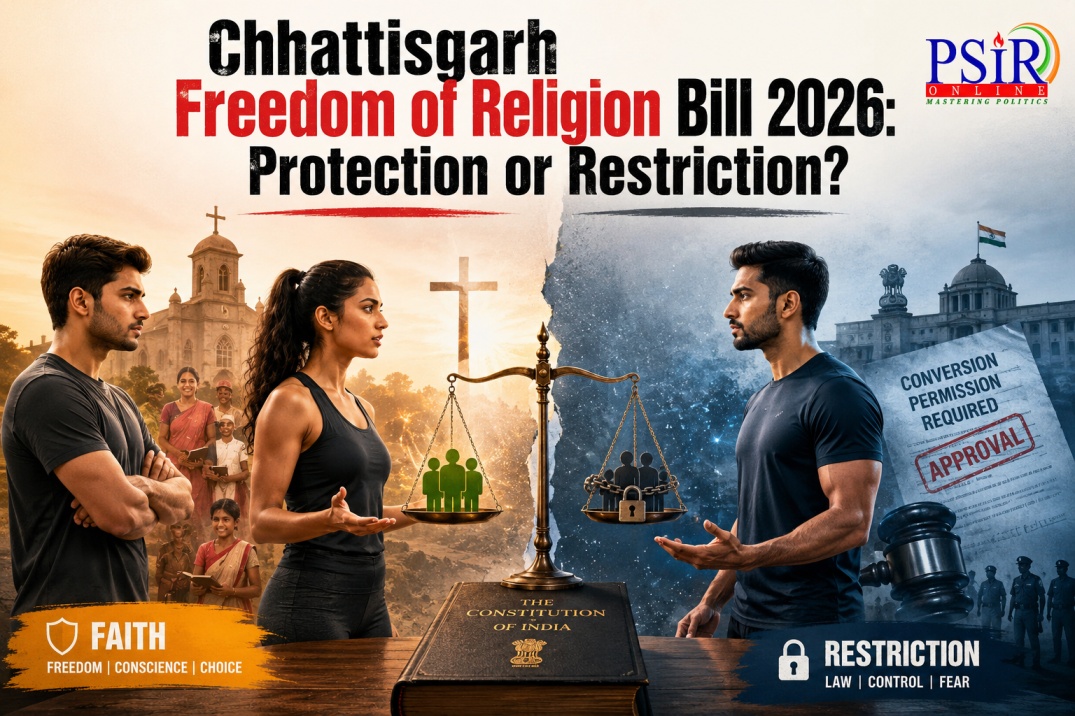
In March 2026, the Chhattisgarh government quietly passed, allegedly, one of the strictest religious laws in India’s recent history — the Chhattisgarh Freedom of Religion Bill 2026. Just days later, thousands of Christians marched through the streets of Raipur carrying torches, protesting what they described as an attack on their fundamental right to faith.
The Bill, which replaces the colonial-era 1968 law with supposedly far harsher provisions — including up to life imprisonment for mass conversions — has sharply divided opinions. The ruling BJP government claims it is a necessary shield to protect vulnerable tribal communities from forced or fraudulent conversions. Critics, however, argue that it severely restricts personal freedom of religion, targets minority communities, and gives sweeping powers that can be misused to harass pastors and ordinary believers.
At its core, the debate is not just about one state’s legislation. It raises a fundamental constitutional question:
Does the Chhattisgarh Freedom of Religion Bill 2026 truly protect the freedom of religion by preventing exploitation, or does it restrict it by placing heavy bureaucratic and legal barriers on personal faith choices?
This article examines both sides of this contentious issue.
CONTEXT AND BACKGROUND
Chhattisgarh has had an older anti-conversion law since 1968 (inherited from undivided Madhya Pradesh). The new 2026 Bill replaces and significantly strengthens it. The BJP government, under Chief Minister Vishnu Deo Sai, pushed it to curb what it calls illegal or fraudulent religious conversions, especially in tribal areas where Christian missionary activities are active.
Key provisions of the Bill include:
· The bill prohibits religious conversion by force, fraud, allurement, undue influence, misrepresentation, or marriage, including conversion attempts carried out through digital or social media platforms.
· Before any conversion, the person concerned must give prior declaration to the District Magistrate or an authorised officer, and the process may involve public notice and objections within a prescribed period.
· Ordinary violations attract 7 to 10 years of imprisonment and a fine of at least ₹5 lakh.
· Conversions involving minors, women, persons of unsound mind, or members of SC/ST/OBC communities carry stricter punishment of 10 to 20 years in prison and a higher minimum fine.
· Mass conversions, usually defined as conversions of two or more persons, can lead to 10 years to life imprisonment and a fine of up to ₹25 lakh.
· The offences are cognizable and non-bailable.
· Victims of illegal conversion may be eligible for compensation of up to ₹10 lakh.
· Reconversion to one’s ancestral religion is exempted from the conversion procedure.
The government argues this protects vulnerable tribal and rural populations from exploitation, maintains social harmony, and ensures conversions are genuinely voluntary. Similar laws exist in several other states.
THE PROTEST IN RAIPUR (MARCH 22, 2026)
Thousands of Christians marched with torches through Raipur, the state capital, on March 22 — just days after the Bill passed on March 19.
Why they protested:
· They fear the law will be misused to harass Christians, pastors, and missionaries through false complaints.
· Provisions like mandatory prior notice, public disclosure, and broad definitions of "allurement" (e.g., charity, prayer meetings, or social services) could criminalize routine religious activities and personal faith choices.
· It targets minority communities (especially in tribal areas with significant Christian populations) while exempting "reconversion" to Hinduism, seen as discriminatory.
· Critics call it a "black law" that violates constitutional rights to freedom of religion (Article 25 of the Indian Constitution).
The torch march was peaceful, with placards demanding the Bill be scrapped. It was part of wider protests across Chhattisgarh, including larger gatherings later (e.g., over 30,000 in Jagdalpur in April). Christian groups submitted memorandums, attempted marches to the governor's residence, and highlighted rising attacks on churches and Christians by right-wing groups.
Broader Implications and Reactions
· Opposition (Congress): Boycotted the assembly proceedings and demanded more consultation.
· Christian community: Views it as part of a pattern of increasing restrictions and vigilantism against minorities in certain states.
· Supporters (BJP, VHP, etc.): Welcome the bill as a strong step against forced conversions, alleged “love jihad,” and inducement-based conversion activities, especially in tribal and rural areas. They argue that the law will protect vulnerable communities and maintain religious and social stability.
· The Bill received the Governor's assent later and came into effect around April 2026.
This fits into India's ongoing national debate on religious conversions, secularism vs. protection of indigenous/tribal cultures, and minority rights. Critics argue these laws can chill free exercise of faith, while proponents say they prevent exploitation. The torch march in Raipur symbolized strong grassroots resistance from Chhattisgarh's Christian community.
THE QUESTION OF RELIGIOUS FREEDOM
The Chhattisgarh Freedom of Religion Bill (or Act), 2026, is a classic example of India's polarized debate on religious freedom. It is framed by supporters as protecting genuine freedom of religion by preventing coercion, while critics see it as restricting it through state oversight and potential misuse against minorities.
Article 25 of the Indian Constitution (Core Reference)
Article 25 guarantees: "Subject to public order, morality and health... all persons are equally entitled to freedom of conscience and the right freely to profess, practise and propagate religion."
· The Supreme Court has clarified that the right to propagate does not include the right to convert others by force, fraud, or allurement (e.g., Rev. Stanislaus v. State of Madhya Pradesh, 1977). However, genuine voluntary conversion is protected.
· Ongoing Supreme Court petitions challenge similar state laws for being overly broad, violating privacy, and chilling free exercise of faith.
Arguments in Favor: It Protects Freedom of Religion
Supporters (BJP government, VHP, and many Hindu/tribal organizations) argue the law safeguards vulnerable individuals' true religious freedom from exploitation.
· Prevents coercion and exploitation: The Bill targets conversions via force, fraud, inducement (allurement), undue influence, misrepresentation, or marriage. This protects poor, tribal, and rural populations (especially in Bastar and other areas) from predatory missionary tactics, including material incentives, false healing claims ("Changai Sabha"), or social pressure.
· Safeguards vulnerable groups: Stricter penalties for cases involving minors, women, SC/ST/OBC, or mass conversions protect those most susceptible to manipulation, preserving their authentic freedom of conscience.
· Transparency and voluntary nature: Prior declaration, inquiry, and public notice ensure conversions are genuine and not hidden. This upholds public order and prevents social discord or family breakdowns.
· Reconversion exemption: Allowing return to "ancestral religion" (often indigenous/tribal faiths or Hinduism) respects cultural roots without restricting choice in the other direction.
· Constitutional alignment: States have legislative competence on this (List II/III). Similar laws in other states exist, and the Supreme Court has not struck them down wholesale. The law balances Article 25 with public order.
· Evidence-based need: Rising complaints of illegal conversions, demographic shifts in tribal areas, and foreign funding concerns justify stronger enforcement over the weak 1968 law.
In this view, unregulated "propagation" can become predation, undermining others' freedom. The law protects the weak and maintains harmony.
Arguments Against: It Violates/Infringes Freedom of Religion
Critics (Christian organizations, opposition parties, human rights groups) argue it is discriminatory, overly restrictive, and weaponized against minorities.
· Chills legitimate religious practice: Broad definitions of "allurement" or "undue influence" can criminalize charity, education, healthcare, prayer meetings, or even personal evangelism — core Christian (and other) activities. Routine faith expression becomes risky.
· Prior permission and public disclosure: Mandatory advance notice (often 30-60 days), public display of details, and inquiries violate privacy (Article 21), create social pressure/objections, and deter genuine personal conversions. This adds bureaucratic hurdles to a fundamental right.
· Discriminatory and targeted: Exempts "reconversion" to Hinduism while heavily scrutinizing conversions to Christianity/Islam. This favors the majority faith and reflects a political agenda to curb minority growth, especially in tribal areas.
· Misuse and harassment: The old 1968 law already led to hundreds of "baseless" FIRs against pastors with zero convictions. The new law's harsh penalties (up to life imprisonment), non-bailable offences, and low evidentiary thresholds will escalate vigilante complaints and police harassment.
· Against constitutional spirit: It burdens the right to propagate (Article 25), equality (Article 14), and personal liberty. Critics cite Supreme Court observations questioning onerous provisions in similar laws. No widespread evidence of forced conversions justifies this overreach.
· Polarizing effect: It heightens fear and division, potentially increasing attacks on Christians rather than protecting harmony.
In this view, the law assumes conversions to minority faiths are suspicious while treating majoritarian reconversions as natural, effectively creating "freedom for some, restrictions for others."
Broader Picture
This is not unique to Chhattisgarh — over a dozen Indian states have similar laws, mostly BJP-ruled. The Supreme Court is examining their constitutionality in consolidated petitions, focusing on privacy, burden of proof, and overbreadth.
Balanced assessment: The law's intent (curbing genuine fraud/coercion) aligns with constitutional limits on propagation. However, its implementation risks — vague terms, reverse burdens in practice, selective enforcement, and heavy bureaucracy — can infringe on voluntary faith choices and minority rights. Effectiveness depends on fair, non-partisan application, which critics doubt given past patterns.
SIMILAR ANTI-CONVERSION LAWS OF INDIA
Here is a comprehensive overview of other similar "Freedom of Religion" or anti-conversion laws in India (as of May 2026).
These laws generally prohibit religious conversions by force, fraud, allurement (inducement), misrepresentation, undue influence, or sometimes through marriage. Most require prior government notice, have reversed burden of proof in practice, and impose heavy penalties. They are officially called "Freedom of Religion Acts" but are widely known as anti-conversion laws.
Current Status (as of May 2026)
· No national law exists. These are all state-level legislations.
· Approximately 12–13 states have active or recently passed such laws.
· Roughly half of India's population lives in states with these laws.
Major States with Such Laws
|
State and Year Mentioned |
Name of Law and Description |
|
Odisha (1967) |
Orissa Freedom of Religion Act, 1967 — India’s first anti-conversion law; prohibits conversion by force, inducement, or fraud. |
|
Madhya Pradesh (1968 / 2021) |
Madhya Pradesh Freedom of Religion Act — enacted in 1968 and strengthened in 2021 with stricter penalties and prior notice requirements. |
|
Chhattisgarh (1968 inherited / 2026) |
Chhattisgarh Freedom of Religion law — inherited the older framework; in 2026, a harsher replacement Bill was passed, proposing severe penalties including life imprisonment for mass conversions. |
|
Arunachal Pradesh (1978) |
Arunachal Pradesh Freedom of Religion Act, 1978 — long dormant; implementation was revived/pushed in 2024–2025. |
|
Gujarat (2003 / 2021) |
Gujarat Freedom of Religion Act — amended in 2021 to specifically include marriage-related conversions. |
|
Himachal Pradesh (2006 / 2019) |
Himachal Pradesh Freedom of Religion Act — enacted in 2006 and made stricter in 2019. |
|
Jharkhand (2017) |
Jharkhand Freedom of Religion law — enacted under the BJP government to regulate conversions by force, fraud, or allurement. |
|
Uttarakhand (2018 / 2025) |
Uttarakhand Freedom of Religion Act — later amended in 2025 with tougher provisions, including use of digital means in unlawful conversion cases. |
|
Uttar Pradesh (2021 / 2024) |
Uttar Pradesh Prohibition of Unlawful Conversion of Religion law — commonly called the “Love Jihad” law; strict on marriage-related conversions and widely used. |
|
Haryana (2022) |
Haryana Freedom of Religion law — restricts conversion by force, coercion, fraud, marriage, or digital means. |
|
Karnataka (2022) |
Karnataka Protection of Right to Freedom of Religion Act, 2022 — enacted by the BJP; later repeal was discussed by the Congress government. |
|
Rajasthan (2025) |
Rajasthan Prohibition of Unlawful Conversion of Religion Bill, 2025 — one of the strictest, with life imprisonment and very high fines. |
|
Maharashtra (2026) |
Maharashtra Freedom of Religion Bill, 2026 — draft/Assembly-passed framework reported in 2026; final implementation status should be checked carefully. |
Note: Tamil Nadu passed one in 2002 but repealed it in 2004 after protests. Some older sources mention 8–10 states, but expansions in 2025–2026 have increased the number.
Common Features Across Most Laws
· Prohibited methods: Force, fraud, allurement (e.g., charity, education, medical help), misrepresentation, coercion, or marriage for conversion.
· Prior Notice: Usually 30–60 days advance intimation to District Magistrate. Details may be publicized.
· Penalties: 3–10 years imprisonment normally; 10–20 years or life for mass conversions, minors, women, SC/ST in some laws. Fines from ₹1 lakh to ₹25 lakh+.
· Reconversion Exemption: Most exempt return to "ancestral religion" (usually Hinduism/tribal faiths).
· Cognizable & Non-bailable: Police can arrest without warrant in many cases; bail is difficult.
· Burden of Proof: Often shifts to the accused to prove the conversion was voluntary.
POSITION OF HIGHER JUDICIARY
The Indian Higher Judiciary's position on anti-conversion (Freedom of Religion) laws is nuanced. It has historically upheld the core idea of such laws but has increasingly expressed concerns about their implementation, overbreadth, and potential misuse in recent years (especially 2025–2026).
1. Landmark Judgment: Rev. Stanislaus v. State of Madhya Pradesh (1977)
This remains the foundational Supreme Court ruling on the issue.
· Key Holding:
o The right to propagate religion under Article 25 of the Constitution does not include the right to convert another person by force, fraud, or allurement.
o What is prohibited is not voluntary conversion, but coercive or induced conversion.
o The Court upheld the constitutional validity of the Madhya Pradesh Freedom of Religion Act, 1968, and the Odisha Freedom of Religion Act, 1967.
· Reasoning: Such laws protect public order, prevent exploitation of vulnerable people, and maintain social harmony. Conversion by improper means can disturb public order.
This judgment has been cited repeatedly by states to defend newer and stricter anti-conversion laws.
2. Recent Supreme Court Observations (2025–2026)
The Supreme Court has not delivered a comprehensive final verdict striking down or upholding all modern anti-conversion laws. However, it has made strong observations in specific cases and is actively hearing multiple challenges.
Important Recent Developments:
· October 17, 2025 (Rajendra Bihari Lal v. State of Uttar Pradesh): The Supreme Court quashed multiple FIRs filed under Uttar Pradesh’s anti-conversion law against Christians (including a university vice-chancellor) in a mass conversion case.
o It called certain provisions "onerous" and "intrusive".
o Emphasized that only the victim or their close family has standing to complain (at that time). Third-party complaints (e.g., by VHP) were invalid.
o Stressed that the law should not be used as a tool to harass innocents or punish legitimate religious practice.
· The Court has linked these issues to right to privacy (K.S. Puttaswamy, 2017) and individual autonomy in choosing faith (Shafin Jahan v. Asokan K.M., 2018).
· Ongoing Batch of Petitions (as of May 2026):
o Multiple petitions (by CJP, NCCI, Catholic Bishops’ Conference, etc.) challenge laws in 12+ states.
o The Supreme Court has issued notices to the Union Government and 12 states (including Chhattisgarh, UP, MP, Rajasthan, etc.).
o Issues under scrutiny: Mandatory prior notice, public disclosure of conversion details, reverse burden of proof, vague definitions of "allurement", exemption for reconversion to Hinduism, and potential violation of Articles 14 (equality), 21 (privacy & liberty), and 25 (freedom of religion).
· The Court has transferred cases from various High Courts to itself for consolidated hearing, indicating the matter's constitutional importance. No final judgment yet.
3. High Court Positions
· Gujarat High Court (2021): Stayed several stringent provisions of Gujarat’s law.
· Madhya Pradesh High Court (2022): Struck down the mandatory declaration/notice requirement in MP’s law (later appealed).
· Some High Courts have granted relief in individual cases of alleged misuse but generally defer to the Stanislaus precedent on validity.
Overall Judicial Stance (Summary)
|
Aspect |
Judiciary's View |
|
Core Validity |
Upheld (Stanislaus, 1977) — States can regulate coercive conversions. |
|
Voluntary Conversion |
Protected as part of freedom of conscience & personal autonomy. |
|
Prior Notice & Publicity |
Viewed with suspicion — potentially violates privacy and chills free exercise. |
|
Misuse & Harassment |
Strongly criticized — laws should not become tools for targeting minorities or pastors. |
|
Vague Terms ("Allurement") |
Problematic if too broad (e.g., charity, prayer). |
|
Final Comprehensive Ruling |
Pending (multiple petitions under active consideration). |
Bottom Line: The higher judiciary accepts that genuine anti-coercion measures are constitutional. However, it is increasingly wary of overly broad, poorly implemented, or selectively enforced versions that burden fundamental rights. The Court has protected individuals from misuse in specific cases and is likely to lay down stricter guidelines on procedural safeguards, burden of proof, and privacy in the pending batch.
CONCLUSION
The Chhattisgarh Freedom of Religion Bill 2026 reflects a deep tension in Indian democracy — the balance between safeguarding vulnerable populations from exploitation and preserving the fundamental right to freely profess, practise, and propagate one’s religion.
While the law’s intent to curb coercive conversions is constitutionally valid, its broad provisions, reverse burden of proof, mandatory prior permissions, and selective exemptions have raised serious concerns about potential misuse and discrimination. The torchlight protests in Raipur were not merely symbolic; they represented a genuine fear among a significant section of citizens that their religious freedom is under threat.
Ultimately, the true test of this law will lie in its implementation. If fairly enforced, it may strengthen social harmony. If used selectively, it risks deepening communal divides. As multiple petitions challenging such laws await the Supreme Court’s verdict, India must find a middle path — one that protects the weak without punishing the innocent, and upholds both public order and personal liberty.
The question remains: Is this legislation a protector of freedom, or a gatekeeper that decides whose freedom matters more?
PRACTICE QUESTIONS FOR PSIR OPTIONAL
1. “The right to propagate religion does not include the right to convert.” Critically examine this statement in the light of the Supreme Court’s judgment in Rev. Stanislaus v. State of Madhya Pradesh and the growing anti-conversion legislations in India.
2. Discuss whether anti-conversion laws in India strengthen secularism by protecting vulnerable communities or weaken secularism by restricting individual liberty and minority rights. Substantiate your answer with recent developments in Chhattisgarh and other states.
3. Examine the constitutional and political implications of mandatory prior notice requirements in anti-conversion laws. How do such provisions affect the balance between public order and personal autonomy under Articles 21 and 25 of the Indian Constitution?
4. “India’s anti-conversion laws reflect the larger contest between majoritarian nationalism and constitutional pluralism.” Analyse this statement with reference to tribal politics, minority rights, and judicial interventions in recent years.