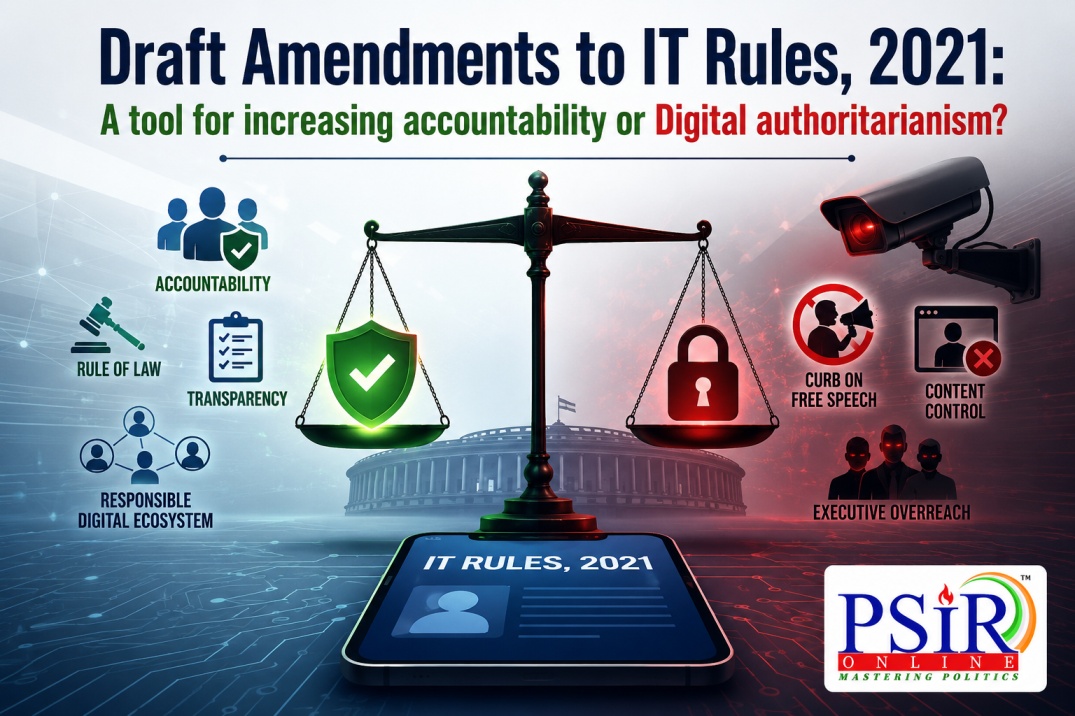
The Draft Amendments to the IT (Intermediary Guidelines and Digital Media Ethics Code) Rules, 2021, proposed by India's Ministry of Electronics and Information Technology (MeitY) on March 30, 2026, aim to strengthen government oversight of online intermediaries (social media platforms, etc.) and digital content. They are presented as "clarificatory and procedural" but have sparked significant debate.
KEY PROPOSED CHANGES
Here are the main provisions from the draft (as summarized in the official MeitY notice and analyses):
1. Binding Nature of Government Advisories/Guidelines (New Rule 3(4)):
a. Intermediaries must comply with any "clarification, advisory, order, direction, SOP, code of practice, or guideline" issued by MeitY (in writing).
b. Compliance becomes part of due diligence under Section 79 of the IT Act (the "safe harbour" provision that protects platforms from liability for user-generated content).
c. Implication: Non-compliance risks losing safe harbour protection, exposing platforms to lawsuits. Previously, such advisories were often non-binding or contestable; now they carry statutory weight. Directions must specify a legal basis but don't require prior judicial approval.
2. Expanded Oversight for News and Current Affairs Content (Amendments to Rule 8 and Rule 14):
a. Part III of the Rules (Code of Ethics, primarily for publishers) now explicitly applies to intermediaries and non-publisher users (e.g., influencers, ordinary users, content creators) who post or share "news and current affairs" content.
b. The Inter-Departmental Committee (IDC) under the Ministry of Information and Broadcasting (MIB) gains broader powers: It can now consider not just escalated grievances but any "matters" referred by the Ministry (beyond formal complaints).
c. This ties into blocking powers (Rules 15–16), including emergency provisions.
3. Data Retention Clarifications (Rule 3(1)(g) & (h)):
a. Retention/deletion obligations under the IT Rules are "without prejudice" to requirements under other laws. This allows longer retention (beyond the standard 180 days) for legal, law enforcement, or other purposes.
4. Expansion of IDC's Examination Scope (Amendments to Rule 14(2) and Rule 14(5)):
a. The Inter-Departmental Committee (IDC) can now examine any “matter” referred by the Ministry (MIB), not limited to formal grievances or complaints.
b. Specific substitution replaces references to “complaints or grievances” with broader “the matter” in the context of IDC proceedings and recommendations. This allows proactive referrals by the government for content review, bypassing the need for user-triggered escalations.
5. Broader Applicability of Blocking and Emergency Powers (Rule 8(1) Proviso):
a. The proviso to Rule 8 is amended to explicitly extend Part III (including the full oversight mechanism under Rules 14, 15, and 16) to intermediaries hosting news/current affairs content and to non-publisher users.
b. This strengthens ties to Rule 15 (procedure for blocking orders) and Rule 16 (emergency blocking without prior notice in urgent cases), enabling faster government-directed actions on user-generated content.
6. Enhanced Compliance Pressure through Safe Harbour Linkage and Over-Compliance Risk:
a. By tying Rule 3(4) compliance to Section 79, the draft indirectly pressures platforms to implement automated tools, content moderation systems, and rapid response mechanisms to meet government instruments (advisories/SOPs).
b. This builds on earlier 2026 amendments (e.g., synthetic content rules) by creating a stronger incentive for proactive monitoring and removal to avoid liability.
These build on prior 2026 amendments (e.g., February rules on synthetic/AI-generated content like deepfakes, with labelling and faster takedowns).
Faster takedowns (e.g., 3 hours in some cases for certain content) and broader Ministry powers (including MIB involvement) are also highlighted in discussions.
|
DOES THESE AMENDMENTS TO THE IT RULES, 2021, REQUIRE A NEW BILL OR PASSAGE AS A FULL LAW IN PARLIAMENT?
No, these draft amendments to the IT Rules, 2021 do not require a new Bill or passage as a full law in Parliament.
Why Not?
The IT (Intermediary Guidelines and Digital Media Ethics Code) Rules, 2021 (and all their amendments) are subordinate legislation (also called delegated legislation or rules). They are made by the executive government (primarily MeitY, sometimes in consultation with MIB) under powers already delegated by Parliament in the parent law — the Information Technology Act, 2000. · Legal Basis: Section 87 of the IT Act, 2000 gives the Central Government the power to make rules "to carry out the provisions of the Act." This includes clauses like 87(2)(z) and 87(2)(zg) that cover intermediary guidelines and digital media ethics. · Process for Amendments: o MeitY prepares the draft. o It invites public comments (as done for the March 30, 2026 draft). o After considering feedback, the government notifies the final rules in the Gazette of India. o The rules come into force on the date mentioned in the notification (or immediately). No fresh Bill needs to be introduced, debated, or voted on in Lok Sabha or Rajya Sabha.
Parliamentary Oversight Exists, But It Is Limited
· Under Section 87(3) of the IT Act, all such rules must be laid before both Houses of Parliament for a total of 30 days (while Parliament is in session). · Parliament can discuss them and pass a resolution to modify or annul the rules. · However, in practice: o This is post-facto scrutiny (after notification). o No prior approval is needed for the rules to take legal effect. o Annulment is rare.
This is standard for most rules under Indian laws (e.g., similar to rules under the Environment Protection Act, Companies Act, etc.).
Why Critics Raise Concerns About This Route?
Many digital rights groups and legal experts argue that these amendments (especially making advisories/guidelines binding and expanding oversight) go beyond mere "procedure" and create new substantive obligations or excessive executive power. They call it: · Excessive delegation (executive doing what should require legislative debate). · Bypassing full parliamentary accountability for major policy changes affecting free speech.
However, legally, the government is within its current powers under the IT Act to notify these amendments without a new Bill. Changing this would require amending the IT Act itself through a proper Bill passed by Parliament.
|
CURRENT STATUS (AS OF MID-2025 CONTEXT IN SOURCES)
· Public comments were invited (initially by April 14, 2026; extensions granted).
· MeitY held stakeholder meetings and indicated openness to suggestions, but the proposals remain under review/consultation.
· Broader context includes prior AI/synthetic content rules and ongoing legal challenges to IT Rules.
These amendments fit into India's evolving digital regulation (e.g., alongside DPDP Act). Supporters see them as necessary modernization; opponents view them as structural risks to online freedoms.
GOVERNMENT RATIONALE
· Curb misinformation, hate speech, deepfakes, and harmful content to create a "safe, trusted, and accountable" internet.
· Enhance accountability of platforms and users, especially for user-generated news that blurs lines with traditional media.
· Provide legal clarity and enforceability for existing directions, addressing gaps in intermediary compliance.
· Level the playing field: Traditional media faces regulation; online user-generated content often doesn't.
CRITICISMS FROM DIGITAL RIGHTS GROUPS, MEDIA, AND EXPERTS
Groups like the Internet Freedom Foundation (IFF), Editors Guild, and others have called the proposals "digital authoritarianism" and urged withdrawal. Main concerns include:
· Chilling Effect on Free Speech (Article 19(1)(a)): Platforms will likely over-comply and censor preemptively (including satire, criticism, parody) to avoid losing safe harbour. User-generated content faces publisher-like scrutiny without the same safeguards.
· Executive Overreach and Lack of Safeguards: Binding advisories bypass Parliament and judicial oversight. The IDC becomes a broader "censorship apparatus" (Ministry refers matters directly). This echoes concerns from ongoing challenges to the 2021 Rules (e.g., stays by Bombay and Madras High Courts on oversight mechanisms).
· Bypassing Judicial Precedents: Contradicts Shreya Singhal (2015), which requires court orders or proper government notifications for takedowns to protect intermediaries. Vague instruments (advisories/SOPs) could lower the threshold for removal.
· Risks to Decentralized Speech and Innovation: Affects influencers, citizens posting news/shares. Potential for surveillance via extended data retention and decentralized orders.
· Procedural Issues: Short initial consultation period (15 days, later extended), lack of transparency in fiduciary-held comments, and circumventing court stays.
Critics argue it expands executive control over the digital public sphere without sufficient proportionality, transparency, or independent oversight, potentially impacting satire, journalism, and democratic discourse.
|
CORE TECHNICAL DEFINITIONS
1. Intermediary (Section 2(w) of the IT Act, 2000 + IT Rules) An intermediary is any entity that, on behalf of another person, receives, stores, or transmits electronic records (data/content) or provides any service with respect to that record. Examples: Telecom/internet service providers (ISPs), web-hosting services, search engines, online marketplaces, cyber cafes, messaging apps, and social media platforms. They are not the creators of the content — they act as neutral conduits or hosts. This distinction is central to intermediary liability.
2. Social Media Intermediary (Rule 2(w)) A sub-category of intermediary that primarily or solely enables online interaction between two or more users and allows them to create, upload, share, disseminate, modify, or access information. Examples: Facebook, Instagram, X (Twitter), WhatsApp, YouTube.
3. Significant Social Media Intermediary (SSMI) (Rule 2(v)) A social media intermediary with more than 5 million registered users in India (threshold notified by the government). SSMIs face stricter obligations (e.g., grievance officers, traceability in some cases, content moderation tools).
4. Publisher of News and Current Affairs Content (Rule 2(t)) An online paper, news portal, news aggregator, news agency, or any functionally similar entity that systematically publishes news. Exclusions: Traditional print newspapers, their e-papers, and individuals/users posting non-commercially (not in systematic business activity). “News and current affairs content” is defined as newly received or noteworthy content (including analysis) about recent socio-political, economic, or cultural events.
5. Publisher of Online Curated Content (Rule 2(u)) Entities that make available a curated catalogue of audio-visual content (e.g., Netflix, Amazon Prime, YouTube Premium originals) where they play a significant role in selecting/determining what is shown. Excludes non-commercial individual users.
6. Safe Harbour (Section 79 of the IT Act, 2000) Legal immunity (protection from liability) granted to intermediaries for third-party/user-generated content hosted on their platforms, provided they observe “due diligence” and do not actively initiate, select, or modify the content. · Protection is conditional — lost if the intermediary fails to act on a valid court order or government notification. · The 2021 Rules + draft amendments tie this protection to compliance with government directions.
7. Due Diligence (Rule 3) Mandatory steps intermediaries must take (e.g., publish terms of service, appoint grievance officers, remove prohibited content within specified timelines) to retain safe harbour. The draft makes compliance with advisories/guidelines part of this.
8. Inter-Departmental Committee (IDC) (Rule 14) A government body (under MIB) with representatives from multiple ministries (MeitY, Home, Law, Women & Child, etc.). It examines grievances/complaints (and now broader “matters”) regarding violations of the Code of Ethics and recommends actions like blocking or removal. Critics call it lacking independence.
9. Ministry of Electronics and Information Technology (MeitY) Nodal ministry for Part II of the Rules (intermediary regulation, safe harbour, due diligence).
10. Ministry of Information and Broadcasting (MIB) Nodal for Part III (Code of Ethics for digital news publishers and curated content). The draft expands MIB’s reach to intermediaries and non-publisher users posting news content.
11. Non-Publisher Users Ordinary users, influencers, or content creators who are not systematic publishers but post/share news and current affairs content. The draft brings them under Part III oversight via intermediaries.
12. Synthetically Generated Information (SGI) / Deepfakes Audio, visual, or audio-visual content artificially or algorithmically created/modified using computer resources so it appears real/indistinguishable from natural persons or real events (prior 2026 amendments). Requires labelling and faster takedowns.
|
CONCLUSION
The Draft Amendments to the IT Rules, 2021 represent a significant expansion of executive oversight over online content and intermediaries. While the government positions them as necessary measures to enhance accountability, combat fake news, deepfakes, and harmful content in the digital ecosystem, critics view them as a concerning shift toward digital authoritarianism.
By making government advisories binding, expanding the scope of the Code of Ethics to user-generated content, and strengthening ministerial powers without fresh parliamentary legislation, these rules risk tilting the balance heavily toward control rather than regulation.
Ultimately, the success or failure of these amendments will depend on whether they can deliver genuine accountability while safeguarding the fundamental right to free speech and preventing over-compliance by platforms. As the proposals remain under consultation, the final version and judicial scrutiny will determine if this becomes a balanced framework for a safer internet or a tool for excessive executive dominance in India’s digital public sphere.
PRACTISE QUESTIONS FOR GS 2 MAINS
1. “The Draft Amendments to the IT Rules, 2021 seek to strengthen accountability in the digital ecosystem, but raise concerns regarding free speech and executive overreach.” Critically examine.
2. Discuss the implications of linking intermediary “safe harbour” protection under Section 79 of the IT Act with mandatory compliance to government advisories and SOPs. How far is this compatible with democratic freedoms?
3. “Delegated legislation has become an important instrument of governance in India, but it also raises questions of parliamentary accountability.” Examine in the context of the Draft Amendments to the IT Rules, 2021.
4. Analyze the tension between regulation of misinformation/deepfakes and protection of Article 19(1)(a) in India. How do the proposed amendments to the IT Rules, 2021 reflect this challenge?