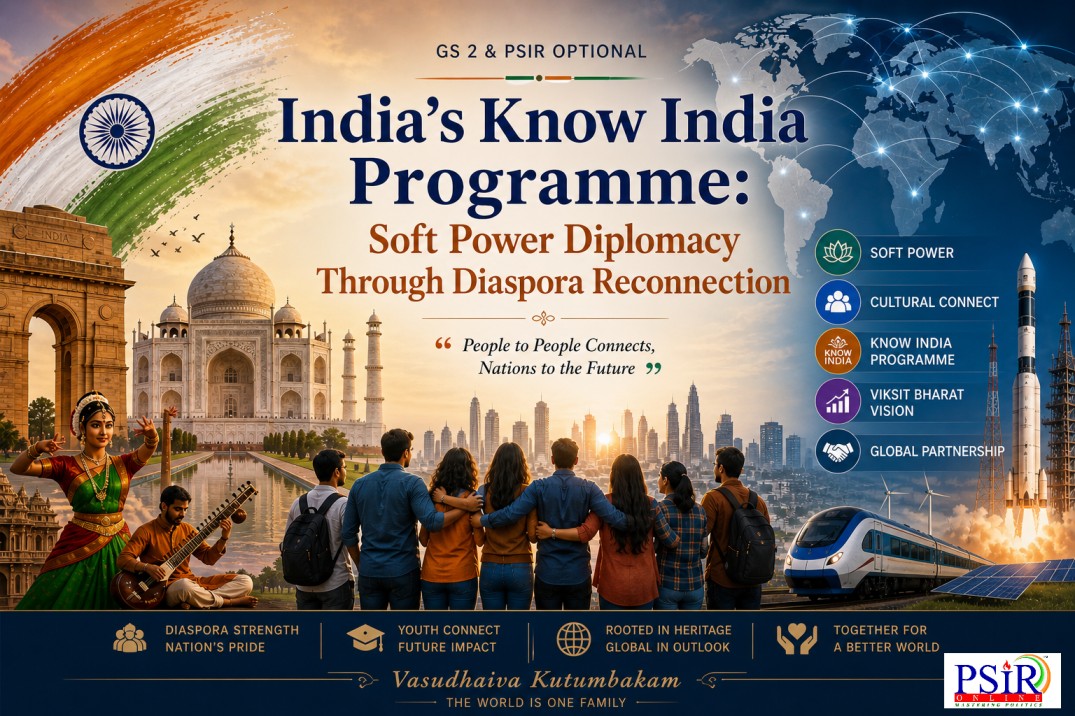
Know India Programme (KIP) is a flagship initiative by India's Ministry of External Affairs (MEA), specifically the Diaspora Engagement Division. It connects young people of Indian origin (PIOs/OCI card holders) with their ancestral roots and modern India.
Purpose and Objectives
KIP aims to:
· Reconnect diaspora youth with India's cultural heritage, history, and civilizational values.
· Showcase contemporary India — its economy, democracy, science & technology, startups, infrastructure, and development initiatives (e.g., Digital India, Startup India, Skill India, Aatmanirbhar Bharat).
· Promote awareness of India's diversity, achievements, and global role.
· Encourage participants to engage with and contribute to India's progress (Viksit Bharat vision).
It is often described as a three-week "knowledge tourism" or immersive orientation programme.
KEY DETAILS FOR THE 88TH EDITION (MARCH 2026)
· Dates: 8 March – 27 March 2026 (about 3 weeks, including international travel).
· Participants: Around 40 young PIOs per edition.
· Target Group: Young Persons of Indian Origin (PIO/OCI card holders), aged 21–35 years (as on the first day of the starting month). NRIs are not eligible.
· Eligibility Highlights:
o Must be a graduate from a recognized university (pursuing graduation does not qualify).
o Proficient in English.
o Preference for those who have never visited India before.
o Preference for applicants from Girmitiya countries (e.g., Mauritius, Fiji, Suriname, Guyana, Trinidad & Tobago, South Africa, Jamaica).
o No prior participation in KIP or similar MEA-funded programmes.
o Valid OCI/PIO card (or proof of Indian origin); medical fitness certificate and international travel/medical insurance required.
What the Programme Typically Includes?
The itinerary mixes education, culture, and exposure:
· Lectures/presentations on India's polity, economy, history, and culture.
· Visits to democratic institutions (Parliament, Election Commission, Rashtrapati Bhavan) and meetings with dignitaries.
· Historical, cultural, and religious sites (e.g., Delhi, Agra, and usually one or two states).
· Exposure to yoga, Ayurveda, classical music/dance.
· Visits to scientific/research institutions, industries, startups, and media organizations.
· University immersion (interactions with students/faculty).
· Showcasing government schemes and India's progress in IT, pharma, infrastructure, etc.
Costs and Hospitality
· Fully supported in India: Accommodation (budget hotels), meals, internal transportation, and programme-related costs.
· International airfare: Ministry covers 90%; participants pay 10%.
· Gratis (free) visa provided.
· Participants handle their own arrangements if arriving early or staying longer.
How to Apply (for 88th Edition)
Applications are usually submitted through Indian Embassies/Consulates abroad (email scanned forms + documents). Deadlines were around mid-February 2026 (e.g., 19–20 Feb depending on the mission).
The official portal is https://kip.gov.in/ (for guidelines, forms, and process). Check your nearest Indian Mission/Post website for exact local deadlines and contacts.
Post-Programme Requirement
Participants submit a 750–1000 word report on their experiences and learnings to receive their certificate.
KIP has run successfully for many years (earlier editions had slightly different age ranges, like 18–30/35). By the 88th edition, thousands of young diaspora members have participated. It's a great opportunity for eligible youth to experience India firsthand, build networks, and strengthen ties with the homeland.
HISTORY OF THE KNOW INDIA PROGRAMME (KIP)
The Know India Programme (KIP) was launched in December 2003 (or 2003-04 financial year) by the Ministry of External Affairs (MEA), Government of India. It was introduced on the occasion of Pravasi Bharatiya Divas to strengthen ties with the Indian diaspora, particularly the younger generation.
Evolution and Growth
· Initial Phase (2003–2010s): Started as an orientation programme for Persons of Indian Origin (PIO) youth (originally aged 18–30/35). It focused on cultural reconnection and familiarization with contemporary India. Early editions were fewer in number.
· Expansion: Over the years, KIP became more structured with multiple editions per year. It incorporated visits to states, exposure to governance, science & technology, startups, and government schemes. The age limit stabilized at 21–35 years, and emphasis grew on participants from Girmitiya countries (countries with historical Indian indentured labour migration).
· Digitalization: Applications moved online via the KIP portal (kip.gov.in) for better reach and transparency.
· Milestones:
o By around 2023–24 (after 20 years), it had completed many editions and was celebrated as a successful flagship programme.
o Editions increased significantly, with some years having special or multiple batches (e.g., special editions tied to events like youth affairs or sports).
As of early 2026 (around the time of the 88th edition announcements), the programme had successfully organized 86 editions with over 3,116 participants. Earlier counts (e.g., 67 editions with 2,411 participants) show steady growth.
Achievements
KIP has established itself as one of MEA’s most effective diaspora engagement tools. Key achievements include:
· Participant Reach: Thousands of young PIOs/OCI holders from across the world (dozens of countries) have participated. Each edition typically hosts up to 40 participants. By 2026, cumulative participation exceeded 3,100 youth.
· Cultural and Emotional Reconnection: Many participants (especially those who had never visited India) report a deepened sense of identity, pride in Indian heritage, and understanding of India’s diversity. It helps bridge the gap for second/third-generation diaspora youth.
· Knowledge and Exposure:
o Hands-on exposure to India’s democratic institutions, historical sites, cultural traditions (yoga, Ayurveda, classical arts), scientific advancements, industries, and modern initiatives.
o Interactions with leaders, universities, and experts.
· Long-term Impact:
o Alumni often become unofficial ambassadors for India in their home countries — promoting business, cultural, and people-to-people ties.
o Strengthened diaspora networks and increased interest in India’s growth story.
o Contributed to broader diaspora policies under initiatives like Pravasi Bharatiya Divas.
· Operational Success: High completion rates, positive feedback, and consistent expansion despite global challenges (e.g., post-COVID resumption). Special editions (like the 85th) have added elements such as sports/youth ministry collaborations.
· Global Recognition: Praised as an immersive “knowledge tourism” model that effectively showcases a “new India” while honoring roots.
A STRATEGIC PILLAR OF SOFT POWER DIPLOMACY AND DIASPORA ENGAGEMENT
The Know India Programme (KIP), launched by India’s Ministry of External Affairs in 2003–04, has evolved into a flagship diaspora outreach initiative. While it reconnects young Persons of Indian Origin (PIO/OCI cardholders aged 21–35) with their roots through a three-week immersive “knowledge tourism” experience, its broader objective extends far beyond cultural nostalgia. KIP forms part of India’s deliberate strategy to harness its 32-million-strong diaspora as a force multiplier in global affairs—blending soft power projection with long-term economic and strategic gains.
Soft Power Diplomacy at Its Core
India’s approach with KIP is quintessentially soft power diplomacy—Joseph Nye’s concept of influence through attraction rather than coercion. By exposing participants to India’s civilizational heritage, democratic institutions, scientific achievements, startup ecosystem, and flagship schemes like Digital India, Startup India, and Aatmanirbhar Bharat, the programme cultivates pride, familiarity, and emotional affinity.
Official MEA descriptions emphasize fostering “a closer connection” and motivating youth to “actively contribute” to Viksit Bharat (Developed India). Participants—often first-time visitors from Girmitiya countries—return as informal ambassadors, shaping perceptions of modern India in their host nations. This aligns with New Delhi’s post-2014 diaspora policy, which views the overseas community not just as remitters but as cultural and political influencers. Scholars note KIP as evidence of “soft power diplomacy under Modi,” complementing tools like International Yoga Day and Pravasi Bharatiya Divas.
In essence, KIP builds people-to-people bridges that enhance India’s global image, counter stereotypes, and create goodwill—key assets in an era of multipolar geopolitics.
Economic Diplomacy: From Awareness to Investment Potential
A key question is whether KIP has translated into tangible economic outcomes, particularly increased investments by PIOs and OCIs.
Direct evidence is limited but supportive. No official data isolates KIP alumni investments; however, the programme explicitly showcases India’s economy, industries, and ease-of-doing-business reforms. Exposure to manufacturing hubs, tech institutions, and government schemes aims to spark interest in partnerships, entrepreneurship, or returns.
Indirect impact is significant. India’s broader diaspora-friendly policies—treating OCI/NRI investments as domestic (non-repatriable) rather than FDI, liberalized visa rules, and OCI card benefits—have eased capital flows. Remittances exceed $100 billion annually, and diaspora FDI has grown. Initiatives like KIP help by creating the emotional prerequisite for such engagement: many analysts argue that homeland visits foster “constructive contribution” through business networks and knowledge transfer.
Studies on Indian diaspora diplomacy highlight that cultural reconnection programmes like KIP strengthen business ties, with alumni databases shared with Indian missions enabling sustained follow-up. In a 2024–25 analysis, government-led efforts including KIP were credited with facilitating diaspora investments through transparent policies and networks.
While KIP is not an investment roadshow, it seeds long-term affinity that complements hard incentives, contributing to India’s shift from “brain drain” to “brain gain and diaspora capital.”
Analysis: Strengths, Limitations, and Strategic Value
Strengths: With over 3,100 participants across 86+ editions by early 2026, KIP has built a growing alumni network of potential advocates and investors. Its focus on youth ensures generational continuity in diaspora ties. Cost-effective (90% airfare subsidy, full hospitality in India) and targeted at under-engaged communities, it delivers high soft-power ROI.
Limitations: Impact on investments remains largely qualitative and indirect. Measuring precise causality is challenging amid India’s overall FDI surge and policy reforms. Not every participant becomes an investor; many prioritize cultural reconnection.
Overall assessment: KIP exemplifies smart, multi-dimensional diplomacy. In a world where diasporas increasingly shape bilateral relations, it positions India to leverage its overseas community for trade advocacy, technology collaboration, and geopolitical support—while reinforcing national branding.
As India pursues its $5-trillion economy goal and global leadership ambitions, programmes like KIP underscore a mature understanding: true power flows from hearts and minds as much as balance sheets. For eligible diaspora youth, it’s more than a tour—it’s an invitation to partner in India’s rise.
PRACTISE QUESTIONS FOR GS 2 MAINS
1. “Diaspora engagement has emerged as a key pillar of India’s foreign policy.” Examine in the context of recent initiatives like the Know India Programme.
2. Discuss the role of soft power in India’s foreign policy. How do cultural and diaspora-based initiatives contribute to India’s global influence?
3. Evaluate the effectiveness of government-led programmes in converting diaspora goodwill into economic and strategic gains.
4. “People-to-people connections are as important as state-to-state relations in diplomacy.” Critically analyse with examples.
PRACTISE QUESTIONS FOR PSIR OPTIONAL
1. Critically examine Soft Power Diplomacy in the context of India’s diaspora policies.
2. How does India’s diaspora policy reflect a shift from “brain drain” to “brain gain”? Substantiate with examples.
3. Analyse the role of diaspora as a non-state actor in international relations. How far can it influence foreign policy outcomes?
4. “Foreign policy is increasingly shaped by transnational networks rather than just states.” Discuss with reference to India’s engagement with its diaspora.