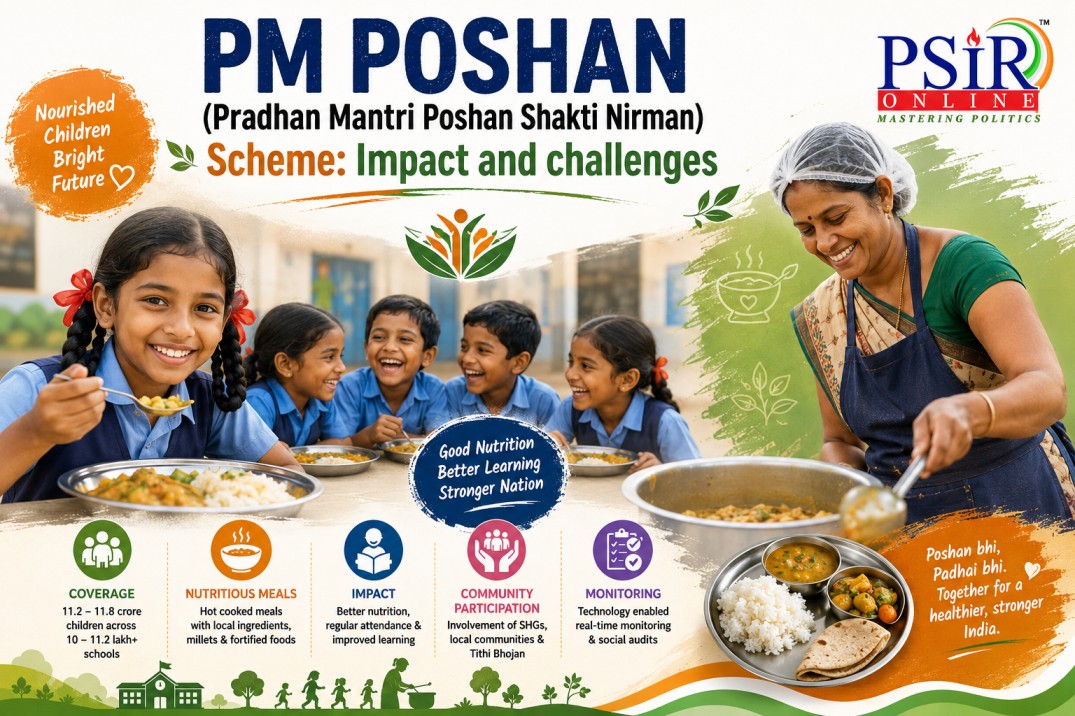
PM POSHAN (Pradhan Mantri Poshan Shakti Nirman) Scheme is a centrally sponsored flagship programme of the Government of India, implemented by the Ministry of Education. It is the rebranded and revamped version of the erstwhile Mid-Day Meal (MDM) Scheme, renamed in 2021.
OBJECTIVES
The scheme primarily addresses hunger and education by:
· Improving the nutritional status of school children.
· Encouraging regular school attendance, especially among children from disadvantaged and economically weaker sections.
· Helping children concentrate better on classroom activities.
· Providing nutritional support during emergencies (e.g., summer vacations in drought-affected areas).
COVERAGE
· Beneficiaries: Approximately 11.2–11.8 crore (112–118 million) children studying in Bal Vatika (pre-primary) and Classes I to VIII.
· Schools: Over 10–11.2 lakh government, government-aided, and local body schools across all States/UTs.
· It is one of the world’s largest school feeding programmes.
NUTRITIONAL AND FOOD NORMS (PER CHILD PER DAY)

· Spices, condiments, and salt are provided as needed.
· Emphasis on variety, local ingredients, millets (Shree Anna), fortified foods, and community-decided menus.
KEY COMPONENTS AND FUNDING
· Food Grains: Supplied free/ at subsidized NFSA rates via FCI (100% central cost, including transportation).
· Material Cost (for pulses, vegetables, oil, etc.): Recently enhanced by 9.5% w.e.f. 1 May 2025 to ₹6.78 (Bal Vatika/Primary) and ₹10.17 (Upper Primary) per child per day.
· Cook-cum-Helpers: Honorarium of ₹1,000 per month (10 months/year); states may top up.
· Infrastructure: Kitchen-cum-stores, devices, repairs; school nutrition gardens.
· Other Features:
o Tithi Bhojan (community participation for special meals).
o Supplementary nutrition in aspirational/anaemia-prone districts.
o Social audits, monitoring via MIS and Automated Monitoring System (AMS).
o Involvement of SHGs, FPOs, and promotion of local/Vocal for Local produce.
The scheme runs from 2021-22 to 2025-26 with a substantial central outlay (part of a total ~₹1.3 lakh crore including states and food grains). It is likely to continue beyond 2025-26.
MONITORING AND IMPLEMENTATION
· Real-time reporting through apps, IVRS, and portals.
· Health check-ups, deworming, and iron-folic acid supplementation in coordination with other ministries.
· Strict guidelines on hygiene, quality (e.g., AGMARK items), and tasting by School Management Committees before serving
|
HISTORY OF MID-DAY MEAL SCHEMES IN INDIA (NOW PM POSHAN)
The Mid-Day Meal (MDM) Scheme, rebranded as Pradhan Mantri Poshan Shakti Nirman (PM POSHAN) in 2021, is one of the world's largest school feeding programmes. It addresses child nutrition, classroom hunger, school enrolment, attendance, and retention, especially among disadvantaged sections. Its roots trace back over a century, evolving from localised colonial-era experiments to a nationwide centrally sponsored scheme.
Pre-Independence and Early Roots (1920s–1940s) · 1920–1925 (Madras Presidency): The earliest initiative began in November 1920 when the Madras Corporation Council approved tiffin (light meal) for students in a Corporation school at Thousand Lights, Chennai (proposed by P. Theagaraya Chetty). It was introduced formally in 1925 for disadvantaged children in the Madras Municipal Corporation area. This is widely regarded as India's (and one of the world's) first structured mid-day meal effort. · 1928 (Calcutta): Keshav Academy introduced compulsory 'Mid-day Tiffin' for schoolboys on a payment basis. · 1941 (Kerala): The School Lunch Programme started. · Other early efforts included free meals in Bombay (Maharashtra, 1942) and cooked rice with yoghurt in Bangalore (Karnataka, 1946). These were small-scale, often municipal or state-driven, aimed at poor children to boost attendance.
Post-Independence State-Level Expansion (1950s–1990s) · Tamil Nadu's Pioneering Role: In the early 1960s, Chief Minister K. Kamaraj expanded the scheme significantly across Tamil Nadu to increase school enrolment. The first major school implementation is sometimes dated to 1955 at Sourashtra Boys Higher Secondary School, Madurai. In 1982, Chief Minister M.G. Ramachandran (MGR) upgraded it to the 'Nutritious Noon Meal Scheme', providing meals to children aged 2–10 below the poverty line for 365 days a year. Tamil Nadu became a model for the country. · By mid-1980s: States like Gujarat, Kerala, and the UT of Puducherry (introduced under French administration in 1930) had universalised cooked meals for primary children using their own resources. · By 1990–91: About 12 states (e.g., Goa, Gujarat, Kerala, Madhya Pradesh, Maharashtra, Meghalaya, Mizoram, Nagaland, Sikkim, Tamil Nadu, Tripura, Uttar Pradesh) implemented MDM programmes on a large or universal scale. Some received international aid (e.g., from CARE, UNICEF, World Food Programme). Many states initially provided dry rations (e.g., 3 kg rice/wheat per child per month with 80% attendance) rather than cooked meals.
National Launch and Centralisation (1995 Onwards) · 15 August 1995: The Government of India (under PM P.V. Narasimha Rao) launched the National Programme of Nutritional Support to Primary Education (NP-NSPE) as a centrally sponsored scheme in 2,408 blocks. It provided free food grains (100g per child/day) to Classes I–V in government, government-aided, and local body schools. The goal: improve enrolment, retention, and nutrition while addressing "classroom hunger." By 1997–98, it covered the entire country. · Supreme Court Intervention (2001): In the People's Union for Civil Liberties (PUCL) v. Union of India "Right to Food" case, the Supreme Court on 28 November 2001 directed all states/UTs to provide cooked midday meals (minimum 300 calories and 8–12g protein) in all government and government-aided primary schools within six months. This was a landmark order converting the scheme into a legal entitlement. Many states transitioned from dry rations to cooked meals between 2002–2004.
Key Revisions and Expansions · September 2004: Shift to cooked meals universally for Classes I–V (300 calories, 8–12g protein). Central assistance for cooking costs (₹1/child/day initially), transport, etc. Extended to drought areas during vacations. · 2006–2007: Calorie norms enhanced (to 450/700); cooking costs revised; focus on micronutrients. · October 2007: Extended to upper primary classes (VI–VIII) in 3,479 educationally backward blocks; later nationwide from 2008–09. Renamed National Programme of Mid-Day Meals in Schools. Upper primary norms: 700 calories, 20g protein. · 2009–2011: Revised food norms (more pulses/vegetables); separate honorarium for cooks (₹1,000/month); kitchen-cum-store construction; decentralised grain payments; higher transport subsidies for special category states. · 2013: Covered under the National Food Security Act. · Ongoing Improvements: Emphasis on hygiene, social audits, school nutrition gardens, Tithi Bhojan (community participation), millets, fortified foods, and involvement of SHGs/FPOs. Supplementary nutrition in high-anaemia areas.
Rebranding to PM POSHAN (2021) · Approved for 2021–22 to 2025–26 (with likely continuation). · Extended to Bal Vatika (pre-primary) children. · Focus on Poshan Shakti Nirman (nutrition power building): local ingredients, diversity, gardens, and convergence with health programmes. · Covers ~11.8 crore children in ~11.2 lakh schools. Central outlay substantial, plus food grains.
|
ASSESSMENT OF THE IMPACT OF THE PM POSHAN SCHEME (FORMERLY MID-DAY MEAL SCHEME)
The Pradhan Mantri Poshan Shakti Nirman (PM POSHAN) scheme, one of the world's largest school feeding programmes, serves approximately 10.3–11.8 crore children (103–118 million) in over 10.9–11.2 lakh government and government-aided schools (including Bal Vatika/pre-primary). It provides hot cooked meals meeting minimum nutritional norms (450 calories/12g protein for primary; 700 calories/20g protein for upper primary).
Overall, the scheme has demonstrated strong positive impacts on education access and equity, with moderate and mixed effects on nutrition. It remains a critical tool for addressing classroom hunger and supporting foundational learning, though implementation gaps, funding constraints, and limited coverage reduce its full potential.
Positive Impacts
1. Educational Outcomes (Strong Evidence)
· Enrolment and Attendance: Regular access significantly boosts enrolment (especially for girls, SC/ST, and disadvantaged children) and daily attendance. Studies show increases of 10–30 percentage points in many regions; attendance rose from ~70% to 77% in some project areas.
· Retention and Dropout Reduction: Lower dropout rates and higher retention, with notable gains among girls and marginalized groups. Dropout rates have declined substantially (e.g., from 15–20% pre-scheme to 3–6% in tracked periods in some states).
· Academic Performance and Concentration: Reduced classroom hunger improves focus and learning. Many studies link it to better academic achievement, though results on test scores are mixed/inconclusive. Socialisation across castes is a noted non-academic benefit.
· Evidence Base: A 2024 systematic review of 31 studies (1997–2022) confirmed consistent positive effects on enrolment, attendance, retention, and dropout.
2. Nutritional and Health Outcomes (Mixed but Positive in Parts)
· Marginal improvements in stunting and underweight in several studies; some gains in height/weight.
· Limited or no significant impact on wasting or mid-upper arm circumference (MUAC) in many evaluations.
· Ancillary benefits: Reduced hunger, better health perception (89% of beneficiaries in one assessment felt healthier), and convergence with deworming/iron supplementation.
· Broader effects: Supports local economies via procurement, employs lakhs of women cooks/helpers (empowerment), and promotes community participation (e.g., Tithi Bhojan, school gardens).
3. Socio-Economic and Equity Impacts
· Promotes social equity by having children from diverse backgrounds eat together.
· Economic returns: Studies (e.g., Akshaya Patra assessments) show high benefit-cost ratios through improved human capital.
Challenges and Limitations
· Coverage Gaps: Only ~41.8% of total school enrolment (government + aided schools) receives meals. Private unaided schools (~95.8 million children, ~39% of enrolment) are excluded, creating inequities for low-fee private school students from poor families.
· Nutritional Quality and Adequacy: Current cooking costs (₹6.78 primary / ₹10.17 upper primary per child/day as of May 2025) are often deemed insufficient for diverse, nutrient-dense meals (e.g., millets, eggs, fruits). States like Tamil Nadu, West Bengal, and Kerala add their own funds for enhancements, but many others cannot. WFP landscape analysis highlights variability in menus and potential for better nutritional standards.
· Implementation Issues:
o Infrastructure deficits (e.g., only ~68% functional kitchens, hygiene/water challenges in ~30% schools).
o Delays in grain supply, quality concerns, and occasional contamination incidents (11 reported in recent years affecting hundreds of children).
o Teacher burden in small/single-teacher schools; pilferage/leakages in some areas.
o Underutilization of funds and irregular cost revisions.
· Mixed Nutritional Impact: While it mitigates acute hunger, broader child malnutrition (stunting ~35%, wasting high per some global indices) requires stronger convergence with other schemes like POSHAN 2.0.
· Exclusion of Out-of-School/Secondary Children: Limited to elementary level in most states; adolescent nutrition gaps persist.
PM POSHAN has been highly successful as a social safety net and education enabler, contributing to higher enrolment/retention (especially post-2001 Supreme Court mandate for cooked meals) and playing a role in India's progress toward universal elementary education. Its nutritional impact is supportive but insufficient alone to resolve India's child malnutrition challenges, due to modest per-meal norms, implementation variability, and exclusion of large segments of children.
RECOMMENDATIONS FOR STRONGER IMPACT
· Extend to secondary classes and EWS children in private schools (via vouchers/DBT).
· Increase and regularly revise cooking costs; mandate more diverse/nutrient-dense menus.
· Scale best practices (Odisha SHG model, Rajasthan mother participation, Tamil Nadu central kitchens).
· Full infrastructure upgrades (kitchens, LPG) and robust monitoring.
CONCLUSION
Overall, PM POSHAN has been a remarkable success as an education and social welfare intervention, but only a partial solution to India’s deeper child malnutrition crisis. Its strength lies more in its role as a safety net and enrolment driver than as a comprehensive nutrition programme.
With regular enhancements (higher material costs, focus on millets and fortification, better monitoring), expanded coverage, and stronger convergence with schemes like POSHAN 2.0, it can deliver even greater impact in the coming years. Continued political commitment and increased investment will be crucial to make it a true “Poshan Shakti” enabler for India’s future generation.
PRACTICE QUESTIONS FOR GS 2 MAINS
1. “PM POSHAN has evolved from a welfare programme into a multidimensional intervention linking nutrition, education, and social justice.” Critically examine the achievements and limitations of the scheme in improving human development outcomes in India.
2. Trace the evolution of the Mid-Day Meal Scheme in India from the colonial period to the PM POSHAN initiative. How has judicial intervention shaped the expansion and institutionalisation of school feeding programmes in India?
3. Despite being one of the world’s largest school feeding programmes, PM POSHAN faces several implementation and nutritional challenges. Discuss the major bottlenecks in the scheme and suggest reforms to improve its effectiveness.
4. School feeding programmes are not merely nutritional interventions but instruments of social transformation. Analyse the role of PM POSHAN in promoting educational equity, gender inclusion, and social integration in India.