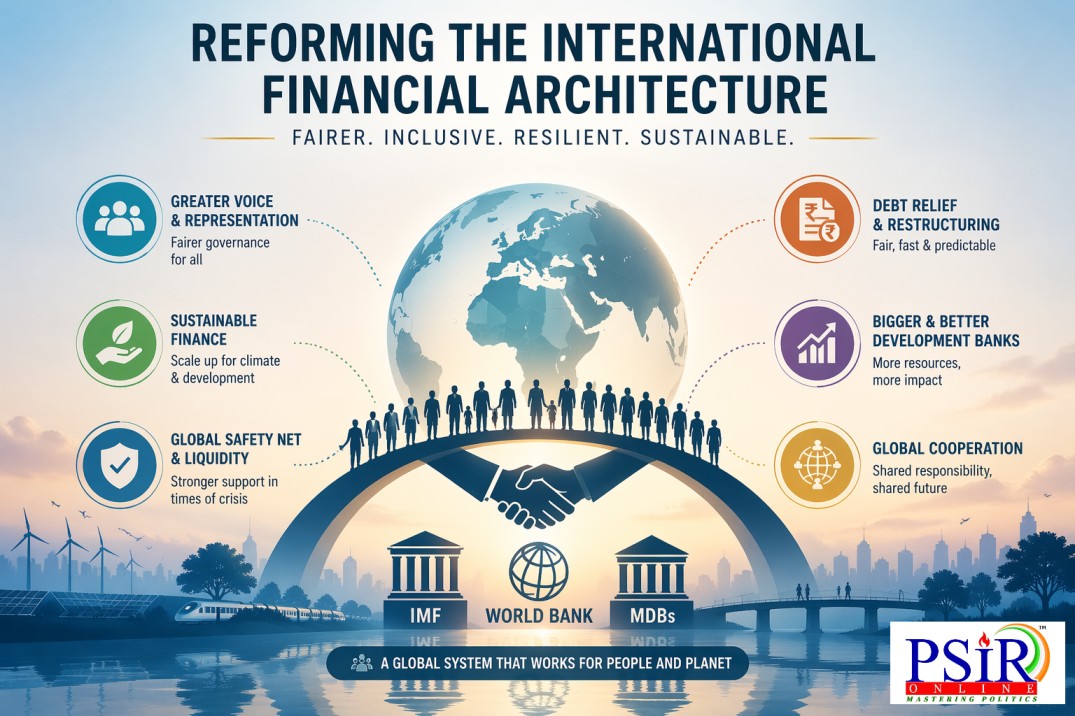
International financial architecture (IFA) reform refers to efforts to update the global system of institutions, rules, norms, and practices that govern international finance, trade, investment, and monetary stability. The core pillars are the Bretton Woods institutions—the IMF and World Bank (plus other multilateral development banks or MDBs)—along with the Bank for International Settlements (BIS), G20 coordination, regional financing arrangements, and elements of global tax and debt frameworks.
WHY REFORM IS NEEDED?
Created in 1944 for a post-WWII world dominated by a few Western economies, these institutions are widely viewed as outdated, dysfunctional, and unjust by critics, including UN Secretary-General António Guterres and Global South leaders. Key problems include:
· Underrepresentation of emerging markets and developing economies (EMDEs) in governance despite their growing share of global GDP and population.
· Insufficient scale and flexibility to close the $4 trillion+ annual financing gap for Sustainable Development Goals (SDGs), climate action, and resilience.
· Debt distress in many low- and middle-income countries, where debt servicing crowds out investments in health, education, and climate.
· Procyclical policies and high costs of capital for vulnerable countries, exacerbated by shocks like pandemics, climate disasters, and geopolitical tensions.
Reform gained momentum post-2008 and post-COVID, accelerated by the UN Summit of the Future (2024), the 4th International Conference on Financing for Development (FfD4 in Seville, 2025), and G20 presidencies (notably Brazil and South Africa).
CORE AREAS OF REFORM
Discussions center on five interconnected pillars (drawing from UN Our Common Agenda Policy Brief 6, Brookings analyses, G20 International Financial Architecture Working Group or IFAWG, and Global South proposals like the Bridgetown Initiative):
1. Governance and Voice Increase EMDE representation via IMF quota reforms (which determine voting power, borrowing access, and SDR allocations) and modernized boards at the IMF/World Bank. Proposals include updating the quota formula (e.g., more weight on PPP-GDP and vulnerability indicators), double-majority voting, and a 25th chair on the IMF board for Sub-Saharan Africa.
2. Debt Sustainability and Restructuring Strengthen mechanisms like the G20 Common Framework and Global Sovereign Debt Roundtable. Calls for faster, more predictable processes; greater private-creditor participation; debt transparency; state-contingent clauses (e.g., pause repayments during disasters); and possible new insolvency-like frameworks. Debt-for-climate or development swaps are also promoted.
3. Scaling Multilateral Development Finance Make MDBs “bigger and better” through capital adequacy reforms (unlocking hundreds of billions in additional lending), hybrid capital, local-currency lending, and a shift toward concessional, long-term, climate-aligned finance. Targets often cited: $500 billion+ annually.
4. Global Financial Safety Net (GFSN) and Liquidity Revitalize Special Drawing Rights (SDRs) with more regular, need-based issuances/rechanneling; reduce reliance on bilateral swaps; and improve coordination with regional arrangements.
5. Broader Systemic Issues Global tax cooperation (e.g., UN Framework Convention on International Tax Cooperation), innovative instruments (thematic bonds, blended finance), and better integration of climate/SDG considerations into all policies.
RECENT PROGRESS AND STATUS
· IMF Quotas: The 16th General Review of Quotas (approved 2023) delivers a 50% increase in resources (~$320 billion) but maintains existing voting shares (U.S. veto intact). Domestic consents are still being finalized (extensions into 2026); full effectiveness pending. The Diriyah Guiding Principles (2025/2026) now guide future quota/governance work toward the 17th Review.
· G20 IFAWG: Remains the main technical forum for MDB reform roadmaps, debt lessons-learned notes, cost-of-capital discussions, and GFSN strengthening. Continuity across presidencies (Brazil → South Africa → U.S. in 2026).
· UN/FfD4 (2025): Produced the Seville Commitment and a platform of initiatives on debt, IFA, and private finance mobilization.
· MDB Evolution: World Bank and others advancing balance-sheet optimization and “jobs/climate” focus; incremental but criticized as insufficient by civil society.
· Debt Tools: Updates to Common Framework guidance and Global Sovereign Debt Roundtable playbooks; slow case-by-case progress (e.g., Ethiopia, Zambia precedents).
INDIA’S POSITION
India's position on International Financial Architecture (IFA) reform is proactive, vocal, and aligned with the Global South. As a major emerging economy and former G20 President (2023), India pushes for a more equitable, representative, and effective global financial system that reflects current economic realities, addresses development and climate needs, and reduces the vulnerabilities of developing countries.
India does not seek radical overhaul or confrontation but pragmatic, incremental reforms that enhance inclusivity, voice for EMDEs (Emerging Markets and Developing Economies), and the scale/speed of financing—while maintaining the stability of institutions like the IMF and World Bank.
Key Elements of India's Stance
India articulates its views consistently through statements by Finance Minister Nirmala Sitharaman, at G20 meetings, FfD4 (Seville 2025), BRICS, and IMF/World Bank gatherings. Core positions include:
1. Greater Voice and Governance Reform
a. Strong support for increasing representation of developing countries in IMF and World Bank decision-making.
b. IMF quota reforms should better reflect current economic weights (using PPP-GDP and other dynamic indicators). India has long argued that its quota (currently ~2.75% voting share) underrepresents its economic size.
c. Broader Executive Board representation, including for underrepresented regions like Africa.
d. India backs the ongoing work under the Diriyah Guiding Principles and the 17th General Review of Quotas.
2. Strengthening Multilateral Development Banks (MDBs)
a. A flagship contribution: During India's 2023 G20 Presidency, it established the Independent Expert Group (IEG) on MDB reforms (co-chaired by Lawrence Summers and N.K. Singh). The group proposed a "triple agenda":
i. Scaling up lending capacity significantly (aiming for hundreds of billions more annually).
ii. Optimizing balance sheets (capital adequacy reforms, hybrid capital, private capital mobilization).
iii. Integrating global challenges like climate and pandemics alongside traditional poverty reduction.
b. India continues to advocate MDBs becoming "bigger, better, and more responsive," with more local-currency lending, concessional finance, and knowledge-sharing from the Global South.
3. Debt Sustainability and Relief
a. Calls for concerted efforts to reform the IFA to prevent debt traps and ensure debt sustainability for the Global South.
b. Support for faster, more predictable debt restructuring mechanisms, greater private creditor participation, transparency, and innovative tools like debt-for-climate swaps.
c. Emphasis on responsible borrowing/lending and strengthening frameworks like the G20 Common Framework.
4. Climate and Development Finance
a. Highlights the massive financing gap (often cited as $4 trillion+ annually) for SDGs and climate action.
b. Pushes MDBs and the broader architecture to mobilize more resources for climate adaptation, energy transition, and resilience in developing countries.
c. Criticizes biases in global capital markets and credit rating agencies that result in higher costs of capital for EMDEs. Calls for fairer credit rating systems.
d. In India's 2025 Article IV consultations with the IMF, authorities noted that multilateral funding often falls short of climate needs and called for IFA reforms to better support developing economies' transitions.
5. Broader Inclusivity and Equity
a. Reforms must enhance inclusivity and equity in the international financial system.
b. Support for better coordination of the Global Financial Safety Net (GFSN), more effective use of SDRs, and addressing illicit financial flows.
c. Alignment with BRICS calls for reforming global governance institutions to reflect contemporary realities (multipolarity).
d. India positions itself as a bridge: pragmatic partner to G7 nations while amplifying Global South concerns.
India's Contributions and Role
· G20 Legacy: India's presidency gave significant momentum to MDB reform through the IEG reports, which continue to guide G20 work under subsequent presidencies (Brazil, South Africa).
· At FfD4 (Seville 2025): FM Sitharaman explicitly supported IFA reforms for inclusivity, MDB strengthening, and fairer credit ratings.
· Practical Stance: India is a net contributor to IMF resources in recent years and has not borrowed since the 1990s. It leverages its strong economic performance (often the fastest-growing major economy) to argue for reforms from a position of credibility rather than dependency.
· Global South Leadership: India frequently coordinates with partners like South Africa, Brazil, and others in BRICS or the G20 troika to maintain continuity on these issues.
Assessment
India's approach is reformist but constructive — it avoids extreme demands (e.g., completely new institutions) that could face resistance from major shareholders like the US, while steadily pushing for measurable changes in quotas, lending capacity, and policy orientation. Progress is seen as too slow by many in the Global South, but India views the G20 IFA Working Group, MDB Evolution process, and UN platforms as useful venues for sustained advocacy.
Overall, India sees IFA reform as essential for a multipolar world where institutions serve shared global challenges (climate, inequality, resilience) without perpetuating outdated power imbalances.
MAIN PARTIES SLOWING OR BLOCKING DEEPER INTERNATIONAL FINANCIAL ARCHITECTURE
The main parties slowing or blocking deeper International Financial Architecture (IFA) reform are the United States and other major developed countries (primarily in the G7/EU bloc, along with Japan, UK, Canada, Australia, Switzerland, and New Zealand). These "incumbent powers" or "Global North" shareholders hold dominant positions in the IMF, World Bank, and other multilateral institutions.
Primary Blocker: The United States
The US is the single most influential actor because:
· It holds veto power in the IMF (≈16.5% voting share; key decisions require 85% majority).
· It has similar influence in the World Bank.
· Any major quota/governance change needs US Congressional approval, which is politically sensitive.
The US has supported modest steps (e.g., the 50% equiproportional quota increase in the 16th General Review of Quotas, completed in 2023 but with consents still finalizing into 2026) but resists real alignment of voting shares that would significantly boost Emerging Markets and Developing Economies (EMDEs), especially China.
Other Key Developed Countries
European countries (collectively holding strong voting power, often coordinated via the EU), the UK, and Japan frequently align with the US. They have blocked or diluted proposals in forums like:
· UN Financing for Development (FfD4 in Seville, 2025), where the EU and UK reportedly made certain sovereign debt reform paragraphs a "red line."
· Debt restructuring discussions, preferring creditor-controlled mechanisms (e.g., G20 Common Framework, Global Sovereign Debt Roundtable) over more debtor-friendly or UN-led processes.

Why Do They Resist Deeper Reform?
1. Preservation of Influence and Veto Power Major quota or governance shifts are viewed as zero-sum. A formula update favoring dynamic EMDEs (using PPP-GDP, etc.) could erode the US/Euro-area veto and boost China (currently close to but below US levels in some metrics). Incumbents see this as risking loss of control over lending policies, conditionality, and strategic decisions. "Veto power is used to protect veto power."
2. Geopolitical and Strategic Concerns In a multipolar world with heightened US-China rivalry, reforms that empower China or give EMDEs more collective voice are seen as weakening Western leverage. Reforms risk "signaling political weakness" domestically.
3. Domestic Political Constraints In the US (and to varying degrees elsewhere), Congress and publics are wary of "giving away power" or increasing financial commitments without clear benefits. Past quota reforms faced delays due to Congressional debates. Under the current US administration (as of 2026), there has been further skepticism toward multilateralism, including aid reductions and withdrawal signals from some processes.
4. Preference for Incremental/Evolutionary Change Developed countries favor "bigger, better MDBs" via balance-sheet optimization, hybrid capital, and private finance mobilization—without large new capital injections or governance overhauls. They prioritize stability, efficiency, and using institutions for global public goods (climate, pandemics) on their terms, rather than radical equity-focused shifts demanded by the Global South.
5. Creditor Interests in Debt Issues High-income countries (and their private sectors) benefit from the current fragmented debt architecture, where they control restructuring processes. They resist binding mechanisms that could force faster relief, haircuts on private creditors, or greater EMDE say in debt sustainability assessments.
Context and Nuance
· Not Absolute Opposition: Developed countries support some progress—e.g., MDB capital adequacy reforms, SDR rechanneling, and technical improvements in the G20 IFA Working Group. The 16th quota increase and "Diriyah Guiding Principles" for future work reflect compromise. However, they draw a firm line at changes threatening their core control.
· Geopolitical Fragmentation: Rising tensions (wars, sanctions, multipolarity) make consensus harder overall, but the core blockage on voice/governance remains rooted in power dynamics rather than just current events.
· Global South Perspective: Countries like India, Brazil, South Africa, and others (via G24, BRICS, V20) view this as defending an outdated, inequitable system created in 1944 when many developing nations were not independent. They argue slow progress undermines legitimacy and fails to address the $4+ trillion SDG/climate financing gap.
In summary, the primary obstacle is not outright rejection of all reform, but resistance to structural power shifts by the US and allied developed economies, driven by self-interest in maintaining influence amid geopolitical competition. This leads to incrementalism rather than the transformative changes pushed by India and the broader Global South.
India continues to advocate pragmatically within the G20, BRICS, and other forums for balanced reforms that enhance EMDE voice without destabilizing the system.
SUGGESTIONS FOR REFORM SEEKERS (GLOBAL SOUTH, EMDES, INDIA, BRICS, G24, ETC.) TO ADVANCE IFA REFORM
Reform seekers have made IFA reform a top global priority through the G20, FfD4 (Seville 2025), and ongoing UN/IMF processes. However, progress remains incremental due to resistance from major shareholders (especially the US and G7) who prioritize preserving influence. The key is a smart mix of pragmatism, unity, and strategic pressure — starting with achievable wins while keeping structural changes (voice, quotas, debt architecture) on the table. As of April 2026, the 16th IMF Quota Review consents are still finalizing (with US Congressional hurdles), the Diriyah Guiding Principles guide future work, and the 17th General Review of Quotas (targeted around 2027–2028) is the next critical window.
Here are actionable, evidence-based suggestions drawn from expert analyses (G24 statements, Brookings, Boston University GDP Center, UN follow-up processes, and BRICS positions):
1. Strengthen Coalitions and Collective Bargaining Power
· Unify positions across G24, BRICS+, G77+China, African Group, and V20 (climate-vulnerable countries). Hold regular pre-meeting coordination before IMF/World Bank Spring/Annual Meetings, G20, and UN ECOSOC events.
· Use India’s strong track record (2023 G20 IEG on MDBs) and BRICS leadership to maintain momentum even under the 2026 US G20 presidency.
· Why it works: Fragmented voices weaken leverage. Unified blocs have already influenced outcomes like SDR rechanneling and MDB reform roadmaps.
2. Prioritize Feasible “Win-Win” Reforms to Build Momentum
· Focus first on MDB “evolution” measures that don’t require new capital or quota shifts: balance-sheet optimization, hybrid capital instruments, local-currency lending, and private-sector mobilization. These can unlock hundreds of billions without threatening developed-country control.
· Support technical improvements in the Global Financial Safety Net (GFSN), SDR rechanneling to MDBs, and climate-resilient debt clauses.
· Why it works: Developed countries are more open to these (they align with stability and private finance goals). Early wins create goodwill and demonstrate EMDE responsibility, making deeper reforms harder to block later.
3. Drive Ambitious but Realistic Proposals in the 17th Quota Review
· Push for a simplified new quota formula that better reflects current realities (e.g., higher weight on PPP-GDP, vulnerability indices, and population) while protecting US veto power (>15%) and avoiding excessive gains for any single EMDE (e.g., China). Complement with an increase in basic votes to boost all EMDEs collectively.
· Advocate modernizing IMF/World Bank boards: double-majority voting (voting shares + majority of countries), more chairs for underrepresented regions (e.g., Africa), and gender-balanced leadership.
· Insist on a firm timeline and link quota realignment explicitly to EMDE voice and development/climate needs.
· Why it works: Recent analyses (e.g., Boston University GDP Center, 2025) show current formulas are politically unfeasible and biased. A targeted new formula offers a compromise path that maintains system stability while delivering equity.
4. Build and Use Parallel/Regional Alternatives as Strategic Leverage
· Expand the BRICS New Development Bank (NDB), Contingent Reserve Arrangement (CRA), and other regional financing arrangements (e.g., Asian Monetary Fund concepts).
· Develop South-South lending platforms, local-currency bonds, and innovative instruments (debt-for-climate swaps, thematic bonds).
· Publicly highlight these as credible options — not replacements — to signal that inaction will accelerate multipolar fragmentation.
· Why it works: Credible alternatives create gentle pressure on Bretton Woods institutions without confrontation, as seen in how BRICS expansion has kept reform talks alive.
5. Maximize UN and Multi-Forum Diplomacy
· Actively shape post-Seville processes: the new Intergovernmental Process on Debt Architecture Reform, ECOSOC special meetings on credit rating agencies (March 2026 onward) and financial integrity, and the UN Framework Convention on International Tax Cooperation (negotiations continuing into 2026–2027).
· Propose a “Borrowers’ Club/Platform” for peer learning and coordinated positions on debt restructuring.
· Link IFA reform to the UN Summit of the Future follow-up and COP processes.
· Why it works: The UN gives EMDEs a more level playing field than the IMF/World Bank boards. FfD4 already created accountability mechanisms — use them relentlessly.
6. Link Reforms to Shared Global Priorities (Climate, Stability, SDGs)
· Frame demands around mutual benefits: faster IFA reform prevents debt crises that spill over globally, supports climate resilience (a G7 interest), and mobilizes private capital for green transitions.
· Highlight data on the $4+ trillion annual financing gap and the high cost-of-capital penalty faced by EMDEs.
· Partner with Northern civil society, think tanks, and progressive voices in G7 countries to build domestic pressure.
· Why it works: Pure equity arguments face resistance; tying reforms to global public goods (climate, pandemics, stability) makes them harder to dismiss.
7. Enhance Accountability, Transparency, and Public Advocacy
· Publish joint “reform scorecards” tracking G7 commitments vs. delivery (e.g., on quota reviews, Common Framework performance).
· Invest in technical capacity (via South Centre, G24 research, independent expert groups) to produce credible proposals that counter Northern narratives.
· Engage media and youth/climate movements to shift public opinion.

Transformative change (e.g., ending US/Euro-area dominance) won’t happen overnight, but sustained, coordinated pressure combined with pragmatic steps can deliver meaningful progress by 2028–2030. India, as a credible bridge-builder with strong economic fundamentals, is uniquely positioned to lead this balanced approach. These strategies are already partially in motion — the challenge is execution and unity.
PRACTISE QUESTIONS FOR GS 2 MAINS
1. “The existing international financial institutions are increasingly seen as outdated and inequitable.” Examine the need for reforms in the global financial architecture.
2. Discuss the role of the G20 in shaping reforms in the International Financial Architecture. How far has it succeeded?
3. Critically analyse India’s position on reforming multilateral development banks and global financial governance.
4. Debt distress in developing countries has exposed structural weaknesses in global financial systems. Evaluate the effectiveness of existing debt resolution mechanisms.
PRACTISE QUESTIONS FOR PSIR OPTIONAL
1. “International financial institutions reflect the power structure of 1945 rather than contemporary global realities.” Critically examine.
2. Analyse the political economy of resistance to International Financial Architecture reforms by developed countries.
3. How do Global South coalitions (such as BRICS and G24) seek to reshape global financial governance? Evaluate their effectiveness.
4. Examine India’s role as a “bridge power” in global economic governance. How does it balance reformist ambitions with systemic stability?