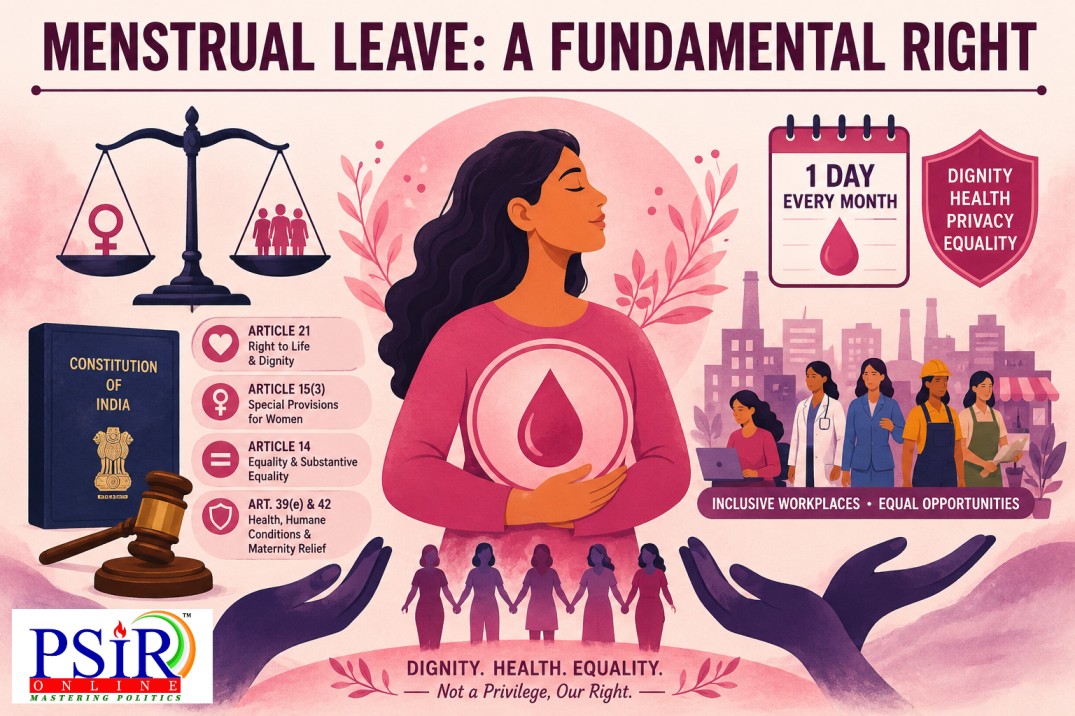
On April 15, 2026, the Karnataka High Court (in Chandravva Hanamant Gokavi v. State of Karnataka and Ors.) issued a significant order upholding and directing the strict implementation of the state's Menstrual Leave Policy, 2025.
KEY DETAILS OF THE RULING
Policy Summary: The 2025 policy (notified around November/December 2025) provides one day of paid menstrual leave per month (capped at 12 days per year) for eligible women employees aged 18–52 in registered establishments. It aims to cover both organized and unorganized sectors.
Court's Directions: The court ordered the state government to implement the existing policy "strictly and faithfully" across all sectors (pending full legislation). It also called for sensitization, guidelines, and eventual rules under the proposed Karnataka Menstrual Leave and Hygiene Bill, 2025.
Constitutional Interpretation: The judgment frames menstrual leave as rooted in fundamental rights:
· Article 21 (Right to Life and Dignity): Menstrual health, dignity, privacy, and bodily autonomy are part of the right to life. The court described menstrual leave as an "assertion of dignity, not a plea for privilege."
· Article 15(3): Special provisions for women.
· Article 14 (Equality): Acknowledging differences to achieve substantive equality, rather than formal equality.
· It also referenced Articles 39(e) and 42 (Directive Principles on worker health, humane conditions, and maternity relief).
This represents a notable judicial endorsement of state-level labor/welfare measures as constitutionally grounded, especially in advancing gender-sensitive workplace policies.
Context and Impact
· The ruling came in response to a writ petition seeking better implementation for women in the unorganized sector.
· It contrasts with the Supreme Court's earlier reluctance (in 2026) to mandate a nationwide policy, citing potential employment impacts and leaving it to policy domains.
· Karnataka's move positions it as a leader on this issue, potentially influencing other states. Implementation challenges remain (e.g., in private/unorganized sectors, documentation, and employer concerns about costs/productivity).
This is a progressive step in recognizing menstrual health as a workplace rights issue tied to constitutional dignity and equality.
HOW MANY STATES HAVE SUCH POLICIES
As of May 2026, 4–5 Indian states/UTs have some form of menstrual leave policy, but they vary widely in scope, coverage, and whether they are mandatory
|
State |
Policy since/Coverage |
Days Allowed |
Mandatory for Private Sector? |
|
Bihar |
1992/ State government women employees |
2 days per month (up to 24/year) |
No |
|
Odisha |
Oct 2024/ State government women employees (up to age 55) |
1 day per month (12/year, as additional casual leave) |
No (voluntary for private) |
|
Kerala |
2023–2024/ Women students in state universities + ITI trainees |
Up to 3 days/month (students); 2 days (trainees) |
No |
|
Karnataka |
Oct -Nov 2025 / Women employees (18–52 years) in government + private sectors (factories, IT, shops, plantations, etc.) |
1 day per month (up to 12/year) |
Yes |
|
Sikkim |
2024/ Limited: High Court registry employees + some university students |
2–3 days per month |
No |
Key Takeaways:
· Only Karnataka has a statewide, mandatory policy covering both public and private sectors (including unorganized sectors to some extent).
· Bihar, Odisha, and others are mostly restricted to government employees.
· No national/central law mandates menstrual leave across India. The Supreme Court has declined to impose one nationwide.
· Many private companies (e.g., Zomato, Swiggy, some MNCs) offer it voluntarily, but it's not legally required outside Karnataka.
No other states have introduced similar comprehensive policies as of now. The Karnataka model is being watched closely and could inspire others.
DOES THIS AFFECT GENDER EQUALITY?
It depends on how one defines "gender equality" — formal equality (identical treatment) versus substantive equality (equitable outcomes accounting for real differences). The Karnataka policy leans into the latter, as affirmed by the High Court, but it carries both benefits and documented risks.
Arguments in Favor (Substantive Equality)
· Biological reality: Menstruation involves pain, fatigue, heavy bleeding, or conditions like dysmenorrhea/endometriosis for a significant percentage of women (studies show 20–90% experience symptoms, with 10–20% severe enough to impair work). Ignoring this in a "one-size-fits-all" (often male-default) workplace creates unequal participation. The policy treats this as a dignity and health issue under Article 21, not a "privilege."
· Workforce inclusion: By reducing forced sick leave, presenteeism (working while unwell), or dropout, it can boost retention and productivity for women. Proponents see it as analogous to maternity benefits — special provisions under Article 15(3) to level the playing field.
· Cultural shift: It challenges stigma around menstruation, potentially leading to broader menstrual hygiene support and normalizing women's health needs.
Arguments Against (Risk of Formal Inequality or Backlash)
· Potential hiring discrimination: Employers may view women as higher-cost or less reliable employees (extra ~12 days leave/year). International evidence from countries with long-standing policies (Japan since 1947, South Korea, Indonesia, Taiwan) shows mixed or negative effects: reluctance to hire/promote women, reinforced stereotypes of "fragility," and sometimes lower female labor participation in affected sectors.
· Stereotype reinforcement: Framing menstruation as requiring special leave can medicalize a normal process and feed perceptions that women are biologically less consistent. Critics (including some feminists) argue this undermines long-term equality by highlighting differences rather than focusing on universal sick leave improvements or better workplace design (e.g., flexible hours, pain management access).
· Implementation issues: In competitive private sectors, women might underuse the leave to avoid bias, or it could widen the gender pay/promotion gap indirectly. Supreme Court observations in related cases noted that mandatory nationwide policies could deter hiring women.
· Scope limitations: It applies mainly to organized sectors; unorganized workers (majority of Indian women) see little benefit, potentially creating new divides.
Evidence and International Context
· Uptake and outcomes: In Spain (3 days/month since 2023), usage is lower than expected due to stigma. Some Asian policies correlate with persistent gender gaps in employment/leadership.
· Counterpoint: Well-designed policies (e.g., framed as general health leave, government-subsidized, paired with anti-stigma training) show fewer downsides. Purely gender-specific mandates often amplify biases.
Overall assessment: The policy advances substantive equality by acknowledging sex-based physiological differences (average menstrual experiences differ from men). However, without strong safeguards against discrimination, cultural change, and broader supports (e.g., better sick leave for all, flexible work), it risks entrenching formal disadvantages in hiring and perceptions. Real gender equality in the workplace benefits from addressing biology without penalizing one sex — outcomes in Karnataka over the next few years (hiring data, female participation, employer feedback) will be telling. Similar debates surround maternity leave, paternity incentives, or other accommodations.
IS THIS THE FIRST TIME?
Yes, this is the first time an Indian court has explicitly termed (or directly linked) menstrual leave as part of a Fundamental Right.
Key Distinction
· Karnataka High Court (April 15, 2026) — In Chandravva Hanamant Gokavi v. State of Karnataka, the court held that the right to menstrual leave (the policy granting paid leave) is intrinsically connected to Article 21 (Right to Life and Dignity), along with Articles 14, 15(3), 39(e), and 42. It described menstrual leave as “an assertion of dignity, not a plea for privilege,” and directed strict implementation.
This is a novel and specific application to workplace leave (paid days off during menstruation).
Earlier Judicial Pronouncements
Prior rulings focused on menstrual health and hygiene (e.g., access to sanitary products, toilets, education), not on paid menstrual leave from employment:
· Supreme Court (January 30, 2026) — In the Jaya Thakur case, the SC declared menstrual health and hygiene management (MHM) a fundamental right under Article 21. It mandated free sanitary pads and separate toilets in schools but explicitly treated mandatory menstrual leave as a policy matter for governments, not something the judiciary should impose nationwide. The Court even flagged risks like reduced hiring of women.
· Other High Courts and earlier petitions — Petitions for menstrual leave were often dismissed or referred to executive/policy domains. No prior judgment elevated paid menstrual leave itself to the status of a fundamental right.
WHAT HAPPENS NEXT?
Short-term (next few months):
The Karnataka government must strictly implement the existing 2025 Menstrual Leave Policy (1 paid day per month, up to 12 days/year for women aged 18–52) across all sectors — government, private, organized, and unorganized — as directed by the High Court.
Key immediate actions required:
· Issue guidelines, circulars, and administrative instructions for uniform rollout, including sensitization programs.
· Ensure compliance in workplaces like IT, garments, hotels, shops, plantations, etc.
· Focus especially on unorganized sectors (e.g., hotel workers, daily wagers), where enforcement is hardest.
Employers (especially private ones) need to update HR policies, leave systems, and record-keeping. Non-compliance can now be challenged in court citing the HC order.
Medium-term (2026–2027):
· The state plans to fast-track the Karnataka Menstrual Leave and Hygiene Bill, 2025 into law.
· Once enacted, the government will frame detailed Rules with possible penal provisions for violations (fines, penalties on employers).
· This will give the policy stronger legal teeth beyond the current Government Order.
Ongoing legal challenges:
· Petitions challenging the policy (e.g., by Bangalore Hotels Association and some women professionals arguing it amounts to "benevolent sexism") are pending before other benches of the Karnataka High Court.
· These could lead to modifications or clarifications, but the April 15 ruling strengthens the policy's constitutional foundation.
· No Supreme Court appeal or stay has been reported on this specific judgment so far.
WILL THIS APPLY TO OTHER STATES?
No, the Karnataka High Court ruling does not automatically apply to other states.
Why It Doesn’t Apply Elsewhere
· Jurisdictional limit: High Court judgments are binding only within their own state (Karnataka). They do not have nationwide force.
· Supreme Court position: In March 2026, the Supreme Court rejected a PIL seeking a mandatory nationwide menstrual leave policy. It expressed concerns that compulsory leave could lead to hiring discrimination against women and left the matter to state governments and legislatures as a policy issue, not a judicial mandate.
· The Karnataka ruling interprets the state’s own 2025 policy as aligned with fundamental rights (Articles 14, 15(3), 21, etc.), but this constitutional reasoning does not compel other states to adopt identical policies.
What Could Happen in Other States?
· Persuasive value only: The judgment can influence other High Courts or state governments as a progressive precedent. It may encourage petitions or policy debates elsewhere, especially on linking menstrual health/leave to dignity under Article 21.
· Voluntary adoption: States can choose to introduce their own policies. As of May 2026:
o No other state has announced a Karnataka-style mandatory private-sector policy.
o Bihar (since 1992), Odisha (2024), and a few others offer limited leave only for government employees.
· Possible future moves: Some states (especially those with strong women’s welfare focus) may fast-track similar bills, watching Karnataka’s implementation outcomes (compliance, hiring impact, uptake rates). The central government could also frame a model policy for voluntary adoption.
Bottom line: The ruling strengthens menstrual leave only in Karnataka. Other states remain free to adopt, modify, or ignore it. Real change elsewhere will depend on political will, legislative action, and local court challenges rather than automatic spillover from this judgment.
PRACTICE QUESTIONS FOR GS 2 MAINS
1. “Menstrual leave policies reflect the transition from formal equality to substantive equality in Indian constitutionalism.” Critically examine in the light of recent judicial developments in Karnataka.
2. Discuss the constitutional dimensions of menstrual leave with reference to Articles 14, 15(3), 21, 39(e), and 42 of the Indian Constitution. Do such policies strengthen or weaken gender justice?
3. The judiciary has increasingly expanded the scope of dignity under Article 21. Examine this statement in the context of menstrual health and workplace rights in India.
4. “Welfare measures aimed at women can sometimes produce unintended labour-market discrimination.” Analyse this argument with reference to menstrual leave debates in India and abroad.
PRACTICE QUESTIONS FOR PSIR OPTIONAL
1. “Equality does not always imply identical treatment.” Examine this statement through feminist political theory and the debate surrounding menstrual leave policies in India.
2. Critically analyse the Karnataka High Court’s interpretation of menstrual leave as an “assertion of dignity, not a plea for privilege” from the perspective of liberal and radical feminist thought.
3. Discuss the tension between welfare constitutionalism and market-oriented labour reforms in contemporary India with reference to menstrual leave policies.
4. How does the menstrual leave debate illustrate the larger conflict between formal equality and substantive equality in democratic theory and public policy?