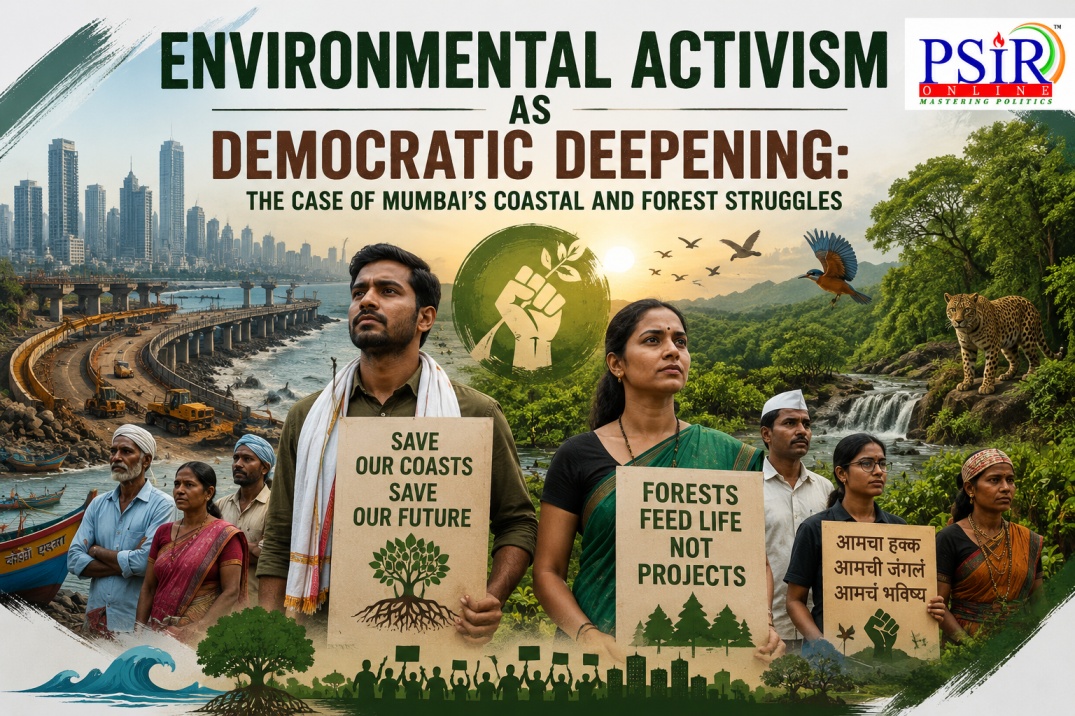
In the bustling megacity of Mumbai, where glittering skyscrapers rise alongside ancient mangroves and fishing villages, a profound contest is unfolding between rapid urban development and ecological survival. On March 23, 2026, thousands of protesters gathered at Azad Maidan under the banner “Rise for Nature, March for Justice”, uniting Koli fishers, Adivasi communities, youth groups, and concerned citizens against large-scale coastal and infrastructure projects threatening the city’s fragile ecosystems. This event was not an isolated outburst but the latest expression of Mumbai’s long-standing environmental activism — a movement that has evolved from the mangrove protection campaigns of the 1990s to the intense Aarey forest protests.
This article argues that such environmental activism represents democratic deepening in Maharashtra. Far from being anti-development disruptions, these movements expand the quality and inclusiveness of democracy by amplifying marginalized voices, demanding accountability from the state, and compelling a more deliberative approach to governance.
BACKGROUND AND ORGANIZATION
The protest united diverse groups under the banner “Rise for Nature, March for Justice” (also called a "Maha-Rally"). Participants included:
· Koli fishing communities (traditional indigenous fishers of Mumbai).
· Adivasis/tribals (forest-dwelling communities).
· Youth groups.
· Citizen activists and environmental organizations (e.g., Save SGNP Citizens' Movement, Save Mumbai Mangroves).
Organizers expected 1,000–1,500 people. The event highlighted the development vs. ecology conflict in Mumbai and coastal Maharashtra. It was framed as a response to what activists called "mass destruction of nature" and displacement of indigenous communities.
WHY THE PROTEST WAS HELD?
Protesters opposed multiple large-scale infrastructure projects they argued threaten:
· Mumbai’s coasts, mangroves, forests, and wildlife.
· Traditional livelihoods of fishers and tribals.
· The city's climate resilience (mangroves act as natural flood barriers and carbon sinks).
Key specific projects opposed:
· Versova-Bhayandar Coastal Road (26+ km, ₹18,000+ crore project): This is the northern extension of Mumbai's coastal road. It threatens ~45,000 mangroves (with ~9,000 permanently affected). It impacts Koli fishing villages in areas like Charkop, Manori, Malvani, and Aksa. Fishers report reduced catches due to construction noise and habitat loss, plus restricted boat access.
· Wadhvan (Vadhavan) Port (near Dahanu, Palghar district): A massive deep-sea port project (₹76,000+ crore) promoted as India's largest. It faces long-standing resistance from local fishers and Adivasis over livelihood loss, coastal ecosystem damage, and violations of environmental regulations (e.g., Dahanu Taluka Environmental Protection rules).
· Jindal Port (Murbe Bay area): Another proposed port project opposed for similar ecological and displacement reasons.
· Other projects: Fourth Mumbai Airport/Port plans, textile parks, and related developments.
· Broader issues: Mangrove destruction in Charkop, forest rights claims in Sanjay Gandhi National Park (SGNP) and Aarey, leopard protection, and the BMC's Draft Eco-Sensitive Zone Master Plan.
Event Details
· Planned Route: A march from Girgaum Chowpatty to Azad Maidan.
· Actual Event: Police denied permission for the full march, so it became a gathering/rally at Azad Maidan starting around 10 AM.
· Slogans and demands focused on justice for nature and affected communities. Speeches highlighted government inaction on citizen concerns, climate emergency, and exploitation of ecological assets.
Main Demands included:
· Settlement of Forest Rights Act (FRA) 2006 claims for tribals in SGNP and Aarey.
· Scrap the BMC’s Draft Eco-Sensitive Zone Master Plan.
· No mangrove cutting for coastal roads.
· Scrap Wadhvan Port, Jindal Port, and related projects.
· Koliwada planning and markets to be decided by fishing communities.
· Stronger wildlife protection (e.g., leopards under Schedule 1).
|
HISTORY OF MUMBAI'S ENVIRONMENTAL ACTIVISM
Mumbai's environmental activism has a rich history rooted in the tension between its rapid urbanization as India's financial capital and the need to protect its unique coastal, mangrove, and forested ecosystems. It blends efforts by traditional communities (Kolis and Adivasis), citizen groups, NGOs, and legal interventions. The movement emphasizes livelihoods, biodiversity, climate resilience (especially flood protection), and sustainable development.
Early Foundations (1970s–1980s) Environmental activism in Mumbai gained momentum in the late 1970s, influenced by India's broader movements like the Chipko Andolan (tree-hugging in the Himalayas) and growing awareness of industrial pollution. · Bombay Environmental Action Group (BEAG): Founded in 1979 by professionals, artists, nature enthusiasts, and entrepreneurs (including Shyam Chainani, Navroz Mody, and others, with ornithologist Dr. Salim Ali as the first president). It emerged from earlier citizen efforts, such as the 1974 "Bombay Bachao" response to a proposed petrochemical complex in Alibag that threatened coastal areas, farmlands, and fishing communities.
BEAG focused on protecting open spaces, heritage sites (like Matheran), and preventing unchecked industrial and residential development. It used public interest litigation (PILs), advocacy, and research to influence policy.
1990s–2000s: Legal Milestones and Mangrove Protection The 1990s and early 2000s saw increased focus on Mumbai's mangroves, vital for coastal protection, fisheries, and biodiversity. · Bombay High Court interventions played a pivotal role. In 2005, a landmark order (influenced by BEAG's PIL) banned the destruction of mangroves on government land, declaring them "protected forests" in many areas. This followed years of dumping, encroachment, and development pressure. · Activists highlighted how mangroves act as natural barriers against flooding and cyclones—critical after events like the 2005 Mumbai floods. This era established environmental protection as a legal and public issue, with groups pushing for enforcement against violators.
2010s: Aarey Forest and Urban Green Spaces The Aarey Milk Colony (a green lung in Goregaon with forests, grasslands, and Adivasi settlements) became a major flashpoint from the mid-2010s. · Plans for a Mumbai Metro Line 3 car shed in Aarey sparked massive protests starting around 2014–2015, intensifying in 2019. · A broad coalition of urban residents, students, youth, Adivasis (Warli and other tribals), and environmentalists formed. Protests included human chains, marches, tree-hugging, and social media campaigns. · Key moments: Overnight tree-felling in October 2019 led to clashes, arrests, and Supreme Court intervention. The movement succeeded in raising national awareness and partial protections (e.g., declaring parts as a forest or eco-sensitive zone), though some construction proceeded. Aarey symbolized the fight for urban forests against infrastructure and highlighted indigenous rights under the Forest Rights Act.
Other campaigns included: · Protecting Sanjay Gandhi National Park (SGNP) from encroachments. · Opposing aspects of the Mumbai Coastal Road Project (Bandra-Worli section and later phases).
2020s: Coastal Roads, Ports, and Climate Justice Recent activism has become more intersectional, linking ecology with climate change, livelihoods of fishers, and social justice. · Mangrove and Coastal Road Protests: Ongoing opposition to the Versova-Bhayandar Coastal Road (and extensions), which threatens tens of thousands of mangroves. Court cases continue, with partial clearances for projects balanced by compensatory planting mandates. · Koli Fishing Communities: As Mumbai's original inhabitants, Kolis have led resistance against projects restricting sea access, destroying fishing grounds, and impacting livelihoods. · Port Projects: Strong opposition to Wadhvan Port and Jindal Port in nearby coastal areas (Palghar/Dahanu), citing threats to ecosystems and fishing villages. · "Rise for Nature, March for Justice" (March 23, 2026): A notable recent example uniting Kolis, Adivasis, youth, and citizens at Azad Maidan. It protested multiple infrastructure threats and called for forest rights settlements. · Groups like Save Mumbai Mangroves, Save SGNP Citizens' Movement, and youth-led initiatives have kept momentum alive through protests, petitions, awareness drives, and legal action.
Key Characteristics and Impact · Diverse Coalitions: Traditional communities (Kolis, Adivasis) + middle-class citizens + youth + celebrities. · Legal Strategy: Heavy reliance on Bombay High Court and Supreme Court PILs. · Challenges: Fragmented movements (issue-specific rather than city-wide), powerful development lobbies, and implementation gaps in environmental clearances. · Achievements: Mangrove protections, delays/revisions to projects, increased public awareness, and policy influence (e.g., eco-sensitive zones).
Mumbai's activism reflects a global urban dilemma: balancing growth with sustainability in a densely populated, climate-vulnerable coastal city. While development projects often proceed with "compensatory" measures, activists continue to argue for better alternatives like public transport prioritization, mangrove restoration, and inclusive planning.
|
DEEPENING OF DEMOCRACY
Environmental movements like Mumbai’s “Rise for Nature, March for Justice” (2026), the Aarey forest protests, mangrove protection campaigns, and Koli-Adivasi resistance enhance democracy in Maharashtra politics in several meaningful ways. They strengthen participatory governance, accountability, and inclusive decision-making in a state often dominated by infrastructure-driven development and political alliances.
1. Broadening Political Participation and Inclusion
These movements bring marginalized voices — Koli fishing communities, Adivasis (Warli and other tribals), youth, and middle-class citizens — into the political arena. Traditional communities, often sidelined in urban planning, gain visibility and agency.
· They transform environmental issues into questions of livelihoods, cultural rights, and justice, forcing political parties to address them. For instance, Forest Rights Act (FRA) claims by tribals in Sanjay Gandhi National Park (SGNP) and Aarey have become electoral talking points.
· Coalitions cut across class and identity lines, fostering intersectional activism that challenges elite-driven development models.
This deepens democracy by expanding who gets to shape policy beyond formal electoral cycles.
2. Strengthening Accountability and Checks on Power
Environmental activism acts as a non-electoral check on government and corporate power:
· Public Interest Litigations (PILs) in Bombay High Court and Supreme Court have repeatedly delayed or modified projects (e.g., mangrove protections in 2005, Aarey disputes). Courts often cite activist evidence, reinforcing judicial oversight.
· Protests highlight gaps in Environmental Impact Assessments (EIAs), lack of community consultation, and alleged violations of laws like the Coastal Regulation Zone (CRZ) norms.
· They expose implementation failures — even when projects get clearances, activists document on-ground mangrove destruction or unfulfilled compensatory promises.
In Maharashtra’s competitive politics (with frequent alliance shifts between BJP-Shiv Sena factions, Congress-NCP, etc.), sustained pressure can influence policy tweaks or force public justifications from ministers.
3. Raising Public Awareness and Shaping Public Opinion
Movements educate citizens and build long-term pressure:
· Social media, street protests, and celebrity involvement (seen in coastal road and Aarey campaigns) amplify issues like flood vulnerability, biodiversity loss, and climate resilience.
· They link local concerns (e.g., Versova-Bhayandar Coastal Road impacting fish catches) to broader narratives of sustainable development vs. short-term growth.
· This influences voter priorities and forces parties to adopt greener rhetoric in manifestos, even if implementation lags.
4. Promoting Deliberative and Participatory Democracy
· Movements push for better consultation processes. Examples include demands for Koli community-led planning in fishing villages and tribal input on forest management.
· They challenge top-down “development at all costs” models, advocating alternatives like improved public transport over more coastal roads or community-based conservation.
· Grassroots mobilization (e.g., long marches by tribals for FRA implementation) demonstrates people’s power and keeps issues alive between elections.
Scholars note that Indian environmental movements have expanded the meaning of democracy by linking ecological rights with social justice and decentralized decision-making.
Limitations and Challenges
These movements do not always “win” outright — many projects (parts of coastal roads, metro car shed in Aarey) proceed despite protests. They face accusations of being “anti-development,” occasional police restrictions, and internal challenges like elitism or fragmented organizing.
However, even partial successes or sustained visibility contribute to a more vibrant democratic culture by preventing complete dominance of any single narrative.
In summary, such movements enrich Maharashtra’s democracy by making it more participatory, accountable, informed, and inclusive. They prevent politics from being reduced solely to electoral arithmetic or big infrastructure announcements, ensuring ecology, traditional livelihoods, and long-term sustainability remain part of the conversation. This is especially relevant in a climate-vulnerable, densely populated state like Maharashtra.
OPTIMUM GOVERNMENT RESPONSE
An optimum government response to Mumbai's environmental movements (such as the "Rise for Nature, March for Justice," Aarey protests, mangrove campaigns, and Koli-Adivasi demands) would balance economic development, ecological sustainability, climate resilience, and social justice. It avoids extremes — neither halting all infrastructure nor ignoring valid ecological concerns.
Here is a practical, multi-pronged framework:
1. Strengthen Genuine Stakeholder Consultation
· Mandate early, transparent, and inclusive public consultations with affected communities (Kolis, Adivasis, fishers, residents) before finalizing projects. Use digital tools, local languages, and independent facilitators.
· Establish joint committees with government officials, activists, scientists, and community representatives for projects like coastal roads or ports.
· Benefit: Builds trust, reduces protests, and leads to better project design.
2. Adopt Science-Based, Integrated Planning
· Fully implement and update the Mumbai Climate Action Plan (MCAP) with stronger enforcement. Prioritize nature-based solutions (e.g., mangrove restoration as flood barriers) alongside engineered infrastructure.
· Conduct rigorous, independent Environmental and Social Impact Assessments (ESIA) that include cumulative impacts (not just project-by-project).
· Prioritize alternatives analysis: For example, evaluate metro expansions, improved public transport, or road widening before new coastal roads that destroy mangroves.
· Protect critical ecosystems (mangroves, SGNP, Aarey) via stricter Eco-Sensitive Zone enforcement and compensatory restoration that is like-for-like and monitored long-term.
3. Livelihood and Rights Integration
· Fast-track Forest Rights Act (FRA) claims for Adivasis and provide secure tenure/alternatives for Koli fishing communities.
· Design community benefit-sharing mechanisms: e.g., community-managed mangrove nurseries, eco-tourism, or skill programs linked to green jobs.
· Ensure fair rehabilitation for any displacements, with consent and better-than-before living conditions.
4. Transparent Monitoring and Accountability
· Create an independent Mumbai Environment and Climate Commission with statutory powers to review major projects.
· Use real-time monitoring (satellites, community apps) for mangrove health, pollution, and project compliance.
· Publish annual reports on environmental clearances, violations, and compensatory outcomes.
5. Promote Sustainable Development Alternatives
· Accelerate low-carbon mobility: Expand metro, buses, and cycling infrastructure to reduce pressure for car-centric coastal roads.
· Invest in coastal resilience projects combining protection with development (e.g., models from Surat or international examples using nature-based solutions).
· Green urban planning: Mandate higher green cover, wetland restoration, and climate budgeting in all BMC and MMRDA projects.
Expected Outcomes of This Approach
· Economic: Projects move forward with fewer delays from litigation/protests.
· Ecological: Better protection of Mumbai’s natural defenses against flooding and climate change.
· Social: Reduced conflict, empowered communities, and stronger public trust in governance.
· Political: Demonstrates responsive, forward-looking leadership in Maharashtra.
Realistic Challenges: This requires coordination between BMC, MMRDA, Maharashtra government, and central ministries. It also needs political will to resist short-term pressures from contractors or lobbies.
Governments that have succeeded in similar contexts (e.g., some C40 cities or states integrating climate action) show that proactive engagement with civil society yields better long-term results than reactive crackdowns or blanket approvals.
CONCLUSION
Mumbai’s environmental movements demonstrate that democracy is not confined to periodic elections but is continually renewed through active citizenship and collective assertion of rights. From the pioneering work of the Bombay Environmental Action Group to the diverse coalitions marching at Azad Maidan, these struggles have carved out vital democratic space for traditional communities whose livelihoods and knowledge systems are often excluded from formal planning processes.
Ultimately, the future of Mumbai — and cities like it across India — depends on whether governments view environmental activism as a threat or as a valuable democratic resource. The optimum path forward lies in collaborative governance: one that integrates scientific rigor, genuine community consultation, livelihood security, and climate resilience into development planning. By embracing this approach, Maharashtra can transform conflict into constructive dialogue, ensuring that the city’s growth does not come at the irreversible cost of its natural heritage.
In the tension between concrete and coast, forest and freeway, Mumbai’s environmental activists are not merely defending nature — they are defending a deeper, more inclusive form of democracy itself. The question remains whether the state will listen and adapt, or continue along the well-trodden path of confrontation and ecological loss.
PRACTICE QUESTIONS FOR PSIR OPTIONAL
1. “Environmental movements in urban India are no longer merely ecological struggles but democratic assertions of marginalized communities.” Examine this statement in the context of Mumbai’s coastal and forest protests.
2. Discuss how environmental activism in Maharashtra has contributed to the deepening of participatory and deliberative democracy. Illustrate your answer with suitable examples from recent movements.
3. Critically evaluate the role of Public Interest Litigation (PIL) and judicial intervention in shaping environmental governance in Mumbai. Has judicial activism strengthened democratic accountability?
4. “The challenge before Indian cities is not development versus environment, but sustainable development with democratic legitimacy.” Analyze this statement with reference to the government’s response to environmental movements in Mumbai