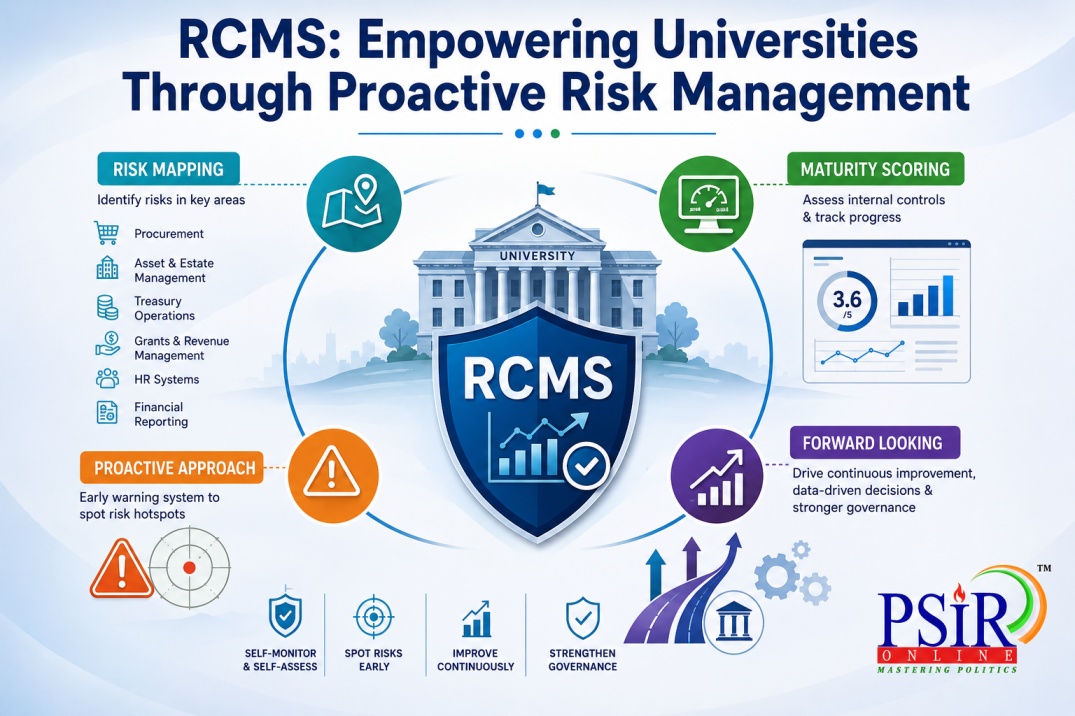
Risk-Controls Maturity Scorecard (RCMS) is a proactive governance and risk management framework introduced by the Comptroller and Auditor General (CAG) of India for higher education institutions (HEIs) and other autonomous bodies.
CONTEXT AND ROLLOUT (MARCH 2026)
On 9 March 2026, CAG organized a national stakeholder workshop in New Delhi with Vice-Chancellors, Registrars, officials from the Ministry of Education (including Secretary Dr. Vineet Joshi), and CAG representatives.
This workshop marked the consultative launch of RCMS. CAG K. Sanjay Murthy and other officials presented it as a major shift in oversight of public-funded autonomous institutions.
· First phase: Starts from April 2026, covering 66 HEIs (44 central + 22 state universities). The rollout is expected to complete within about 8 months (by end of FY27).
· Broader plan: Eventually extend to around 1,400 autonomous bodies audited by CAG. These bodies manage massive public funds — for example, central autonomous institutions under the Ministry of Education handle assets worth ~₹1.77 lakh crore and receive ~₹75,645 crore in grants annually.
The initiative addresses the limitations of traditional post-facto audits, which often detect issues like financial irregularities, procurement lapses, or delays in utilization certificates only after they occur.
WHAT IS RCMS?
RCMS is not an additional audit or external inspection tool. It is a self-monitoring and self-assessment framework that institutions can use themselves.
Key Elements:
· Risk Mapping: Identifies potential risks in critical areas such as:
o Procurement
o Asset and estate management
o Treasury operations
o Grants and revenue management
o HR systems
o Financial reporting
· Maturity Scoring: Institutions assess the strength of their internal controls using evidence-based indicators. They receive a maturity score and dashboards for real-time tracking.
· Proactive Approach: It acts as an early warning system — helping leadership (e.g., Vice-Chancellors) spot "risk hotspots" before they escalate into major problems.
· Forward-Looking: Moves from reactive compliance to continuous improvement, data-driven decisions, and stronger governance.

Deputy CAG A.M. Bajaj clarified that primary responsibility for risk management lies with the institutions themselves; RCMS merely provides a structured framework to support that.
Is RCMS a Completely New Thing?
It is new for the Indian higher education and autonomous bodies ecosystem in its structured, CAG-backed form. However, it draws inspiration from global best practices at leading universities like Oxford, Harvard, and Cambridge, which have long used sophisticated risk management and internal control frameworks.
RCMS adapts these international maturity models (common in corporate governance and enterprise risk management) to the Indian public-funded education context. It represents an evolution in CAG's auditing philosophy — from pure financial compliance to enabling better institutional self-governance.
|
CAN CAG ROLL OUT THIS ADMINISTRATIVE REFORM WITHOUT MINISTRY APPROVAL? (CONSTITUTIONAL ANGLE)
Yes, it is within CAG’s mandate — it is not against the Indian Constitution. · CAG’s Constitutional Powers (Articles 148–151): CAG is an independent constitutional authority. Article 149 allows Parliament to prescribe duties and powers regarding accounts of the Union, States, and "any other authority or body." The CAG’s (Duties, Powers and Conditions of Service) Act, 1971 (Sections 14, 15, 19, 20) gives CAG wide authority over autonomous bodies substantially financed by government funds (like universities). · RCMS is not a new audit or regulation imposed externally. It is a voluntary/self-monitoring framework and support tool to help institutions strengthen internal controls. Primary responsibility remains with institutional management (Vice-Chancellors/Registrars). CAG is simply providing a structured methodology to improve governance in bodies it already audits. · This fits CAG’s broader role in promoting better financial prudence, risk management, and value-for-money in public-funded entities. Similar initiatives (guidelines, best practices, maturity models) are common in CAG’s work. · The consultative approach (workshop with Ministry and universities) and Ministry’s explicit support further legitimize it. It is not a unilateral "reform" bypassing the executive — it complements existing oversight.
In short: CAG is acting within its auditing and advisory domain for entities under its purview. It does not require fresh "approval" for such internal improvement tools, just as it issues audit manuals or performance audit guidelines. This strengthens, rather than undermines, constitutional accountability mechanisms.
|
RECEPTION BY STAKEHOLDERS
The Risk-Controls Maturity Scorecard (RCMS) has been warmly received by stakeholders, with broad support from universities, Vice-Chancellors, Registrars, and the Ministry of Education.
· At the 9 March 2026 national workshop in New Delhi, participants (including VCs from central and state universities) welcomed the initiative. They assured complete support for implementation and shared perspectives on operational risks and governance challenges.
· Many requested customization (considering the diversity and varying maturity levels of institutions) and capacity building/training for effective adoption. No outright opposition was reported.
· Ministry of Education officials, including Secretary Dr. Vineet Joshi and Additional Secretary Anandrao V. Patil, strongly endorsed it. They described RCMS as a positive shift from "reactive compliance to proactive risk management" and committed to supporting wider learning, capacity building, and continuous improvement.
Public reports and press coverage (Livemint, Economic Times, CAG press release) portray it as a constructive, forward-looking reform with institutional buy-in. No major criticism or backlash from universities has surfaced in available coverage as of mid-2026.
INTENDED OUTCOMES OF RCMS
The Risk-Controls Maturity Scorecard (RCMS) aims to transform governance in higher education institutions (HEIs) and autonomous bodies from reactive, post-facto audits to proactive, real-time risk management. CAG officials and the Ministry of Education have outlined several clear intended outcomes.
1. Early Identification and Mitigation of Risks
· Institutions will systematically map risks in key areas such as procurement, asset/estate management, treasury operations, grants/revenue management, HR systems, and financial reporting.
· This creates an early warning system that spots "risk hotspots" before they escalate into financial irregularities, compliance failures, or governance lapses (e.g., delays in utilization certificates or procurement issues).
· Outcome: Fewer audit paras, reduced financial losses, and prevention of problems rather than just detection after the fact.
2. Strengthened Internal Controls and Financial Prudence
· Evidence-based maturity scoring and dashboards enable institutions to assess the strength of their controls.
· Leadership (Vice-Chancellors, Registrars) gains data-driven insights for better decision-making.
· Primary responsibility remains with institutional management; RCMS simply provides a structured framework to support it.
· Outcome: Improved financial discipline, better utilization of public funds (e.g., the ~₹75,645 crore in annual grants and ₹1.77 lakh crore in assets managed by central autonomous bodies), and higher overall governance standards.
3. Shift to Proactive and Continuous Improvement
· Moves away from "compliance-based oversight" to forward-looking risk management.
· Institutions can regularly review and strengthen systems, fostering a culture of continuous improvement.
· Outcome: More resilient institutions capable of handling growing public investments and increasing numbers of autonomous bodies (currently ~1,400 audited by CAG).
4. Better Audit Quality, Transparency, and Accountability
· Poor maturity scores act as formal red flags, potentially leading to more focused audits.
· Enhances transparency and reduces the scope for "claims of ignorance" in cases of mismanagement.
· Outcome: Improved public accountability, higher-quality audits, and alignment with global best practices (inspired by Oxford, Harvard, Cambridge).
5. Capacity Building and Institutional Empowerment
· The consultative rollout (starting with 66 HEIs) includes training and customization requests.
· Ministry of Education has committed support for wider adoption.
· Outcome: Empowered university leadership, reduced dependency on external audits, and scalable governance improvements across diverse institutions.
Overall Vision: CAG envisions RCMS as a tool that helps autonomous bodies manage massive public resources more effectively amid expanding investments, ultimately leading to stronger, more self-reliant institutions.
POSSIBLE SHORTFALLS AND CHALLENGES
While RCMS is promising, like any new maturity framework, it has potential limitations. These are inferred from stakeholder feedback at the March 2026 workshop, general challenges in implementing risk maturity models in public sector/educational contexts, and common issues seen in similar global initiatives.
1. Implementation Burden and Resource Constraints
· Many universities (especially smaller or state ones) lack dedicated risk management staff, expertise, or robust IT systems for real-time dashboards and evidence collection.
· Shortfall: It could become another administrative burden, diverting time from core academic activities. Initial rollout may face resistance or incomplete adoption due to capacity gaps.
2. One-Size-Fits-All vs. Institutional Diversity
· Institutions vary widely in size, maturity, funding, and operational complexity.
· Workshop participants specifically requested customization for "diversity and maturity levels."
· Shortfall: A rigid scorecard might not suit all contexts, leading to unfair scoring, demotivation, or superficial compliance rather than genuine improvement.
3. Risk of Bureaucratic or Tick-Box Approach
· Without strong ownership, it may devolve into paperwork and box-ticking for better scores instead of real cultural change.
· Shortfall: Superficial adoption where institutions focus on documentation over actual risk mitigation, especially if linked to future audits.
4. Data Quality, Technology, and Subjectivity Issues
· Maturity scoring relies on self-reported evidence; poor data quality or biased reporting could undermine reliability.
· Shortfall: Inaccurate scores, disputes over assessments, or challenges in maintaining real-time monitoring without advanced tools.
5. Potential for Increased CAG Scrutiny or Perception of Overreach
· Low scores could invite stricter audits or external intervention, creating fear rather than empowerment.
· Shortfall: Some institutions might view it as indirect control, leading to cautious or defensive implementation rather than open risk disclosure.
6. Sustainability and Long-Term Effectiveness
· Without ongoing training, refresher workshops, and Ministry/CAG support, momentum could fade after the pilot.
· Measuring true outcomes (e.g., reduced irregularities) will take years.
· Shortfall: Pilot success in 66 institutions may not easily scale to 1,400+ bodies, especially amid leadership changes common in universities.
Mitigation Noted So Far: The consultative workshop approach, Ministry support for capacity building, and emphasis on it being a self-tool (not additional audit) are designed to address these. However, success will depend heavily on execution in the 2026–27 pilot phase.
In summary, intended outcomes focus on prevention, empowerment, and efficiency, while possible shortfalls center on practical execution challenges in a diverse, resource-constrained environment. The framework is still in early rollout, so real-world results will become clearer over the next 1–2 years
PRACTICE QUESTIONS FOR GS 2 MAINS
1. “The Risk-Controls Maturity Scorecard (RCMS) marks a shift from post-facto auditing to proactive governance in higher education institutions.” Examine.
2. Discuss how RCMS reflects the evolving role of the Comptroller and Auditor General (CAG) from financial compliance oversight to institutional governance facilitation.
3. “Institutional autonomy and accountability must go together in public-funded universities.” In the light of RCMS, analyse the constitutional and administrative dimensions of this statement.
4. RCMS seeks to improve transparency, financial prudence, and risk management in higher education institutions. Critically evaluate its potential benefits and implementation challenges.