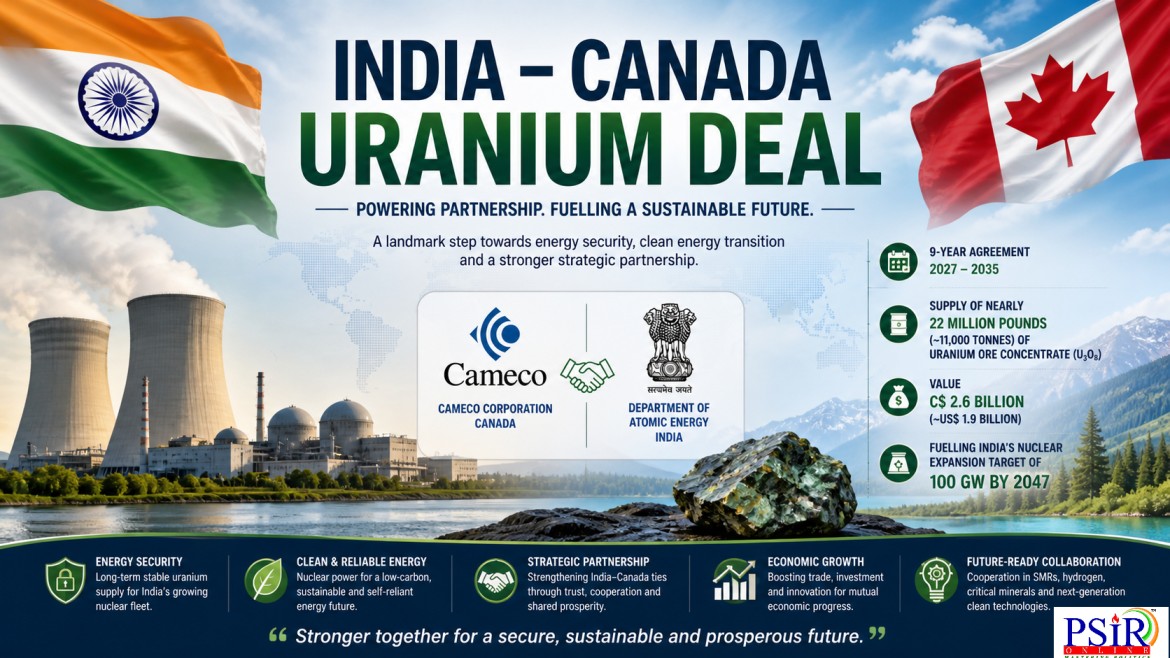
The landmark India-Canada uranium supply agreement was signed on March 2, 2026, in New Delhi during Canadian Prime Minister Mark Carney’s official visit to India (February 27–March 2, 2026). It marked a major step in resetting and strengthening bilateral ties, which had been strained in prior years.
KEY DETAILS OF THE AGREEMENT
· Parties: Canada's Cameco Corporation (a major Saskatchewan-based uranium producer) and India's Department of Atomic Energy (DAE).
· Scope: Cameco will supply nearly 22 million pounds (about 11,000 tonnes) of uranium ore concentrate (U₃O₈) to India over a nine-year period (2027–2035).
· Value: Approximately C$2.6 billion (around US$1.9 billion), with prices tied to market-related terms.
· Purpose: Fuel for India's fleet of civil nuclear reactors, supporting the country's ambitious nuclear power expansion (targeting ~100 GW by 2047 from current levels of around 8 GW).
This is a commercial long-term supply contract, not a new inter-governmental treaty. It builds on existing India-Canada nuclear cooperation frameworks.
CONTEXT AND SIGNIFICANCE
· Bilateral Reset: Carney's visit was the first by a Canadian PM to India since 2018. The deal helped mend relations strained by diplomatic tensions (e.g., the 2023 Khalistan-related issues). Both leaders emphasized "strategic trust" and a forward-looking partnership.
· Broader Energy Partnership: Announced alongside a new Canada-India Strategic Energy Partnership, covering uranium, small modular reactors (SMRs), advanced reactors, LNG, hydrogen, critical minerals, and more. This supports India's clean energy goals and Canada's resource exports.
· Economic Ties: The leaders also advanced talks on a Comprehensive Economic Partnership Agreement (CEPA), aiming to conclude it by end-2026 and double bilateral trade toward $50 billion by 2030
HISTORICAL CONTEXT OF INDIA-CANADA NUCLEAR COOPERATION
India-Canada nuclear relations have evolved from deep early collaboration to periods of suspension, revival, and recent diplomatic challenges, reflecting the complex interplay of technology, trust, and geopolitics.
Early Foundations (1950s–1970s)
Cooperation began in the 1950s under the “Atoms for Peace” initiative. Canada supplied the CIRUS research reactor (commissioned in 1960) and played a pivotal role in India’s first major power reactors. The Rajasthan Atomic Power Station (RAPS-1), a CANDU-type Pressurised Heavy Water Reactor (PHWR), was built with Canadian assistance and became operational in 1972. RAPS-2 followed. This partnership helped India develop expertise in heavy-water technology, which became the backbone of its indigenous nuclear programme. Canada provided technology, training, and initial fuel.
The Rift (1974 Onwards)
Relations soured after India’s “Smiling Buddha” peaceful nuclear explosion in 1974. Canada, suspecting that plutonium from the Canadian-supplied CIRUS reactor may have been used, suspended all nuclear cooperation and withdrew support for the Rajasthan reactors. This forced India to develop self-reliance, accelerating its three-stage nuclear programme. Nuclear ties remained frozen for decades.
Revival in the 21st Century
The turning point came after the 2008 NSG waiver, which allowed India access to global nuclear trade despite being outside the NPT. In June 2010, the two countries signed a Nuclear Cooperation Agreement (NCA) for peaceful uses of nuclear energy. It entered into force in 2013. The agreement opened doors for Canadian uranium exports and potential reactor/component sales. Since then, Canada has been an important (though not the largest) uranium supplier to India.
Recent Diplomatic Chill (2023–2025)
Bilateral relations deteriorated sharply in September 2023 following Canadian allegations linking Indian officials to the killing of Hardeep Singh Nijjar (a pro-Khalistan figure) in British Columbia. Both sides expelled diplomats, suspended visa services, and froze high-level engagements, including trade talks. Nuclear and economic cooperation were indirectly affected amid the trust deficit.
The 2026 Reset
Mark Carney’s visit and the March 2026 uranium deal mark a pragmatic reset. It builds on the 2010 NCA framework while injecting fresh commercial momentum. The high-profile signing, attended by leaders from both sides, signals a conscious move to separate economic and civil nuclear cooperation from political differences.
WHY IT MATTERS FOR INDIA?
India's nuclear program is a cornerstone of its energy strategy, and this long-term uranium supply deal with Cameco directly addresses a critical bottleneck in its ambitious expansion plans.
Current Status of India's Nuclear Power
As of early 2026, India operates 24 nuclear reactors with a total installed capacity of around 8.8 GW (gigawatts). Nuclear power contributes only about 2-3% of the country's total electricity generation, despite being a clean, reliable baseload source (it runs continuously, unlike solar or wind).
India relies heavily on Pressurised Heavy Water Reactors (PHWRs), which use natural or slightly enriched uranium as fuel. Domestic uranium production is limited due to low-grade ore (typically 0.02–0.45% concentration vs. global averages of 1–2%), meeting only around 30–36% of current needs. As a result, over 70% of uranium requirements are imported.
Ambitious Expansion Targets
India has set a bold goal of 100 GW nuclear capacity by 2047 (the centenary of independence). This represents a more than 10-fold increase from current levels. Key milestones include:
· ~22–22.5 GW by 2031–32.
· Annual additions of 3.5–4 GW in the coming decades (nearly 10 times the historical pace).
· This expansion is part of the Nuclear Energy Mission announced in the 2025–26 Union Budget, supported by significant R&D funding (including ₹20,000 crore for small modular reactors). Plans mix:
· Indigenous PHWRs.
· Imported large reactors.
· Small Modular Reactors (SMRs) (e.g., Bharat Small Modular Reactor – BSMR-200).
· Fast Breeder Reactors (moving toward thorium-based Stage 3 of India's three-stage nuclear program).
Why Uranium Supply Is Critical
The deal supplies ~22 million pounds (≈11,000 tonnes) of uranium ore concentrate over 2027–2035. This provides predictable, long-term fuel security for new and existing reactors. India's annual uranium demand is currently around 1,500–2,000 tonnes and will rise sharply with capacity growth. Without reliable imports, expansion could stall.
Diversification of sources is key: India already imports from Kazakhstan (major partner), Russia, Uzbekistan, and others. The Canada deal adds a stable Western supplier with high-grade uranium, reducing risks from geopolitical disruptions or supply chain issues.
Role in Energy Security and Net-Zero Goals
· Baseload Power: Nuclear provides steady, dispatchable electricity essential for a grid integrating more renewables. It complements solar/wind by filling gaps when the sun isn't shining or wind isn't blowing.
· Energy Security: Reduces dependence on coal imports and volatile fossil fuel markets. India aims for net-zero emissions by 2070; nuclear is a low-carbon technology that can decarbonize power while supporting industrial growth.
· Economic & Strategic Benefits: Supports "Viksit Bharat" (Developed India) by ensuring affordable, reliable power for manufacturing, EVs, data centers, and hydrogen production. It also creates jobs in high-tech sectors and boosts self-reliance through eventual thorium utilization (India has vast thorium reserves).
In short, this agreement is not just about buying fuel—it's a strategic enabler for India's clean energy transition, helping bridge the gap until domestic production, reprocessing, and advanced reactors (including SMRs) scale up significantly.
The Cameco deal, alongside similar arrangements (e.g., with Kazakhstan), gives India the fuel confidence to accelerate reactor construction and private-sector involvement in nuclear.
WHY IT MATTERS FOR CANADA?
For Canada (and especially Saskatchewan), the $2.6 billion (C$) uranium supply agreement with India represents a significant commercial and strategic win. It strengthens a key export sector, supports economic growth in a resource-dependent province, and aligns with broader national goals of trade diversification.
Economic Boost to Saskatchewan and Cameco
Saskatchewan is a global leader in uranium, hosting world-class high-grade deposits in the Athabasca Basin (e.g., Cameco’s Cigar Lake and McArthur River mines). The province produces nearly all of Canada’s uranium, with much of it exported (Canada is typically the world’s second-largest producer after Kazakhstan).
· Revenue and Contract Value: The nine-year deal (starting 2027) provides Cameco with predictable, long-term revenue of ~C$2.6 billion on market-related pricing. This helps stabilize operations amid global uranium price fluctuations and supports investment in new projects (e.g., Rook I and others).
· Jobs and Local Impact: Saskatchewan’s uranium sector already supports thousands of direct and indirect jobs (over 3,300 including contractors in recent estimates), with a strong focus on northern and Indigenous communities (often ~40–50% of the workforce at mine sites). Industry growth is projected to add over 1,500 new jobs by/around 2026 across mining and related activities. High-skilled roles in engineering, trades, operations, and supply chains benefit from such contracts.
· Broader Provincial Economy: Uranium contributes to royalties, taxes, and economic multipliers (procurement, infrastructure, and community investments). Northern Saskatchewan sees direct benefits through local hiring, training programs, and equity participation opportunities.
Cameco, a major employer and taxpayer, gains a foothold in one of the world’s fastest-growing nuclear markets (India), enhancing its global portfolio.
Trade Diversification Amid Global Shifts
Prime Minister Mark Carney’s government has emphasized reducing over-reliance on the United States (Canada’s dominant trading partner) due to tariffs, geopolitical tensions, and economic uncertainty. The India deal is part of a strategic push to diversify exports, especially in critical minerals and clean energy commodities.
· It forms a cornerstone of the new Canada-India Strategic Energy Partnership (covering uranium, LNG, hydrogen, critical minerals, etc.).
· It supports ambitions for a Comprehensive Economic Partnership Agreement (CEPA) by end-2026, aiming to significantly boost bilateral trade (targets mentioned include pathways toward $50–70 billion in the medium term).
· Uranium fits Canada’s strengths as a reliable supplier of responsibly produced resources to support global decarbonization.
High-Level Political and Diplomatic Symbolism
The signing event in New Delhi was attended by:
· Canadian PM Mark Carney
· Indian PM Narendra Modi
· Cameco CEO Tim Gitzel
· Saskatchewan Premier Scott Moe
This high-profile gathering underscores the deal’s importance — blending commerce, diplomacy, and provincial interests. It signals strong government support for the sector and helps reset bilateral relations after years of strain. For Saskatchewan, having its Premier at the table highlights how resource provinces directly benefit from federal trade efforts.
Wider Canadian Benefits
· Energy Transition Leadership: By exporting uranium, Canada helps power clean electricity abroad while advancing its own nuclear expertise and critical minerals strategy.
· Geopolitical Resilience: Diversifying markets reduces vulnerability and positions Canada as a key player in the global nuclear fuel supply chain.
· Multiplier Effects: Beyond direct exports, it encourages further collaboration in SMRs, advanced reactors, and related technologies.
In essence, the agreement delivers tangible economic gains for Saskatchewan (jobs, revenue, northern development) while advancing Canada’s national interest in diversified, resilient trade partnerships. It’s a practical example of “resources for the energy transition” diplomacy.
GLOBAL ANGLE: STRENGTHENING CIVIL NUCLEAR COOPERATION BETWEEN TWO G20 DEMOCRACIES
The India-Canada uranium supply agreement of March 2, 2026, carries significant global importance as a model of responsible civil nuclear cooperation between two major G20 democracies. In an era of rising geopolitical tensions and energy insecurity, it demonstrates how trusted partners can collaborate on clean energy while upholding rigorous non-proliferation standards.
India’s expanding nuclear program operates under a unique framework: its civilian reactors receiving imported fuel, like this Canadian uranium, are placed under International Atomic Energy Agency (IAEA) safeguards. This ensures the material is used exclusively for peaceful power generation and cannot be diverted to military purposes. The deal reinforces India’s commitment to global norms despite not being a signatory to the Nuclear Non-Proliferation Treaty (NPT), building on the 2008 NSG waiver. Canada, a strong advocate for non-proliferation and a leading uranium producer with exemplary safety records, only supplies fuel under such verified safeguards.
This partnership advances shared goals in the global energy transition. Nuclear power provides reliable, low-carbon baseload electricity essential for net-zero pathways. India’s target of 100 GW by 2047 will displace significant coal-fired generation, cutting emissions. Canada’s high-grade uranium from Saskatchewan supports this while helping meet rising global demand for nuclear fuel as more countries (including in Asia, Europe, and the Middle East) revive or expand atomic energy programs.
Strategically, the agreement deepens ties between two large, resource-rich democracies, diversifying supply chains away from concentrated producers and reducing risks from geopolitical disruptions. It aligns with broader G20 priorities on clean energy, critical minerals security, and sustainable development. By fostering collaboration on small modular reactors (SMRs) and advanced technologies alongside fuel supply, it sets a precedent for transparent, rules-based nuclear commerce.
PRACTISE QUESTIONS FOR GS 2 MAINS
1. The India–Canada uranium supply agreement marks a significant reset in bilateral relations. Examine the factors that led to the deterioration and subsequent revival of India–Canada ties.
2. Discuss the role of civil nuclear cooperation in India’s energy security strategy. How does the recent uranium deal strengthen India’s clean energy transition goals?
3. India’s nuclear energy expansion faces structural and resource constraints. Critically analyze how international partnerships help overcome these limitations.
4. In the context of India’s net-zero commitments, evaluate the importance of nuclear energy vis-à-vis renewable energy sources.
PRACTISE QUESTIONS FOR PSIR OPTIONAL
1. “Civil nuclear cooperation reflects both strategic trust and geopolitical pragmatism.” Discuss this statement with reference to India–Canada relations.
2. Analyse the evolution of India–Canada nuclear relations from the “Atoms for Peace” phase to the present strategic partnership. What theoretical insights can explain this trajectory?
3. How does the India–Canada uranium deal illustrate the role of international institutions like the IAEA in facilitating cooperation among non-NPT states?
4. Discuss the significance of nuclear diplomacy in shaping India’s position in the global energy and strategic order. Substantiate with contemporary developments.