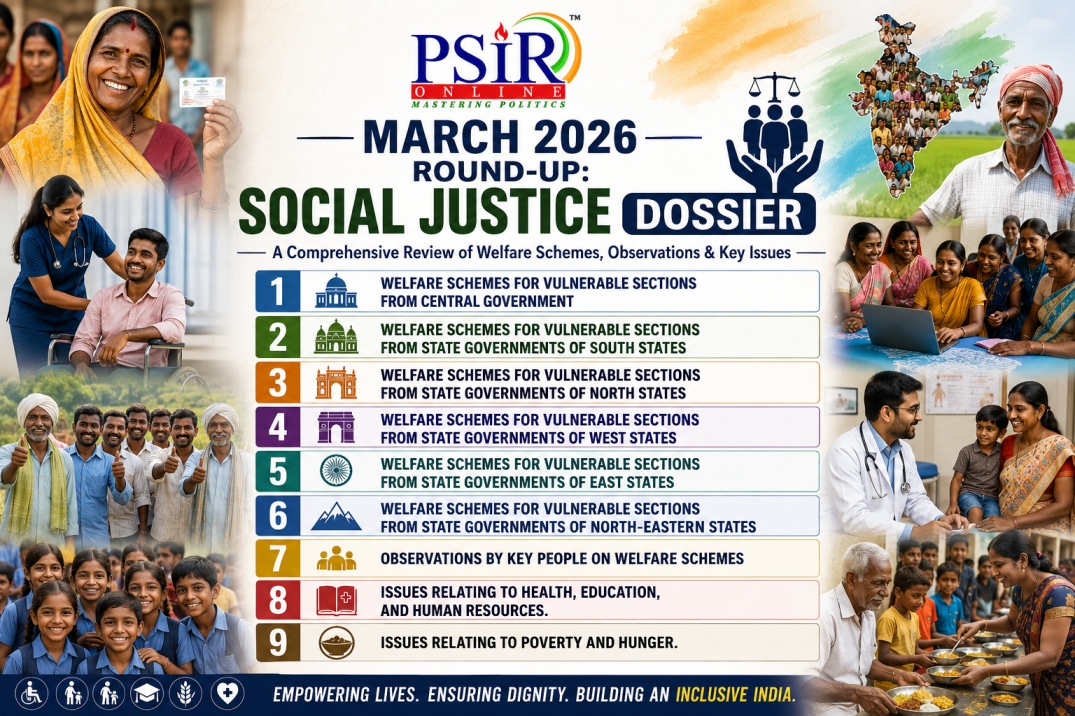
1. WELFARE SCHEMES FOR VULNERABLE SECTIONS FROM CENTRAL GOVERNMENT
No major new central government welfare schemes specifically for vulnerable sections (e.g., SC/ST, women, children, elderly, disabled, or other marginalized groups) were launched or announced in March 2026.
The Union Budget 2026-27 (presented in February 2026) included several relevant announcements and enhancements for vulnerable groups. These were discussed and implemented in follow-up webinars and actions around March 2026, but they were not new March launches.
Key Relevant Budget Announcements (Feb 2026, with March follow-ups)
· Divyangjan Kaushal Yojana — Skill development and training programs tailored for persons with disabilities (Divyangjan) in sectors like IT, AVGC, hospitality, and services. Aimed at dignified livelihoods and workplace inclusion.
· Divyang Sahara Yojana — Support for assistive devices and technology through strengthened ALIMCO (Artificial Limbs Manufacturing Corporation of India) and centers.
· Ayushman Bharat PM-JAY expansions — Ongoing focus on vulnerable families, with senior citizen coverage (70+) already in place from earlier. March 2026 saw updates on cards issued and treatments sanctioned.
· Other ongoing emphases: Enhanced support under schemes like PM-JANMAN (for PVTGs), Dharti Aaba Janjatiya Gram Utkarsh Abhiyan (tribal areas), women/youth/ Divyangjan-focused initiatives, and credit/entrepreneurship support for SC/ST/women.
Other March 2026 Context (No New Launches)
· Discussions/webinars on post-Budget schemes for Divyangjan (e.g., 8 March 2026 PIB mention of breakout sessions on the above yojanas).
· Progress reports on existing schemes like SMILE (Support for Marginalized Individuals for Livelihood and Enterprise — for transgender persons and beggars), with data up to March 2026 on rehabilitations.
· Routine updates on pensions, scholarships, and extensions of prior schemes (e.g., some continuations till 2026).
2. WELFARE SCHEMES FOR VULNERABLE SECTIONS FROM STATE GOVERNMENTS OF SOUTH STATES
No major brand-new welfare schemes specifically launched by South Indian state governments (Tamil Nadu, Karnataka, Andhra Pradesh, Telangana, Kerala) exclusively in March 2026 for vulnerable sections (SC/ST, women, children, elderly, disabled, minorities, etc.). Most activity involved follow-ups, implementations, disbursements, or expansions tied to the 2026-27 state budgets (presented in February/March 2026).
Here is a summary of notable announcements and actions in March 2026:
Tamil Nadu
· 5 March 2026: Chief Minister launched the Tamil Nadu Women Entrepreneurs Development Scheme (under MSME Department) to promote self-employment and economic empowerment for women, especially from vulnerable/marginalized backgrounds.
· Ongoing disbursements: Additional aid (e.g., Rs 2,000) credited to elderly, widows, and persons with disabilities alongside pensions for marginalized sections (early March reports).
· Focus on expansions of existing schemes like Kalaignar Magalir Urimai Thittam (women's cash support), Pudhumai Penn, Tamil Puthalvan (student support), pensions, and differently-abled welfare. No entirely new March launches beyond the entrepreneurs scheme.
Karnataka
· Early March 2026 (Budget 2026-27 presented around 6 March): Announcements included new/expanded measures for vulnerable groups:
o New post-matric hostels, residential schools, and upgrades for minorities, SC/ST.
o Karnataka Adivasi Development Corporation and Buddhist Development Corporation for tribal and deprived communities.
o Support for working women’s hostels, education for children of devadasis, and livelihood schemes.
o Enhanced allocations for SC/ST welfare corporations and guarantee schemes.
· These were primarily budget provisions rather than standalone March launches. Implementation and follow-ups occurred in March.
Telangana
· March 2026 Budget (presented mid-March): Announced a spree of new/expanded schemes, including the Indiramma Family Life Insurance Scheme (₹5 lakh cover per family, rollout from June 2026). Focus on insurance, education, health, and welfare for all families (with emphasis on vulnerable sections).
· 100-day action plan for welfare scheme implementation (starting early March).
Andhra Pradesh & Kerala
· Limited specific March 2026 launches reported for new vulnerable-section schemes.
· Andhra Pradesh: Focus on ongoing schemes like free travel for differently-abled (Divyang Shakti) and minorities; expansions continued.
· Kerala: Discussions on pensions and welfare, but major actions (e.g., free bus travel for women) were earlier or later.
3. WELFARE SCHEMES FOR VULNERABLE SECTIONS FROM STATE GOVERNMENTS OF NORTH STATES
No entirely new standalone welfare schemes exclusively for vulnerable sections (SC/ST, women, children, elderly, disabled, etc.) were launched by most North Indian state governments in March 2026. Activity was dominated by state budget 2026-27 presentations (mostly in February-March) and follow-up implementations, disbursements, or expansions of existing programs.
Here’s a summary of notable announcements and actions in March 2026:
Uttar Pradesh
· Early March 2026 (around 9 March): Government rolled out/expanded initiatives for workers and vulnerable groups. This included enhanced support such as:
o Increased pensions and maintenance grants for persons with disabilities (e.g., ₹1,000 monthly).
o Leprosy-affected pensions raised to ₹3,000.
o Artificial limbs/assistive devices.
o Financial assistance for inter-caste marriages (up to ₹61,000) and daughters’ marriages of registered workers.
· Focus on education scholarships for SC/Backward Classes and social security for unorganised workers. These were largely budget-driven implementations rather than brand-new schemes.
Punjab
· 8 March 2026 (Budget presentation): Announced Mukh Mantri Mawan Dhian Satikar Yojana — a new monthly stipend scheme for women.
o ₹1,000 per month to eligible adult women (18+).
o ₹1,500 per month for SC women.
o Direct bank transfer; exclusions for government employees, MPs/MLAs, and income tax payers.
· This was a major women-focused welfare announcement tied to the budget.
Haryana
· 2 March 2026 (Budget 2026-27 presented): Emphasis on women, youth, and social justice with increased allocations:
o Pink Cab Scheme: Interest-free loans (up to ₹10 lakh) + training for women to purchase electric vehicles and become entrepreneurs (“Lakhpati Didis”).
o Enhanced budgets for Social Justice & Empowerment (₹17,250 crore) and Women & Child Development.
o Other measures: Apprenticeship promotion for Antyodaya youth, Veer Bal Memorial Initiative, and women-friendly workplace awards.
Rajasthan, Himachal Pradesh, Uttarakhand & Others
· Rajasthan: Budget follow-ups and ongoing schemes (e.g., pensions, girl child support). No major new vulnerable-section launches reported specifically in March.
· Himachal Pradesh: Budget announcements focused on rural economy (e.g., “One District, Three Products” plan) rather than new social welfare schemes for vulnerable groups.
· Uttarakhand: Routine pension transfers and implementation of existing schemes.
· Limited specific March 2026 reports for Madhya Pradesh, Delhi, etc., beyond general budget enhancements.
4. WELFARE SCHEMES FOR VULNERABLE SECTIONS FROM STATE GOVERNMENTS OF WEST STATES
No major entirely new standalone welfare schemes for vulnerable sections were launched exclusively in March 2026 by most West Indian state governments (Maharashtra, Gujarat, Goa, Rajasthan). Activity centered on 2026-27 state budget implementations (presented in February), disbursements, expansions, and follow-ups.
Here is a state-wise summary of notable March 2026 actions:
Goa
· High-Support Disability Scheme (launched/rolled out around early March 2026): One-time financial assistance of ₹40,000 for persons with benchmark disabilities requiring high support (e.g., assistive devices, care). Announced by Social Welfare Minister; targets vulnerable disabled individuals.
· Ongoing: Disbursements under Griha Aadhar (housewife support) and Dayanand Social Security Scheme (DSSS) — pensions for elderly, widows, disabled (₹2,000–₹3,500/month). Widows with children under 21 made eligible for enhanced support.
Maharashtra
· Focus on budget rollout (presented early March 2026): Continued/expanded Mukhyamantri Majhi Ladki Bahin Yojana (₹1,500/month to eligible women) with massive allocation. New emphasis on Majh Astitva initiative for single women (widowed, deserted, divorced) via special camps for scheme access.
· Substantial allocations: ₹23,150 crore for SC welfare and ₹21,000 crore for tribal development. Year declared as "Year of Social Equality and Harmony."
· No brand-new March launches reported beyond implementation drives.
Gujarat
· Budget follow-ups (presented Feb 2026): Emphasis on women (e.g., Namo Kaushalya Lakshmi Yojana for ITI girls, widow assistance under Ganga Swaroopa, Lakhpati Didi scaling) and SC/ST via sub-plans. Enhanced health coverage under PMJAY-MA.
· No specific new vulnerable-section scheme launches reported in March; focus on ongoing implementation.
Rajasthan
· Budget-driven measures (presented Feb 2026): Expansions for women (Lakhpati Didi loan limits increased), youth self-employment, and social pensions. No standout new March 2026 launches for vulnerable groups.
5. WELFARE SCHEMES FOR VULNERABLE SECTIONS FROM STATE GOVERNMENTS OF EAST STATES
No major entirely new standalone welfare schemes for vulnerable sections (SC/ST, women, children, elderly, disabled, etc.) were launched exclusively in March 2026 by East Indian state governments (Bihar, Jharkhand, West Bengal, Odisha). Most activity involved 2026-27 state budget implementations (presented in February 2026), disbursements, expansions, and follow-ups.
Here is a state-wise summary of notable March 2026 actions:
West Bengal
· Banglar Yuva Sathi (Yuva Sathi) Scheme (payments advanced and started 7 March 2026): Monthly allowance of ₹1,500 for unemployed youth (aged 21–40 years, passed Class 10, not receiving other major benefits). Aimed at supporting vulnerable young people (including from marginalized backgrounds) with direct bank transfers. Originally slated for April but advanced. Large-scale applications and disbursements in March.
· Ongoing focus on expansions of women’s schemes (e.g., Lakshmir Bhandar transitions) and other social welfare during budget rollout. No other major new vulnerable-group launches reported specifically in March.
Odisha
· Primarily budget follow-ups (presented February 2026). Key emphases:
o Mukhyamantri Kanya Sumangal Yojana — Savings instrument (₹20,000 at birth for girl child in EWS families, with further support up to graduation).
o Subhadra Yojana — Continued cash transfers (₹10,000/year) to women; fresh applications opened around this period.
o Pension expansions under Madhu Babu Pension Yojana (covering more excluded elderly/disabled).
· Focus on women, girl child, and social security for vulnerable groups via implementation drives.
Bihar
· Budget implementations (presented early 2026). Emphasis on:
o Women employment/entrepreneurship under Mukhyamantri Mahila Rozgar Yojana (top-ups and disbursements continuing).
o Enhanced social security pensions (elderly, widows, disabled) with ongoing DBT.
· No brand-new March 2026 launches; focus on rollout for vulnerable sections.
Jharkhand
· Budget follow-ups (presented February 2026). Key allocations/implementation:
o Mukhyamantri Maiya Samman Yojana — Monthly financial assistance (₹2,500) to eligible women (18–50 years).
o Measures for SC/ST welfare and women farmers (Mahila Kisan Khushali Yojana).
· Emphasis on social justice and vulnerable groups through budget rollout
6. WELFARE SCHEMES FOR VULNERABLE SECTIONS FROM STATE GOVERNMENTS OF NORTH-EASTERN STATES
No major brand-new standalone welfare schemes for vulnerable sections (women, SC/ST, disabled, elderly, children, etc.) were launched by most North East Indian state governments (Arunachal Pradesh, Assam, Manipur, Meghalaya, Mizoram, Nagaland, Sikkim, Tripura) exclusively in March 2026. Activity focused on budget 2026-27 implementations, disbursements under existing schemes, and expansions.
Assam (Most notable activity)
· Orunodoi Scheme (including 3.0 enhancements): On 10 March 2026, the government credited a one-time ₹9,000 (including advance installments + Bihu bonus) to around 40 lakh women beneficiaries from economically weaker/vulnerable families. This flagship women-centric DBT scheme provides ongoing monthly support (around ₹1,250, with LPG subsidy component) and prioritizes widows, single women, disabled persons, transgender individuals, and other marginalized groups.
· CM Aatmanirbhar Asom Abhijan (CMAAA) 3.0: Registration started around 11 March 2026 for self-employment/entrepreneurship support, targeting unemployed educated youth (with relaxations for SC/ST/OBC), aiding vulnerable youth sections.
Other North East States
· Manipur: Announcements around Women's Day (8 March 2026) included financial assistance packages for women affected by ethnic conflict (₹350 crore earmarked). Ongoing social welfare department activities (e.g., empowerment hubs recruitment) continued, but no major new scheme launches.
· Other states (Arunachal Pradesh, Meghalaya, Mizoram, Nagaland, Sikkim, Tripura): Primarily budget rollout, pension disbursements, and implementation of ongoing schemes for SC/ST, women, and disabled. No standout new March 2026 launches reported for vulnerable sections. Central initiatives (e.g., Buddhist Circuits scheme from Union Budget) and infrastructure support benefited the region but are not state-specific new welfare schemes.
7. OBSERVATIONS BY KEY PEOPLE ON WELFARE SCHEMES
No highly specific public judgments, expert observations, or direct praises/criticisms by PM Narendra Modi, President Droupadi Murmu, or Vice President C.P. Radhakrishnan in March 2026 explicitly ranking "best performing" or "underperforming" welfare schemes for vulnerable sections (e.g., SC/ST, women, PVTGs, poor, disabled).
Available records from March 2026 focus on general endorsements of ongoing schemes, budget-related expansions, and inclusive development rather than detailed performance audits or comparative rankings. Key points include:
Prime Minister Narendra Modi
· Post-Budget Webinars (early March 2026): PM Modi addressed sessions under “Sabka Saath, Sabka Vikas – Fulfilling Aspirations of People,” emphasizing education, skills, agriculture/rural transformation, healthcare, and inclusion for disadvantaged groups (women, youth, farmers, Divyangjan). He highlighted direct benefit transfers (e.g., PM Kisan), scheme extensions (Jal Jeevan Mission to 2028), and human-centric reforms. No explicit "best/underperforming" labels, but positive framing of schemes like PM-KISAN (recent large DBT transfers) and farmer/MSME support as rapid progress toward Viksit Bharat.
· TV9 Summit (March 23, 2026): Reiterated achievements in banking inclusion (Jan Dhan), farmer support, and infrastructure, linking them to welfare delivery. Focused on resilience amid global challenges rather than scheme-specific performance metrics.
· Broader context: Emphasis on DBT efficiency, poverty reduction, and schemes reaching vulnerable groups, consistent with prior years' narratives.
President Droupadi Murmu
· Positive remarks on PM POSHAN (Poshan Shakti Nirman) scheme, describing nutritious meals for children as an "investment in human capital" (around mid-March context). This aligns with vulnerable sections (children from poor/rural backgrounds).
· Earlier (pre-March, but echoed in session context): Highlighted expansion of social security to ~95 crore citizens (from 25 crore in 2014), poverty alleviation (~25 crore lifted), and focus on women, Dalits, tribals via schemes like PMAY, tribal development programs. No March-specific underperformance notes.
Vice President C.P. Radhakrishnan
· Limited direct March 2026 references to welfare performance. Addresses covered broader economic/manufacturing growth and events, with indirect nods to inclusive policies. No standout scheme-specific praise or critique found for vulnerable sections.
Expert/Independent Observations (March 2026 Context)
· Positive: Continued praise for DBT scale, digital inclusion (Aadhaar linkage), and coverage expansion in social protection (e.g., ILO-noted doubling of coverage). Tribal schemes like Dharti Aaba Janjatiya Gram Utkarsh Abhiyan and JANMAN mentioned in budget contexts as accelerating development.
· Critiques/Gaps: Reports noted underutilization in some areas (e.g., Jal Jeevan Mission, PMAY-Urban in prior FY data influencing 2026 discussions), cuts or slower progress for minorities/PVTGs, and implementation challenges reaching the weakest (STs, Muslims). Budget analyses highlighted social sector spending pressures and execution gaps despite allocations.
· General expert views (e.g., in analyses around Budget 2026-27): Welfare remains human-centric but faces calls for better targeting, reduced leakages, and addressing underperformance in health/education for vulnerable groups. No explosive March-specific exposés.
8. ISSUES RELATING TO HEALTH, EDUCATION, AND HUMAN RESOURCES.
NEW POLICY/PROGRAMS/SCHEMES
In March 2026, no entirely brand-new standalone national schemes were launched specifically in the health, education, or human resources sectors. Most activity involved implementation follow-ups, webinars, and parliamentary actions tied to the Union Budget 2026-27 announcements (presented in February 2026). These focused on skilling for the care economy, biopharma innovation, allied health professionals, regulatory easing, and education-employment linkages.
Health Sector
· Biopharma Shakti (Strategy for Healthcare Advancement through Knowledge, Technology and Innovation): ₹10,000 crore over 5 years. Aims to position India as a global biopharma hub for biologics, biosimilars, and clinical research. Includes:
o 3 new National Institutes of Pharmaceutical Education and Research (NIPERs).
o Upgradation of 7 existing NIPERs.
o Network of over 1,000 accredited clinical trial sites.
o Regulatory reforms for faster approvals.
· Allied Health Professionals (AHP) Expansion: Target to add 1 lakh allied health professionals over 5 years via new/upgraded institutions and training in 10 disciplines (e.g., optometry, behavioural health, applied psychology, anaesthesia, radiology).
· Caregiver Training Initiative: Training of 1.5 lakh multiskilled caregivers (blended health + allied skills) to address the growing care economy (geriatric, home care, assisted living).
· Regional Medical Value Tourism Hubs: Development of 5 integrated hubs with diagnostics and rehabilitation (public-private partnership).
· Mental Health & Trauma Care: Establishment of NIMHANS-2 and upgrades; strengthening district-level trauma centres.
· Drugs and Clinical Trials (Amendment) Rules, 2026: Notified/effective in early March — reduced approval timelines (e.g., 90 to 45 days in some cases) to boost innovation and access.
Ongoing/Enhanced: Increased allocations for Ayushman Bharat PM-JAY (₹9,500 crore), PM-ABHIM (critical care blocks & labs), and AYUSH integration.
Education & Human Resources (Skilling)
· Right of Children to Free and Compulsory Education (Amendment) Bill, 2026: Introduced in Rajya Sabha on 13 March 2026. Protects service conditions of existing teachers (prospective application of new qualification norms; no adverse impact).
· Skilling & Education-Employment Linkages (Budget follow-up emphasis in March webinars):
o Upgradation of 1,000 ITIs and 5 National Centres of Excellence under PM SETU.
o Focus on AVGC (Animation, Visual Effects, Gaming, Comics), design, AI, and creative skills.
o University Townships and multidisciplinary alignment with industry.
· Divyangjan Kaushal Yojana: Customized skilling for persons with disabilities (₹200 crore allocation noted in budget context).
Post-Budget Webinars (e.g., 9 March 2026) under “Sabka Saath, Sabka Vikas” reinforced these with PM Modi’s addresses on preventive health, care workforce, and future-ready curricula.
OBSERVATION BY KEY PEOPLE
In March 2026, key observations and activities by India's top leaders on health, education, and human resources centered on post-Union Budget 2026-27 implementation, skilling for a care economy, holistic/preventive health, and aligning education with employment. No major critical "judgements" or underperformance notes emerged in high-profile national day speeches; the tone remained affirmative and forward-looking, emphasizing expansion and integration with Viksit Bharat goals.
Prime Minister Narendra Modi (Key Event: Post-Budget Webinars, esp. March 9, 2026)
PM Modi delivered a special address during the "Sabka Saath, Sabka Vikas – Fulfilling Aspirations of People" webinar series (focused on education, skills, health, and related sectors).
· Health & Care Economy: He stressed strengthening India's healthcare and care ecosystem, highlighting rising global demand for geriatric, home, and assisted-living caregivers. He urged development of a skilled care workforce and noted progress in preventive/holistic health (e.g., Yoga, Ayurveda gaining worldwide popularity). He referenced strengthened infrastructure via Ayushman Bharat, Arogya Mandirs, and new medical colleges.
· Education & Skilling/Human Resources: Emphasis on linking education to the real economy, with greater focus on AI, automation, digital economy, and design-driven manufacturing. He welcomed discussions on future-ready curricula, skilling pathways, innovation ecosystems, university townships, and education-to-employment/enterprise alignment. Sectors like education, skills, health, tourism, sports, and culture were positioned as core to public aspirations.
These aligned with Budget 2026-27 announcements (presented earlier but implemented/discussed in March), including:
· Biopharma Shakti (₹10,000 crore over 5 years) for a global biopharma hub.
· Upgrades to medical education, allied health professionals (target: 1 lakh added), new AIIMS/NIPERs, regional medical tourism hubs, and AYUSH expansions (e.g., new Ayurveda institutes).
· Education allocations rose (e.g., overall Ministry of Education ~₹1.39 lakh crore), with pushes for University Townships, girls' STEM hostels, and skill alignment.
President Droupadi Murmu (March 17, 2026 Event)
· At an event commemorating five billion meals by the Akshaya Patra Foundation, President Murmu highlighted the link between nutrition and education: "It is essential that our children have access to nutritious food and quality education." She praised the foundation's role in advancing educational objectives through mid-day meals and stressed holistic child development (health, nutrition, clean environment).
· Other March activities (e.g., Santal Conference on March 7) touched on tribal health/education harmony, consistent with broader government campaigns like Sickle Cell Anaemia Elimination and Eklavya Model Schools.
Vice President C.P. Radhakrishnan
· March 19, 2026: Stressed the importance of early education for foundational development.
· March 21–22, 2026: At events like the Nisargopachar Ashram Foundation Day (Pune), he highlighted skilling for India as a global human resources hub and the role of naturopathy/Yoga in preventive health and Swasth Bharat. He noted AYUSH's contribution to wellness tourism under PM Modi's vision.
· Broader emphasis on education's transformative role in Viksit Bharat and expanding quality healthcare access (e.g., new AIIMS).
9. ISSUES RELATING TO POVERTY AND HUNGER.
NEW POLICY/PROGRAMS/SCHEMES
No major new standalone national policies, programs, or schemes specifically for poverty alleviation or hunger eradication were launched in March 2026.
Activity in March primarily involved implementation follow-ups, post-Union Budget 2026-27 webinars (e.g., “Sabka Saath, Sabka Vikas” series), and continued emphasis on existing flagship initiatives. These built on earlier announcements from the February 2026 Budget and prior extensions.
Key Ongoing/Emphasized Initiatives (No Fresh Launches in March)
· Pradhan Mantri Garib Kalyan Anna Yojana (PMGKAY): Continued provision of 5 kg free food grains per person per month (plus regular NFSA entitlements) to ~81 crore beneficiaries. This remains the world’s largest food security program, extended till December 2028 (no new March extension announced). It directly addresses hunger and supports poverty reduction by easing food costs for the poor.
· Mission Saksham Anganwadi & Poshan 2.0 (PM POSHAN): Focus on nutrition, supplementary feeding, and early childhood care. Discussions and implementation progress continued, with emphasis on fortified foods and convergence with other welfare schemes.
· Broader Poverty Reduction Efforts (via Budget follow-ups):
o Rural livelihood missions (e.g., DAY-NRLM/DAY-NULM) and employment guarantees.
o Housing (PMAY), skill development, and direct benefit transfers for vulnerable groups.
o Tribal-specific outreach (e.g., under PM-JANMAN and related campaigns) for remote areas.
March 2026 Context
· Post-Budget Webinars (early–mid March): PM Modi and ministers highlighted inclusive growth, rural transformation, and welfare delivery for the poor (e.g., economic resilience, livelihoods, and food security). No new scheme announcements.
· Emphasis remained on digital delivery, targeting efficiency (e.g., eKYC, Aadhaar linkage), and convergence of existing schemes rather than new launches.
· Global/international context (e.g., Global Alliance Against Hunger and Poverty) featured India’s ongoing programs as best practices, but no India-specific new initiatives emerged in March.
OBSERVATION BY KEY PEOPLE
In March 2026, observations and activities on poverty and hunger by India's top leaders emphasized continuity of flagship programs like PMGKAY and nutrition initiatives, with positive framing of poverty reduction achievements rather than critical judgements or new major launches. Global risks to poverty gains were highlighted amid international instability, but domestic narratives focused on resilience, food security, and inclusive welfare.
Prime Minister Narendra Modi
· Post-Budget Webinars and Addresses (early–mid March 2026): Reiterated government commitment to welfare delivery for the poor through schemes like PM Garib Kalyan Anna Yojana (PMGKAY) (free food grains to ~81 crore beneficiaries) and rural transformation efforts. Emphasis on direct benefit transfers, farmer support (e.g., PM-KISAN), and resilience against global shocks. No explicit "best/underperforming" rankings, but strong endorsement of food security as a foundation for poverty alleviation.
· Broader Context (including March events): Highlighted lifting ~25 crore people out of poverty over the past decade, creating a "neo-middle class," and protecting citizens from global crises (e.g., wars, energy issues) through schemes ensuring minimal hardship. Warned globally about risks of reversing poverty gains due to ongoing conflicts and instability.
President Droupadi Murmu (Key Event: March 17, 2026)
· At the commemoration of Akshaya Patra Foundation's 5 billion meals milestone (25 years of service) at Rashtrapati Bhavan: Stressed that "it is essential that our children have access to nutritious food and quality education." Praised the foundation's role in advancing educational objectives via mid-day meals, describing nutritious food as an "investment in human capital" and a shared responsibility for children's bright future. This directly ties to hunger reduction and child nutrition under PM POSHAN and related programs.
Vice President C.P. Radhakrishnan
· Limited specific March 2026 references to poverty/hunger schemes. Broader addresses aligned with government efforts on inclusive growth, social security expansion (from 25 crore to ~95 crore beneficiaries), and rural livelihoods, consistent with post-Budget and welfare narratives. No standout scheme-specific critiques or new observations noted.
Expert/Independent Observations (March 2026 Context)
· Positive: Continued recognition of PMGKAY as a major food security lifeline (world's largest), poverty reduction via DBT, housing (PMAY), and nutrition convergence. Multi-dimensional poverty decline acknowledged in analyses.
· Concerns/Gaps: Discussions on under-utilization in some nutrition programs, fiscal pressures on subsidies, implementation challenges reaching the most vulnerable (e.g., tribals, remote areas), and calls for better targeting amid global headwinds. Global Hunger Index context (serious category) influenced broader expert commentary, though government data emphasized progress.