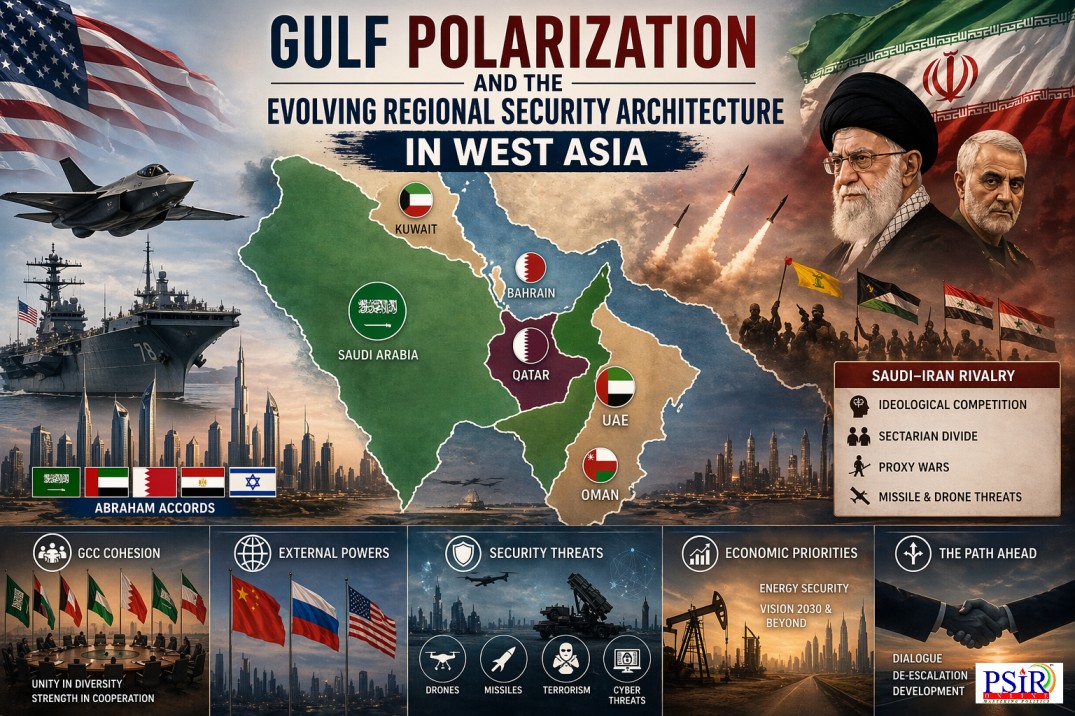
In the contemporary landscape of West Asia (often referred to as the Middle East), the Gulf region—comprising the six member states of the Gulf Cooperation Council (GCC: Saudi Arabia, United Arab Emirates, Qatar, Kuwait, Oman, and Bahrain)—stands at a critical juncture of geopolitical transformation. Polarization refers to the deepening fault lines that compel states to align along ideological, sectarian, or great-power axes, often at the expense of strategic autonomy. This dynamic is reshaping the regional security architecture, traditionally anchored in US hegemony, GCC collective defense, and pragmatic non-alignment.
This phenomenon exemplifies core theoretical debates:
· realism highlights balance-of-power politics and security dilemmas amid Saudi-Iran rivalry and US-China competition;
· liberalism underscores the limits of institutions like the GCC in fostering integration amid divergent national interests; and
· constructivism illuminates how sectarian identities (Shia-Sunni) and threat perceptions construct alliances and enmities.
The 2023 China-brokered Saudi-Iran rapprochement offered a brief respite from escalation, but the 12-Day War (June 2025) between Israel and Iran, followed by the broader US-Israeli strikes on Iran in February 2026 and Iranian retaliatory attacks on Gulf targets, have accelerated polarization. Gulf states now face acute pressures: choose sides (e.g., explicit US-Israel alignment), hedge (multi-alignment for risk mitigation), or seek external protection (from extra-regional powers like China or Russia).
HOW THE GULF’S SECURITY SETUP HAS EVOLVED
The Gulf region has spent the last century trying to figure out who should protect it. Here is the timeline of how that "security architecture" shifted:
1. The British Era (Before 1971) For a long time, Britain was the "policeman" of the Gulf, protecting the local sheikhdoms from outside threats. When Britain left in 1971, it created a power vacuum.
2. The Rise of the US and the Iran Threat (1970s–1980s) The US stepped in to fill the gap. After the 1979 Iranian Revolution and the Iran-Iraq War, the Gulf states created the Gulf Cooperation Council (GCC) in 1981. Their goal was to team up for safety, though they struggled to truly coordinate their military forces.
3. American Dominance and Regional Chaos (1990s–2010) After the 1991 Gulf War, the US established a permanent military presence (like the Fifth Fleet in Bahrain). However, the 2003 US invasion of Iraq caused major instability. It deepened the religious divide between Sunni and Shia groups and allowed Iran to gain influence by supporting various armed groups (proxies) across the region.
4. Proxy Wars and Turmoil (2011–2020) The 2011 "Arab Spring" protests caused further instability. Gulf countries and Iran ended up on opposite sides of many regional conflicts. The Saudi-led intervention in Yemen was the perfect example of "proxy warfare"—it was expensive, lasted years, and showed how vulnerable Gulf countries were to missile attacks.
5. A Changing World and Recent Tensions (2020s–Present) The landscape has become more complicated recently:
· The US Shift: As the US focused more on Asia, Gulf states felt less sure about American protection.
· New Alliances: Some Gulf nations normalized relations with Israel (the Abraham Accords) to form an informal group against Iran.
· China’s Role: In 2023, China helped Saudi Arabia and Iran briefly de-escalate their tensions, which helped the Gulf states focus on their economic growth plans (like Vision 2030).
· Recent Escalation: Since late 2023 (the Gaza conflict) and the subsequent clashes in 2025 and 2026, the region has become very dangerous again. With Iran attacking US bases in Qatar and Kuwait, Gulf states are no longer just "buffers"—they are at risk of being pulled directly into a major war.
GCC COHESION: ACHIEVEMENTS, CRISES, AND CONTEMPORARY CHALLENGES
What the GCC has Achieved?
Despite its problems, the GCC has reached several milestones:
· Economic Progress: They have created a shared market, simplified taxes for trade, and are building joint infrastructure like shared power grids and rail networks.
· Security Cooperation: They formed a joint military force (the Peninsula Shield) and work together to share intelligence on terrorism.
· A United Voice: They often issue collective statements on major global issues, such as the situation in Palestine or the truce in Yemen.
· Fixing Internal Fights: In 2021, the "Al-Ula Declaration" successfully ended a multi-year diplomatic blockade against Qatar, showing they can resolve internal disputes.

Why Cohesion is Difficult?
The GCC faces several ongoing hurdles that keep it from being a fully integrated team:
· Internal Rivalries: There is constant competition between Saudi Arabia and the UAE to be the regional leader. Meanwhile, countries like Qatar have their own independent foreign policies, and Oman and Kuwait prefer to stay neutral and avoid picking sides.
· Power Imbalances: Saudi Arabia and the UAE are much larger and richer than the other members, which creates an uneven playing field. Smaller nations often look to outside protectors rather than relying on the GCC alone.
· Weak Structure: Unlike NATO, there is no binding agreement that forces everyone to defend one another. Decisions require total agreement from everyone, meaning one country can effectively "veto" or block a group decision.
· Outside Influence: Global powers—like the US, China, and Russia—sometimes play the Gulf countries against each other, which makes it easier for them to remain divided.
THE SAUDI-IRAN RIVALRY: FROM "COLD WAR" TO DIRECT CONFLICT
For years, Saudi Arabia and Iran have been the two biggest rivals in the Middle East. Their competition is about who gets to be the leader of the region, mixed with religious differences (Sunni vs. Shia) and political tension.
· The "Cold War" Phase (Before 2023): They didn't usually fight each other directly. Instead, they fought "proxy wars"—they supported opposing sides in conflicts like Yemen, Syria, Iraq, and Lebanon.
· The Peace Attempt (2023–2025): Thanks to a deal brokered in Beijing, the two countries agreed to become friends again. They reopened embassies and tried to calm things down so they could focus on their economies (like Saudi Arabia’s "Vision 2030" plan).
· The 2026 Breakdown: The recent wars between 2025 and 2026 destroyed that peace. Even though Saudi Arabia and the UAE tried to stay out of the fighting (by refusing to let the US or Israel use their land to attack Iran), Iran attacked Gulf facilities anyway.
· Current Reality: The friendly talk is over. The Gulf states now realize that they cannot just be "friends" with Iran. Instead of trying to de-escalate (détente), they are now focused on "deterrence"—building up their own defenses so that Iran is afraid to attack them again.
US MILITARY BASES: PROTECTORS OR TARGETS?
The US has a massive military footprint in the Gulf, with about 40,000–50,000 troops and several major bases (like the US Navy base in Bahrain and the Air Force base in Qatar).
For a long time, these bases acted like a "shield." They made enemies think twice before attacking Gulf countries. However, the events of 2026 have changed that calculation.
Why the bases are a problem now:
In early 2026, Gulf countries tried to tell the US, "Do not use our land to attack Iran." They were worried that if the US used their bases for attacks, Iran would bomb them in return. The problem? Iran bombed them anyway. Suddenly, these bases—which were meant to keep the Gulf safe—turned into "bullseyes" that invited attacks.
The Pros and Cons of having US bases:
|
The Good (Pros) |
The Bad (Cons) |
|
Deterrence: Having the US nearby usually scares off other countries from starting a war. |
Target Status: The bases make the host countries a clear target for missiles or drones. |
|
Rapid Response: If a major crisis happens, the US military is already right there to help. |
Loss of Control: Gulf leaders feel like they lose some of their independence when foreign troops are always on their land. |
|
Economic Benefits: The US military presence brings in contracts, jobs, and infrastructure. |
Local Backlash: The people living in these countries are not always happy about foreign troops staying there permanently. |
HEDGING: DON’T PUT ALL YOUR EGGS IN ONE BASKET
"Hedging" is the strategy of keeping options open. Gulf nations know that relying solely on the United States is risky, but they also don't want to switch entirely to China or Russia. They are choosing to maintain relationships with everyone to keep their options flexible.
· Saudi Arabia: Uses a "zero-enemy" policy. They buy US weapons for security, but use Chinese money and expertise for their economic transformation (Vision 2030), and coordinate with Russia on oil prices.
· UAE: Highly flexible. They built security ties with Israel and the US, but keep strong trade and investment links with China and Russia.
· Qatar: The Master Mediator. They host a massive US military base but maintain open channels with rivals like Iran, Turkey, and even groups like Hamas.
· Oman & Kuwait: The traditionalists. They prefer to stay neutral and avoid picking sides, acting as "bridge-builders," though this is becoming harder to do.
The Risk: If a country "over-hedges" (tries to please everyone too much), big powers like the US or China might get frustrated and demand they pick a side.
REGIONAL DETERRENCE: BUILDING THEIR OWN SHIELD
For a long time, the Gulf relied on the US to keep them safe. Now, they are realizing they need to be able to defend themselves. This is a shift from "we have the US" to "we have the US plus our own defenses."
· New Tech: They are investing heavily in advanced air and missile defense systems.
· New Partnerships: They are exploring integrated defense networks, sometimes even looking at Israeli technology, to create a collective "shield."
· Diversity: They are not afraid to shop around. If the US won't sell them something, they are willing to look at Russian or Chinese options to fill the gaps.
THE END OF "MIDDLE-GROUND" DIPLOMACY
It used to be easy for countries like Oman or Kuwait to play the role of the neutral mediator. That time is fading.
· Polarization: As the world becomes more divided (US vs. China, or Iran vs. the Gulf), there is less room for neutrality.
· Forced Choices: During recent crises, Gulf states were pressured to allow (or deny) access to their bases. This makes it almost impossible to maintain a "neutral" status.
· Loss of Leverage: Smaller states are finding that as the region polarizes, they have less power to influence the big players.
THE FUTURE: STABILITY OR BATTLEFIELD?
The Gulf is at a major turning point. The old way of doing things—relying purely on the US and staying out of big-power conflicts—is over.
· The Path Forward: The GCC (the Gulf Cooperation Council) needs to decide if it will act as one strong, united bloc or if individual countries will continue to make separate deals.
· The Big Risk: If the Gulf states don't find a way to unite and manage these pressures, they risk becoming a "theatre" for other countries to fight their proxy wars in, rather than being the masters of their own region.
|
In international relations, the Gulf is a perfect case study of "middle powers" trying to survive in a world where the two biggest superpowers (US and China) are fighting for influence. They are using hedging to stay independent, building their own defenses to stay safe, and struggling to stay neutral in a world that is demanding they take sides. |
IMPLICATIONS OF GULF POLARIZATION FOR REGIONAL SECURITY AND STABILITY IN WEST ASIA
The dynamics outlined in the preceding article—deepening polarization, strained GCC cohesion, contested US basing, hedging strategies, evolving regional deterrence, and the erosion of middle-ground diplomacy—carry profound and multifaceted implications for West Asia’s security and stability. These forces operate in a multipolar context where the traditional US-centric order is giving way to hybrid, networked arrangements.
This reflects realist security dilemmas (states arming and aligning in response to perceived threats), liberal institutional fragility (GCC’s limited integration), and constructivist identity reinforcement (sectarian fault lines amplified by rivalry). The 2025–26 Iran-related conflicts serve as a pivotal stress test, accelerating these trends while exposing both resilience and vulnerabilities.
Short-Term Implications (Immediate Post-2026 Crisis Phase)
Polarization has already produced a “new normal” of heightened alert but contained escalation.
· Heightened Risk of Miscalculation and Horizontal Escalation: Iranian retaliatory strikes on Gulf facilities (Qatar, Kuwait, UAE) in early 2026 demonstrated that US bases can become liabilities rather than pure deterrents. Gulf states’ partial denial of basing access prevented wider entanglement but signaled to Tehran that hosts are not automatic belligerents. This creates entrapment-abandonment dilemmas (Snyder’s alliance theory): too close to the US invites Iranian targeting; too distant risks US disengagement. Result: fragile stability prone to incidents (e.g., drone swarms, cyber attacks) that could spiral if misread.
· Temporary GCC Unity on Existential Threats: Coordinated air-defense responses and joint condemnations post-2026 strikes reinforced the “indivisible security” principle. However, this unity is reactive and thin—driven by survival rather than strategic convergence. Internal rivalries (Saudi-UAE leadership competition, Qatar’s independent channels) persist, limiting operational integration.
· Erosion of Crisis Management Channels: Middle-ground diplomacy (Oman’s mediation tradition, Kuwait’s hosting role) has narrowed. States that once bridged US-Iran or Saudi-Iran divides now face pressure to pick sides during crises. This reduces “off-ramps,” increasing the probability of rapid escalation in Yemen, the Red Sea, or the Strait of Hormuz.
· Economic Shock Absorption Capacity: High oil prices and sovereign wealth fund buffers allowed Gulf states to weather 2026 disruptions. Yet sustained polarization raises insurance premiums for shipping and investment, indirectly pressuring smaller economies (Bahrain, Oman).
Medium-to-Long-Term Implications (Strategic Reconfiguration Phase)
Over the next decade, structural shifts will define whether the region trends toward greater stability or chronic fragility.
· Fragmentation vs. Deeper GCC Integration:
o Risk: Divergent hedging preferences (UAE’s agile Israel-US tilt vs. Oman’s strict neutrality vs. Saudi’s institutional balancing) could fracture collective decision-making. Without binding defense reforms, the GCC risks becoming a “talking shop” on non-existential issues.
o Opportunity: Existential Iranian pressure may catalyze the long-discussed “union phase”—joint command structures, integrated missile defense, or even a collective security treaty. Vision 2030 diversification agendas (non-oil economies) create shared incentives for stability.
· Transformation of Deterrence Architecture:
o Shift from reliance on US extended deterrence to networked, hybrid deterrence (US + indigenous capabilities + Israel + selective China/Russia tech). This diversifies risk but introduces coordination problems and potential arms-race spirals.
o Proliferation risks rise: Gulf states may quietly explore nuclear hedging if Iran’s program advances unchecked, undermining the NPT regime and regional stability.
· Hedging as Double-Edged Sword:
o Stabilizing Role: Multi-alignment (US arms + Chinese infrastructure + Russian energy coordination) prevents over-dependence on any single patron, reducing abandonment fears and giving Gulf states leverage in great-power bargaining. This enhances strategic autonomy for medium powers.
o Destabilizing Risk: Great powers may exploit divisions (e.g., China courting Qatar/UAE while Russia deepens OPEC+ ties), turning the Gulf into a theater of proxy influence. Over-hedging can signal weakness, inviting adventurism.
· Persistent Proxy and Asymmetric Threats:
o Saudi-Iran rivalry, though diplomatically managed post-2023 Beijing deal, has reignited via proxies (Houthis, Iraqi militias, Hezbollah). Polarization sustains these battlegrounds, draining resources and perpetuating humanitarian crises (Yemen, Lebanon).
o Non-state actors gain space when state alignments are ambiguous.
· Broader West Asia Spillovers:
o Polarization reinforces the Abraham Accords bloc (Israel-GCC normalization) as a de facto anti-Iran axis, potentially stabilizing the Levant through shared intelligence but alienating non-aligned actors (Turkey, Iraq) and fueling anti-normalization backlash.
o Energy transition (global shift from hydrocarbons) adds urgency: Gulf states must secure sea lanes and diversify economies before oil rents decline, or risk internal instability that spills regionally.
IMPLICATIONS OF GULF POLARIZATION AND EVOLVING REGIONAL SECURITY ARCHITECTURE FOR INDIA
Gulf polarization—driven by Saudi-Iran rivalry, strained GCC cohesion, contested US basing, hedging by Gulf states, shifting deterrence patterns, and the erosion of middle-ground diplomacy—has direct and significant consequences for India. As a rising power with vital stakes in West Asia, India’s energy security, economic interests, diaspora welfare, and strategic autonomy are deeply intertwined with regional stability. The 2025–2026 Iran-related conflicts (including the 12-Day War and subsequent US-Israeli strikes with Iranian retaliation) served as a stress test, exposing vulnerabilities while creating opportunities for New Delhi.
From a PSIR perspective, this situation tests India’s multi-alignment strategy (balancing relations with the US, Israel, Gulf monarchies, and Iran without full commitment to any bloc). It also highlights middle-power agency in a multipolar order, where India leverages economic ties and hedging to navigate great-power competition (US-China) and regional fault lines. The implications span economic, security, diplomatic, and strategic domains, with both risks and openings.
1. Energy Security and Economic Vulnerabilities
India imports a substantial portion of its crude oil and LNG from the Gulf (Saudi Arabia, UAE, Iraq, and others), with nearly 50% of its crude and significant LNG/LPG transiting the Strait of Hormuz. Polarization and conflict heighten risks of supply disruptions, price spikes, and maritime threats.
Key Implications:
· Oil Price Volatility and Inflation: Iranian actions (missile/drone strikes, threats to Hormuz) during 2026 escalated risk premiums for tankers, pushing global oil prices higher. This directly impacts India’s import bill, fuel subsidies, and overall inflation—critical for a developing economy with high energy demand.
· Diversification Pressure: The crises reinforced the need to reduce over-reliance on any single route or supplier. India has accelerated imports from diversified sources (e.g., Russia, US) and pushed for deeper GCC ties via trade agreements and local currency settlements to insulate transactions from sanctions volatility.
· Fertilizer and Broader Trade Disruptions: Gulf supplies are vital for fertilizers and other inputs; disruptions affect agriculture. GCC accounts for over 13% of India’s goods exports and a significant share of imports—logistical issues from airspace closures or shipping risks hit bilateral trade.
· Remittance Risks: The Gulf hosts millions of Indian workers (largest diaspora group). Conflict-induced economic slowdowns or safety concerns could reduce remittances (roughly one-third to 40% of India’s total inflows originate from GCC countries), affecting household incomes and the current account. Reports in 2026 noted potential 10-20% slowdowns in vulnerable sectors like construction and hospitality.
2. Diaspora Safety and Humanitarian Concerns
With over 8–10 million Indians in the Gulf (millions in UAE, Saudi Arabia, Kuwait, Qatar, etc.), polarization turns the region into a high-risk zone during escalations.
Key Implications:
· Evacuation and Safety Operations: Airspace restrictions and attacks on Gulf facilities in 2026 prompted advisories, control rooms, and contingency planning by Indian missions. Any major escalation risks mass evacuations, straining logistics and diplomacy.
· Long-Term Welfare: Economic uncertainty in Gulf states (from higher defense spending or reduced oil revenues) could affect job security for Indian expatriates, indirectly pressuring remittances and domestic politics in India.
· Soft Power Leverage: India’s proactive consular outreach strengthens people-to-people ties but also exposes limits of influence if conflicts recur.
3. Strategic and Security Implications
Gulf polarization complicates India’s security calculus in the Indian Ocean Region (IOR) and West Asia.
Key Implications:
· Maritime Security Threats: Threats to the Strait of Hormuz and Red Sea shipping lanes directly affect India’s trade (95% by volume via sea). India has warned against attacks on commercial vessels and emphasized freedom of navigation. Naval presence and exercises (e.g., with UAE, others) gain urgency.
· US Basing and Alliance Dilemmas: Attacks on US facilities in Qatar, Kuwait, and UAE during 2026 highlighted how bases can become targets. For India, this raises questions about US reliability as a security partner while testing interoperability under agreements like LEMOA (Logistics Exchange Memorandum of Agreement). India must navigate sensitivities—cooperating with the US/Israel on defense without alienating Gulf hosts or Iran.
· Hedging Opportunities for India: Gulf states’ diversification (away from exclusive US reliance toward China, Russia, Pakistan, and others) opens space for deeper India-GCC defense ties. India has strategic partnerships with most GCC states (except Bahrain), joint exercises (Desert Cyclone, etc.), and growing defense-industrial cooperation. Some analyses see Gulf interest in India as a balanced partner for training, technology, and maritime security—positioning India as a potential hedge against over-dependence on any power.
· Iran Factor: India maintains historic ties with Iran (Chabahar port for connectivity to Central Asia, energy potential). Polarization forces careful balancing: supporting GCC positions (e.g., co-sponsoring resolutions condemning Iranian attacks on Gulf states) while keeping channels open with Tehran for energy and diplomacy. Sanctions and US pressure complicate this.
· China-India Soft Rivalry in the Gulf: China’s economic footprint (infrastructure, 2023 Saudi-Iran mediation) competes with India’s. Polarization may push Gulf states toward diversified partners, benefiting India if it offers reliable, non-ideological engagement. However, China’s deeper pockets pose challenges in investment and influence.
4. Diplomatic and Geopolitical Opportunities
· Strengthened Bilateral Ties with GCC: Crises prompted high-level Indian outreach (e.g., EAM visits to UAE). This deepens economic (trade corridors, investments), defense, and technology partnerships. UAE and Saudi Arabia are key pillars; Vision 2030 alignments offer mutual gains in green energy, manufacturing, and connectivity.
· Testing Multi-Alignment: India balanced condemnation of Iranian attacks on Gulf targets with calls for restraint and dialogue involving all parties (including indirect engagement with Iran). This preserves strategic autonomy amid US-Israel ties and BRICS dynamics (where India held presidency in 2026 amid divisions).
· Potential for Enhanced Role: If GCC cohesion strengthens or hedging intensifies, India could emerge as a preferred security partner in niche areas (maritime domain awareness, counter-terrorism, training) without formal alliances. Opportunities in data centers, green transitions, and infrastructure as Gulf states seek hedges against regional risks.
· Risk of Entrapment: Closer alignment with US/Israel-backed frameworks could strain relations with Iran or non-aligned Gulf voices, while excessive caution might cede space to China or Pakistan (e.g., Saudi-Pakistan defense pact).
5. Long-Term Scenarios and Policy Takeaways for India
· Best-Case: Polarization leads to pragmatic GCC reforms and diversified deterrence, allowing India to expand economic/security footprints through bilateralism and minilaterals. Energy diversification succeeds; remittances stabilize; India positions as a stabilizing middle power.
· Worst-Case: Prolonged instability or renewed escalation disrupts energy flows, triggers mass diaspora issues, spikes inflation, and forces uncomfortable choices—potentially weakening India’s growth trajectory and strategic flexibility.
· Most Likely: Hybrid fragility persists. India continues calibrated multi-alignment: deeper GCC economic/defense ties, selective US coordination (e.g., logistics, intel), cautious Iran engagement, and competition/cooperation with China. The 2026 crises accelerated “Act West 2.0”—shifting from transactional to strategic partnerships.
RECOMMENDATIONS FOR INDIAN POLICYMAKERS
· Accelerate energy diversification (renewables, alternative suppliers, strategic reserves).
· Institutionalize defense and maritime cooperation with GCC states via joint frameworks.
· Enhance consular and economic support for the diaspora.
· Leverage forums like I2U2 (India-Israel-UAE-US) or broader connectivity initiatives while preserving autonomy.
· Monitor China’s role and counter with competitive yet cooperative economic diplomacy.
In summary, Gulf polarization poses immediate risks to India’s energy, economic, and human security but offers medium-term opportunities to deepen partnerships with a diversifying GCC. It underscores the limits and strengths of India’s multi-alignment in a multipolar West Asia. This case illustrates how regional security dilemmas in one theater ripple into great-power transitions and middle-power strategies.
PRACTICE QUESTIONS FOR GS 2 MAINS
1. “The evolving security architecture in West Asia reflects a shift from US-centric dominance to a multipolar order.” Examine the implications of this transition for regional stability.
2. Discuss how internal divisions within the Gulf Cooperation Council (GCC) affect its ability to function as an effective regional security organization.
3. The presence of foreign military bases in the Gulf has transformed from a security guarantee to a potential vulnerability. Critically analyze.
4. Evaluate the implications of West Asian geopolitical polarization on India’s energy security and diaspora interests.
PRACTISE QUESTIONS FOR PSIR OPTIONAL
1. Analyse Gulf polarization through the lenses of realism, liberalism, and constructivism. Which approach best explains the current regional dynamics?
2. “Hedging is the dominant strategy of middle powers in a multipolar world.” Discuss with reference to the foreign policies of Gulf states.
3. Examine the concept of “security dilemma” in the context of the Saudi-Iran rivalry and its impact on regional order.
4. Critically assess India’s multi-alignment strategy in West Asia in the backdrop of increasing great-power competition and regional polarization.