On April 20–23, 2026, the Mahanadi Water Disputes Tribunal (MWDT), chaired by Justice Bela M. Trivedi, expressed strong displeasure over repeated delays and the failure of Odisha and Chhattisgarh to provide consistent data on annual water availability or reach a concrete settlement. It gave the states a final opportunity to finalize minutes from a technical committee meeting (held April 8) and place any consensus on record by the next hearing on May 2, 2026—or it would proceed on merits.
Subsequent developments (as of early May 2026) show the states submitted a joint technical assessment setting average annual water availability at around 62+ MAF total, with figures like ~28.5 MAF at the Odisha-Chhattisgarh border. However, this has sparked controversy in Odisha, with activists claiming the data undercuts the state's earlier positions on reduced non-monsoon flows due to upstream projects in Chhattisgarh.
BACKGROUND ON THE MAHANADI DISPUTE
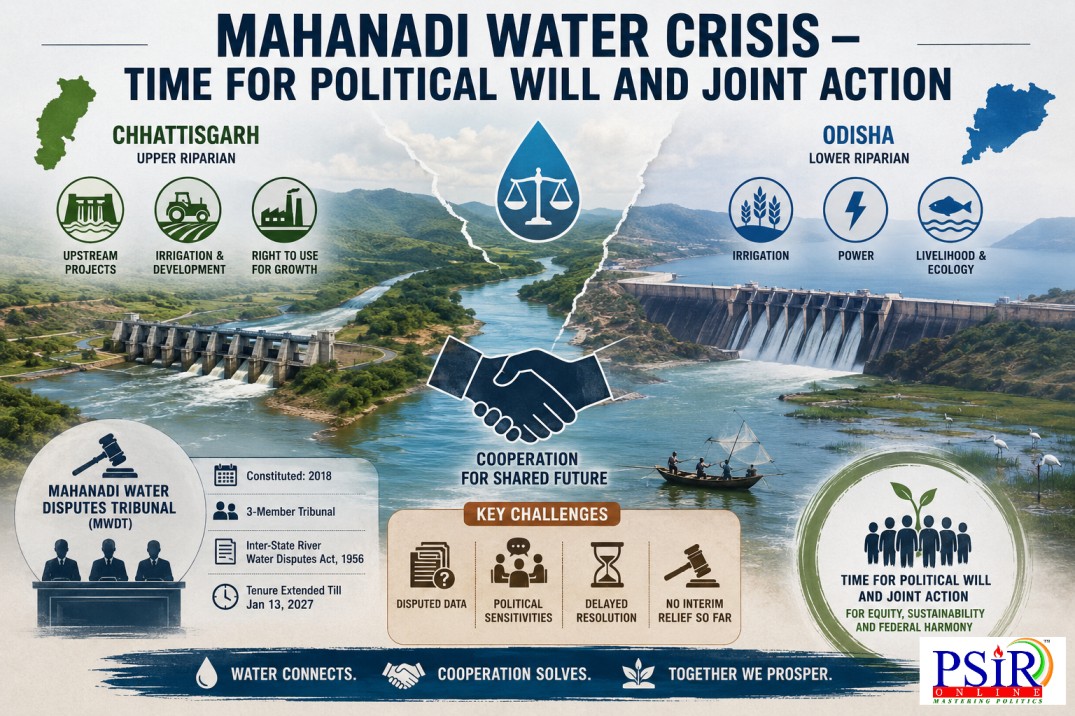
The core issue is water sharing in the Mahanadi basin. Chhattisgarh (upper riparian) has built numerous projects (barrages, etc.), which Odisha (lower riparian) argues reduce flows to the Hirakud reservoir and downstream areas, affecting irrigation, power, and ecology—especially in non-monsoon seasons. The dispute escalated when Odisha approached the Centre in 2016; the tribunal was constituted in 2018. It has received multiple extensions, with the latest pushing its tenure to January 2027
|
MAHANADI WATER DISPUTES TRIBUNAL (MWDT)
Mahanadi Water Disputes Tribunal (MWDT) is a three-member body constituted under the Inter-State River Water Disputes Act, 1956 (based on Article 262 of the Indian Constitution) to adjudicate the water-sharing dispute between Odisha (lower riparian) and Chhattisgarh (upper riparian) over the Mahanadi River.
Key Facts · Constituted: March 12, 2018, following Odisha's complaint to the Centre (2016) and a Supreme Court directive under Article 131. · Current Chairperson: Justice Bela M. Trivedi (former Supreme Court judge; took over after Justice A.M. Khanwilkar's resignation in 2024). · Members: Justice Ravi Ranjan and Justice Indermeet Kaur (as of 2026). · Tenure Extensions: Multiple extensions granted. The latest (April 2026) extends it by 9 months till January 13, 2027. · Official Site: Documents and orders available on the Ministry of Jal Shakti website (jalshakti-dowr.gov.in).
Core Dispute The Mahanadi River (851 km long) originates in Chhattisgarh (Amarkantak hills/Dhamtari district), flows ~494 km through Odisha, and drains into the Bay of Bengal. Catchment: ~53.9% in Chhattisgarh, ~45.73% in Odisha. · Odisha's Position: Upstream projects (barrages, anicuts — over 500 claimed) in Chhattisgarh reduce non-monsoon flows to Hirakud Dam and downstream areas, affecting irrigation, power, fisheries, and ecology (including Chilika Lake). · Chhattisgarh's Position: It has the larger catchment and rights to use water for its development (irrigation, industry). No prior agreement violated. · No Formal Agreement: There is no binding inter-state water-sharing pact (a 1983 agreement with erstwhile Madhya Pradesh is referenced but contested).
Tribunal Proceedings and Recent Developments (as of May 2026) · The tribunal has held multiple hearings, technical committee meetings, and field visits (e.g., Hirakud Dam, Chilika Lake in Feb 2026). · the Mahanadi Water Disputes Tribunal (MWDT) has not issued any interim order directing Chhattisgarh (upper riparian state) to release a specific quantity of water to Odisha.
|
ARTICLE 262 AND ITS "ACTUAL WORKING"
Article 262 of the Indian Constitution empowers Parliament to adjudicate inter-state river water disputes and bars the Supreme Court or other courts from interfering. It led to the Inter-State River Water Disputes Act, 1956 (amended in 2019 to create a permanent tribunal with benches and timelines).
In practice ("actual working"), it often faces significant delays:
· Asymmetric data sharing: States frequently dispute hydrological data, methodologies for yield assessment, and project impacts. The Mahanadi case exemplifies this—repeated adjournments for "amicable talks" while technical committees haggle over MAF figures.
· Political sensitivities: Water is a state subject with huge electoral stakes (agriculture, livelihoods). Governments prioritize negotiations or stall to avoid domestic backlash, leading to extensions and political-level interventions rather than swift adjudication.
· Broader pattern: Many tribunals (Cauvery, Krishna, etc.) take years or decades. The 2019 amendments aimed at faster resolution (e.g., 1.5–2 year timelines), but implementation gaps persist due to data disputes, lack of binding interim measures, and enforcement challenges.
This case highlights how Article 262 provides a framework but relies on state cooperation. Without transparent, jointly verified data and political will, tribunals become protracted forums rather than decisive ones. The tribunal's ultimatum reflects frustration with this dynamic, pushing for settlement in "larger public interest."
KEY DEVELOPMENTS OF MWDT SO FAR
April 20/23, 2026 Order (Most Recent Major One): The tribunal expressed strong displeasure over repeated delays and lack of concrete settlement proposals despite states claiming "amicable talks." It gave one last opportunity to Odisha and Chhattisgarh to finalize minutes of the technical committee meeting (April 8) on annual water availability (in MAF) and place any consensus on record by the next hearing on May 2, 2026. If not, it would proceed to adjudicate on merits with its own formula.
The tribunal has passed multiple other orders on:
o Extensions of its tenure (latest: 9 months till January 13, 2027).
o Field visits (e.g., to Hirakud Dam and Chilika in early 2026).
o Directions for data submission, joint assessments, and technical committee reports.
o Procedural matters like hearings and interim relief requests.
Post-May 2, 2026 Developments
· States submitted joint data on river flows (monsoon & non-monsoon), projecting total basin availability around 62+ MAF, with figures at key points (e.g., ~28.5 MAF at Odisha-Chhattisgarh border). This has sparked controversy in Odisha, with activists claiming it weakens the state's position on reduced flows.
· Next hearing: Scheduled for May 30, 2026.
· Political-level talks planned (e.g., May 23, 2026 meeting between the states).
Current Status
The tribunal is still in the adjudication phase and has not pronounced a final verdict. It continues to encourage a mutually agreed settlement while preparing to decide on merits if needed. Any final award would be binding but subject to limited review, with implementation depending on central and state cooperation.
MEASURES FOR OPTIMAL RESOLUTION
Faster and optimal resolution of the Mahanadi water dispute is possible, especially with the current momentum toward an amicable settlement (as of mid-May 2026). Both states have already submitted a joint technical assessment on river yield, the tribunal has explicitly welcomed out-of-court talks, and a high-level Chhattisgarh delegation is visiting Odisha on 23 May 2026 with the next tribunal hearing fixed for 30 May.
Here are practical, actionable measures (short-term + long-term) that can deliver quicker results:
1. Escalate to Chief Ministers’ Level Immediately (Highest Impact Short-Term Step)
· Hold a bilateral CM-level meeting within 2–3 weeks (right after the 23 May delegation). Both states now have BJP-led governments, creating a favourable political climate for quick consensus.
· Pre-decide key non-controversial points (e.g., minimum non-monsoon flows to Hirakud) and place a draft interim agreement before the tribunal by early June.
· Why it works: Tribunals repeatedly state that political will is the fastest route; past delays occurred precisely because talks stayed at official/technical levels.
2. Convert the Joint Technical Committee into a Permanent, Time-Bound Body
· Make the existing joint committee permanent under the Central Water Commission (CWC) with weekly meetings and a hard deadline (e.g., 31 July 2026) for a full sharing formula.
· Mandate independent third-party validation of the joint data already submitted using satellite remote-sensing and real-time telemetry (India has world-class capabilities via ISRO and NWIC).
· This directly tackles the core problem of “asymmetric data sharing” that has caused repeated adjournments.
3. Negotiate an Interim Flow Agreement Right Now
· Even before a final award, agree on binding minimum releases from Chhattisgarh’s upstream projects (e.g., Kalma Barrage and others) during non-monsoon months to safeguard Hirakud, irrigation, and Chilika ecology.
· The tribunal can record this as a consent order — it is legally enforceable and gives immediate relief to Odisha while talks continue.
4. Strengthen Central Government Facilitation & Incentives
· The Union Jal Shakti Ministry/CWC should act as active mediator (not just observer) and offer financial incentives — e.g., special central funding for joint reservoir modernisation, new irrigation projects, or environmental restoration in both states.
· Link resolution progress to faster clearance of pending projects in both states.
5. Institutional Long-Term Fix: Create a Mahanadi River Basin Organisation (MRBO)
· Establish a permanent basin authority (on the lines of the Ganga or Godavari models) with representatives from both states, Centre, experts, and stakeholders.
· Responsibilities: real-time data sharing, annual reviews, climate-change adaptive planning, and dispute prevention.
· This shifts the approach from adversarial tribunal hearings to cooperative management — proven to resolve disputes faster in other basins.
6. Enforce Strict Timelines & Use Technology
· Tribunal should set a final cut-off (say, 31 August 2026) for amicable settlement; if missed, it proceeds to award without further adjournments.
· Deploy IoT-based telemetry, satellite monitoring, and AI hydrological models for undisputed data — this eliminates the single biggest cause of delay.
If Odisha and Chhattisgarh act on these lines, the Mahanadi dispute can become a model of cooperative federalism instead of another prolonged tribunal saga.
PRACTICE QUESTION FOR GS 2 MAINS
1. The increasing use of tribunals in inter-state river water disputes reflects both the strengths and limitations of cooperative federalism in India. Discuss with reference to recent developments in the Mahanadi dispute.
2. Article 262 provides a constitutional framework for resolving inter-state water disputes, yet delays continue to persist. Examine the structural and political reasons behind such delays.
3. “Data transparency has become the new battleground in India’s federal water disputes.” Analyse this statement in the context of contemporary river-sharing conflicts.
4. Discuss how environmental concerns, livelihood security, and regional politics intersect in inter-state river water disputes in India.
PRACTICE QUESTIONS FOR PSIR OPTIONAL
1. “Indian federalism operates through negotiation as much as through constitutional design.” Critically analyse this statement with suitable contemporary illustrations.
2. Examine the role of political leadership and party alignment in shaping the functioning of cooperative federalism in India.
3. Inter-state river water disputes reveal the tension between developmental nationalism and sub-national regional interests. Discuss.
4. Analyse the role of constitutional mechanisms and extra-constitutional political negotiations in resolving Centre–State and inter-state disputes in India.