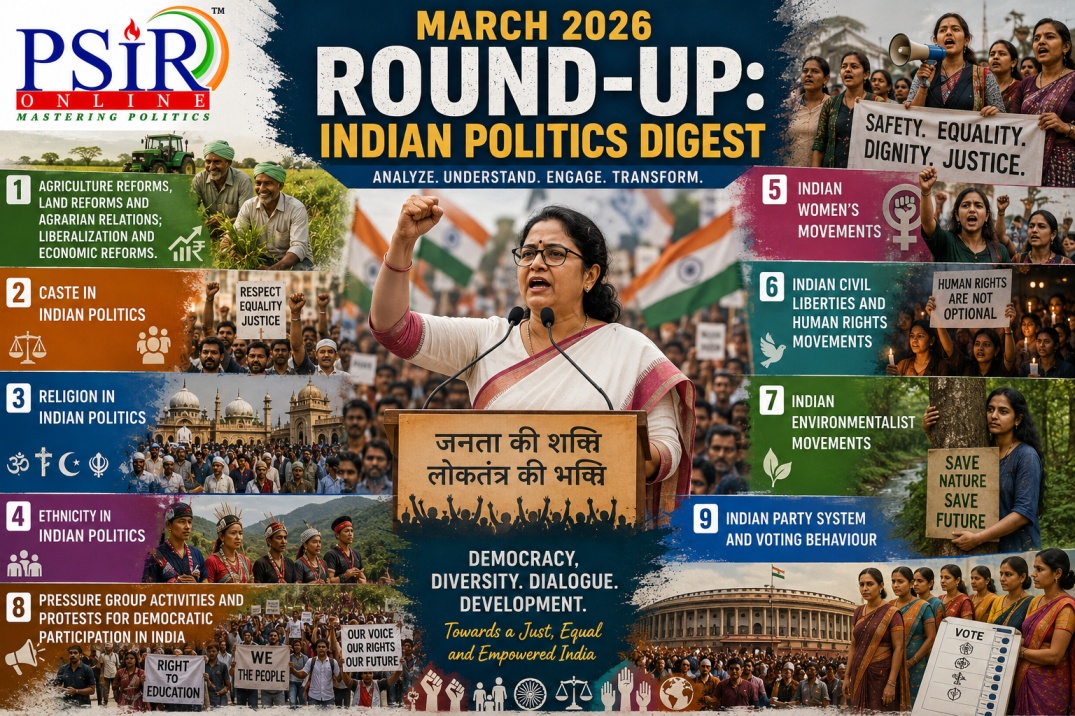
1. AGRICULTURE REFORMS, LAND REFORMS AND AGRARIAN RELATIONS; LIBERALIZATION AND ECONOMIC REFORMS.
In March 2026, Indian politics around agriculture, land reforms, and economic liberalization showed continuity with ongoing tensions rather than major new breakthroughs. Farmer pressure groups and unions remained highly active, primarily protesting perceived threats from international trade deals, while the government emphasized incremental policy tweaks focused on farmer protection, insurance, and high-value agriculture.
Agriculture Reforms and Farmer Movements
· Farmer Protests Against India-US Trade Framework: The most prominent development was renewed agitation by farmer organizations like the Samyukt Kisan Morcha (SKM) and All India Kisan Sabha. Protests occurred nationwide, including a notable gathering in Delhi on March 9, 2026, involving farmers and industrial workers. They opposed an interim India-US trade deal, fearing tariff concessions would allow subsidized US agricultural imports (e.g., in certain commodities) to undercut small Indian farmers.
o Key concerns included threats to livelihoods, especially for small/marginal farmers and in Himalayan regions (e.g., apple growers), competition with mechanized US farms, and failure to deliver on legal Minimum Support Price (MSP) guarantees.
o Actions included rallies, road blockades, effigy burnings, and village-level meetings. These built on earlier February 2026 protests and reflected pressure group politics linking trade policy with agrarian demands.
o The government (via Commerce Minister Piyush Goyal) defended the framework, claiming major agricultural products were largely excluded, but unions viewed it as insufficient consultation and a "surrender."
· Policy Focus on Protection and Efficiency: On March 25, 2026, Union Agriculture Minister Shivraj Singh Chouhan chaired a review emphasizing a shift toward "quantity and quality-led growth," better crop loss assessment, insurance mechanisms (e.g., under PM Fasal Bima Yojana), and timely relief amid climate volatility.
This aligned with broader post-Budget 2026-27 efforts to move beyond pure production to income stability, risk mitigation, and high-value crops.
· Women in Agriculture: Awareness programs and workshops (e.g., on organic farming) marked International Women's Day (March 8), highlighting empowerment themes. A Global Conference on Women in Agri-Food Systems was also scheduled around mid-March.
Land Reforms and Agrarian Relations
· Limited Specific Developments: No major new national land reform legislation or large-scale redistribution drives emerged in March 2026. Discussions remained rooted in long-standing issues like digitization of land records, tenancy reforms, and ceilings, with ongoing challenges in implementation.
· Agrarian relations discourse continued through farmer protests, which indirectly touched on land access, debt, and viability for small holders.
· Broader context includes prior state-level efforts (e.g., digitization progress at ~98.5% for rural records) and calls for better tenancy laws to improve productivity and access for marginal farmers.
Liberalization and Economic Reforms
· Trade and Liberalization Tensions: The India-US interim trade framework (with tariff adjustments) became a flashpoint, framed by critics as advancing liberalization at the expense of domestic agriculture. This echoed historical sensitivities around farm laws (e.g., 2020-21 protests).
o No sweeping new liberalization packages specific to March, but it fit into wider economic reform narratives (e.g., ease of doing business, FDI tweaks). Earlier Budget 2026-27 elements focused on manufacturing, infrastructure, and agri-related tech/AI, with agriculture positioned more as a growth engine via exports and value addition.
o Pressure groups (farmers + trade unions) linked these to demands for protecting small producers amid global integration.
2. CASTE IN INDIAN POLITICS
In March 2026, caste remained a central axis of Indian politics, with judicial rulings, preparations for the national caste census, and regional political maneuvers dominating discourse. Pressure groups, Dalit organizations, and opposition parties actively engaged, while parties navigated caste-based coalitions.
Key Judicial Development: Supreme Court Ruling on SC Status and Conversion
· March 24, 2026 Ruling (Chinthada Anand vs. State of Andhra Pradesh): The Supreme Court held that a person professing a religion other than Hinduism, Sikhism, or Buddhism cannot claim Scheduled Caste (SC) status. Conversion results in an "immediate and complete" loss of SC benefits, including reservations and protections under the SC/ST (Prevention of Atrocities) Act.
· The Court reaffirmed that SC status is tied to specific religious identities under the Constitution (Scheduled Castes) Order, 1950.
· Reactions: This sparked debate and criticism from Dalit Christian and Muslim groups, who argued it ignores persistent caste discrimination across religions. Dalit organizations and opposition voices called for inclusion in the upcoming caste census and broader protections. Some viewed it as reinforcing constitutional intent, while others saw it as limiting social justice.
This ruling intensified discussions on caste identity, conversion, and affirmative action.
National Caste Census Preparations
· The government prepared for India's first digital national census with full caste enumeration (first since 1931), scheduled to begin in phases from April 2026 (with some regions earlier). This was a major political flashpoint.
o Opposition parties (e.g., Congress) and social justice advocates pushed for it as a tool for better-targeted welfare and potential reservation revisions.
o The BJP faced internal and external pressure; the move was seen by some as a strategic response to state-level demands (Bihar, Karnataka, etc.) and electoral calculations, despite past skepticism about its divisive potential.
o Expectations were high for data on OBCs, sub-castes, and socio-economic indicators, which could reshape delimitation, women's reservation implementation, and fiscal devolution.
Regional and Pressure Group Politics
· Bihar: Political flux around Nitish Kumar's reported plans to step down as CM (around early March) and move to Rajya Sabha highlighted caste coalition management. Efforts focused on retaining Extremely Backward Classes (EBCs) and Mahadalit support amid shifting alliances.
· Uttar Pradesh and Other States: Parties vied for Dalit votes ahead of future polls. Discussions on sub-categorization and welfare schemes continued.
· Dalit and Marginalized Groups: Limited large-scale protests in March, but ongoing advocacy by Dalit outfits on atrocities, reservations, and the upcoming census. Academic and activist circles marked discussions around Dalit history and movements.
· Women and Caste Intersection: Reports on local governance (Panchayati Raj) highlighted how quotas enable entry for SC/ST/OBC women but face barriers from caste hierarchies in real decision-making power.
Broader Context
Caste politics showed continuity in vote-bank strategies, demands for sub-categorization within OBCs/SC lists, and tensions between "social justice" parties and the BJP's Hindutva-plus-social-engineering approach. The impending census amplified expectations (and fears) of renewed Mandal-style mobilization.
No single transformative national movement dominated March 2026, but the Supreme Court verdict and census buildup kept caste at the forefront of political, legal, and social debates. Developments were more institutional and preparatory than street-led, though pressure groups remained vigilant on implementation and equity.
3. RELIGION IN INDIAN POLITICS
In March 2026, religion remained deeply intertwined with Indian politics, marked by anti-conversion legislation, judicial rulings on religious identity and reservations, international scrutiny of religious freedom, and ongoing majoritarian vs. minority tensions. Pressure groups, civil society, and political parties actively mobilized around these issues.
Anti-Conversion Laws and Protests
· Maharashtra's Dharma Swatantrya Adhiniyam, 2026: The Maharashtra Cabinet approved this draft anti-conversion law on March 5, 2026. It aimed to strictly regulate religious conversions and interfaith relationships, drawing criticism for being more stringent than similar laws in other states. Civil society groups (nearly 30 organizations, including women's rights advocates) held a joint press conference on March 11 in Mumbai, raising alarms over potential misuse against minorities, especially Christians.
· Chhattisgarh Developments: The state passed the Chhattisgarh Freedom of Religion Bill, 2026. Thousands of Christians marched with torches in Raipur on March 22 to protest it, fearing increased harassment and restrictions on prayer, charity, and personal faith choices.
These moves reflected BJP-ruled states advancing Hindutva-aligned policies, often framed as protecting "freedom of religion" while critics saw them as targeting Christian and Muslim conversions.
Judicial Rulings on Religion and Identity
· Supreme Court Verdict (March 24, 2026): In Chinthada Anand vs. State of Andhra Pradesh, the Court ruled that conversion to religions other than Hinduism, Sikhism, or Buddhism results in the "immediate and complete" loss of Scheduled Caste (SC) status and associated benefits, including under the SC/ST (Prevention of Atrocities) Act. This reaffirmed the Constitution (Scheduled Castes) Order, 1950, and sparked debate among Dalit Christian/Muslim groups about ongoing caste discrimination.
The ruling intersected religion with caste politics and affirmative action.
International Reports and Reactions
· USCIRF 2026 Report: Released around mid-March, the U.S. Commission on International Religious Freedom highlighted concerns over minority rights, recommending sanctions against the RSS (including asset freezes and entry bans) for its alleged role in violations. The Indian government rejected it as biased. Opposition parties like Congress supported aspects, while church leaders criticized the government's dismissal.
This fueled domestic discourse on sectarian politics and Hindu nationalism.
Pressure Groups, Movements, and Broader Tensions
· Hindu Nationalist Mobilization: Groups affiliated with the Sangh Parivar remained active. Discussions around temple land issues and cultural assertions continued, alongside preparations for state elections where Hindutva vs. secularism was a key theme (e.g., in West Bengal, Assam).
· In March 2025, communal violence broke out in Nagpur after protests by Hindu nationalist groups demanding the removal of Aurangzeb’s tomb. The clashes left many people injured, led to arrests, and prompted the authorities to impose curfew in affected areas. Officials later demolished homes linked to some accused persons, but the Bombay High Court stopped further demolitions. The incident deepened tensions and drew wide political and public attention.
· Minority and Civil Society Responses: Christian organizations protested anti-conversion bills and burial-related disputes (e.g., Supreme Court interventions in Chhattisgarh on exhumations). Dalit and minority advocacy groups linked issues to broader social justice. Sikh diaspora activities (e.g., events abroad) reflected separate identity assertions.
· Communal and Cultural Context: While no massive nationwide riots dominated March, underlying tensions persisted, including concerns over hate speech, demographic anxieties in border states, and competitive faith politics ahead of elections.
Overall Assessment: March 2026 saw institutional and legislative pushes favoring majoritarian cultural narratives (anti-conversion laws, SC status rulings), countered by protests from minority pressure groups and civil society. These dynamics tested India's secular framework amid upcoming state polls and the national caste census preparations. Developments were more policy/judicial-driven than large-scale street movements, but they amplified polarization between Hindutva politics and demands for minority protections.
4. ETHNICITY IN INDIAN POLITICS
In March 2026, ethnicity in Indian politics was prominently featured through ongoing ethnic tensions in Northeast India, particularly in Manipur, alongside cultural promotion initiatives and tribal advocacy for land and rights. Pressure groups and ethnic organizations played key roles in both conflict dynamics and peace efforts.
Manipur Ethnic Conflict: Persistent Tensions and Early Peace Efforts
· The long-running ethnic conflict between the predominantly Hindu Meitei (valley-dominant) and Christian Kuki-Zo (hill-dominant) communities, which erupted in May 2023, continued into 2026, with over 250–260 deaths and 60,000+ displaced overall.
· Key March Development: On or around March 21, 2026, newly installed Chief Minister Yumnam Khemchand Singh (BJP) held talks with Kuki-Zo Council representatives in a neutral location (Guwahati). This marked the first direct dialogue between the sides in nearly three years. The CM described it as a "good beginning" to rebuild trust and address the trust deficit.
o Reactions were mixed: Some viewed it positively for dialogue; others (e.g., certain Meitei and Naga groups) criticized the exclusion of broader stakeholders, warning it could complicate multi-ethnic dynamics.
· Emerging Layers: Tensions extended beyond Meitei-Kuki to include Naga-Kuki frictions (e.g., incidents in Ukhrul and Kangpokpi districts involving abductions and clashes). This added complexity, with calls for inclusive talks involving all major ethnic groups (Meitei, Kuki-Zo, Naga).
These developments highlighted pressure group politics, with ethnic councils (Kuki-Zo Council, United Naga Council, Meitei organizations) actively shaping narratives, demanding separate administration or protections, and influencing state responses.
Cultural and Promotional Initiatives
· Tribes Art Fest 2026 (March 3–13, New Delhi): Organized by the Ministry of Tribal Affairs, it celebrated over 30 tribal art forms from across India, featuring 70+ master artists and 1,000+ artworks. This served as a cultural-political move to highlight indigenous heritage and promote national integration.
· North East Conference 2026 (early March, Delhi): Focused on Northeast India's heritage, development, customary traditions, social harmony, and infrastructure. It brought together policymakers, academics, and community leaders, underscoring ethnic diversity as a strength amid challenges.
Broader Tribal and Ethnic Advocacy
· Tribal pressure groups continued demands for Forest Rights Act (FRA) implementation, land rights, and protections against displacement (e.g., in central India and Maharashtra, with echoes in earlier 2026 marches).
· In Assam and other Northeast areas, indigenous communities pushed for Scheduled Tribe status and safeguards against illegal settlers/immigration under Sixth Schedule provisions.
· Intersection with other issues: Ethnic demands often overlapped with anti-conversion laws, reservation politics, and border security concerns (e.g., Myanmar refugee influx affecting ethnic balances).
Overall, March 2026 reflected a mix of conflict management (Manipur peace talks) and cultural assertion (tribal festivals/conferences). Pressure group activism by ethnic councils and tribal outfits remained central, pressuring governments on autonomy, land, and representation. While no nationwide ethnic explosion occurred, Northeast dynamics—rooted in historical hill-valley divides, identity assertions, and resource competition—dominated ethnic politics. These movements tested federal accommodation strategies amid India's diverse ethnic landscape.
5. INDIAN WOMEN’S MOVEMENTS
In March 2026, Indian women’s movements centered on International Women’s Day (IWD) celebrations, government-led empowerment initiatives, and advocacy against perceived regressive legislation. Activities blended official events promoting "Nari Shakti" (women's power) with civil society pushback on rights issues.
International Women’s Day (March 8, 2026)
· Theme: “Rights. Justice. Action. For ALL Women and Girls” (aligned with global UN focus on dismantling barriers to equality).
· Government Initiatives: Nationwide events emphasized women-led development (Nari Shakti as foundation for Viksit Bharat). Key highlights in Delhi included:
o Shakti Walk (#SheLeadsBharat) along Kartavya Path (India Gate to Vijay Chowk), showcasing women from diverse fields.
o Celebrations at Manekshaw Centre with President Droupadi Murmu, honoring achievers in governance, science, enterprise, security, and grassroots leadership.
· Community & Health Events: Pinkathon and women’s runs in cities like Delhi, Bengaluru, and others promoted health, fitness, and awareness. Workshops on organic farming, empowerment, and economic participation occurred.
These events reflected a narrative of progress in women’s workforce participation, education, and leadership under schemes like Beti Bachao Beti Padhao and Ayushman Bharat.
Pressure Group Politics and Protests
· Opposition to Transgender Persons (Protection of Rights) Amendment Bill, 2026: This was a major flashpoint. The bill (introduced mid-March, passed Lok Sabha on March 24 and Rajya Sabha on March 25) shifted from self-identification to a more medicalized/certification-based process. It faced strong criticism from feminist, queer, and transgender activists as regressive and violating dignity/autonomy.
o Protests erupted in Delhi (e.g., Jantar Mantar on March 26) and other cities, with demands for repeal and inclusive consultation. Groups argued it undermined the 2014 NALSA judgment and broader gender rights.
o Amnesty International and others called it a major step backward for human rights.
· Broader advocacy continued on issues like gender-based violence, workplace safety, political representation, and implementation of existing laws. No large-scale nationwide street movements akin to past years dominated, but civil society groups remained vocal.
Broader Context
· Women’s Reservation (Nari Shakti Vandan Adhiniyam): Discussions around the 2023 Act’s implementation (tied to delimitation) featured in IWD discourse, with calls for faster rollout and sub-quotas for marginalized women. Political debates intensified later in April.
· Intersectional focus: Events highlighted rural women, tribal communities, and economic empowerment, alongside global solidarity on violence and justice.
6. INDIAN CIVIL LIBERTIES AND HUMAN RIGHTS MOVEMENTS
In March 2026, civil liberties and human rights movements in India faced significant challenges, with continued concerns over shrinking civic space, restrictions on free speech, targeting of journalists and activists, and institutional issues. Pressure groups, NGOs, and international bodies remained active in advocacy and protest.
Key Institutional and International Developments
· National Human Rights Commission (NHRC): In March 2026, the Global Alliance of National Human Rights Institutions (GANHRI) recommended downgrading India's NHRC to "B" status due to concerns about its independence, transparency, and effectiveness. Human rights organizations, including FIDH and others, urged sustained international pressure for reforms ahead of GANHRI meetings.
o The NHRC itself published its March 2026 newsletter, highlighting awareness programs, workshops on women's safety, mental health, and youth empowerment, while addressing specific complaints like assaults on journalists.
· UN and International Scrutiny: On March 3, the UN High Commissioner for Human Rights raised issues about violence and displacement in Manipur and shrinking civic space in Jammu & Kashmir, which the Indian government dismissed. Broader global reports (e.g., HRW World Report 2026, Freedom in the World 2026) continued to critique India’s trajectory on democratic backsliding, minority rights, and civil liberties.
Freedom of Expression and Media
· Arrests and FIRs:
o March 24: Maharashtra police filed an FIR against comedian Kunal Kamra for a parody in his stand-up show referring to a leader as a "traitor."
o March 24: Assam police arrested journalist Dilwar Hussain Mozumdar for reporting on a protest about alleged financial misconduct at a state-run bank.
· Ongoing concerns included harassment of journalists, sedition/UAPA cases, and restrictions on dissent, as noted in broader 2025–2026 assessments.
Minority Rights, Communal Tensions, and Other Issues
· Nagpur Clashes (March): Hindu-Muslim violence erupted in Nagpur after Hindu nationalist protests demanding removal of a former Muslim ruler’s tomb. Dozens were injured, over 60 arrested, and a curfew imposed. Authorities razed homes of some accused Muslims until a High Court halted further demolitions.
· Kashmir: Continued advocacy for detained journalist and human rights defender Irfan Mehraj, who marked three years in pre-trial detention under UAPA.
· Transgender Rights: Toward the end of March (passed Lok Sabha on 24th, Rajya Sabha on 25th, presidential assent shortly after), the Transgender Persons (Protection of Rights) Amendment Bill, 2026 was enacted. It faced strong criticism from Amnesty International, UN experts, and activists for moving away from self-identification toward a more medicalized/certification-based system, seen as regressive and violating rights to dignity and autonomy.
Pressure Groups and Civil Society Movements
· Organizations like People’s Union for Civil Liberties (PUCL) remained active, issuing statements and organizing events on issues such as custodial torture and police accountability (e.g., a March 12 event on Delhi Police actions).
· Broader campaigns focused on protecting NGOs from FCRA restrictions, opposing asset seizures of non-profits, and highlighting impacts on minority rights and climate advocacy groups.
· Civil society pushed back against perceived majoritarianism, internet shutdowns, and restrictions in conflict areas like Manipur.
Overall Assessment: March 2026 saw heightened international and domestic scrutiny of India’s human rights record alongside specific legislative and enforcement actions that activists viewed as erosive of civil liberties. Movements were largely advocacy-driven (statements, legal challenges, international appeals) rather than massive street mobilizations, amid ongoing pressures on media, minorities, and dissent.
7. INDIAN ENVIRONMENTALIST MOVEMENTS
In March 2026, Indian environmentalist movements focused on awareness campaigns, local protests against development projects, and policy discussions, with a blend of government-led initiatives and civil society advocacy. Activities emphasized climate awareness, biodiversity, and resistance to ecologically harmful infrastructure.
Major Awareness Events
· Earth Hour 2026 (March 28): Celebrated its 20th anniversary with widespread participation. WWF-India organized the Earth Hour Festival on March 15 in New Delhi, featuring music, art, and conservation themes. Nationwide events encouraged switching off non-essential lights from 8:30–9:30 PM. The Indian Army and other institutions joined to promote climate awareness under "Our Power, Our Planet."
· World Sustainable Development Summit (WSDS) 2026: Held around March 22 in New Delhi, it brought together global voices on climate action, energy transition, and sustainable development. Discussions highlighted India's role and challenges in balancing growth with environmental goals.
Pressure Group Protests and Local Movements
· Mumbai "Rise for Nature, March for Justice" (March 23): A significant protest at Azad Maidan united fishing communities (Kolis), tribals (Adivasis), youth groups, and citizen activists. They opposed large-scale infrastructure and port projects threatening Mumbai’s coasts, forests, mangroves, and wildlife. Authorities denied permission for a march from Girgaum Chowpatty, leading to a gathering instead. This reflected ongoing urban environmental activism against development vs. ecology conflicts.
· Broader movements continued on issues like forest rights, anti-mining, and coastal protection, building on historical campaigns (e.g., Chipko-inspired efforts).
Policy and Institutional Developments
· Parliamentary Discussion (March 9): Lok Sabha/Rajya Sabha debated the Ministry of Environment, Forest and Climate Change (MoEF&CC), covering Mission LiFE (Lifestyle for Environment) and citizen involvement in sustainability.
· National Green Tribunal (NGT) Activity: Multiple orders in March, including scrutiny of Himachal Pradesh’s waste management claims (March 23–24) and other cases on pollution and environmental compliance.
· Climate Policy Context: Around late March, India’s revised emissions reduction plans through 2035 drew attention for a cautious approach, balancing development needs with global climate goals.
Overall, March 2026 featured symbolic and awareness-driven actions (Earth Hour, summits) alongside targeted local resistance (Mumbai protests). Environmentalist groups and pressure networks (WWF-India, community collectives) pushed for stronger protections amid development pressures, while engaging with government programs like Mission LiFE. Movements remained more localized and event-based than nationwide mobilizations, consistent with India’s federal environmental politics
8. PRESSURE GROUP ACTIVITIES AND PROTESTS FOR DEMOCRATIC PARTICIPATION IN INDIA
In March 2026, pressure group activities and protests focused on democratic participation in India emphasized electoral integrity, voter rights, and regional demands for greater autonomy and representation. Civil society organizations, regional alliances, and advocacy groups drove these efforts amid concerns over institutional credibility and exclusion.
Electoral Reforms and Transparency Advocacy
· ADR Stakeholder Discussion (March 10, 2026, New Delhi): The Association for Democratic Reforms (ADR) and National Election Watch (NEW) organized a key event at the India International Centre. It featured sessions on:
o Criminalization of politics and its impact on electoral integrity.
o Rebuilding transparency in political finance after the Electoral Bonds scheme.
o The appointment process of Election Commissioners and its effect on credibility.
o Participants included former Chief Election Commissioners (e.g., Om Prakash Rawat), MPs, academics, and civil society leaders. The goal was to develop concrete reform proposals for submission to authorities, highlighting ongoing civil society efforts to strengthen democratic institutions.
· This reflected sustained pressure group work on systemic electoral issues.
Voter Rights and Special Intensive Revision (SIR) Protests
· Protests emerged against the Election Commission of India's Special Intensive Revision (SIR) of electoral rolls, which removed millions of names ahead of state elections (notably in West Bengal and other states). Critics alleged disproportionate impact on minorities, poor voters, and marginalized groups.
o In Kolkata, demonstrations occurred in late March (e.g., around March 28), with voting-rights activists and civil society groups protesting alleged harassment and arbitrary deletions. Placards and rallies demanded transparency and protection of constitutional voting rights.
o Groups like the Voter Adhikaar Dharna Manch organized awareness drives and dharnas, warning that the process undermined democratic participation.
These actions framed SIR as a threat to inclusive democracy.
Regional Autonomy Movements: Ladakh Protests
· March 16, 2026: Major protests and a shutdown in Leh and Kargil (Ladakh), called by the Leh Apex Body (LAB) and Kargil Democratic Alliance (KDA). Thousands marched demanding:
· Full statehood for Ladakh.
· Inclusion under the Sixth Schedule of the Constitution (for tribal safeguards, land, and cultural protections).
· Separate parliamentary seats and job reservations.
· The protests proceeded despite the recent release of activist Sonam Wangchuk (on March 14). They highlighted long-standing grievances over limited democratic representation since Ladakh became a Union Territory in 2019.
This was one of the most visible pressure group mobilizations for enhanced federal democratic rights.
Broader Civil Society Context
· Groups like PUCL (People’s Union for Civil Liberties) remained active on related civil liberties issues intersecting with democratic space (e.g., events on police accountability).
· No single nationwide mass movement dominated, but these activities illustrated decentralized, issue-based pressure politics aimed at safeguarding participation, transparency, and regional voices.
Overall, March 2026 developments were institutional-advocacy focused (ADR event) combined with targeted regional and rights-based protests (Ladakh, voter rolls). Pressure groups continued to compensate for limited formal access by mobilizing public opinion and pushing for reforms, amid ongoing debates on democratic backsliding and electoral fairness. These fit into longer-term patterns of civil society engagement in India's federal democracy.
9. INDIAN PARTY SYSTEM AND VOTING BEHAVIOUR
In March 2026, Indian politics was dominated by intense preparations for the multi-state Assembly elections (Assam, West Bengal, Tamil Nadu, Kerala, and Puducherry) scheduled for April 2026, with results in early May. This period highlighted evolving coalition strategies, the persistent strength of regional parties, and the BJP’s continued push for expansion.
National and Regional Political Parties + Ideological/Social Bases
· BJP (NDA): The party focused on consolidating its Hindutva ideological base while expanding through welfare schemes ("labharthi politics") and cultural polarization. It aggressively targeted West Bengal (aiming to end TMC rule) and strengthened positions in Assam. Candidate lists released in March showed efforts to attract diverse social groups, including OBCs, tribals, and younger voters.
· Congress and INDIA Bloc: The opposition alliance (led by Congress) emphasized secularism, social justice, and federalism. Regional allies like TMC (Mamata Banerjee), DMK, and others maintained strong caste/regional identity bases. The bloc faced internal coordination challenges but projected unity against "one-party dominance."
· Regional Parties: Strong in their domains — TMC in Bengal (Bengali sub-nationalism), DMK/AIADMK/TVK in Tamil Nadu (Dravidian ideology), and others. Regional forces continued to act as counterweights to national parties, especially in the South and East.
Patterns of Coalition Politics
· Pre-poll Maneuvering: NDA and INDIA blocs finalized seat-sharing and strategies. In West Bengal, BJP-led NDA positioned itself against TMC+ and Left+ alliances. In other states, similar alliance arithmetic played out.
· National Implications: The 2024 Lok Sabha outcome (BJP short of majority, relying on allies like JD(U) and TDP) continued to shape dynamics. Regional parties gained leverage in coalition bargaining at both state and national levels.
· March saw heightened activity around alliance consolidation, with leaders like Mamata Banerjee signaling efforts to strengthen the INDIA bloc for future national contests (e.g., 2029).
Trends in Electoral Behaviour
· High Stakes Buildup: The Election Commission announced the election schedule on March 15, 2026, triggering the Model Code of Conduct. Focus areas included voter list revisions (Special Intensive Revision), polarization on issues like infiltration/identity (especially in Assam and Bengal), and youth/Gen Z mobilization (nearly 29% of voters in some states).
· Campaigns emphasized welfare, anti-incumbency, and communal/identity fault lines. High voter turnout expectations and use of digital/propaganda tools were notable.
· Analysts observed a trend toward majoritarian consolidation in some regions alongside resilient regional and caste-based voting in others.
Changing Socio-Economic Profile of Legislators
· No major nationwide study or shift specific to March 2026 was released, as new assemblies were elected only in May. However, ongoing trends from the 18th Lok Sabha (2024) continued:
o Increasing representation of younger MPs/MLAs, higher educational qualifications, and more business/professional backgrounds.
o Gradual rise in women and OBC representation, though upper castes still held disproportionate influence in many parties.
o Discussions in March around candidate selection reflected parties’ attempts to balance winnability with diversity (e.g., more under-40 candidates).
Overall, March 2026 served as a critical preparatory phase for what proved to be a pivotal electoral cycle. It underscored the tension between the BJP’s drive toward dominance and the resilience of regional/coalition politics rooted in India’s federal and diverse social structure. Developments were campaign-oriented rather than transformative, setting the stage for significant shifts visible in May results.