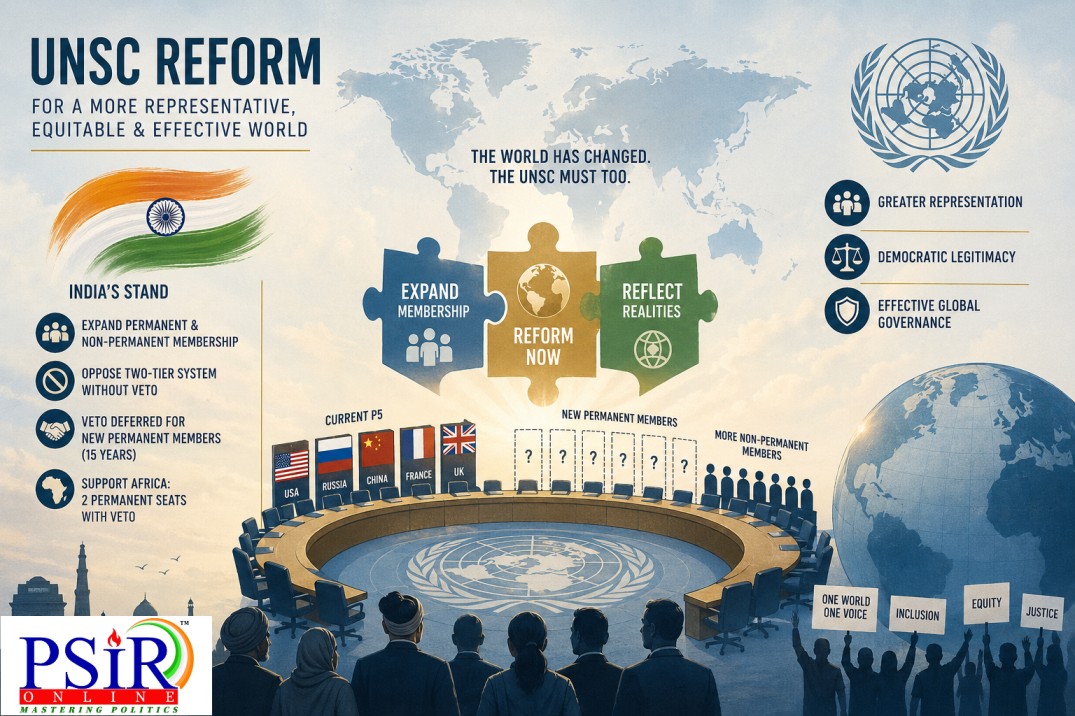
On 20 February 2026, India “sharpened” its demand for comprehensive reform of the United Nations Security Council (UNSC) during the latest round of Intergovernmental Negotiations (IGN) in New York. This move comes amid growing global frustration that the Council’s structure, frozen in the 1945 order, no longer reflects the weight, contributions, or geopolitical realities of fast‑rising powers such as India, Brazil, Japan, and Germany.
WHY UNSC REFORM MATTERS
The UNSC holds primary responsibility for maintaining international peace and security, yet only five permanent members—China, France, Russia, the United Kingdom, and the United States—enjoy veto power. Over 75 years later, the Council still excludes major economies and regions such as Africa, Latin America, and much of Asia, deepening the legitimacy deficit of the UN system.
India frames comprehensive reform as a matter of democratic legitimacy, geographic representation, and functional effectiveness:
· Expansion of both permanent and non‑permanent membership to include the Global South.
· Redress of the veto‑centric imbalance that allows five states to override the will of 180+ others.
· Alignment of the Council with 21st‑century power distributions, including India’s role as a nuclear‑armed, G20 and BRICS member with significant UN peacekeeping contributions.
INDIA’S POSITION ON UNSC REFORM
India’s latest statement in the IGN reiterated its long‑standing case for a comprehensive, transparent, and irreversible overhaul of the Council. Key elements of its position include:
· Expansion of permanent membership: India insists that genuine reform must include new permanent seats, not just larger but still temporary non‑permanent representation.
· Opposition to a “two‑tier” system: India rejects proposals for a third category of permanent members without veto or a “semi‑permanent” tier, calling them delay tactics that dilute equality and credibility.
· Flexibility on veto (G4 compromise): India, along with the G4 group (India, Brazil, Germany, Japan), has backed a transitional model in which new permanent members would not exercise veto power for 15 years, pending a future review.
· Support for African demands: India endorses African‑led calls for at least two permanent seats with veto rights if the veto itself is retained, to rectify colonial‑era under‑representation.
India argues that without expanding the permanent category, reform remains “incomplete and unjust”, and that the current status‑quo delegitimizes multilateralism.
COUNTRIES AND GROUPS THAT ACCEPT INDIA’S POSITION
India’s call for comprehensive UNSC reform is broadly supported by a majority of UN member states, especially the Global South. Particularly notable are:
· G4 nations (Brazil, Germany, Japan, India): They jointly present a detailed model for enlarging both permanent and non‑permanent membership, with temporary deferral of veto for new entrants.
· African Group and the African Union: They demand two permanent seats with veto rights for Africa, closely aligning with India’s push for structural enlargement and against a diluted veto regime.
· OIC, L69, and many developing countries: Numerous coalition statements and written submissions in the framework document favour expansion in both categories of membership, lending statistical weight to India’s claim that over 90% of submissions support this track.
· UN Secretary‑General and civil‑society voices: António Guterres and several think‑tank studies have explicitly welcomed India’s support for reform and urged the P‑5 to move beyond “incrementalism”.
POSITIONS OF UNSC PERMANENT MEMBERS
China
China has not formally endorsed expansion of permanent membership and often uses arguments about “consensus” and “manageability” to block substantive progress.
· It rhetorically supports UN reform and developing‑country representation, but acts as a decisive brake on specific proposals that would institutionalize India, Japan, or European powers as permanent members.
· China prefers incremental improvements in decision‑making practice over a legally entrenched expansion of the permanent category.
Russia
Russia publicly accepts, in principle, the need for new permanent and non‑permanent members, but insists on maintaining the centrality of the five veto‑wielding states.
· Moscow harbours geostrategic reservations about the entry of certain Western or Indo‑Pacific powers, especially if it weakens Russia’s room to manoeuvre.
· It uses reform debates to highlight multipolarity but stops short of concrete compromise on veto or clear candidate lists.
USA
The Biden administration has gone further than many predecessors in endorsing UNSC enlargement, including both permanent and non‑permanent seats.
· The United States has signalled support for India and Japan as likely permanent members, positioning reform as part of a broader Indo‑Pacific strategy.
· However, Washington remains cautious on curtailing veto rights, preferring “practices” and transparency measures rather than a wholesale overhauling of veto politics.
United Kingdom
The UK has long backed a more flexible Council, including a new category of longer‑term seats that could evolve into permanent status without full veto.
· London acknowledges European over‑representation and is open to adjustments that would make room for India, Brazil, Japan, and African candidates.
· Its preferred route is gradual institutional evolution rather than a one‑time constitutional overhaul.
France
France, like the UK, is relatively “forward‑leaning” on reform among the P‑5.
· It has supported new permanent seats and expanded non‑permanent representation, particularly for Africa and Latin America.
· Paris has also experimented with self‑restrictions on veto use in mass‑atrocity cases, signalling openness to soft‑law constraints even as it resists formal abolition.
VIEWS OF OTHER POWERFUL COUNTRIES ON UNSC REFORM
Germany
As a G4 member, Germany championed the 15‑year veto deferral formula for new permanent members.
· Berlin argues that a reformed, expanded Council better reflects the EU’s economic weight and Germany’s major contributions to UN peacekeeping and development.
· It accepts temporary asymmetry in veto rights as a pragmatic price for unblocking a stalled negotiation.
Israel
Israel has not formally claimed a permanent seat but has repeatedly urged greater regional representation in the Council, especially for the Middle East.
· Its position is often framed around geopolitical balance and opposition to proposals that it views as entrenching Arab or Iranian influence without reciprocal space for Israel.
Canada
Canada, part of the “Uniting for Consensus” (UfC) group, has historically opposed expansion of permanent membership, worrying that it will entrench power and reduce flexibility.
· Ottawa favours larger non‑permanent, rotating seats and procedural reforms (e.g., transparency, veto practice) as a less rigid alternative.
Australia
Australia has aligned with the Quad‑linked consensus backing UNSC enlargement, including support for India and Japan as permanent members.
· Canberra also supports stronger African representation, seeing it as essential for the Council’s legitimacy in the Indo‑Pacific and global rules‑based order.
Japan
Japan, as a G4 member and major financial contributor, has consistently demanded permanent membership for itself and India.
· Tokyo’s stance centres on functionality and burden‑sharing: its high UN budget share and peacekeeping contributions, it argues, justify a permanent seat.
WHICH REFORMS ARE PRACTICALLY FEASIBLE?
Given entrenched disagreements, only a limited set of options appears politically realistic in the near term.
· Expansion of permanent seats with deferred veto: The G4 proposal (new permanent members without veto for 15 years) is currently the most concrete compromise on the table. It balances India’s demand for permanent status with P‑5 anxieties about veto dilution.
· African permanent seats: Strong symbolic and political backing exists for at least two permanent seats for Africa, but battles over veto and candidate lists block agreement.
· Enhanced non‑permanent seats: A rise in non‑permanent membership (e.g., two‑tier or longer‑term seats) is easier to negotiate and is implicitly favoured by Canada and some European states.
· Procedural constraints on veto: Past ideas such as super‑majority vetoes or automatic referral to the General Assembly after a veto remain politically fragile but are the most “pragmatic” band‑aid reforms.
SUGGESTED MEASURES TO MOVE FORWARD
1. Consolidate and formalize the G4–African consensus
a. India, Brazil, Germany, Japan and African‑Union‑designated candidates should jointly table a single text on permanent‑seat expansion, with a clear 15‑year veto‑deferral mechanism and a sunset review clause.
2. Link expansion to performance and contribution criteria
a. Define transparent metrics for new permanent members (peacekeeping contributions, UN budget share, regional leadership, adherence to human‑rights norms) to reduce purely political horse‑trading.
3. Gradual veto constraints
a. Adopt a code of conduct on veto use in cases of mass atrocities, with a commitment to subject such vetoes to an automatic General Assembly review.
4. Reform of working methods and transparency
a. Expand open debate formats, increase the role of regional groups in selection, and institutionalize regular reporting by the Council to the General Assembly.
5. Build a “coalition of the willing” among large democracies
a. India can spearhead an informal grouping of major democracies (Quad partners, EU members, Latin American powers) to coordinate positions and pressure the P‑5 through coordinated diplomacy at the General Assembly.
6. Leverage major UN milestones
a. Use the UN’s 80th anniversary and future high‑level summits as deadlines to push for a beginning of text‑based negotiations, moving beyond vague “framework” talk.
India’s sharpest 20 February 2026 intervention in the IGN underscores that comprehensive UNSC reform is no longer optional if multilateralism is to retain credibility. While a full overhaul faces resistance from vested interests, a pragmatic, stepwise enlargement—anchored in the G4–Africa consensus and a transitional veto regime—offers the most viable path toward a more representative and effective Security Council
PRACTISE QUESTIONS FOR GS 2 MAINS
1. “The legitimacy crisis of the United Nations Security Council (UNSC) stems from its outdated structure.” Examine in the context of India’s demand for comprehensive UNSC reform.
2. Discuss India’s position on UNSC reform. How does it balance principles of equity, representation, and pragmatic compromise?
3. Why has UNSC reform remained elusive despite broad global support? Analyze the role of P5 countries in shaping the reform trajectory.
4. Evaluate the feasibility of proposed UNSC reform models such as expansion of permanent membership with deferred veto and increased non-permanent seats.
PRACTISE QUESTIONS FOR PSIR OPTIONAL
1. Critically analyze the politics of UNSC reform negotiations. To what extent do power asymmetries and institutional inertia shape outcomes?
2. Examine India’s UNSC reform strategy in the context of Global South solidarity and great power politics.
3. “UNSC reform debates reflect the tension between realism and institutionalism in global governance.” Discuss with reference to current negotiations.
4. Assess the role of coalition-building (G4, African Union, L69, UfC) in advancing or obstructing UNSC reform. What lessons does this offer for multilateral diplomacy?