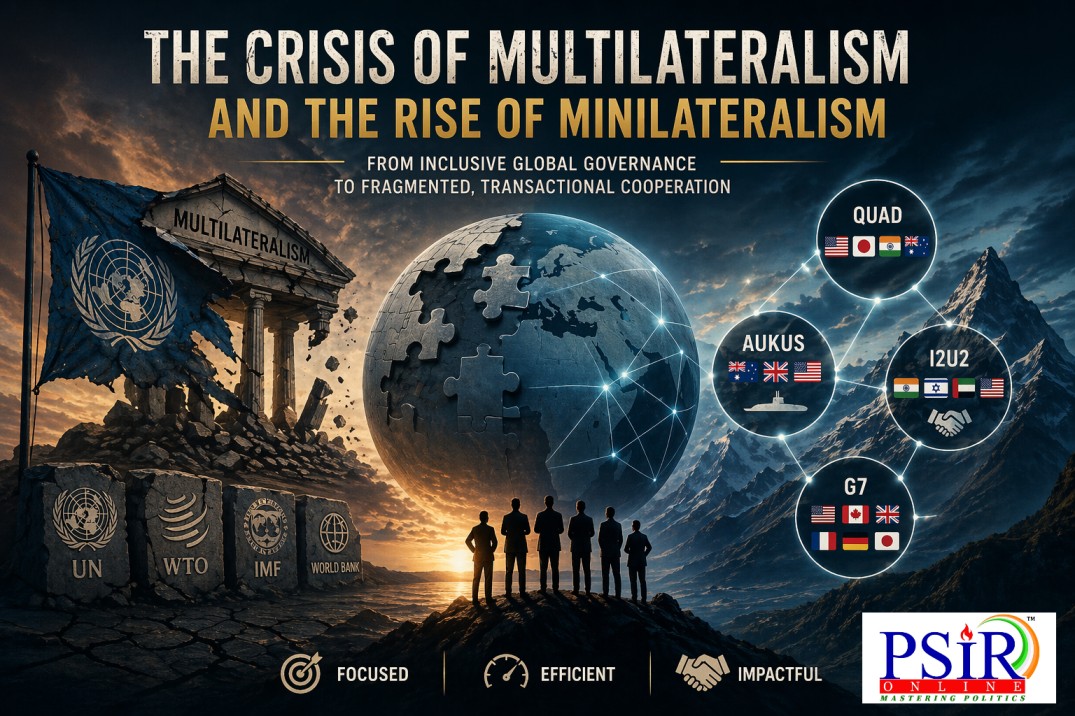
The architecture of the post-WWII liberal international order (LIO) was built on a foundation of "embedded liberalism"—the idea that open markets, democratic governance, and rule-based multilateral institutions would create a stable, peaceful, and prosperous global system. At the center of this edifice stood the United States, acting as both the primary architect and the security guarantor.
However, in the mid-2020s, that foundation is visibly fracturing. Reports of US disengagement from over 65 international organizations, bodies, and treaty commitments signal more than just domestic policy shifts; they indicate a profound structural realignment. This trend suggests that the world is moving away from the comprehensive, inclusive, and norm-driven multilateralism of the 20th century toward a more fragmented, transactional, and "minilateral" world.
THE HISTORICAL CONTEXT: THE DECLINE OF THE "BENIGN HEGEMON"
To understand the current crisis, we must view it through the lens of Hegemonic Stability Theory (HST). According to HST, international regimes are most stable when a single dominant power—a hegemon—is willing and able to bear the costs of providing public goods, such as security, open trade, and stable global institutions.
Following 1945, the US assumed this role. It created the UN, the Bretton Woods institutions (IMF and World Bank), and the GATT/WTO. These organizations were designed to institutionalize American power while providing a platform for international cooperation. The system was "liberal" because it was theoretically open to all states, provided they adhered to Western normative standards.
The Shift in US Calculus
The current trend of "disengagement" suggests a fundamental change in how Washington calculates the utility of these institutions. The US, once the primary funder and leader of these entities, is increasingly adopting a "Transactional Multilateralism" framework:
· Cost-Benefit Analysis: If an organization’s output does not directly align with immediate US national security or economic interests, the incentive to fund it diminishes.
· The "A La Carte" Strategy: The US is moving toward selective participation. It participates in, supports, and funds only those international frameworks that offer clear, tangible advantages, while ignoring or actively undermining those perceived as bureaucratic, inefficient, or hostile to American interests.
THEORETICAL PERSPECTIVES ON THE DISENGAGEMENT TREND
How do we interpret this shift? Three major IR theories provide a framework for analysis.
A. Neorealism: The Return of Power Politics
Neorealists argue that international institutions are merely reflections of the distribution of power. When the US was the undisputed unipole, it could afford the costs of multilateralism to maintain legitimacy. As the international system transitions toward multipolarity, the US is behaving as a rational actor, abandoning "costly" institutions that it no longer solely controls. In this view, the "death" of the LIO is a natural byproduct of a shifting power balance.
B. Liberal Institutionalism: The Danger of Fragmentation
Liberal institutionalists argue that the US is committing a strategic error. By stepping back, the US is not just weakening "international organizations"; it is weakening the global mechanisms that lower transaction costs, facilitate cooperation, and prevent conflict. When the hegemon abandons the rules-based order, it encourages other powers to disregard these norms, leading to a "Hobbesian" environment where might makes right.
C. Constructivism: The Crisis of Meaning
Constructivists focus on the normative decay. The "liberal" order was held together by shared values—human rights, democracy, and collective security. The turn toward transactionalism signals a loss of belief in these shared values. If the world stops viewing international organizations as vessels for progress and starts viewing them as arenas for zero-sum competition, the very identity of the global order changes.
THE RISE OF "MINILATERALISM": EFFICIENCY VS. INCLUSIVITY
As the US disengages from large, inclusive bodies (like parts of the UN system or broad-based trade blocs), it is increasingly pivoting toward "Minilateralism." Coined by scholars like Moises Naim, minilateralism refers to the practice of small, ad-hoc groups of countries coming together to solve specific problems, rather than relying on large, slow, and often gridlocked multilateral forums.
Characteristics of the Minilateral Model
|
Feature |
Multilateralism (Traditional) |
Minilateralism (Emerging) |
|
Membership |
Broad, inclusive (e.g., UN, WTO) |
Small, exclusive (e.g., QUAD, AUKUS) |
|
Goal |
Global governance, norms |
Problem-solving, functional output |
|
Speed |
Slow, consensus-based |
Fast, high-stakes coordination |
|
Legitimacy |
Derived from universal representation |
Derived from functional capability |
Case Studies in Minilateralism
1. The QUAD (US, Japan, India, Australia): A maritime-focused security and technology grouping designed to balance regional power dynamics in the Indo-Pacific, bypassing larger regional forums like ASEAN which might be susceptible to broader geopolitical pressure.
2. AUKUS: A trilateral security pact between Australia, the UK, and the US, prioritizing high-end military technology transfer that would be impossible to coordinate through a broader UN mandate.
3. I2U2 (India, Israel, UAE, US): A grouping focused on specific economic corridors and food security, prioritizing bilateral/trilateral efficiency over global developmental rhetoric.
The Critical Tension
The strength of minilateralism is its efficiency. It allows like-minded states to move quickly. However, its weakness is exclusivity. By bypassing broader institutions, these groupings often leave the Global South behind, creating a perception that global governance is now a "club for the rich and powerful." This risks delegitimizing the global order in the eyes of the majority of the world's population, potentially fueling support for alternative (and often anti-Western) power centers like BRICS+.
IMPLICATIONS FOR GLOBAL GOVERNANCE AND THE GLOBAL SOUTH
The US disengagement strategy creates a significant power vacuum. If the US is no longer willing to underwrite the global system, other powers—most notably China—are stepping in to occupy these spaces.
· Regime Complexity and Fragmentation: We are moving toward a world of "regime complexity," where multiple, overlapping, and competing institutions try to govern the same issues. For example, regarding infrastructure development, we now have the G7's "Partnership for Global Infrastructure and Investment" (PGII) competing with China's "Belt and Road Initiative" (BRI).
· The Global South’s Agency: Developing nations are increasingly "hedging." They are not necessarily choosing between the US and China; instead, they are engaging in a multi-aligned strategy, taking funding from one and security from the other. This complicates the US goal of binary alignment.
· The Erosion of Universalism: The post-WWII order was predicated on universalism—the idea that certain rights and rules applied to everyone, everywhere. A move toward "a la carte" multilateralism signals that we are returning to a sphere-of-influence model, where rules apply only within the boundaries of the alliance.
A "DEATH" OR A REBIRTH?
Is the world witnessing the death of the liberal international order? The answer depends on how one defines "order."
If "Liberal International Order" is defined as a universal system of inclusive, norm-based governance where the US acts as the primary underwriter, then yes, the order is in a state of terminal decline. The willingness of the US to withdraw from 65+ entities is the final acknowledgment that the post-Cold War dream of universal integration has failed.
However, if we view the world as moving toward a "minilateral" framework, we are not witnessing the death of order, but rather its re-ordering. This new system is more realistic, more efficient, and perhaps more resilient to the paralysis that plagues large organizations like the UN General Assembly. But it is also inherently more volatile. It lacks the institutional "shock absorbers" that prevented conflict in the 20th century.
This is the defining challenge of the 21st century. The transition from inclusivity to efficiency may solve short-term policy problems, but it risks creating a long-term geopolitical deficit. By prioritizing the "a la carte" menu of immediate national interests, the global powers may find that they have collectively dismantled the only table where, when the crisis comes, they can actually sit down and talk.
The challenge ahead is not to restore the dead order of 1945, but to build a new system that reconciles the efficiency of minilateral groupings with the legitimacy that only inclusive, universal institutions can provide. The "a la carte" world is here; the question is whether it can provide a menu that includes stability for everyone, or only for the few.
PRACTISE QUESTIONS FOR GS 2 MAINS
1. “The crisis of multilateralism reflects a deeper structural shift in global power distribution.” Examine in the context of recent trends in global governance.
2. Critically analyse the implications of the United States’ shift towards “transactional multilateralism” for international institutions and global cooperation.
3. Discuss the rise of minilateral groupings such as QUAD and AUKUS. How do they challenge the principles of inclusivity and universalism in global governance?
4. “The Global South is no longer a passive actor but an active hedger in global politics.” Evaluate this statement in light of emerging regime complexity.
PRACTISE QUESTIONS FOR PSIR OPTIONAL
1. Explain the decline of the Liberal International Order using the lens of Hegemonic Stability Theory. Is the decline inevitable in a multipolar world?
2. Compare and contrast the interpretations of US disengagement from global institutions by Neorealism, Liberal Institutionalism, and Constructivism.
3. “Minilateralism represents efficiency at the cost of legitimacy.” Critically evaluate with suitable examples from contemporary international relations.
4. Analyse whether the current transition signifies the “death” of the Liberal International Order or its transformation into a new form of global order.