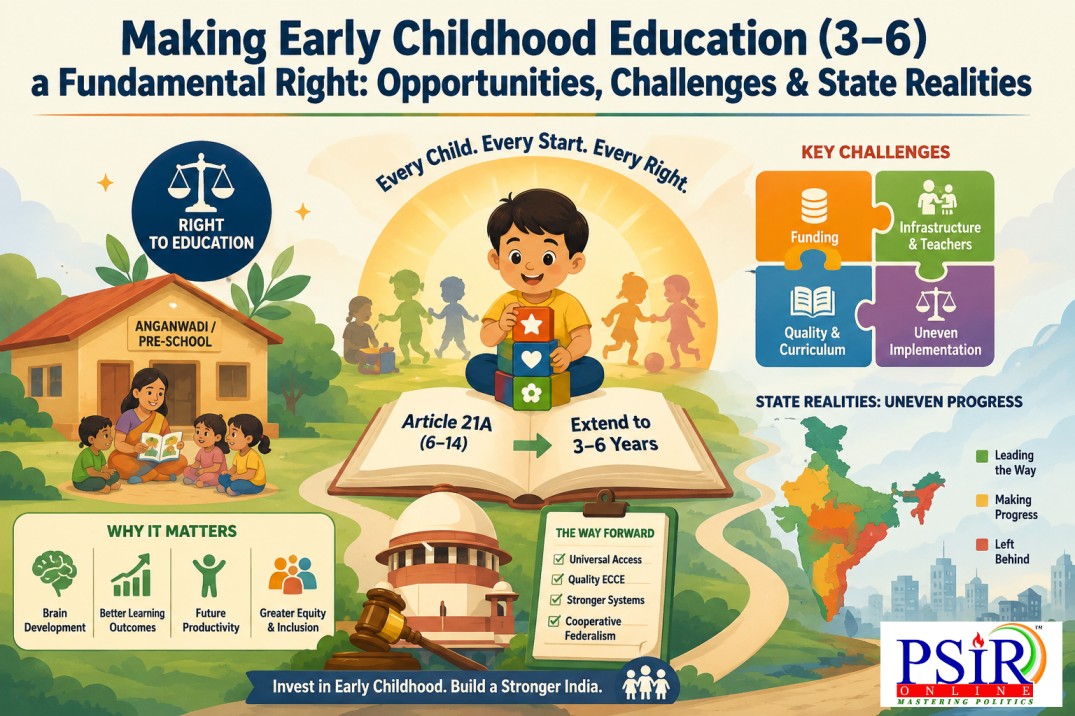
In April 2026, the Supreme Court of India (bench led by Chief Justice Surya Kant and Justice Joymalya Bagchi) issued notices to the Centre, all States, and Union Territories on a Public Interest Litigation (PIL) filed by advocate Haripriya Patel.
KEY DETAILS OF THE PIL
· Core Demand: Extend the fundamental Right to Education under Article 21A of the Constitution to children aged 3–6 years (pre-primary / early childhood care and education — ECCE), making it free and compulsory. Currently, Article 21A and the RTE Act, 2009, cover only ages 6–14.
· Rationale: The petition highlights that the National Education Policy (NEP) 2020 restructures schooling into a 5+3+3+4 model, treating ages 3–8 as the "foundational stage." It argues that excluding 3–6 year olds leaves a critical developmental window outside constitutional protection, despite global evidence on the high returns of early childhood investment in human capital.
· Broader Context: The PIL also seeks uniform nationwide implementation of the RTE Act (for 6–14) and NEP 2020, addressing uneven adoption across states.
The Court remarked that it would like to "examine the issue" and issued notices for responses.
BACKGROUND ON ARTICLE 21A AND NEP ALIGNMENT
· Article 21A (inserted by the 86th Constitutional Amendment, 2002): "The State shall provide free and compulsory education to all children of the age of six to fourteen years in such manner as the State may, by law, determine."
· NEP 2020 explicitly pushes for universal ECCE from age 3, including play-based learning in Anganwadis and pre-schools, to build strong foundational literacy and numeracy.
· This PIL essentially asks the judiciary to bridge the gap between policy aspiration (NEP) and enforceable fundamental right (Article 21A), potentially via interpretation, "reading down/up," or nudging legislative action.
|
WHAT IS THE UNEVEN ADOPTION?
Uneven adoption (often called "uneven implementation") of the RTE Act 2009 (ages 6–14) and NEP 2020 simply means that while the laws/policies are framed at the national level, their actual rollout, enforcement, and quality differ hugely from state to state. Education is on the Concurrent List, so states have flexibility — but this has led to big gaps in access, quality, funding, and compliance. The PIL by advocate Haripriya Patel highlights exactly this inconsistency and asks the Supreme Court to push for uniform, enforceable standards nationwide. Here are the key areas of unevenness with real-time examples: 1. RTE Act 2009 – Major Gaps in 25% EWS Quota (Section 12(1)(c)) This is the most litigated and uneven part: private unaided schools must reserve 25% seats for Economically Weaker Sections (EWS) / disadvantaged children, with government reimbursement. · Supreme Court crackdown (May 2026): The Court recently demanded compliance reports from all states/UTs and warned of consequences. It categorised states into groups — some outright refusing, some bypassing via rules, some with massive delays. · Maharashtra: Huge pending reimbursement of ₹2,930 crore to private schools (as of April 2026) → many schools refuse admissions or drag cases. · States that have still not fully implemented the quota (ongoing since 2024): Punjab, Kerala, Telangana, and West Bengal. Punjab even argued it has enough government schools, so no need. · Dilution tactics: Several states amended their RTE rules to exempt private schools if a government school exists within 1 km — critics say this defeats the purpose of social integration. · Seat fill rates: As low as 27.5% in some states (CAG 2025 report) due to poor awareness, complicated online portals, and documentation issues.
2. Infrastructure, Teachers & Learning Outcomes (RTE Norms) Even basic RTE norms (pupil-teacher ratio, classrooms, toilets, libraries) are uneven: · High-performing states (e.g., Kerala, Tamil Nadu, Himachal Pradesh): Better infrastructure and teacher availability. · Lagging states (e.g., Bihar, Uttar Pradesh, Jharkhand): Persistent shortfalls in functional toilets, electricity, and trained teachers → reflected in ASER 2024 learning recovery being slower in these regions despite overall national improvement.
3. NEP 2020 – Structural & Curricular Reforms NEP 2020 is advisory (not mandatory law), so states adopt at their own pace. Only about one-third of states have fully notified NEP and the National Credit Framework even by late 2025. Early & proactive adopters: o Karnataka, Madhya Pradesh, Uttarakhand, Himachal Pradesh: First to roll out 5+3+3+4 structure, FLN (Foundational Literacy & Numeracy) mission, and new curricula. o Uttar Pradesh: Dramatic improvement in Class 3 reading — from 12.3% (2018) to 27.9% (ASER 2024) due to strong FLN push. Slow or partial adopters: o Many states introduced the new structure “on paper” but lag in teacher training, play-based learning, and assessment changes. States showing resistance: o Tamil Nadu & Kerala: Slow on certain NEP aspects (e.g., three-language formula, alignment with central schemes like PM-SHRI). Tamil Nadu has publicly opposed parts of NEP citing federalism and local needs. FLN implementation: All states/UTs were implementing by early 2025, but quality and outcomes vary wildly. ASER 2024 showed big gains in states like Uttar Pradesh, Haryana, Maharashtra, but many others are still below pre-COVID (2018) levels in reading/arithmetic.
Why the PIL flags this? The petition argues that without uniform enforcement, children in “weaker” states (like Bihar, parts of UP, or North-East) are left behind, defeating the constitutional goal of equality under Article 21A. The Supreme Court has already started seeking responses on these exact gaps. In short, RTE suffers from funding delays, quota non-compliance, and dilution; NEP suffers from patchy structural rollout and political resistance. If the Court accepts the PIL’s demand, it could lead to stronger central monitoring or directives for all states to align quickly.
|
ADVANTAGES OF MAKING SCHOOLING OF 3-6 YEARS CHILDREN AS FUNDAMENTAL RIGHT
If the Supreme Court accepts the PIL and extends Article 21A (Right to Education) to ages 3–6 as a fundamental right, here’s what would likely happen:
1. Stronger Legal Enforceability
· Parents and children could directly approach courts (High Courts under Article 226 or Supreme Court under Article 32) for violations, such as lack of access to quality pre-primary education, inadequate infrastructure, or poor teacher standards.
· It would shift ECCE (Early Childhood Care and Education) from a policy aspiration (under NEP 2020 and Directive Principles like Article 45) to a justiciable fundamental right, similar to how RTE transformed elementary education after 2009.
2. Major Implementation and Infrastructure Push
· Universal access: Governments (Centre + States) must ensure free, compulsory, neighbourhood-based pre-primary education. This involves upgrading ~14 lakh Anganwadis (ICDS) into quality pre-schools with play-based learning, Balvatikas attached to primary schools, and teacher-pupil ratios (likely 30:1 or better).
· Teacher training & standards: Anganwadi workers would need reclassification, NCTE-aligned qualifications, better pay, and training. This could resolve the current split between Ministry of Women & Child Development (nutrition-focused) and Ministry of Education.
· Curriculum alignment: Full rollout of NEP 2020’s 5+3+3+4 structure foundational stage (ages 3–8) with NCFFS 2022 play-based pedagogy.
3. Positive Developmental & Social Impacts
· Brain development & equity: Over 85% of brain development occurs before age 6. Quality ECCE reduces learning gaps, improves foundational literacy/numeracy (supporting NIPUN Bharat), lowers dropout rates, and boosts lifetime outcomes — especially for disadvantaged groups (SC/ST, rural, migrants).
· Better school readiness → improved learning outcomes in later grades (ASER/NAS data shows current gaps).
· Alignment with global standards (many countries make pre-primary compulsory/free) and SDG 4.2.
Overall Outlook
This would be a transformative step — completing the vision of the 86th Amendment and NEP 2020 — potentially benefiting millions of children by closing the foundational gap. However, success depends on coordinated funding, capacity building, and monitoring (e.g., via NCPCR). Without strong execution, it risks becoming another under-resourced mandate.
The case is still early (notices issued in April 2026; responses awaited). Outcomes could range from judicial directives for phased implementation to a recommendation for constitutional amendment.
CHALLENGES IN IMPLEMENTING THE PROPOSAL
Making pre-primary education (ages 3–6) a Fundamental Right by extending Article 21A faces several significant challenges. These are legal, financial, administrative, and federal in nature. The Supreme Court has only issued notices on the PIL (April 2026) so far, and the government’s response will highlight many of these issues.
1. Constitutional / Textual Challenges
· Article 21A explicitly limits the right to ages 6–14 years (inserted via the 86th Amendment in 2002). Extending it to 3–6 would require either:
o Judicial “reading up” / expansive interpretation (risky, as courts usually hesitate to rewrite explicit text).
o A Constitutional Amendment (preferred route for legitimacy, but politically slow and requires Parliament approval).
· Currently, ages 0–6 fall under Article 45 (Directive Principle of State Policy), which is non-justiciable (not enforceable in court). Converting policy into a fundamental right shifts the burden dramatically.
2. Huge Financial Burden
· Cost estimates: Recurring incremental cost could exceed 1% of GDP annually (some think tanks put total ECCE universalisation at 1.5–2.2% of GDP when including infrastructure and salaries).
· India already struggles to spend 6% of GDP on education (NEP target). Pre-primary would require massive new spending on:
o Upgrading ~14 lakh Anganwadis.
o Teacher salaries, training, and pupil-teacher ratio of 30:1.
o Play-based materials, infrastructure, and monitoring.
· States with weak finances (Bihar, UP, Jharkhand, etc.) would struggle the most, widening regional inequalities.
3. Institutional & Administrative Turf Wars
· Split responsibility: Early childhood is handled by Ministry of Women & Child Development (Anganwadis) — focused on nutrition and care — while school education is under Ministry of Education. Merging them into a uniform RTE framework creates major coordination issues.
· Anganwadi workers: Currently “honorary volunteers” with low pay. Making them formal teachers requires reclassification, higher salaries, NCTE qualifications, and career progression — a huge HR overhaul.
· Quality risk: Rapid expansion could lead to poor implementation (quantity over quality), rote learning instead of play-based pedagogy, and diluted standards.
4. Federalism Issues (Centre vs States)
· Education is on the Concurrent List, but implementation is primarily a state subject. States vary widely in capacity, political will, and existing infrastructure.
· Many states have been slow on NEP 2020 itself. Forcing uniform standards could spark resistance (e.g., Tamil Nadu and Kerala have voiced concerns on certain NEP aspects citing federalism).
· Reimbursement disputes (like the existing 25% EWS quota) would multiply if extended to pre-primary, especially for private playschools.
5. Practical & Quality-Related Challenges
· Infrastructure & Teacher Shortage: Only a small percentage of pre-primary setups currently have dedicated trained ECE teachers. Effective learning time in many Anganwadis is very low (~35 minutes/day).
· Private Sector Regulation: Extending RTE norms (including 25% quota) to thousands of private playschools could face legal pushback and increase litigation.
· Diverse Needs: India’s socio-economic, linguistic, and cultural diversity makes a one-size-fits-all approach difficult, especially in rural, tribal, and migrant areas.
· Enforceability without Quality: Making it a right without adequate budget and monitoring could lead to more court cases than actual improvement (similar to implementation gaps in current RTE).
Summary Outlook
While the move would be transformative for child development (85% of brain development happens before age 6), experts and policymakers worry it could become an unfunded mandate that strains resources without guaranteed quality gains. Many suggest a phased approach, dedicated funding (via Finance Commission), and a possible new constitutional provision (like “Article 21B”) instead of stretching the existing one.
The Centre and States’ responses to the PIL (expected in coming months) will clarify their stance on these challenges.
PRACTICE QUESTIONS FOR GS 2 MAINS
1. “The demand to extend Article 21A to children aged 3–6 years reflects the changing understanding of education as a developmental right.” Critically examine the constitutional, social, and federal implications of making Early Childhood Care and Education a Fundamental Right. (15 Marks)
2. Uneven implementation of the Right to Education Act and NEP 2020 across states raises important questions regarding cooperative federalism in India. Discuss with suitable examples. (15 Marks)
3. “Policy aspirations without enforceable rights often deepen regional inequalities.” In the light of the recent PIL on Early Childhood Education, analyse the challenges in translating educational policy into constitutional guarantees. (10 Marks)
4. Examine the opportunities and challenges associated with integrating Anganwadi-based Early Childhood Care and Education into the formal school education framework in India. (10 Marks)
PRACTICE QUESTIONS FOR PSIR OPTIONAL
1. “The expansion of socio-economic rights reflects the evolving nature of constitutionalism in democratic states.” Discuss in the context of the debate on extending the Right to Education to children below six years. (20 Marks)
2. Critically analyse the tension between judicial activism and parliamentary supremacy in the context of the Supreme Court examining extension of Article 21A to Early Childhood Education. (15 Marks)
3. “Indian federalism often produces asymmetrical policy outcomes despite uniform constitutional commitments.” Evaluate this statement with reference to the uneven implementation of RTE Act and NEP 2020 across Indian states. (20 Marks)
4. Discuss the role of the judiciary in transforming Directive Principles into enforceable rights in India. Can Early Childhood Care and Education become the next stage in this constitutional evolution? (15 Marks)