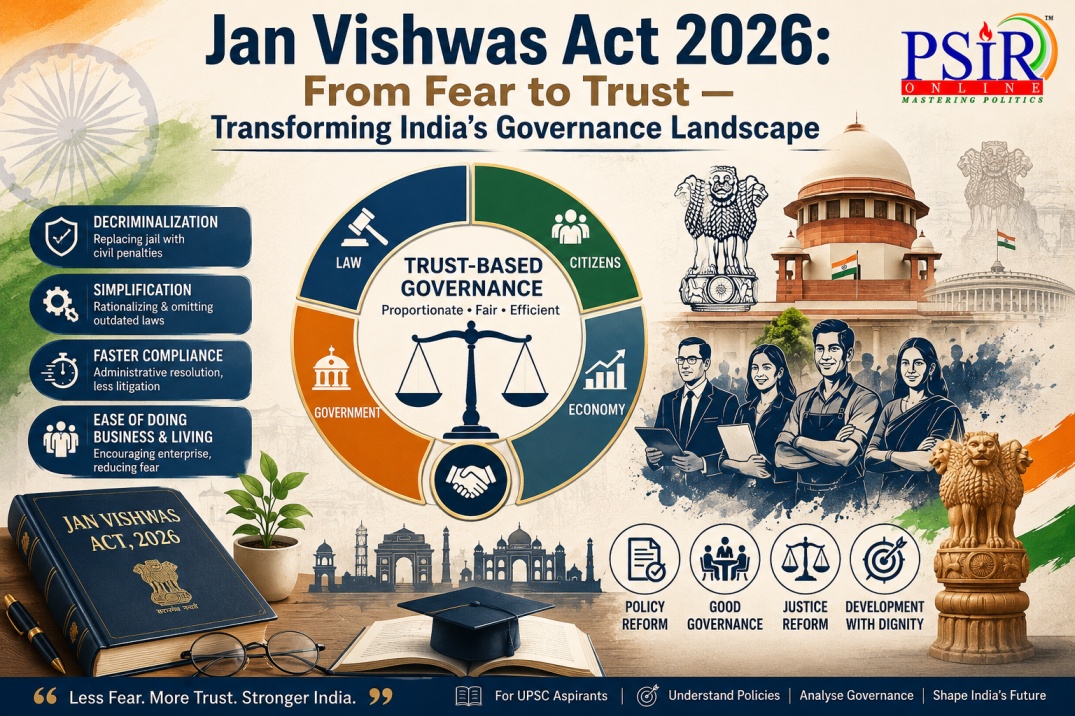
The Jan Vishwas (Amendment of Provisions) act, 2026 is a major legislative reform in India aimed at shifting from a "fear-based" or overly punitive regulatory system to a trust-based governance model. It focuses on decriminalizing or rationalizing minor, procedural, technical, or outdated offences while replacing criminal penalties (like imprisonment) with civil penalties, warnings, improvement notices, and administrative mechanisms.
BACKGROUND AND LEGISLATIVE JOURNEY
· Builds on 2023 Act: The first Jan Vishwas Act (2023) amended 42 Central Acts (183 provisions) across 19 ministries, mainly for ease of doing business. It replaced many jail terms with fines/penalties.
· 2025 precursor: A narrower bill (17 or 16 Acts, ~355 provisions) was introduced in August 2025, referred to a Select Committee (chaired by Tejasvi Surya). The committee's March 13, 2026 report recommended expansions.
· 2026 Bill: Introduced in Lok Sabha on March 27, 2026 by Minister of State for Commerce and Industry (Jitin Prasada). It replaced the 2025 version (withdrawn March 17). Passed Lok Sabha on April 1 and Rajya Sabha on April 2, 2026. Many provisions notified effective May 15, 2026.
It amends ~79-80 Central Acts (administered by 23 Ministries), covering 784 provisions. Of these, 717 are decriminalized, with 67 aimed at ease of living. Overall, it rationalizes over 1,000 offences/actions.
KEY CHANGES AND MECHANISMS
The Bill uses four broad approaches across laws:
1. Decriminalization (majority of changes): Removes imprisonment/fines handled via criminal courts; replaces with civil penalties (imposed by adjudicating officers), warnings, or improvement notices. Serious harm offences retain criminal liability.
2. Omission: Deletes ~125 redundant/outdated offences (e.g., false fire alarms, certain minor municipal lapses, false copyright register entries).
3. Compounding: Makes ~35 offences compoundable (settle by paying a sum, avoiding trials).
4. Rationalization: Reduces harsh punishments, revises fines (with 10% automatic increase every 3 years in many cases), introduces graded responses (warning first, then penalty).
Additional features:
· Graded enforcement: Warnings/advisories for first/second offences (e.g., Apprentices Act); improvement notices (e.g., Legal Metrology Act).
· Adjudicating officers & appeals: Faster administrative resolution, reducing court burden.
· Distinction between fines and penalties: Penalties are civil/administrative (quicker, no police/criminal record for minor issues).
Examples of Amendments
· Drugs & Cosmetics Act, 1940: Manufacturing/sale of cosmetics in contravention → Imprisonment (up to 1 year) replaced with civil penalty (₹1 lakh or 3x value confiscated).
· National Highways Act, 1956: Making highway impassable/less safe → Imprisonment (up to 5 years) → Civil penalty (₹10 lakh to ₹1 crore).
· Tea Act, 1953: Failure to furnish returns/false returns → Warning (first), civil penalty (subsequent).
· Copyright Act, 1957: False entries in register → Imprisonment removed.
· Motor Vehicles Act, 1988: 30-day grace period for expired driving licences; some ticket/commuter issues as civil penalties; extended time for accident compensation claims.
· NDMC Act, 1994 (New Delhi): Property tax standardization (unit area method); illegal public water use as fixed civil penalty; removes advertisement tax.
· Electricity Act, 2003 & Indian Succession Act, 1925: Non-compliance → Fine only (no jail in some cases).
· Others: Colonial-era laws (Cattle Trespass, Live Stock Importation); municipal (Delhi Municipal Corporation, Delhi Development); health (Clinical Establishments, Pharmacy); exports (APEDA, Coir); railways/metro (smoking, berth issues as penalties).
Sectors covered: Industry/business, infrastructure, municipal governance, health, transport, intellectual property, trade, environment, and more.
Objectives and Expected Impact
· Trust-based governance: Moves away from colonial/over-criminalized rules where minor lapses (missed filings, paperwork errors) triggered jail threats.
· Ease of Doing Business: Benefits MSMEs/startups by reducing compliance burden, fear of prosecution, and litigation. Faster administrative fixes.
· Ease of Living: Protects ordinary citizens from criminal cases for routine issues (e.g., minor municipal violations, public transport lapses).
· Decongest courts: Reduces burden on criminal justice system (India has thousands of such minor offences across Central laws).
· Proportionate regulation: Criminal law reserved for serious harm; civil tools for minor issues. Periodic penalty revisions keep them relevant.
POSITIVE VIEWS FROM EXPERTS AND INDUSTRY BODIES
Experts and industry leaders largely praise the Jan Vishwas (Amendment of Provisions) Bill, 2026 as a landmark reform promoting trust-based governance, reducing over-criminalization, and enhancing ease of doing business and living.
· Vidhi Centre for Legal Policy (Ayushi Sharma and Naveed Mehmood Ahmad, who assisted DPIIT on the exercise): They describe it as India’s most ambitious single-legislation decriminalisation effort in scale and scope. It rationally reserves criminal law for serious harm while using civil/administrative tools for minor violations. This addresses the problem of over 7,300 criminal offences in Central laws (many in regulatory statutes), making the criminal law landscape more reasonable and reducing court burden.
· CII (Chandrajit Banerjee, Director General): Calls it a "structural revolution" and "decisive scale-up." Extensive stakeholder consultations (including Select Committee with 49 sittings) ensured proportionality. It shifts from fear-driven to voluntary compliance, benefits MSMEs, reduces regulatory uncertainty, and helps decongest courts (potentially reviewing millions of minor cases). Retains strong sanctions for serious offences like spurious drugs or environmental damage.
· Economic and Governance Analysts (e.g., Economic Times editorial, News18 opinion): Seen as boosting GDP (estimates of 0.5-1% additional growth via better regulatory environment), improving India’s global rankings, attracting FDI, and fostering entrepreneurship by removing the "fear of jail" for technical lapses. Graded enforcement (warnings first, then penalties) and periodic fine revisions add predictability.
· Legal Practitioners (e.g., Global Law Experts, TOI contributor Vivek Narayan Sharma): Positive for litigation management—fewer prosecutions, faster administrative resolution, alignment with modern regulatory philosophy, and focus on facilitation over coercion. It modernizes colonial-era laws and everyday citizen-state interactions.
Overall positives: Proportionate regulation, court decongestion, economic efficiency, and cultural shift from suspicion to trust.
CRITICAL VIEWS AND CONCERNS
Critics, including opposition voices and some legal/governance experts, raise issues around implementation risks, potential dilution of deterrence, executive overreach, and uneven impact.
· Weak Structure for Penalties and Checks: Critics argue the Bill bypasses deep consultation for such major changes in criminal liability. Replacing imprisonment with fines/penalties leaves thresholds, discretion, and escalation largely to executive rules rather than strong statutory safeguards. This risks arbitrary enforcement or weak adjudication without adequate judicial oversight.
· Diluted Deterrence in Critical Sectors: In areas like public health (e.g., Drugs & Cosmetics), infrastructure safety (National Highways), food safety, or real estate, monetary penalties might become a "manageable cost of doing business" for larger entities, weakening accountability for negligence that harms public interest. Imprisonment's deterrent effect is hard to replace fully.
· Favours Big Players and Implementation Challenges: Over-reliance on civil penalties could disadvantage smaller entities unable to absorb fines easily. Uniform enforcement across ministries/departments may vary, leading to inconsistent outcomes. Some fear reduced compliance if penalties feel too lenient.
· Opposition/Political Critique (e.g., DMK's P. Wilson, Congress statements): Excessive powers to adjudicating officers reduce judicial oversight. Concerns over insufficient consultation (despite Select Committee) and claims it trades public safety for business ease. Some view it as not going far enough or risking public trust.
· Missing Elements: Suggestions for complementary reforms like community service for better reformative impact, or stronger retrospective application for pending cases.
CAN THIS ACT TRANSFORM INDIA’S GOVERNANCE LANDSCAPE?
Yes, the Jan Vishwas (Amendment of Provisions) Bill/Act 2026 has strong potential to meaningfully transform India's governance landscape and support broader economic development, though its full impact will depend heavily on effective implementation, enforcement consistency, and complementary reforms.
Transformative Potential in Governance
Experts widely describe it as a structural reset or philosophical shift in how the state interacts with citizens and businesses:
· From "Inspector Raj" and fear-based compliance to trust-based governance: It moves away from presuming guilt for minor lapses (paperwork errors, technical violations) toward facilitation, warnings, graded penalties, and administrative resolution. This changes the citizen-state relationship from suspicion/control to partnership and empowerment.
· Proportionate regulation: Criminal law is reserved for serious harm (e.g., spurious drugs, major safety violations), while minor issues use civil penalties, improvement notices, or compounding. This modernizes colonial-era and over-criminalized laws.
· Decongesting the justice system: With India's courts facing over 5 crore pending cases, offloading thousands of petty regulatory prosecutions frees judicial capacity for serious matters.
· Broader cultural and administrative shift: It aligns with other reforms (GST, IBC, faceless assessments, digital governance) and promotes "minimum government, maximum governance." Vidhi Centre for Legal Policy calls it India's most ambitious single-legislation decriminalisation exercise in scale and scope.
This could reduce bureaucratic harassment, improve predictability, and foster a more responsive, citizen-friendly regulatory environment—key elements of modern, effective governance.
Potential to Help India's Development (Economic and Social)
· Boost to Ease of Doing Business and MSMEs/Startups: Removes the "fear of jail" for technical lapses, lowers compliance costs (potentially tens of thousands of crores in savings), unlocks restrained capital, encourages formalization, and speeds decision-making. This is seen as a game-changer for India's 6+ crore MSMEs and startup ecosystem, improving global competitiveness and FDI inflows.
· Economic growth contribution: Analysts link it to higher investment, entrepreneurship, job creation, and alignment with Viksit Bharat 2047 / $5 trillion economy goals. Even modest regulatory friction reductions can add to GDP growth (past EoDB improvements have shown measurable effects).
· Ease of Living: Benefits ordinary citizens through simpler municipal, transport, and daily compliance rules, reducing stress and legal friction in everyday life.
Many view it as part of a reform continuum that strengthens India's position as an investment destination and supports sustained development.
Caveats and Limitations (Not a Silver Bullet)
While the potential is significant, experts note it is not transformative on its own:
· Implementation is key: Success hinges on training adjudicating officers, consistent enforcement across ministries/states, clear guidelines, and preventing arbitrary use of discretion. Weak execution could lead to uneven outcomes or new compliance issues.
· Deterrence concerns: In critical areas (health, safety, infrastructure), shifting to monetary penalties might turn violations into a "cost of business" for larger players, potentially weakening accountability if enforcement is lax. Strong safeguards for serious offences are essential.
· Broader ecosystem needed: It works best alongside judicial reforms, state-level changes, capacity building, and monitoring to avoid dilution of public safety or favoritism toward big entities.
CONCLUSION
Yes — it has genuine transformative potential as one of the largest systematic efforts to modernize India's regulatory framework, reduce over-criminalization, and build trust. If implemented robustly, it can meaningfully ease governance burdens, accelerate economic activity, and contribute to India's development ambitions. However, like previous reforms, its real-world success will be determined by execution on the ground over the coming years, not just the legislation itself. It represents a promising directional shift rather than an instant overhaul.
PRACTICE QUESTIONS FOR GS 2 MAINS
1. The Jan Vishwas Act 2026 represents a shift from “fear-based regulation” to “trust-based governance.” Critically examine its significance for democratic governance and ease of doing business in India. (15 Marks)
2. Discuss how the decriminalization of minor offences under the Jan Vishwas Act 2026 can contribute to judicial reforms and administrative efficiency in India. Also examine the associated challenges. (15 Marks)
3. “Decriminalization without adequate safeguards may dilute deterrence in critical sectors.” Analyse this statement in the context of the Jan Vishwas Act 2026. (10 Marks)
4. Evaluate the Jan Vishwas Act 2026 as part of India’s broader governance reform trajectory aimed at achieving “Minimum Government, Maximum Governance.” (20 Marks)