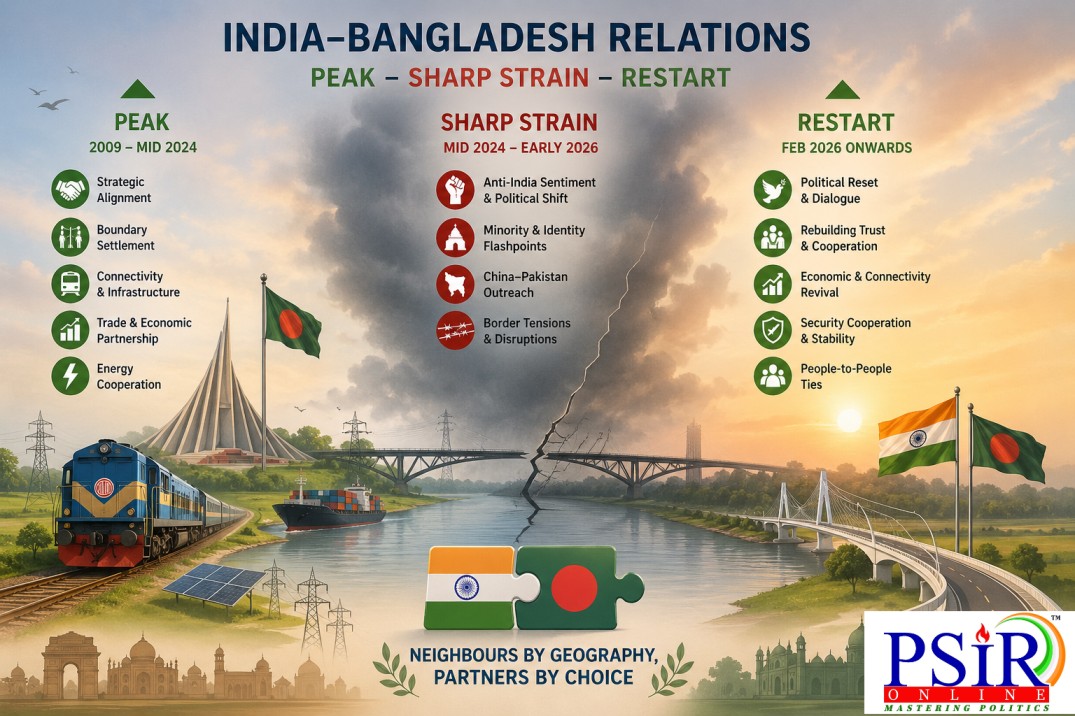
India–Bangladesh relations have undergone a dramatic shift since mid-2024, moving from a long “golden era” of strategic alignment under Sheikh Hasina and Narendra Modi to a phase of deep strain under an anti-India interim-cum-youth-revolution narrative, and now showing tentative signs of a “restart” after the February 2026 parliamentary elections. This trajectory illustrates the cyclical nature of bilateral ties, influenced heavily by domestic politics in Dhaka, public sentiment, and the interplay of security, economic interdependence, and regional geopolitics involving China and Pakistan. For India, Bangladesh remains a critical neighbour sharing a 4,096-km border, vital for Northeast stability, trade, energy security, and connectivity under the Act East Policy. For Bangladesh, India is an indispensable partner for transit, power, and market access, yet often viewed through the prism of historical sensitivities and sovereignty concerns.
The relationship has historically oscillated between cooperation and suspicion. Pre-2009 phases saw ups and downs under different regimes, but the 2009–mid-2024 period marked a high point. The 2024 youth-led uprising that ousted Hasina introduced a sharp rupture, amplified by the interim government’s rhetoric and specific crises in late 2025. The February 2026 elections, delivering a BNP-led victory with Jamaat-e-Islami gains, have opened a window for recalibration. This article examines the three phases in detail, drawing on historical context, key events, and strategic implications, with takeaways tailored for UPSC-style analysis.
1. “PEAK” PHASE (2009–MID-2024: UNDER HASINA–MODI ALIGNMENT)
The “golden era” of India–Bangladesh relations coincided with Sheikh Hasina’s long tenure as Prime Minister (2009–2024) and Narendra Modi’s government (from 2014). This phase was defined by mutual strategic interests: countering Islamist extremism, resolving long-standing border disputes, enhancing economic integration, and advancing sub-regional connectivity. Hasina’s Awami League was perceived in New Delhi as a reliable partner that prioritised security cooperation over ideological differences, even as it consolidated domestic power.
Strategic alignment Hasina’s government collaborated closely with India on counter-insurgency. Bangladesh cracked down on North-East Indian insurgent groups using its territory as safe havens, leading to the extradition or neutralisation of several ULFA and other militants. Joint exercises between border forces (BSF and BGB) intensified, and intelligence sharing improved dramatically. This alignment was not merely tactical; it reflected a broader convergence against radicalisation and cross-border terrorism. India, in turn, extended political and diplomatic support to Hasina, including during her electoral challenges. The relationship was often described by Indian officials as one of the most stable in South Asia, underpinned by personal rapport between Hasina and Modi.
Boundary and connectivity A landmark achievement was the Land Boundary Agreement (LBA) of 2015. This resolved a colonial-era anomaly involving 162 enclaves (chhitmahals) along the border. Under the agreement:
· India transferred 111 enclaves (17,160 acres) to Bangladesh.
· Bangladesh transferred 51 enclaves (7,110 acres) to India.
· Adverse possessions were also exchanged, with Bangladesh gaining a net territorial advantage.
The LBA, ratified after decades of deadlock, was hailed as a model of mature neighbourhood diplomacy. It enabled the demarcation of the entire 4,096-km land border and facilitated practical measures like fencing and joint border management.
Connectivity projects surged:
· Restoration and expansion of rail links, including the Akhaura–Agartala cross-border railway (operationalised in 2023).
· Road connectivity improvements and the India–Bangladesh Friendship Pipeline for petroleum products.
· Inland waterways revived under the Protocol on Inland Water Transit and Trade (PIWTT), allowing Indian vessels access to Bangladeshi ports like Chattogram and Mongla for cargo to the Northeast.
· The Maitri Setu bridge over the Feni River and other infrastructure boosted people-to-people and trade flows.
These initiatives reduced logistical bottlenecks for India’s landlocked Northeast states, cutting travel times and costs significantly.
Economic ties Bangladesh emerged as India’s largest trade partner in South Asia. By FY 2023–24, bilateral trade approached $15 billion, with India exporting around $11–12 billion (cotton yarn, machinery, chemicals, petroleum products) and importing $2–3 billion (RMG, fish, jute). Key enablers included:
· Duty-free access for most Bangladeshi products under SAFTA (South Asian Free Trade Area), with India granting additional concessions.
· Lines of credit (LoCs) from India totalling over $8 billion for infrastructure, power plants, and railways.
· Energy trade: Bangladesh imported over 2,000 MW of power from India by 2024, including from the Adani Godda plant and grid interconnections like Baharampur–Bheramara.
Despite Bangladesh’s persistent trade deficit, the relationship was framed as mutually beneficial, with Indian investments in pharmaceuticals, textiles, and manufacturing.
Sub-regional cooperation Bangladesh actively participated in BBIN (Bangladesh–Bhutan–India–Nepal) initiatives for motor vehicles agreement (MVA), power trade, and water management. Bay of Bengal initiatives, including BIMSTEC, saw Dhaka aligning with Delhi on connectivity and blue economy projects. Joint river management talks on Teesta and Ganga waters continued, even if full agreements remained elusive.
This peak phase lasted until the July–August 2024 mass uprising, triggered by student protests against job quotas, which rapidly escalated into a broader anti-Hasina movement. Hasina’s flight to India on 5 August 2024 marked the symbolic end of the alignment.
2. “SHARP STRAIN” PHASE (AUG 2024 – JAN 2026: REVOLUTION, INTERIM ANTI-INDIA NARRATIVE, AND CRISES)
The ouster of Hasina transformed bilateral dynamics overnight. The Yunus-led interim government, installed amid the “second liberation” narrative, faced domestic chaos—economic slowdown, law-and-order breakdown, and rising Islamist influence. To consolidate power and deflect criticism, it leaned into an anti-India posture, reviving historical grievances over the 1971 war, water sharing, and perceived Indian interference.
a) Political overhaul and anti-India narrative Hasina’s refuge in India was portrayed as Delhi shielding an “authoritarian” leader. Yunus and his advisers repeatedly accused India of meddling, while radical youth and Islamist groups amplified narratives of Indian hegemony. Public discourse in Bangladesh shifted: surveys showed plummeting favourability towards India (down to single digits in some polls), contrasted with rising positive views of China and Pakistan. The interim regime cancelled or slowed several Indian-led projects, renegotiated energy deals, and publicly courted Islamabad and Beijing.
b) Youth leader Hadi killing and anti-India protests In December 2025, the assassination of Sharif Osman Hadi—a prominent youth activist and anti-Hasina figure—ignited massive unrest. Hadi, shot in Dhaka on 12 December while campaigning, died in Singapore on 18 December. Protesters accused Indian-backed elements (allegedly Awami League affiliates sheltered in India) of orchestrating the killing. Demonstrations turned violent: mobs attacked media offices (Prothom Alo, Daily Star), cultural centres, and marched towards the Indian High Commission demanding Hasina’s extradition and closure of Indian missions. India summoned Bangladesh’s envoy and protested the hostile rhetoric. The episode entrenched perceptions of Indian interference.
c) Hindu minority killing and communal spiral Simultaneously, the lynching of Dipu Chandra Das, a 27-year-old Hindu garment worker in Bhaluka (Mymensingh), on 18 December 2025, over alleged blasphemy, exacerbated communal tensions. Graphic videos of the mob beating, hanging, and burning Das circulated widely. In India, Hindu organisations protested, highlighting rising extremism and minority persecution in Bangladesh. Dhaka downplayed the incident as isolated, but it fed Indian domestic narratives and Bangladeshi counter-accusations of Indian disinformation campaigns. The dual crises—Hadi and Das—created a perfect storm of bilateral mistrust.
d) Interim regime’s anti-India posture Yunus-appointed officials issued threats of “strong protests,” border escalation, and even veiled references to territorial claims. Blame was routinely shifted to India for economic woes, border killings, and political instability. While the interim government occasionally acknowledged the need for stable ties, public statements and actions (e.g., seeking Hasina’s extradition formally) sustained the strain. Visa services were suspended, diplomats recalled, and connectivity projects stalled.
e) Election of an “anti-India-leaning” party (BNP–Jamaat alliance) The February 12, 2026, elections capitalised on this sentiment. The BNP, historically wary of close Indian embrace and more inclined towards Pakistan and China, secured a landslide (~209 seats). Jamaat-e-Islami won a historic ~68 seats, its best performance. The coalition victory reflected voter backlash against Hasina’s authoritarianism and the interim’s chaos, but also anti-India mobilisation. New Delhi viewed the outcome with concern over potential strategic realignment.
During this 18-month “sharp strain” period, rhetoric, violence, border skirmishes, and public hostility reached new lows. Trade continued at reduced levels due to structural interdependence, but diplomatic and people-to-people ties collapsed.
3. “RESTART” SIGNALS (FEB 2026 ONWARDS: NEW EQUILIBRIUM IN THE MAKING)
Post-election developments indicate a pragmatic reset. The BNP-led government, while not as India-centric as Hasina’s, recognises material realities: energy dependence (India supplies ~15% of Bangladesh’s power), trade deficits, and Northeast connectivity needs.
a) Diplomatic outreach and reset language India’s External Affairs Minister and Foreign Secretary engaged early. Modi congratulated Tarique Rahman promptly. High-level delegations attended the swearing-in. By March–April 2026, both sides signalled “constructive engagement” and “strengthening ties.” Dhaka toned down anti-India rhetoric; New Delhi adopted a pragmatic tone, focusing on elected government legitimacy.
b) Sectoral areas of cooperation
· Economic and trade: Discussions on tariff reductions, non-tariff barriers, and addressing Bangladesh’s deficit. Visa services resumed in phases (medical, student, tourist).
· Energy and connectivity: Renewed talks on power trade expansion, grid interconnections, and BBIN revival. Adani supplies continued uninterrupted despite earlier strains.
· Visa and movement: Eased regimes for cross-border travel, critical for Northeast and cultural ties.
c) Managing the anti-India tide The BNP acknowledges India’s indispensability. Domestic politics constrain overt warmth, but elite diplomacy and economic imperatives drive moderation.
d) Limits and risks of the “restart”
· Hasina’s asylum remains a flashpoint; extradition demands persist.
· China–Pakistan factor: BNP’s historical tilt and Jamaat’s influence open space for Beijing/Islamabad.
· Indian domestic pressure: Hindu-nationalist concerns over minority violence limit concessions.
· Fragility: A single incident (border clash or communal flare-up) could derail progress.
The restart is functional rather than transformative—rooted in interdependence rather than ideological alignment.
KEY TAKEAWAYS
India–Bangladesh ties exemplify the interplay of domestic politics, geography, and geopolitics in neighbourhood relations.
Conceptual points:
· Cyclical nature: Ties oscillate with Dhaka’s regime type (pro- vs anti-India) and regional balancing (China/Pakistan vs India). The 2024–2026 episode proves even “friendly” partners can pivot sharply under youth nationalism and Islamist mobilisation.
· Material interdependence as stabiliser: Despite rhetoric, trade (~$12–15B), energy (~2,000+ MW imports), and transit sustain ties. Economic realism often trumps political posturing.
· Security–economy–identity triad: NE insurgency, border management, and minority issues remain core challenges. Communal incidents amplify domestic pressures on both sides.
· Geopolitical contestation: China’s infrastructure push and Pakistan’s diplomatic outreach test India’s influence; BBIN/BIMSTEC offer counter-leverage.
· Fragility of resets: Post-2026 equilibrium rests on elite diplomacy and pragmatism but risks derailment from incidents or domestic mobilisation. Long-term stability requires addressing structural issues (water sharing, trade imbalance, minority protection).
In conclusion, the Peak–Strain–Restart arc underscores that India–Bangladesh relations are resilient yet vulnerable. As of April 2026, the tentative thaw offers opportunities for deeper integration, provided both sides prioritise pragmatism over populism. For India, sustaining engagement with a BNP-led Bangladesh while safeguarding core interests will define the next chapter in this vital bilateral partnership. The relationship’s future hinges on converting economic necessities into strategic trust.
PRACTISE QUESTIONS FOR GS 2 MAINS
1. India–Bangladesh relations have historically oscillated between cooperation and suspicion. In light of recent developments (2024–2026), examine the factors responsible for this cyclical nature. (15 marks)
2. Discuss the significance of economic and energy interdependence in stabilising India–Bangladesh relations despite political tensions. (10 marks)
3. Evaluate the impact of domestic political changes in neighbouring countries on India’s foreign policy, with special reference to Bangladesh after 2024. (15 marks)
4. How do identity issues and minority rights influence bilateral relations between India and Bangladesh? Suggest measures to address these challenges. (10 marks)
PRACTISE QUESTIONS FOR PSIR OPTIONAL
1. “Neighbourhood relations are shaped more by domestic political shifts than by structural geopolitical realities.” Critically examine with reference to India–Bangladesh relations in the period 2024–2026. (20 marks)
2. Analyse India–Bangladesh relations through the lens of complex interdependence theory. Does economic interdependence guarantee political stability? (15 marks)
3. Examine the role of China–Pakistan strategic outreach in shaping Bangladesh’s foreign policy choices and its implications for India’s regional strategy. (20 marks)
4. “The India–Bangladesh relationship reflects a security–economy–identity triad.” Critically analyse this statement with suitable examples. (15 marks)