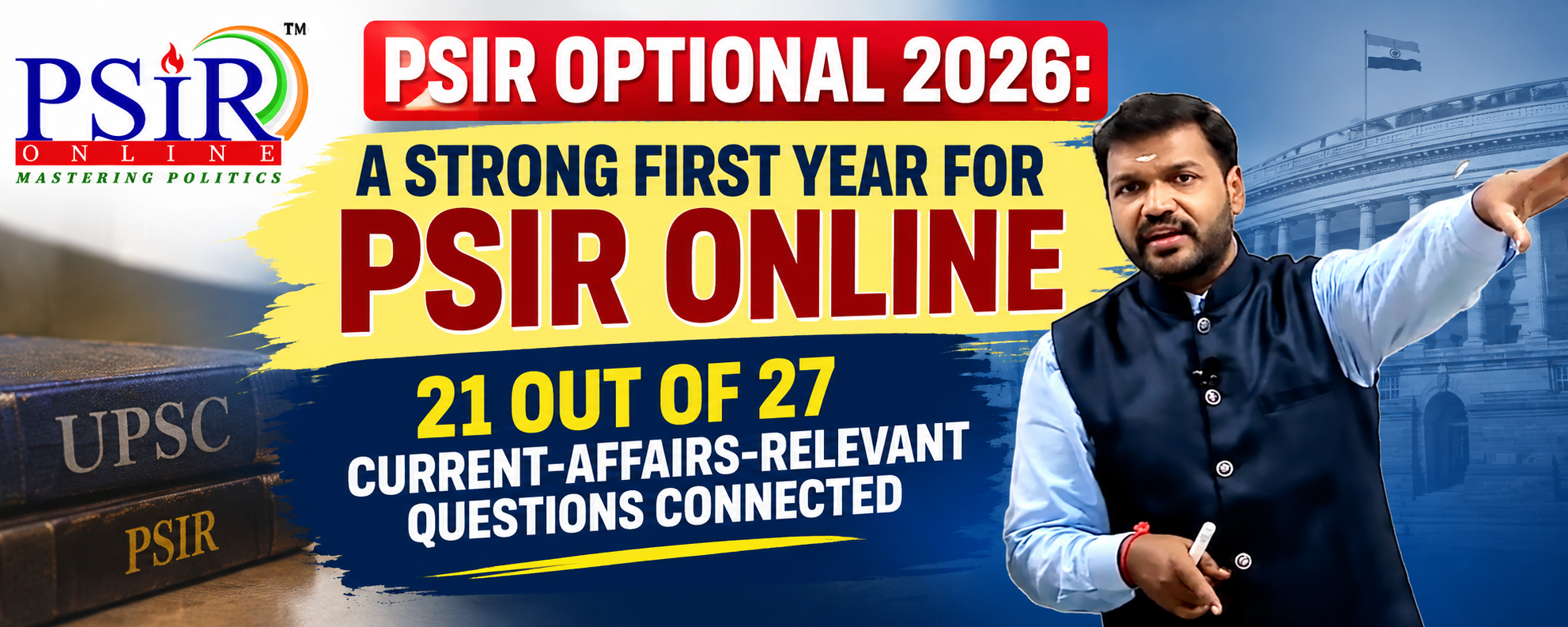
The first year of any academic platform is a test of whether its approach works when students finally face the unpredictability of the UPSC examination. For PSIR Online, UPSC Mains 2026 was not only the first examination cycle after our launch, but also the first opportunity to see whether our approach to current affairs could translate into the actual PSIR Optional paper. The answer, based on a question-by-question analysis of the 2026 paper, is encouraging.
Our approach has always been that current affairs for PSIR should not be treated as a separate ocean of information. Contemporary developments become useful only when they are connected to the syllabus, concepts, theories and analytical themes of Political Science and International Relations. We therefore examined the 2026 paper by first identifying the questions in which current-affairs knowledge had a meaningful role, and then comparing those questions with the current-affairs material published on PSIR Online.
The result is 21 connections out of 27 current-affairs-relevant questions across the three sections analysed below. This represents an overall connection rate of approximately 78%. The figures are presented section-wise because the nature and extent of current-affairs dependence differed across the paper.
|
PSIR OPTIONAL 2026 |
CURRENT AFFAIRS RELEVANT QUESTIONS |
CONNECTED WITH PSIR ONLINE |
CONNECTION RATE |
|
Paper I – Section B |
7 |
5 |
71% |
|
Paper II – Section A |
7 |
5 |
71% |
|
Paper II – Section B |
13 |
11 |
85% |
|
TOTAL |
27 |
21 |
78% |
DISCLAIMER
“Connected” does not mean that PSIR Online had the ready-made UPSC answer. The aspirant still needed a strong command of the static PSIR syllabus—political theory, thinkers, concepts, comparative politics, Indian politics, international relations and India’s foreign policy. What PSIR Online provided through its current-affairs coverage was the contemporary ammunition—recent developments, case studies, geopolitical events, institutional changes, data and analytical perspectives needed to apply static concepts to contemporary issues, enrich arguments, establish linkages and construct relevant, analytical and multidimensional answers in the PSIR Optional paper.
These figures should not be understood as a claim of question prediction. UPSC questions remain inherently unpredictable, and not every current-affairs connection can or should be described as a direct match. In the detailed analysis that follows, we have therefore consciously distinguished between direct, extremely direct, strong conceptual/thematic and partial connections. The purpose is not to claim that we “predicted” UPSC, but to examine whether the issues that UPSC ultimately considered relevant were already being identified and analysed for PSIR aspirants.
Importantly, the current-affairs resources referred to in this analysis were made available free of cost on the PSIR Online website through Indian Polity 360, Indian Politics Digest, International Relations Bulletin and Foreign Policy Spotlight. The following sections examine the evidence in detail.
PAPER 1 , SECTION B:
CURRENT AFFAIRS BASED QUESTIONS
The current-affairs component of Paper I, Section B was more substantial than a purely static reading of the paper might suggest. Out of the 14 questions, seven questions had a meaningful current-affairs dimension:
While the conceptual foundation of these questions remained within the prescribed PSIR syllabus, contemporary developments, recent political debates and real-world examples could significantly strengthen the quality of answers.
This distinction is important because these were not seven pure current-affairs questions. Rather, they were syllabus-based questions in which current affairs could play an important role in building a richer and more contemporary answer. For instance, Identity, ethnic conflicts, federal water disputes and environmental politics require conceptual understanding first, while recent developments provide the illustrations and analytical depth. The question on astroturfing had a particularly strong contemporary dimension, while Parliamentary Functioning over the last two decades naturally required awareness of political developments beyond static constitutional knowledge. Thus, the 2026 paper demonstrates that current affairs in PSIR are most useful when they are integrated with the syllabus rather than prepared as a separate body of information.
HOW MUCH DID PSIR ONLINE COVER AMONG THE ABOVE?
The table below provides a question-by-question comparison between the seven questions in Paper I, Section B that had a meaningful current-affairs component and the issues covered in PSIR Online’s current-affairs material. The comparison shows that 5 out of these 7 questions had a direct or strong conceptual connection with topics that had already been covered.
The relevant current-affairs preparation for this section is available free of cost on the PSIR Online website, through the Indian Polity 360 and Indian Politics Digest sections, where contemporary developments are analysed specifically from a PSIR perspective.
|
PSIR PAPER 1, SECTION B, CURRENT AFFAIR BASED QUESTIONS |
PSIR ONLINE CURRENT-AFFAIRS COVERAGE [INDIAN POLITY 360 & INDIAN POLITICS DIGEST] |
MATCH |
|
5(c) Identity in modern Indian politics |
Ladakh Model – Identity, Autonomy & Environment + Democratic Uprise in Ladakh — explicitly framed around identity, autonomy, ethnicity and political mobilisation. |
🟢 DIRECT connection |
|
5(d) Proxy leadership in Panchayati Raj |
Say No to Proxy Sarpanch — this is almost unbelievably direct. Our article discusses proxy governance, substantive empowerment, 73rd Amendment and exactly the issue asked. |
🟢 DIRECT connection |
|
7(a) Voting behaviour + astroturfing |
Role of Political Consultants in Electoral Success — discusses voter behaviour, micro-targeting, digital campaigns, bots, manufactured consent and creation of a false electoral "wave". |
🟡 STRONG CONCEPTUAL MATCH |
|
8(a) Inter-State water disputes |
Mahanadi Water Crisis — specifically analyses the Odisha–Chhattisgarh dispute, Article 262, tribunal, causes, political dimensions, data disputes and resolution. |
🟢 DIRECT connection |
|
8(c) Environmental degradation & political will |
‘Mahanadi Water Crisis – Time for Political Will and Joint Action’ explicitly discusses political will; ‘Environmental Activism as Democratic Deepening: The Case of Mumbai’s Coastal and Forest Struggles’ article discusses environmental degradation, governance and the need for political willingness to resist short-term pressures. |
🟢 DIRECT connection |
DISCLAIMER:
“Connected” does not mean that PSIR Online had the ready-made UPSC answer. The aspirant still needed a strong command of the static syllabus—Indian political thinkers, constitutional provisions, institutions, federalism, political processes and theoretical frameworks. What PSIR Online current affairs provided was the contemporary ammunition—recent political developments, judicial interventions, institutional debates, policy changes, electoral developments and case studies needed to connect the static concepts with contemporary Indian politics and construct a relevant, analytical Optional answer.
For a platform that was launched only this year, and for which this was also the first UPSC Mains examination, a 5/7 connection is a particularly encouraging outcome. UPSC’s question paper is inherently unpredictable, and current affairs cannot realistically be reduced to exact question prediction. The significance of this result therefore lies not in claiming that we predicted the questions, but in the fact that five of the seven questions for which current-affairs knowledge mattered had already found a meaningful place in our free current-affairs coverage. It is a small but significant indication that even in our very first year, focused, syllabus-linked and PSIR-oriented current-affairs preparation can make a real difference.
PAPER 2 SECTION A
CURRENT AFFAIRS BASED QUESTIONS
The 2026 Paper II, Section A was considerably more current-affairs intensive than a purely conceptual reading of the syllabus would suggest. While the theoretical concepts provided the foundation for most questions, several questions required the aspirant to bring in recent international developments, contemporary strategic trends, institutional changes and ongoing geopolitical disputes. The table below captures the level of current-affairs knowledge required:
|
Question |
Current Affairs Requirement |
What the aspirant needed to know |
|
1(a) Institutional approach |
🔵 Low |
Primarily a conceptual/theoretical question; current examples were not essential. |
|
1(b) Extractive capitalism |
🔵 Low |
Required conceptual understanding of comparative political economy; contemporary examples could enrich the answer. |
|
1(c) Balance of Power |
🔵 Low–Moderate |
Mainly static IR theory, though contemporary examples of balancing could strengthen the answer. |
|
1(d) Clientelism |
🔵 Low |
Primarily conceptual, with comparative examples useful for illustration. |
|
1(e) Defensive Realism |
🟡 Moderate |
Strong conceptual understanding was essential, but knowledge of how identity and technology shape contemporary security calculations would improve the answer. |
|
2(a) Changing nature of the State |
🟡 Moderate |
Required theoretical understanding of the changing state, supported by contemporary developments in advanced industrial societies. |
|
2(b) Human Rights frameworks |
🟡 Moderate–High |
Needed awareness of how geopolitics, great-power rivalry and national interests affect contemporary human-rights institutions and their implementation. |
|
2(c) Diplomacy |
🔵 Low–Moderate |
Primarily theoretical; knowledge of contemporary debates could be used but was not indispensable. |
|
3(a) NATO |
🟢 High |
Strong current-affairs knowledge was required—recent developments within NATO, tensions involving its largest member, burden-sharing/transactional pressures and the future direction of the alliance. |
|
3(b) Objectivity in IR theory |
🔵 Low–Moderate |
Primarily theoretical; knowledge of contemporary debates could be used but was not indispensable. |
|
3(c) US–China & deterrence |
🟢 High |
Required familiarity with the evolving US–China strategic relationship, military competition, technology, Taiwan/Indo-Pacific dynamics and the applicability/limits of mutual deterrence. |
|
4(a) QUAD |
🟢 High |
Required recent knowledge of QUAD's evolution, institutional architecture, strategic objectives and contemporary challenges beyond merely knowing its four members. |
|
4(b) CMEA |
🔵 Low |
A predominantly historical/static question on the Cold War international economic order. |
|
4(c) UNCLOS |
🟢 High |
The basic provisions are static, but a strong answer required awareness of contemporary maritime disputes and the practical relevance of UNCLOS in today's international politics. |
Hence, from the table we can easily infer that 7 out of 14 questions were dependent on current affairs.
HOW MUCH DID PSIR ONLINE COVER AMONG THE ABOVE?
The comparison reveals a remarkably strong correlation between PSIR Online’s current-affairs coverage and the 2026 Paper II, Section A questions. Of the SEVEN questions identified as having a significant current-affairs requirement, five had a direct connection with issues covered in our International Relations Bulletin and Foreign Policy Spotlight.
Thus, 5 out of 7 current-affairs-relevant questions had a meaningful connection with our coverage.
|
PSIR PAPER 2, SECTION A, CURRENT AFFAIR BASED QUESTIONS |
PSIR ONLINE CURRENT AFFAIRS COVERAGE [INTERNATIONAL RELATIONS BULLETIN & FOREIGN POLICY SPOTLIGHT] |
MATCH |
|
2(b) International Human Rights frameworks are hostage to politics among nations |
The IR Bulletin covered the politicisation of human rights institutions, geopolitical divisions within the UNHRC, and how major-power politics affects international human-rights responses. The February and March coverage specifically discussed the HRC, geopolitical pressure and the inability to secure action against major powers. |
🟢 DIRECT connection |
|
3(a) Future of NATO amidst transactional coercion from its biggest member |
PSIR Online extensively covered the emergence of transactional US foreign policy, pressure on international institutions and allies, US disengagement, and the resulting strain on the existing multilateral/security order. The March coverage also noted mixed European/NATO responses to the Iran crisis. |
🟢 DIRECT connection |
|
3(c) Does mutual deterrence theory explain US–China relations? |
Multiple entries dealt with US–China strategic competition, Taiwan, technology/export controls, military signalling, nuclear deterrence and the post–New START strategic environment. The February bulletin explicitly discussed US–China tensions and nuclear arms-control dynamics. |
🟢 DIRECT connection |
|
4(a) QUAD requires more robust architecture than the summit-driven mode |
This is one of the clearest matches. The Minilateralism article explicitly identifies QUAD as a leading example of the shift from broad multilateralism towards smaller, functional groupings; the Foreign Policy Spotlight also tracked QUAD's institutional activity, including the absence of a leaders' summit and continued ministerial/working-level cooperation. |
🟢 DIRECT connection |
|
4(c) What is UNCLOS? Explain its salient features |
The March IR Bulletin carried a dedicated article titled “UNCLOS, Naval Warfare, and Freedom of Navigation: Strait of Hormuz Crisis 2026.” It covered UNCLOS, maritime zones, freedom of navigation, transit passage, territorial seas, EEZs and contemporary maritime conflict—and even included PSIR practice questions on UNCLOS. |
🟢 DIRECT connection |
DISCLAIMER:
“Connected” does not mean that PSIR Online had the ready-made UPSC answer. The aspirant still needed a strong command of the static conceptual and theoretical framework of Comparative Politics and International Relations—key concepts, theories, approaches, institutions and scholars. What PSIR Online current affairs provided was the contemporary ammunition—global developments, geopolitical shifts, international conflicts, emerging trends, institutional developments, data and analytical perspectives needed to apply theoretical concepts to contemporary world politics and build a substantive, analytical answer.
Particularly striking were QUAD, US–China strategic competition and deterrence, UNCLOS, NATO and the politicisation of international human rights, where the current-affairs material provided not merely examples but the contemporary context and conceptual dimensions required to construct a substantive PSIR answer.
The relevant current-affairs preparation is available free on the PSIR Online website through the International Relations Bulletin and Foreign Policy Spotlight, where contemporary international developments are organised and analysed specifically from a PSIR perspective. The result reinforces the value of focused, syllabus-linked current affairs: rather than asking aspirants to follow every international development, PSIR Online’s approach seeks to identify the issues that matter for the syllabus and connect them with the concepts and theories required in the examination.
PAPER 2 SECTION B
CURRENT AFFAIRS BASED QUESTIONS
The 2026 Paper II, Section B demonstrates a strong contemporary orientation, with most questions requiring the aspirant to go beyond textbook knowledge and understand the current trajectory of India’s foreign relations.
While the static syllabus provides the conceptual and historical foundation, questions on Pakistan–Afghanistan tensions, India–Israel security cooperation, China’s growing influence in South Asia, India–Maldives relations, the India–EU partnership, cross-border migration, Kachchatheevu, India–Russia relations and contemporary West Asia clearly reward up-to-date knowledge. The table below indicates the extent of current-affairs preparation required for each question.
|
UPSC Question |
Current Affairs Requirement |
What the aspirant needed to know |
|
5(a) India’s objections to agricultural negotiations at WTO |
🟡 MODERATE |
Knowledge of India’s position on food security, agricultural subsidies, MSP/public stockholding and the continuing debate over agricultural negotiations at the WTO. |
|
5(b) India’s response to Pakistan–Afghanistan tensions |
🟢 HIGH |
Recent Pakistan–Afghanistan tensions, their security implications for India, Taliban–Pakistan dynamics, terrorism, border instability and India’s available strategic options. |
|
5(c) India–Israel security cooperation |
🟢 HIGH |
Contemporary India–Israel relations, particularly cooperation in defence, counter-terrorism/intelligence and emerging security/technology domains, along with the wider West Asian context. |
|
5(d) India–Bangladesh land-boundary agreement |
🔵 LOW–MODERATE |
Primarily knowledge of the 2015 Land Boundary Agreement, enclaves, boundary demarcation and its significance for bilateral relations. Current affairs can provide context but are not central. |
|
5(e) India–Brazil economic cooperation |
🟡 MODERATE - HIGH |
Recent bilateral economic engagement, trade, investment, energy, agriculture and cooperation in multilateral forums, particularly the Global South dimension. |
|
6(a) China’s growing influence across South Asia |
🟢 HIGH |
Current Chinese engagement with Pakistan, Sri Lanka, Maldives, Nepal, Bangladesh and other South Asian countries, BRI, infrastructure, strategic presence and the implications for India. |
|
6(b) India–Maldives relations |
🟢 HIGH |
Recent political and strategic developments in India–Maldives relations, including leadership changes, India’s security role, development assistance, maritime security and the evolving external-power equation. |
|
6(c) India–EU trade & Security/Defence partnership |
🟢 HIGH |
Recent India–EU developments, the trade agreement/“mother of all deals”, and the emerging security and defence partnership, including strategic and geopolitical cooperation. |
|
7(a) Illegal cross-border migration |
🟢 HIGH |
Contemporary migration pressures, especially along India’s eastern borders, their security, demographic and political implications, and recent government measures and their effectiveness. |
|
7(b) Kachchatheevu in India–Sri Lanka relations |
🟢 HIGH |
The contemporary political debate around Kachchatheevu, the 1974/1976 agreements, fishermen’s issues, maritime boundaries and their continuing relevance to bilateral relations. |
|
7(c) India’s multi-alignment |
🟢 HIGH |
Contemporary examples of India’s simultaneous engagement with USA, Russia, China, EU, QUAD, BRICS, SCO and Global South institutions, demonstrating strategic autonomy and multi-alignment. |
|
8(a) India–Russia relations & American influence |
🟢 HIGH |
Recent India–Russia developments, defence and energy ties, Ukraine-related pressures, Russia–China relations and US attempts/incentives to influence India–Russia engagement. |
|
8(b) India’s approach to West Asia |
🟢 HIGH |
Recent West Asian crises, Israel–Palestine, Iran, Gulf politics and competing regional rivalries, along with India’s balancing of relations with different actors. |
|
8(c) India–South Africa cooperation |
🟡 MODERATE–HIGH |
Contemporary bilateral relations plus cooperation through BRICS, IBSA, G20, Global South initiatives and other multilateral forums. |
Hence from the table we can easily identify that 13 out of 14 questions had current affairs orientation.
HOW MUCH DID PSIR ONLINE COVER AMONG THE ABOVE?
The comparison becomes particularly meaningful when we restrict it to the 13 questions in Paper II, Section B for which current-affairs knowledge had a significant role, rather than treating all 14 questions alike. Among these 13 questions, 9 had a direct or very strong connection with issues covered in PSIR Online’s current-affairs material, while 2 more had strong thematic connections.
Thus, 11 out of 13 current-affairs-relevant questions—approximately 85%—had a meaningful connection with PSIR Online’s coverage.
The detailed table below maps these connections question by question, while also retaining the distinction between direct, thematic and partial matches rather than treating every similarity as a “hit.”
|
PSIR PAPER 2, SECTION B, CURRENT AFFAIR BASED QUESTIONS |
PSIR ONLINE CURRENT AFFAIRS COVERAGE [FOREIGN POLICY SPOTLIGHT & INTERNATIONAL RELATIONS BULLETIN] |
MATCH |
|
5(a) India’s objections to agricultural negotiations at WTO |
WTO coverage dealt with India’s position on agriculture, public stockholding for food security, developing-country interests and MC14 negotiations—precisely the contemporary context needed for the question. |
🟢 DIRECT connection |
|
5(b) Pakistan–Afghanistan tensions & India’s options |
A dedicated analysis covered India’s evolving Afghanistan policy, Taliban–Pakistan tensions, India’s strategic options, security concerns and the triangular India–Afghanistan–Pakistan relationship. |
🟢 DIRECT connection |
|
5(c) India–Israel security cooperation |
The dedicated India–Israel article covered the Special Strategic Partnership, defence, counter-terrorism, intelligence sharing, missiles, drones, cybersecurity and emerging technologies. |
🟢 DIRECT connection |
|
5(e) India–Brazil economic cooperation |
The dedicated Delhi–Brasília Axis article covered the 2026 Brazilian President’s visit, business delegation, trade, critical minerals, technology and the broader Global South/strategic partnership. |
🟢 DIRECT connection |
|
6(a) Chinese influence across South Asia |
Coverage of India–China relations, Chinese strategic influence, the China–Pakistan axis and China’s role in India’s neighbourhood provided the contemporary geopolitical background for analysing the challenge. |
🟡 STRONG THEMATIC MATCH |
|
6(b) India–Maldives relations |
The Foreign Policy coverage tracked India’s role in the Maldives through maritime security, essential supplies, development assistance, tourism and connectivity, giving students contemporary material for evaluating the relationship. |
🟡 STRONG THEMATIC MATCH |
|
6(c) India–EU “mother of all deals” & Security/Defence partnership |
This was one of the clearest matches: PSIR Online covered the India–EU FTA, the “mother of all deals”, strategic deepening, security and defence cooperation, technology and implementation in detail. |
🟢 DIRECT connection |
|
7(a) Illegal cross-border migration & security |
Coverage included India–Bangladesh border and “push-in” tensions, as well as refugee and border-security issues involving Myanmar. These provided useful contemporary illustrations, though the exact question’s full government-response component was not directly covered. |
🟠 PARTIAL connection |
|
7(b) Kachchatheevu & India–Sri Lanka relations |
Contemporary India–Sri Lanka relations were covered, including the broader strategic, economic and maritime relationship, but Kachchatheevu itself was not a central dedicated topic in the material reviewed. |
🟠 PARTIAL connection |
|
7(c) India’s multi-alignment |
Multi-alignment and strategic autonomy appeared repeatedly across coverage of India–Israel, India–Russia, India–EU and other partnerships, providing abundant contemporary illustrations of the strategy. |
🟢 DIRECT connection |
|
8(a) India–Russia relations & US influence |
Repeated coverage dealt with India–Russia strategic partnership, Russian oil, defence cooperation, RELOS, energy security and India’s management of relations with Russia and the US. |
🟢 DIRECT connection |
|
8(b) India & West Asia |
The International Relations Bulletin and Foreign Policy coverage extensively examined West Asian polarisation, Iran, Gulf rivalries, the Strait of Hormuz, energy security and India’s balancing diplomacy. |
🟢 DIRECT connection |
|
8(c) India–South Africa cooperation |
India–Africa coverage addressed strategic partnership, energy, infrastructure, capacity building, Global South cooperation and preparations for the India–Africa Forum Summit, providing contemporary material for both bilateral and multilateral dimensions. |
🟢 DIRECT connection |
DISCLAIMER:
“Connected” does not mean that PSIR Online had the ready-made UPSC answer. The aspirant still needed a strong command of the static framework of India’s Foreign Policy—including its objectives, determinants, principles, strategic interests, bilateral relations, regional policies and major foreign-policy doctrines. What PSIR Online current affairs provided was the contemporary ammunition—recent diplomatic developments, bilateral and multilateral engagements, strategic partnerships, geopolitical developments, foreign-policy initiatives and emerging challenges needed to connect India’s established foreign-policy framework with contemporary events and produce a relevant, analytical answer.
The result is particularly encouraging because this was PSIR Online’s first year of operation and our first UPSC Mains examination cycle. The relevant preparation for this section was available free of cost on the PSIR Online website through the International Relations Bulletin and Foreign Policy Spotlight, where contemporary developments were selected and analysed from a PSIR perspective.
The significance of the 11/13 connection is not that we claim to have predicted UPSC’s questions—the unpredictability of the examination makes such a claim neither necessary nor appropriate.
Rather, it shows that focused, syllabus-linked current-affairs preparation can help students enter the examination with the relevant issues, examples and analytical frameworks already in place. For our first year, having 11 of the 13 current-affairs-relevant questions connect with our coverage is a result we can acknowledge with quiet confidence.
CONCLUSION
The 2026 UPSC PSIR Optional examination has provided PSIR Online with an encouraging first-year validation of its approach to current affairs. In our very first year of operation, and in our first UPSC Mains examination cycle, 21 out of 27 questions identified as having a meaningful current-affairs component had a direct, strong or meaningful connection with issues covered through our current-affairs resources. An overall connection rate of approximately 78%, with the strongest result coming in Paper II, Section B at 11 out of 13, is certainly a result we can acknowledge with satisfaction.
More importantly, the analysis demonstrates that effective PSIR current-affairs preparation is not about collecting an unlimited number of facts or attempting to predict UPSC questions. It is about identifying important contemporary developments, understanding their political significance and connecting them with the concepts, theories and themes of the syllabus. The detailed question-wise comparison also shows that we have deliberately avoided exaggerating the results by distinguishing direct matches from thematic and partial connections.
For PSIR Online, this first Mains cycle is therefore not the conclusion, but the beginning of a longer journey. The current-affairs resources used in this analysis—Indian Polity 360, Indian Politics Digest, International Relations Bulletin and Foreign Policy Spotlight—are available free of cost on the PSIR Online website. The experience of UPSC 2026 gives us both encouragement and a clear direction: to continue making current affairs focused, syllabus-linked, analytical and genuinely useful for PSIR Optional preparation.
