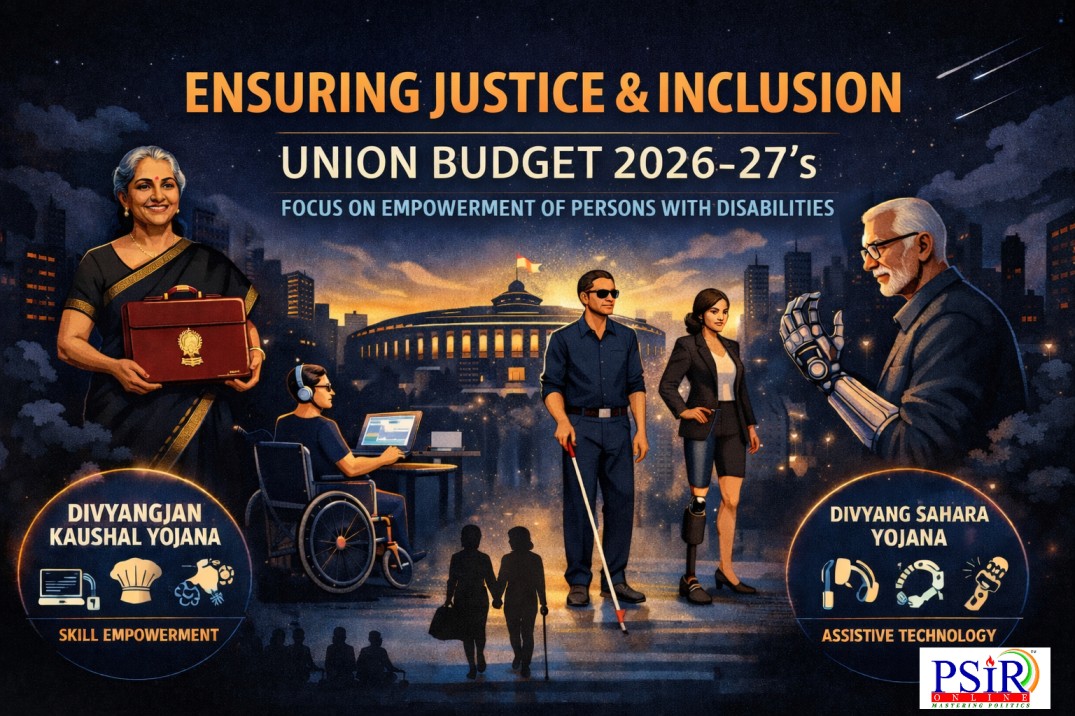
The Union Budget 2026-27 marks a significant step towards delivering justice and inclusion for persons with disabilities (Divyangjan) in India. With a notable 29% increase in allocation, the Department of Empowerment of Persons with Disabilities (DEPwD) has received ₹1,669.72 crore.
Introducing two flagship schemes — Divyangjan Kaushal Yojana (₹200 crore) for customized skill training and dignified livelihoods, and Divyangjan Sahara Yojana (₹100 crore) for timely access to high-quality assistive devices — the Budget strengthens economic empowerment, accessibility, and rehabilitation. These measures aim to translate the Rights of Persons with Disabilities Act into meaningful opportunities, fostering an inclusive ‘Viksit Bharat’ where every Divyangjan can thrive with dignity.
MACROECONOMIC CONTEXT FOR PWDS
· The Department of Empowerment of Persons with Disabilities (DEPwD), under the Ministry of Social Justice and Empowerment, received ₹1,669.72 crore in Budget 2026–27, an increase of about 31% over the 2025–26 revised estimates (₹1,275 crore).
· This implies a higher priority to disability inclusion in the overall social‑justice basket, even as critics argue that most of the growth is still locked in beneficiary‑focused schemes rather than systemic accessibility.
NEW SCHEMES: EMPLOYMENT AND ASSISTIVE TECHNOLOGY
The Finance Minister announced two flagship initiatives specifically for PwDs:
a) Divyangjan Kaushal Yojana (₹200 crore)
b) Divyang Sanctuary / Divyang Sahara Yojana (₹100 crore)
DIVYANG KAUSHAL YOJANA (ANNOUNCED IN UNION BUDGET 2026-27):
New skill development programme for Divyangjan (persons with disabilities) in high-growth sectors like IT, AVGC (animation, visual effects, gaming, comics), hospitality, food & beverages, and services. Aims at dignified employment and livelihood opportunities.
|
Feature |
Details |
|
Announced by |
Union Finance Minister Nirmala Sitharaman |
|
Budget Session |
Union Budget 2026–27 (presented Feb 1, 2026) |
|
Nodal Ministry |
Department of Empowerment of Persons with Disabilities, Ministry of Social Justice and Empowerment |
|
Budget Allocation (FY 2026–27) |
₹200 crore |
|
Target Beneficiaries |
Divyangjan (Persons with Disabilities – PwDs) across India |
|
Core Objective |
Provide customized, industry-relevant skill training for dignified livelihood opportunities |
|
Focus Sectors |
IT, AVGC (Animation, Visual Effects, Gaming, Comics), Hospitality, Food & Beverages, Services |
|
Key Feature |
Training modules tailored to specific disability groups (e.g., visual, hearing, locomotor, intellectual) |
Objectives
· Enhance employability of Divyangjan in high-growth, future-ready sectors.
· Move beyond traditional trades to task-oriented, process-driven roles suited to different disabilities.
· Ensure sustainable career pathways through skill certification, industry linkage, and post-training placement support.
· Promote inclusive growth under the vision of Sabka Sath, Sabka Vikas
Implementation Strategy
· Customized Training: Curriculum designed specific to each divyang group's capabilities and accessibility needs.
· Sector Focus: Emphasis on IT/digital services, AVGC (creative economy), hospitality, and F&B—sectors with high job creation potential.
· Certification & Placement: Alignment with NSQF (National Skills Qualification Framework); tie-ups with industry partners for apprenticeships and job placements.
· Special Focus: Priority to women with disabilities, economically weaker sections, and beneficiaries from aspirational districts/remote areas.
DIVYANG SAHARA YOJANA (ANNOUNCED IN UNION BUDGET 2026-27):
Focused on timely access to high-quality assistive devices for Divyangjan. Supported by enhanced allocations (e.g., ₹375 crore via ALIMCO for purchase/fitting of devices) and plans for more ALIMCO marts
|
Feature |
Details |
|
Announced by |
FM Nirmala Sitharaman (Budget Speech, Feb 1, 2026) |
|
Nodal Ministry |
Ministry of Social Justice & Empowerment → Dept. of Empowerment of Persons with Disabilities (DEPwD) |
|
Implementing Agency |
ALIMCO (Artificial Limbs Manufacturing Corporation of India) |
|
Budget Allocation (FY 2026–27) |
₹100 crore (scheme) + ₹375 crore (ALIMCO capital support for production/fitting) |
|
Target Beneficiaries |
Divyangjan (PwDs) and senior citizens |
|
Core Objective |
Ensure timely, affordable access to high-quality, modern assistive devices |
|
Key Innovation |
Integration of AI and advanced tech in device design; modern retail-style Assistive Technology Marts |
Core Objectives
1. Timely Access: Reduce waiting periods for assistive devices by scaling up domestic production capacity.
2. Quality Upgrade: Move from basic aids to smart, AI-enabled devices (e.g., AI-powered hearing aids, smart canes, bionic limbs).
3. Affordability: Subsidized/free devices for eligible beneficiaries, especially BPL families and those in remote areas.
4. Modern Retail Experience: Set up Assistive Technology Marts where beneficiaries can see, try, and purchase devices in a dignified, customer-friendly environment.
5. Inclusive Coverage: Explicitly includes senior citizens (linking with Rashtriya Vayoshri Yojana objectives)
Key Components & Implementation Strategy
1. ALIMCO Capacity Expansion
· Production Scale-Up: ₹375 crore allocated to ALIMCO for expanding manufacturing facilities, reducing lead times, and meeting rising demand.
· R&D Investment: Funding for developing next-gen assistive technologies, including:
o AI-integrated hearing aids with noise cancellation
o Smart canes with obstacle detection
o Lightweight, durable prosthetic limbs with sensory feedback
o Voice-controlled mobility aids.
· Technology Partnerships: Collaborations with IITs, startups, and global assistive tech firms for innovation.
2. Assistive Technology Marts
· Modern Retail Model: Unlike traditional distribution camps, these marts will function like experience centres where beneficiaries can:
o Try devices before fitting
o Get customized adjustments
o Receive after-sales support
o Access counselling on device usage.
· Expansion Plan: Currently ~100 PM Divyasha Kendras; plan to add 80+ new Assistive Technology Marts across India.
· Location Strategy: Priority to tier-2/3 cities, aspirational districts, and high-PwD population areas.
3. Strengthening PM Divyasha Kendras
· Upgradation of existing kendras with better inventory, digital booking systems, and trained staff.
· Integration with UDID (Unique Disability ID) database for seamless verification and tracking.
CONTINUITY AND EXPANSION OF EXISTING PROGRAMMES
Beyond the two new schemes, several ongoing disability‑related budgets have been strengthened or maintained:
· Assistance to Disabled Persons for Purchase/Fitting of Aids and Appliances (ADIP):
o Budget: ₹375 crore in 2026–27, up from about ₹316.7 crore earlier, indicating a renewed focus on rehabilitation and assistive devices.
· National Institutes for PwDs:
o Allocation raised to ₹439.21 crore, supporting training, research, and vocational services through institutions like NIMH, NIEPMD, and others.
· Scholarship for Students with Disabilities:
o Around ₹150 crore, with only a marginal increase; this is seen as insufficient in real‑term growth given rising enrolment and accommodation costs.
· Centre for Disability Sports:
o Received ₹32.5 crore as a dedicated allocation, signalling institutional recognition of para‑sports as a pathway to dignity and economic mobility.
CONCEPTUAL SHIFT: FROM WELFARE TO RIGHTS‑BASED INCLUSION
For PSIR‑oriented analysis, Budget 2026–27 can be read as an attempt to operationalise the Rights of Persons with Disabilities Act, 2016 (RPwD) in economics and technology:
· RPwD 2016 anchors such as:
o 4% reservation in government jobs, 5% in higher education, and universal accessibility in transport, ICT, and buildings.
· Budget measures align with Articles 14, 15, 16, 21 and 38 by reframing PwDs as state‑enabled economic agents, not just welfare recipients.
· The emphasis on AI‑integrated assistive devices and remote‑friendly skilling reflects a rights‑based industrial policy dimension, where technology is leveraged to expand reasonable accommodation in the workplace.
KEY GAPS AND CRITICISMS

Even as the budget receives cautious praise from civil‑society groups like NCPEDP and EYEWAY, several critical concerns remain:
· Accessibility lags behind skilling:
o The Scheme for Implementation of the RPwD Act (SIPDA)—the main vehicle for accessibility—gets only ₹125 crore, a tiny portion of DEPwD’s total budget, creating a “policy divide” between welfare and structural inclusion.
· Limited social‑security push:
o The budget focuses on skilling and assistive tech, but offers little in direct income or social‑security support for severely disabled or non‑employable groups.
· Utilisation and implementation deficits:
o Analysis shows that many disability‑related schemes historically suffer from under‑spending and complex procedures, so the success of Divyangjan Kaushal and Divyang Sahara Yojana will depend on capacity building at district and block levels.
MEASURES FOR THE OVER-ALL DEVELOPMENT OF PwDs
For a holistic development of Persons with Disabilities (PwDs), policy and governance must move beyond piecemeal welfare to a rights‑based, multi‑sectoral, and life‑cycle approach. Below are structured, UPSC‑friendly measures that can be used in answer‑writing (GS‑2, GS‑3, PSIR‑oriented).
1. Prevention and Early Intervention
· Strengthen maternal and child‑health systems
o Ensure universal ante‑natal and post‑natal screening, nutrition support, and immunisation coverage to reduce preventable disabilities arising from birth‑related complications, malnutrition, and vaccine‑preventable diseases.
· Early detection and habilitation
o Integrate early‑childhood screening for visual, hearing, and motor disabilities into ASHA‑centred primary‑health and Anganwadi networks; link early detection with immediate referral to rehabilitation services.
2. Inclusive Education and Skilling
· Universal, barrier‑free schooling
Implement the Right to Education (RTE) in letter and spirit for children with disabilities by ensuring:
§ Infrastructure accessibility (ramps, toilets, tactile paths).
§ Adequate number of resource‑teachers, sign‑language interpreters, and assistive aids.
· Tailored skill‑development and vocational training
o Integrate PwDs into Skill India, PMKVY, and sector‑specific skilling missions, with disability‑specific modules in IT, AI‑assisted work, logistics, handicrafts, and service roles.
o Create divyang‑inclusive industrial training institutes (ITIs) and monitor placement‑linked outcomes to avoid “skilling without employment”.
3. Employment and Economic Empowerment
· Effective implementation of reservations and beyond
o Strengthen monitoring of 4% reservation in government jobs and 5% in higher education under the RPwD Act, 2016 through mandatory quarterly reporting and penalty mechanisms for non‑compliance.
o Introduce a “Disability‑Inclusive Employment Policy” for the private sector, mandating reasonable accommodation, flexible work, and remote‑work options.
· Entrepreneurship and income‑support
o Provide concessional credit, collateral‑free loans, and interest subsidies to PwDs for self‑employment and micro‑enterprises.
o Promote self‑help groups (SHGs) of PwDs with dedicated bank and nodal‑officer support, especially in rural areas.
4. Accessibility and Universal Design
· Bound‑by‑law universal accessibility
o Expand the Accessible India Campaign (Sugamya Bharat Abhiyan) with binding, time‑bound norms for all new buildings, transport systems, and public infrastructure.
o Ensure universal access in smart‑city projects, including: tactile paving, accessible bus stops, audio‑visual signals, and barrier‑free public toilets.
· Digital and ICT accessibility
o Mandate website, app, and e‑governance portals to follow WCAG (Web Content Accessibility Guidelines), with screen‑reader support and high‑contrast modes.
o Integrate AI‑based assistive tools (voice assistants, sign‑language virtual interpreters) into public‑service delivery platforms.
5. Health, Rehabilitation, and Assistive Technology
· Comprehensive rehabilitation under universal‑health umbrella
o Bring rehabilitation, physiotherapy, and assistive‑device provision under Ayushman Bharat and related schemes, ensuring coverage for both catastrophic and chronic conditions.
o Set up district‑level rehabilitation centres with trained professionals (physiotherapists, occupational therapists, speech therapists).
· Affordable and locally produced assistive devices
o Scale up ALIMCO‑like public‑sector units to mass‑produce low‑cost artificial limbs, hearing aids, and mobility devices.
o Develop “Assistive Technology Marts” where PwDs can try, test, and get counselling before choosing devices.
6. Social Protection and Safety Nets
· Robust social‑security architecture
o Raise and rationalise disability pension schemes; index them to inflation and target severe and multiple disabilities more generously.
o Integrate PwDs into old‑age pension, housing, and disaster‑relief schemes through disability‑smart Aadhaar‑based identification.
· Anti‑exploitation and legal‑aid mechanisms
o Strengthen disability‑specific legal‑aid cells and fast‑track courts to address abuse, discrimination, and denial of rights.
o Ensure PLVs (Persons with Lived Experience) have representation in disability commissions, planning bodies, and grievance‑redressal committees.
7. Social Awareness and Cultural Change
· Nationwide disability‑sensitisation campaigns
o Launch media‑based campaigns and school‑curriculum modules on disability rights, inclusion, and reasonable‑accommodation to combat stigma.
o Engage film, sports, and cultural icons to model inclusive behaviour and challenge stereotypes.
· Inclusive sports and community participation
o Mandate adaptive sports infrastructure and parallel events in Khelo India, state‑level, and school meets so PwDs participate alongside, not apart.
o Promote clubs, hobby groups, and cultural platforms for PwDs to build social capital and self‑esteem.
8. Institutional and Governance Reforms
· Single‑window PwD ecosystem
o Create a centralised online portal integrating certification, schemes, jobs, training, and grievance redressal for PwDs, with AI‑chatbot support.
o Introduce a “Disability‑Inclusive Development Index” to rank states and districts on accessibility, employment, and service‑delivery for PwDs.
· Policy modernisation and monitoring
o Finalise and implement an updated National Policy for PwDs with clear quantified targets, timelines, and independent monitoring.
o Strengthen Central and State Disability Commissions with statutory powers, dedicated budgets, and data‑driven grievance‑tracking
PRACTISE QUESTIONS FOR GS 2 MAINS
1. “The Union Budget 2026–27 marks a shift from welfare to rights-based inclusion for persons with disabilities.” Critically examine this statement in the context of recent policy measures.
2. Discuss the significance of the Divyangjan Kaushal Yojana in promoting inclusive economic growth. What challenges may arise in its implementation?
3. Analyze how assistive technology initiatives like the Divyangjan Sahara Yojana can contribute to substantive equality under Articles 14 and 21 of the Indian Constitution.
4. Despite increased allocations, accessibility remains a major concern in disability policy. Examine the limitations in the current budgetary approach toward structural inclusion.
5. Evaluate the role of governance and institutional reforms in ensuring holistic development of persons with disabilities in India. Suggest measures to improve policy outcomes.