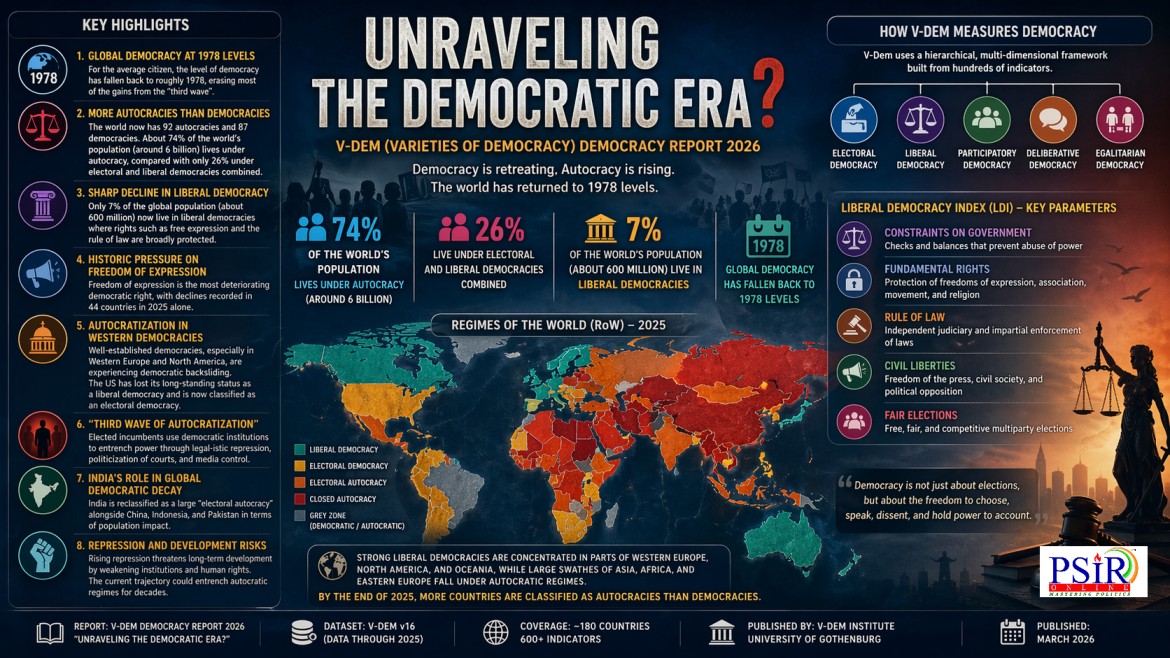
V-Dem (Varieties of Democracy) Democracy Report 2026 ("Unraveling The Democratic Era?") is the 10th edition, published in March 2026 by the V-Dem Institute at the University of Gothenburg. It is based on V-Dem Dataset v16 (data through 2025) and analyzes democracy across ~180 countries using expert-coded indicators and measurement models.
KEY HIGHLIGHTS
1. Global democracy at 1978 levels
· For the average citizen, the level of democracy has fallen back to roughly 1978, erasing most of the gains from the “third wave” of democratization.
· The report is based on over 200 countries and more than 600 indicators, with data extending up to 2025, making this a highly granular, long‑run assessment.
2. More autocracies than democracies
· The world now has 92 autocracies and 87 democracies, underscoring that the global balance has tipped toward autocratic rule.
· About 74% of the world’s population (around 6 billion) lives under autocracy, compared with only 26% under electoral and liberal democracies combined.

3. Sharp decline in liberal democracy
· Only 7% of the global population (about 600 million) now live in liberal democracies where rights such as free expression and the rule of law are broadly protected.
· The Liberal Democracy Index (LDI)—V‑Dem’s core measure—shows that key liberal pillars (courts, media, civil society) are under sustained pressure, especially in middle‑income and Western states.
4. Historic pressure on freedom of expression
· Freedom of expression is the most deteriorating democratic right, with declines recorded in 44 countries in 2025 alone.
· The report notes a global rise in online and offline repression, including legal harassment of journalists, digital surveillance, and narrowing civic space.
5. Autocratization in Western democracies
· Well‑established democracies, especially in Western Europe and North America, are experiencing democratic backsliding, with the United States showing the sharpest single‑year decline.
· The US has lost its long‑standing status as a liberal democracy and is now classified as an electoral democracy, due to erosion of judicial independence, polarized party systems, and threats to dissent.

6. “Third wave of autocratization”
· The report frames the current trend as a “third wave of autocratization”, where elected incumbents use democratic institutions to entrench power (e.g., via legal‑istic repression, politicization of courts, and media control).
· This is not just about coups or overt dictatorships but incremental, rule‑using, ill‑liberal reforms that hollow out liberal democracy.
7. India’s role in global democratic decay
· India is identified as a primary driver of global democratic decay, reclassified as a large “electoral autocracy” alongside China, Indonesia, and Pakistan in terms of population impact.
· The report cites concerns over harassment of journalists, weakened judicial independence, and narrowing political pluralism, though India remains formally competitive in elections.
8. Repression and development risks
· The report links rising repression—including restrictions on civil society, political violence, and torture—to long‑term development risks, including weaker institutions and poorer human‑rights outcomes.
· It warns that the current trajectory could entrench autocratic regimes for decades, unless backlash from civil society, the judiciary, and international actors is strengthened.
HOW COUNTRIES ARE CLASSIFIED (REGIMES OF THE WORLD – ROW)
V-Dem uses the Regimes of the World (RoW) typology (based on LDI and EDI scores, with confidence intervals for “grey zones”). Thresholds are approximate and data-driven (exact cutoffs use expert-coded indicators for multiparty elections, fairness, freedoms, etc.).


The map reveals a fragmented global picture: strong liberal democracies are concentrated in parts of Western Europe, North America, and Oceania, while large swathes of Asia, Africa, and Eastern Europe fall under autocratic regimes. It underscores that by the end of 2025, more countries are classified as autocracies than democracies.
PARAMETERS OF CALCULATION USED BY V-DEM
V‑Dem calculates its democracy scores using a hierarchical, multi‑dimensional framework built from hundreds of indicators, but the core “headline” indices focus on a few high‑level principles.
1. Core principles used
V‑Dem distinguishes five main “principles” of democracy, each with its own index:
· Electoral democracy
· Liberal democracy
· Participatory democracy
· Deliberative democracy
· Egalitarian democracy
and creates six- indices, which are
· Liberal democracy index (LDI)
· Electoral democracy index (EDI)
· Liberal component index (LCI)
· Egalitarian component index (ECI)
· Deliberative component index (DCI)
· Participatory component index (PCI)
The values of each indices are calculated for all countries separately and countries are ranked based on each indices separately. The most important indices are LDI and EDI
2. Main parameters behind the Liberal Democracy Index (LDI)
The Liberal Democracy Index (the one usually cited in headlines) combines electoral and liberal features, and is parameterized by:
· Voting rights and elections
o Share of adult citizens with the right to vote (suffrage).
o Whether officials are elected (elected‑officials criterion).
o Quality of elections (free and fair, clean elections).
· Liberal‑rights components
o Freedom of expression (including media and alternative sources of information).
o Freedom of association (unions, parties, NGOs).
o Individual liberties and equality before the law (civil and minority rights, protection from state abuse).
o Constraints on the executive
§ Judicial constraints on the executive.
§ Legislative constraints on the executive.
All these are converted to a 0–1 scale, then aggregated into a single Liberal Democracy Index score via a weighted formula.
3. Parameters behind the Electoral Democracy Index (EDI)
The Electoral Democracy Index leans heavily on Robert Dahl’s polyarchy model, using five sub‑components:
· Elected officials (executive, legislature elected).
· Free and fair elections.
· Clean elections (minimal manipulation, vote‑buying, fraud).
· Freedom of expression.
· Freedom of association.
Each sub‑component is built from several specific indicators (e.g., 8–12 items each), coded by expert assessments plus some factual constitutional data, then scaled 0–1 and aggregated into a composite EDI.
4. How scores are actually computed
Indicators → Component indices → Democracy indices
In short, V‑Dem’s democracy score is not a single‑parameter number but a multi‑layered aggregation of electoral quality, civil liberties, executive constraints, participation, and egalitarian inclusion, all grounded in expert‑coded indicators and formal statistical models.
TOP 10 COUNTRIES (LIBERAL DEMOCRACY INDEX, 2025)
These are the top‑ranked liberal democracies by LDI score in 2025:
|
Rank |
Country |
LDI score (≈) |
|
1 |
Denmark |
0.88 |
|
2 |
Sweden |
0.85 |
|
3 |
Norway |
0.85 |
|
4 |
Switzerland |
0.84 |
|
5 |
Estonia |
0.84 |
|
6 |
Ireland |
0.82 |
|
7 |
Costa-Rica |
0.81 |
|
8 |
Finland |
0.81 |
|
9 |
France |
0.80 |
|
10 |
Belgium |
0.79 |
RANK OF INDIA AND KEY COUNTRIES IN LDI (LIBERAL DEMOCRATIC INDEX)
Here are approximate ranks and status on the Liberal Democracy Index (2025)
|
Country |
LDI score (≈) |
Rank (of 179) |
Regime type |
|
India |
0.26 |
105 |
Electoral autocracy |
|
USA |
0.57 |
51 |
Electoral democracy |
|
China |
0.04 |
171 |
Closed autocracy |
|
Russia |
0.06 |
162 |
Closed/autocratic |
|
Pakistan |
0.18 |
117 |
Electoral autocracy |
|
Bangladesh |
0.12 |
133 |
Closed autocracy |
|
Brazil |
0.70 |
28 |
Electoral democracy |
|
Japan |
0.73 |
24 |
Liberal democracy |
|
South Korea |
0.74 |
22 |
Liberal democracy |
|
Israel |
0.59 |
48 |
Electoral democracy |
INDIA’S INDEX SCORE AND RANK
|
S.No |
INDEX |
SCORE |
RANK |
|
1 |
Liberal democratic Index (LDI) |
0.26 |
105 |
|
2 |
Electoral democracy index (EDI) |
0.38 |
106 |
|
3 |
Liberal component index (LCI) |
0.58 |
99 |
|
4 |
Egalitarian component index (ECI) |
0.41 |
138 |
|
5 |
Participatory component index (PCI) |
0.54 |
83 |
|
6 |
Deliberative component index (DCI) |
0.57 |
100 |
This table provides a breakdown of India's performance across different democratic metrics as measured by the V-Dem (Varieties of Democracy) Institute for their 2026 Democracy Report.
Understanding the Indices
To understand this table, it helps to know what each component index measures. These indices range from 0 (lowest) to 1 (highest):
· Liberal Democratic Index (LDI): The "overall" score. It combines the electoral aspects of democracy with the protection of individual liberties and checks on the executive power (such as a strong judiciary and rule of law).
· Electoral Democracy Index (EDI): Focuses on the core of representative democracy—whether elections are free and fair, and the presence of basic freedoms (media, association, expression) that allow for competitive elections.
· Liberal Component Index (LCI): Measures the extent to which the government is constrained by law and the protection of individual civil liberties.
· Egalitarian Component Index (ECI): Measures how equally resources, power, and freedoms are distributed across different socio-economic and identity-based groups in society.
· Participatory Component Index (PCI): Measures how much citizens are involved in the democratic process directly—through civil society organizations, direct democracy, and local governance.
· Deliberative Component Index (DCI): Measures whether political decisions are made through public reasoning, respectful discourse, and consultation rather than by coercion or narrow elite interests.
Key Observations:
· Relative Strength: India’s highest ranking in this set is in the Participatory Component Index (83), suggesting that elements of direct citizen participation, such as engagement in local institutions or civil society, are measured as relatively stronger than other areas.
· Relative Weakness: The Egalitarian Component Index (138) is significantly lower in rank than the other indices. This suggests the V-Dem data indicates challenges regarding the equal distribution of resources, power, and access to rights across different societal groups.
· Core Democratic Metrics: The LDI (105) and EDI (106) scores reflect the report's broader assessment of India's democratic trajectory. In the 2026 report, V-Dem categorized India as an "electoral autocracy," a classification derived from these combined measurements of electoral integrity, civil liberties, and institutional checks.
LESSONS FOR INDIA FROM THE V-DEM DEMOCRACY REPORT 2026
India remains classified as an Electoral Autocracy (since 2017) and slipped five places to 105th out of 179 countries on the Liberal Democracy Index (LDI). Its autocratization episode — one of the longest and largest in magnitude globally — began around 2009 and continues as a “slow but systematic dismantling of democratic institutions.” Because of India’s enormous population, these domestic declines are a major driver of the global democratic reversal (population-weighted world democracy scores have fallen to 1978 levels). The report highlights the most affected areas in India as freedom of expression, media independence (including harassment of critical journalists), civil society repression, attacks on the opposition, and weakening of legislative oversight and public consultation.
Key lessons India can draw:
· Elections alone do not guarantee democracy. Multiparty polls exist, but without robust judicial/legislative checks, free media, and civil liberties, the system slides into electoral autocracy — exactly where India has been stuck for nearly a decade.
· Gradual erosion is more dangerous than sudden collapse. The report shows that autocratization rarely happens overnight; it creeps in through incremental restrictions on expression, civil society, and institutional independence. Once entrenched, reversal is difficult and rare.
· Freedom of expression and media are the first and most common victims worldwide — and India is no exception. These are the leading indicators of decline in the 44 autocratizing countries in 2025.
· Large countries matter globally. India’s trajectory affects the lives of nearly one-fifth of humanity and drags down the worldwide averages, showing that domestic choices have planetary consequences.
PRACTICAL SUGGESTIONS FOR INDIA
To halt further decline and move toward democratization (as seen in a few successful global reversals like Brazil, Zambia, or South Korea), the report’s broader findings point to these evidence-based steps:
1. Protect and expand freedom of expression and media independence — Reduce harassment of journalists, restore critical media space, and ensure diverse viewpoints can be aired without fear. This is the single most common area that improves when countries start democratizing.
2. Strengthen institutional checks and balances — Bolster judicial independence, legislative oversight of the executive, and the autonomy of bodies like the Election Commission. Countries that reversed autocratization almost always saw judicial constraints on the executive improve first.
3. Create space for a vibrant civil society and opposition — Stop attacks on NGOs, activists, and opposition parties. Sustained, broad-based pro-democracy mobilization by civil society has proven decisive in every successful reversal case documented by V-Dem.
4. Improve public consultation and pluralism — Bring back meaningful pre-legislative consultation, reduce polarization, and address the low egalitarian and participatory scores. Greater inclusion of diverse voices strengthens legitimacy and resilience.
5. Focus on long-term institutional repair rather than short-term electoral wins. The report shows that once a country enters the electoral autocracy category, it tends to stay there unless deliberate, sustained reforms are made across multiple dimensions.
In short, the V-Dem data offers India a clear warning: the democratic backsliding is real, measurable, and continuing. But it also offers hope — several countries have successfully reversed similar trends by prioritizing exactly the areas where India is currently weakening. The choice lies in whether India treats these findings as a call to action or continues on the current path.
PRACTISE QUESTIONS FOR GS 2 MAINS
1. “The world has entered a phase of democratic recession.” In the light of the V-Dem Democracy Report 2026, examine the major trends indicating global democratic decline.
2. The rise of “electoral autocracies” represents a shift in the nature of authoritarianism. Discuss with reference to contemporary global developments.
3. Critically analyze the factors responsible for democratic backsliding in India as highlighted in recent global democracy indices.
4. Freedom of expression is often the first casualty of democratic erosion. Examine this statement with suitable examples.
PRACTICE QUESTIONS FOR PSIR OPTIONAL
1. “Autocratization today is incremental and institutional rather than abrupt.” Discuss in the context of the “third wave of autocratization.”
2. Examine the methodological framework of V-Dem in measuring democracy. How does it differ from minimalist definitions of democracy like Dahl’s polyarchy?
3. “Elections alone do not make a democracy.” Evaluate this statement using the distinction between electoral democracy and liberal democracy.
4. Discuss the global implications of democratic decline in large countries like India on the international political order.