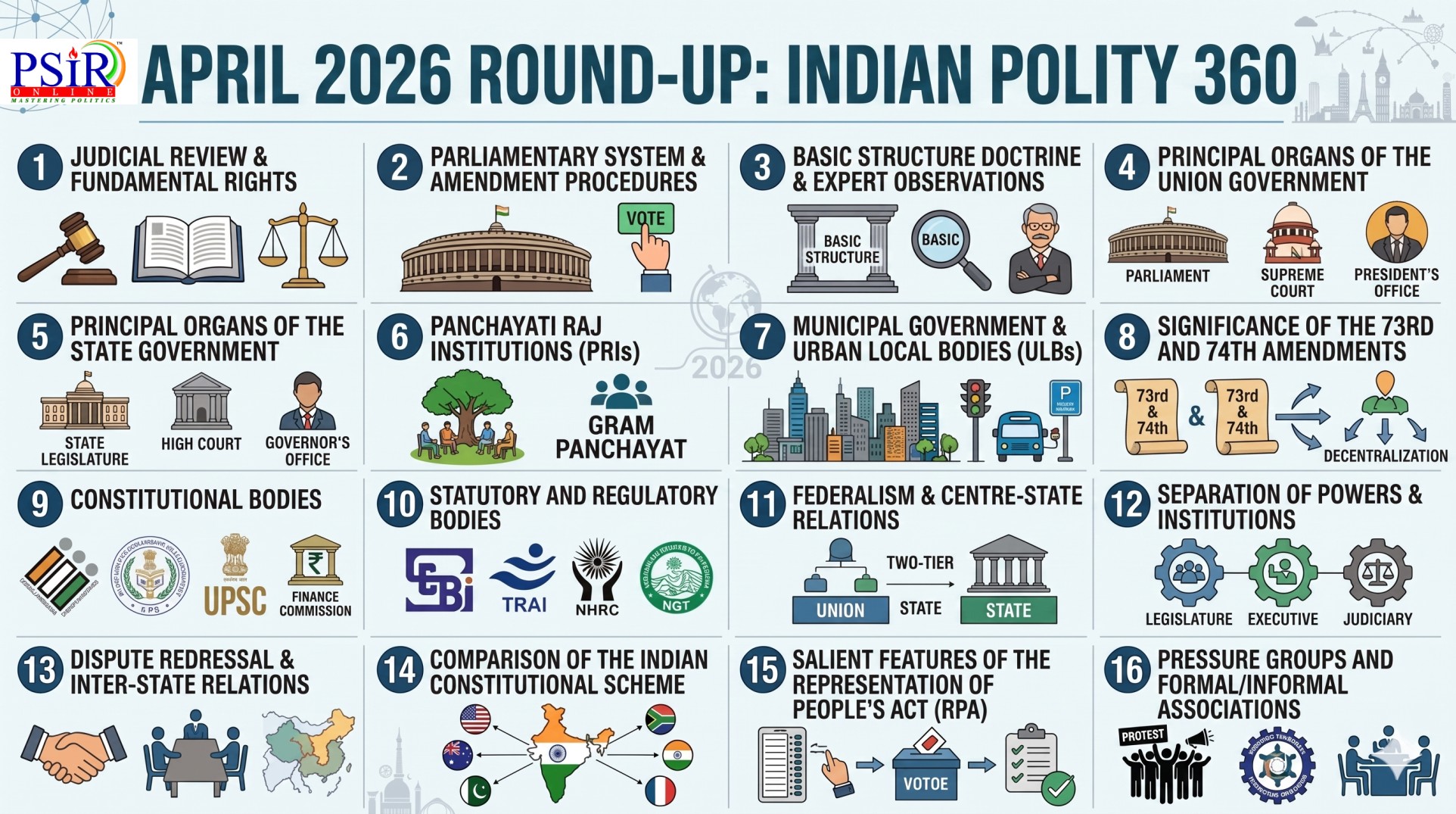
[NOTE: THE CURRENT AFFAIRS FOR THE MONTH OF APRIL HAS BEEN ORGANISED AS PER THE TOPICS MENTIONED IN PSIR AND GS 2 (MAINS) SYLLABUS. FEW TOPICS MIGHT LOOK REPETITIVE AS IT OVERLAPS UNDER MANY SUB-HEADINGS. BUT THE INFORMATION INSIDE THOSE TOPICS WILL BE DIFFERENT AND WILL PERTAIN TO THE MAIN HEADING CONCERNED. HENCE STUDENTS ARE REQUESTED TO READ EACH AND EVERY LINE OF THE SECTION TO GET COMPLETE UNDERSTANDING]
1. JUDICIAL REVIEW & FUNDAMENTAL RIGHTS
The Supreme Court issued several landmark observations during April 2026, reinforcing the dynamism of Article 21 and institutional equity.
· Road Safety as a Fundamental Right: In Phalodi Accident, In re (2026), the Court recognized commuter safety as an integral facet of the Right to Life with Dignity under Article 21. The bench stated that the State has a "positive mandate" to ensure a safe environment for citizens on national highways.
· Mandatory Representation for Women: The Court mandated a 30% horizontal reservation for women in Bar Associations across India. It warned that failure to comply could lead to the suspension of the Bar Association through judicial orders.
· Rights of Transgender Candidates: A ruling allowed transgender candidates to apply for public employment regardless of whether specific gender notifications were issued, further cementing the principles of equality and non-discrimination.
· Institutional Safeguards for Disabled Prisoners: In Sathyan Naravoor v. Union of India (2026), the Court issued directions to establish a uniform framework across all states to ensure the rights and dignity of prisoners with disabilities.
2. PARLIAMENTARY SYSTEM & AMENDMENT PROCEDURES
April 2026 was marked by a historic, albeit contentious, legislative attempt to modify the structure of the Lok Sabha and the implementation of women's reservations.
The "Delimitation Package" of 2026
On April 16, 2026, the government introduced three interconnected bills intended to overhaul the parliamentary seat distribution:
1. The Constitution (131st Amendment) Bill, 2026
2. The Delimitation Bill, 2026
3. The Union Territories Laws (Amendment) Bill, 2026
Salient Features of the Proposals
· Expansion of the Lok Sabha: The 131st Amendment sought to increase the maximum strength of the Lok Sabha from 550 to 850 members (815 from States and 35 from UTs).
· Census Decoupling: The Bill aimed to authorize Parliament to determine which census should be used for delimitation. This was a significant departure from the current requirement of using the first census published after 2026.
· Women's Reservation Fast-Track: These bills attempted to implement the one-third reservation for women (initially promised in the 106th Amendment, 2023) by using the 2011 Census for immediate delimitation, rather than waiting for the 2027 Census results.
Legislative Outcome: On April 17, 2026, the Lok Sabha voted down the Constitution (131st Amendment) Bill. Although 298 members voted in favor and 230 against, it failed to meet the mandatory two-thirds majority required for a Constitutional Amendment under Article 368.
3. BASIC STRUCTURE DOCTRINE & EXPERT OBSERVATIONS
The defeat of the 131st Amendment sparked intense expert debate regarding the Basic Structure Doctrine.
4. PRINCIPAL ORGANS OF THE UNION GOVERNMENT
The interaction between the Executive, Legislature, and Supreme Court centered on the Delimitation Package, which tested the "Actual Working" of the parliamentary system against its "Envisaged Role."
The Legislature (Parliament)
· Legislative Push: On April 16, 2026, the Union Executive introduced the Constitution (131st Amendment) Bill and the Delimitation Bill, 2026. These sought to expand the Lok Sabha from 550 to 850 seats and fast-track women's reservations using the 2011 Census.
· Actual Working: In a rare display of legislative check, the Lok Sabha defeated the 131st Amendment on April 17. Despite a simple majority, it failed to secure the two-thirds majority required under Article 368. Experts noted this as a functional success of the "Envisaged Role" of the opposition in a bicameral democracy.
· Privilege Motion: On April 21, a privilege notice was moved against the Prime Minister for remarks made in a televised address on April 18, highlighting the Legislature's role in holding the Executive accountable for its public conduct.
The Executive
· Policy Programmes: The Executive notified new rules under the Jan Vishwas (Amendment) Act to establish a Central Online Gaming Authority, shifting regulatory power from states to a central oversight body.
· Foreign Policy: The Executive hosted the South Korean President (April 19–21), resulting in Korea joining the International Solar Alliance and the Indo-Pacific Oceans Initiative.
The Supreme Court
5. PRINCIPAL ORGANS OF THE STATE GOVERNMENT
The State-level focus was dominated by the 2026 Assembly elections, particularly the constitutional crisis in Tamil Nadu, and progressive judicial rulings on social welfare.
The Executive (Governor & CM)
The Legislature
The High Courts
6. PANCHAYATI RAJ INSTITUTIONS (PRIS)
The focus for rural local bodies in April 2026 was the digital integration of governance and the evaluation of sustainable development at the village level.
National Panchayati Raj Diwas (April 24, 2026)
The Ministry of Panchayati Raj celebrated the anniversary of the 73rd Constitutional Amendment Act with several key launches:
· Panchayat Advancement Index (PAI) 2.0: A revamped monitoring framework launched at Vigyan Bhawan to rank Panchayats based on their performance in localized Sustainable Development Goals (SDGs).
· Panchayat Dharohar Initiative: Three illustrated monographs were released documenting the rural heritage of Tripura, Tirupati, and Uttarkashi, aimed at integrating cultural preservation with local governance.
· Digital Governance Expansion: The government highlighted the success of platforms like eGramSwaraj and Meri Panchayat, reporting that over 2.5 lakh Panchayats are now utilizing digital auditing and planning tools.
Expert Observations on 3Fs (Functions, Funds, Functionaries)
Experts during the April 2026 seminars noted that while political representation is high (with nearly 50% women representatives), the "3Fs" devolution remains uneven across states. A critical observation was the "grass without roots" phenomenon, where state bureaucracies continue to bypass elected PRIs in high-budget infrastructure projects.
7. MUNICIPAL GOVERNMENT & URBAN LOCAL BODIES (ULBS)
Urban governance in April 2026 was defined by a major policy shift that experts argue challenges the spirit of the 74th Constitutional Amendment.
The Solid Waste Management Rules, 2026
Effective April 1, 2026, these new rules introduced a highly centralized framework for waste management:
Fiscal Stress and Unfunded Mandates
Reports in April 2026 highlighted increasing fiscal stress on Municipal Corporations. While the 16th Finance Commission had suggested higher grants, many ULBs reported that new environmental obligations (like the 2026 Waste Rules) were not backed by formula-based financial transfers, leading to "unfunded mandates."
8. SIGNIFICANCE OF THE 73RD AND 74TH AMENDMENTS
The legislative and judicial discourse in April 2026 reaffirmed the transformative legacy of these amendments while identifying modern threats to their intent.
· Inclusive Leadership: As of April 2026, India boasts over 1.4 million elected women representatives in local bodies, a direct result of the mandatory reservations under these Amendments.
· Judicial Vigilance: The Supreme Court (in various observations during April) emphasized that the State Election Commissions (SECs) must remain independent of state executive influence to ensure the "sanctity of grassroots democracy."
· The Federalism Debate: Expert commentary on the defeat of the 131st Amendment Bill (which occurred in the same month) often referenced the 73rd/74th Amendments as the benchmark for successful decentralization, warning that any attempt to centralize power (like the new Waste Rules) contradicts the constitutional mandate of "Local Self-Government" as a State subject (Entry 5, List II).
9. CONSTITUTIONAL BODIES
Election Commission of India (ECI) & Delimitation
The most significant development occurred on April 16, 2026, with the introduction of the Delimitation Bill, 2026.
· New Legislation: The bill proposed a new Delimitation Commission consisting of a retired Supreme Court Judge (Chairperson), the Chief Election Commissioner (or a nominee), and State Election Commissioners.
· Role in Parliament Expansion: The ECI is set to oversee the logistics of expanding the Lok Sabha to 850 seats. However, the failure of the associated 131st Amendment Bill on April 17 created a temporary procedural deadlock regarding the legal basis for using 2011 Census data for this expansion.
· Judicial Observation: In Pritam Harmalkar vs. ECI (April 8, 2026), the judiciary reinforced the ECI’s discretionary powers in managing election petitions during assembly polls.
16th Finance Commission (FC)
The 16th FC, chaired by Dr. Arvind Panagariya, officially began its award period on April 1, 2026.
· Vertical Devolution: The Commission maintained the states' share of the divisible pool at 41%.
· Horizontal Devolution Criteria: A new parameter, "Contribution to GDP," (10% weight) was introduced, rewarding states based on their economic output. This replaced the previous "Tax and Fiscal Efforts" metric.
· Grants-in-Aid: The Commission revamped the grant structure, discontinuing revenue deficit and sector-specific grants in favor of basic and performance-based grants for local bodies.
Comptroller and Auditor General (CAG)
· Report No. 6 of 2026: Tabled on April 2, 2026, this report provided a financial audit of the Union Government’s accounts for the year 2024–25. It flagged concerns regarding the "under-utilization of capital outlays" in specific infrastructure ministries.
· UT Finances: The CAG released a dedicated report on Union Territory Finances, specifically highlighting the fiscal health of Jammu & Kashmir and Puducherry.
Union Public Service Commission (UPSC)
· Calendar & Notifications: The UPSC released the 2026 Examination Calendar and official notifications for the Civil Services (CSE) and Indian Forest Service (IFoS) exams in April.
· Expert Observation: Discussions in academic circles focused on the UPSC's "Actual Working" in maintaining the integrity of the interview process amidst increasing lateral entry at joint secretary levels.
National Commission for Scheduled Castes (NCSC)
· Caste Identity in Habitations: In late April, the NCSC issued a high-profile notice to the Virudhunagar District Collector (Tamil Nadu). The Commission is probing a complaint regarding "caste-based names" of habitations (e.g., "Paraseri"), arguing such names violate the SC/ST (Prevention of Atrocities) Act and Article 17 (Abolition of Untouchability).
10. STATUTORY AND REGULATORY BODIES
National Human Rights Commission (NHRC)
· Newsletter Release (April 2026): The NHRC emphasized Climate Justice and the Right to Water as emerging human rights frontiers. The Commission issued advisories to states to ensure "community-led governance" of water resources to prevent discrimination in rural sanitation.
National Commission for Women (NCW)
· Political Empowerment: Following the introduction of the Delimitation Bills, the NCW launched a policy push to ensure that the proposed one-third reservation for women in legislatures is not diluted by "proxy representation" (the Sarpanch Pati culture) as it scales to the national level.
Central Online Gaming Authority (Statutory Body)
· Inception: Notified in April 2026 under the Jan Vishwas (Amendment) Act, this new regulatory body began its operations. It is a quasi-judicial authority tasked with verifying "games of skill" versus "games of chance" and issuing decade-long registrations to e-sports entities.
11. FEDERALISM & CENTRE-STATE RELATIONS
The "Demographic Federalism" Crisis
The most significant development was the introduction of the Constitution (131st Amendment) Bill and the Delimitation Bill, 2026 on April 16.
· The Conflict: The Bills sought to increase Lok Sabha seats to 850 based on the 2011 Census. Experts and regional leaders from Southern states observed that this "integrationist tendency" threatened the federal balance by rewarding states with higher population growth while penalizing those that successfully implemented family planning.
· Legislative Check: On April 17, the 131st Amendment Bill was defeated in the Lok Sabha. Although it had a simple majority, it failed the mandatory two-thirds majority (Article 368). This event was hailed by legal experts as a victory for "Federal Equilibrium," ensuring that major structural changes to the Union require broad consensus.
The 16th Finance Commission (FC) Era
The 16th FC's award period (2026–2031) officially commenced on April 1, 2026, introducing new dynamics in fiscal federalism:
· Vertical Devolution: Remained at 41%, but the horizontal formula now includes "Contribution to GDP" (10% weight).
· Fiscal Discipline: The Commission recommended states bring down fiscal deficits to 3% of GSDP and strictly prohibited "off-budget borrowings," a move seen as a major centralization of fiscal oversight.
12. SEPARATION OF POWERS & INSTITUTIONS
Gubernatorial Power & Institutional Balance
During the Courts and Constitution Conference (late March/early April 2026), legal experts analyzed recent Supreme Court advisory opinions regarding Article 200.
· Observation: Experts described the Governor’s office as a "colonial relic" that often acts as a "square peg in a round hole" within a quasi-federal republic. The discussion focused on preventing Governors from using pocket vetoes to stall state legislation, emphasizing that the Governor's role is to facilitate, not frustrate, the will of the state legislature.
Executive Overreach vs. Legislative Integrity
The Jan Vishwas (Amendment) Act rules notified in April 2026 established a Central Online Gaming Authority. Critics noted that this moves "Betting and Gambling" (State List, Entry 34) into a centrally regulated digital sphere, bypassing state legislative competence through executive rulemaking.
13. DISPUTE REDRESSAL & INTER-STATE RELATIONS
Inter-State Water Disputes
· Mahanadi Dispute: On April 23, 2026, the Mahanadi Water Disputes Tribunal issued a final ultimatum to Odisha and Chhattisgarh to reach a mutual settlement. This highlighted the "Actual Working" of Article 262, where tribunals often face delays due to asymmetric data sharing and political sensitivities.
Boundary and Resource Conflict
· Andhra Pradesh Reorganisation: The Andhra Pradesh Reorganisation (Amendment) Bill, 2026, passed in early April, addressed long-standing issues regarding asset division and the boundary between Andhra Pradesh and Telangana, providing a legislative redressal mechanism for post-bifurcation friction.
14. COMPARISON OF THE INDIAN CONSTITUTIONAL SCHEME
The legislative push for parliamentary expansion in April 2026 sparked a global comparative debate among constitutional experts.
· Federalism vs. Descriptive Democracy: Experts compared India's Article 327 (which gives Parliament exclusive right over delimitation) with Article 1, Section 4 of the US Constitution, which leaves redistricting to the states. Analysts observed that India’s unitary tilt in delimitation aims to maintain national unity, whereas the US model prioritizes state-level "residual powers."
· Expansion of Article 21: The Supreme Court’s recognition of commuter safety and road safety as a facet of the Right to Life (Article 21) was noted by experts as a uniquely Indian "transformative" judicial approach. This contrasts with the UK’s parliamentary sovereignty model or the more restricted judicial review seen in some civil law systems in Europe.
· Secularism & Gender: Comparative studies in April 2026 highlighted that while many Western secular models (like France's laïcité) maintain a strict distance from religion, the Indian judiciary continues to play an active "social reformer" role, as seen in the mandate for 30% women's representation in Bar Associations.
15. SALIENT FEATURES OF THE REPRESENTATION OF PEOPLE’S ACT (RPA)
The RPA and associated election laws were the primary focus of the government's April 2026 legislative agenda.
The Delimitation Bill, 2026 (Introduced April 16)
This bill seeks to amend the framework for redrawing constituencies, introducing features that redefine representative democracy:
· Census Linkage: The bill proposed a shift to use the 2011 Census for delimitation to fast-track women's reservations, bypassing the previous mandate to wait for the first census after 2026.
· Expansion of Strength: It aimed to increase Lok Sabha seats from 543 to 850.
· Actual Working: The defeat of the 131st Amendment Bill on April 17—which was necessary to give effect to these RPA changes—demonstrated the rigid constitutional safeguards that prevent the Executive from easily altering the representative scheme.
Judicial Interpretations of RPA
In April 2026, the Supreme Court exercised powers under Article 142 to direct the Election Commission of India (ECI) to give immediate effect to appellate orders from Tribunals regarding election petitions, ensuring that judicial redressal in electoral matters is not delayed by bureaucratic timelines.
16. PRESSURE GROUPS AND FORMAL/INFORMAL ASSOCIATIONS
The month of April 2026 highlighted the intense influence of both professional associations and regional interest groups on the Indian polity.
· Bar Associations as Pressure Groups: The Supreme Court's mandate for 30% women's representation in Bar Associations (April 2026) turned these professional bodies into a focal point of constitutional debate. The Court observed that these associations are not just "private clubs" but essential components of the justice delivery system.
· Regional Pressure Groups & Delimitation: Southern Indian states and various linguistic associations acted as powerful informal pressure groups to stall the 131st Amendment Bill. Their lobbying centered on "Demographic Federalism," arguing that the new seat allocation would penalize states that successfully implemented family planning.
· Industry & Environmental Groups: In the wake of the new Solid Waste Management Rules (April 2026), various municipal associations and "informal waste-picker unions" lobbied for greater financial devolution, highlighting the tension between centralized environmental mandates and grassroots functional autonomy.