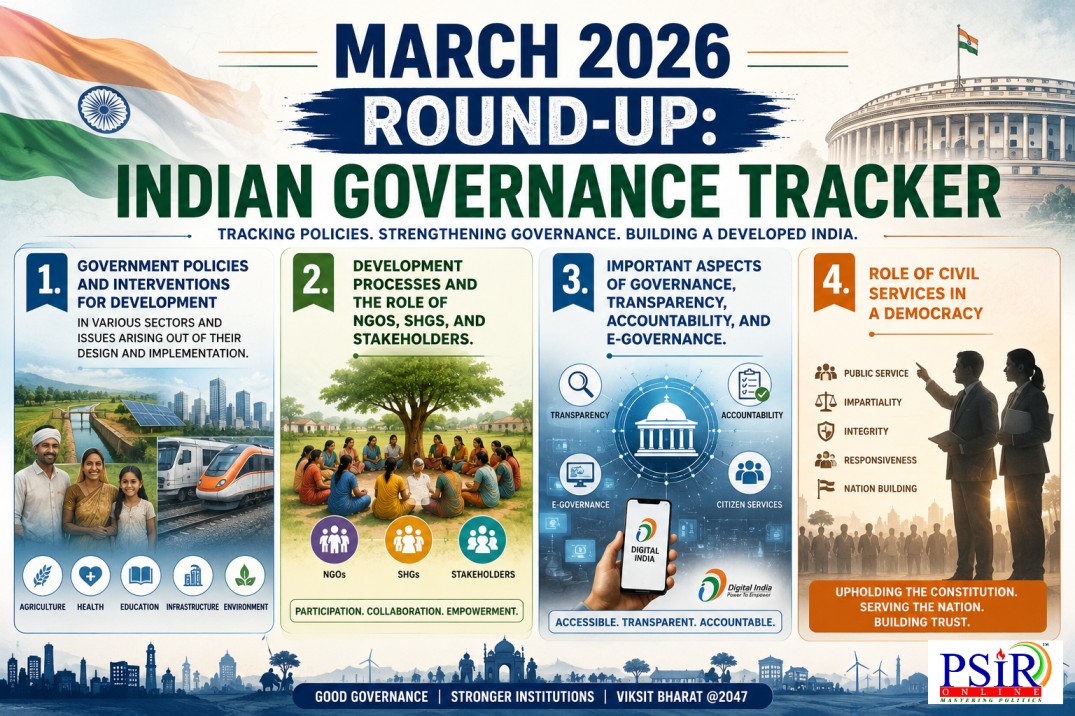
[NOTE: THE CURRENT AFFAIRS FOR THE MONTH OF MARCH HAS BEEN ORGANISED AS PER THE TOPICS MENTIONED IN GS 2 (MAINS) SYLLABUS. FEW TOPICS MIGHT LOOK REPETITIVE AS IT OVERLAPS UNDER MANY SUB-HEADINGS. BUT THE INFORMATION INSIDE THOSE TOPICS WILL BE DIFFERENT AND WILL PERTAIN TO THE MAIN HEADING CONCERNED. HENCE STUDENTS ARE REQUESTED TO READ EACH AND EVERY LINE OF THE SECTION TO GET COMPLETE UNDERSTANDING]
1. GOVERNMENT POLICIES AND INTERVENTIONS FOR DEVELOPMENT IN VARIOUS SECTORS AND ISSUES ARISING OUT OF THEIR DESIGN AND IMPLEMENTATION.
In March 2026, India saw continued implementation of the Union Budget 2026-27 (presented in February), parliamentary legislative activity during the Budget Session's second phase (resuming March 9), and key speeches by top leaders emphasizing development, governance reforms, and Viksit Bharat goals.
Focus areas included manufacturing, infrastructure, agriculture, digital economy, ease of doing business, and social welfare, alongside issues like implementation challenges, equity, and global headwinds (e.g., West Asia conflicts).
Key Speeches and Observations by Leaders
Prime Minister Narendra Modi delivered notable addresses, including at the TV9 Summit (March 23) and post-Budget webinars (e.g., March 9 on "Sabka Saath Sabka Vikas – Fulfilling Aspirations of People").
Vice President C.P. Radhakrishnan addressed themes of governance and youth (though his major Civil Services Day keynote was in April; March activities tied into broader Budget Session roles). He urged civil servants toward team excellence, local realities in scheme execution, and acting as "agents of transformation." Earlier Republic Day camp interactions (Jan 2026) reinforced youth's role in Viksit Bharat, national integration, and selfless service.
President Droupadi Murmu had limited March-specific national importance speeches noted (her key parliamentary address was January 28). She focused on social justice, poverty reduction (25 crore lifted), and schemes like PM JANMAN for marginalized groups. She assented to bills like the Transgender Persons Amendment Act (late March).
Expert and media observations generally praised the growth-oriented push (e.g., manufacturing, semiconductors, infrastructure) but noted modest allocations in health/social sectors, implementation gaps in states, and needs for better targeting/equity.
New Legislations, Amendments, and Policy Programmes (March 2026)
Parliamentary Activity (Budget Session, post-recess): Several bills introduced/passed, focusing on ease of business, decriminalization, and sector reforms.
· Transgender Persons (Protection of Rights) Amendment Bill, 2026: Introduced in Lok Sabha on March 13, passed by both houses (Lok Sabha March 24, Rajya Sabha March 25), and received presidential assent around March 30. It narrows the definition of a "transgender person" (removing broader self-perceived identity elements like trans-men/women or genderqueer, while retaining socio-cultural groups like hijra/kinner and certain intersex variations).
· Jan Vishwas (Amendment of Provisions) Bill, 2026: Introduced late March (around March 27), it amends ~80 central Acts (784 provisions across 23 ministries) to decriminalize/rationalize minor offences, replacing many with civil penalties. This builds on the 2023 version and aims at trust-based governance, reducing compliance burden, easing business/ living, and decongesting courts. It passed Parliament in early April.
· Foreign Contribution (Regulation) Amendment Bill, 2026: Introduced in March; if an organization's FCRA certificate is cancelled/not renewed, assets from foreign contributions vest in a government-designated authority.
· Other Bills Introduced: Corporate Laws (Amendment) Bill, 2026 (amends Companies Act 2013 and LLP Act 2008; referred to JPC); Central Armed Police Forces (Amendment) Bill, 2026 (deputation from IPS for senior levels); Digital Trade Facilitation Bill draft (legal recognition for electronic trade documents).
· FDI Policy Amendments (March 10 Cabinet approval): Revised Press Note 3 guidelines for investments from land-bordering countries (LBCs). Allows up to 10% non-controlling beneficial ownership under automatic route (per PMLA definition); fast-track 60-day approvals for strategic manufacturing sectors (e.g., electronics, semiconductors, solar). Aims to balance security with investment facilitation.
· Cabinet/Policy Decisions: Bharat Audyogik Vikas Yojana (industrial push), Jal Jeevan Mission updates, farmer support, MSME/exporter relief (~₹500 crore package). FDI guideline tweaks for land-border countries.
Issues Arising from Design and Implementation
· Implementation Gaps: State-level blocks on central schemes (e.g., in some opposition-ruled states); need for better local adaptation (as per VP remarks).
· Equity and Inclusion: SC status rulings (limited to specific religions; conversion leads to loss); maternity leave expansion for adoptive mothers (SC struck down age restriction as discriminatory).
· Regulatory Balance: Corporate/IT amendments praised for ease of business but flagged for potential over-delegation, censorship risks, or compliance burdens.
· Macro Challenges: Current account deficit (1.3% GDP in Q3 FY26), global conflicts impacting energy/trade; calls for diversification and fiscal prudence.
· Expert Views: Positive on structural reforms and private investment push, but emphasis on execution, skills, climate resilience, and inclusive growth for sustained Viksit Bharat trajectory. World Bank/others noted strong buffers but risks from external shocks.
2. DEVELOPMENT PROCESSES AND THE ROLE OF NGOS, SHGS, AND STAKEHOLDERS.
In March 2026, the Indian government's approach to development processes emphasized inclusive, grassroots-driven models centered on Self-Help Groups (SHGs), with notable symbolic and practical recognition of their role alongside broader stakeholder engagement.
However, a major regulatory development concerning NGOs—the introduction of the Foreign Contribution (Regulation) Amendment Bill, 2026—drew significant scrutiny and debate. No sweeping new national schemes specifically targeting "Development Processes and the Role of NGOs, SHGs, and Stakeholders" were announced that month, but existing frameworks like DAY-NRLM continued to be highlighted, with continued emphasis on women-led collectives, tribal inclusion, and community ownership in areas like water security and rural livelihoods.
Key Leadership Observations and Speeches (March 2026)
· President Droupadi Murmu: On March 11, she addressed the Jal Mahotsav 2026 (organized by the Ministry of Jal Shakti under Jal Jeevan Mission). She praised SHGs for their involvement in water testing, operation, and maintenance, noting their role in creating positive societal changes and empowering women. She stressed community ownership (e.g., via Jal Arpan Diwas handing over infrastructure to gram panchayats) and multi-stakeholder coordination (with missions like Swachh Bharat, groundwater boards, and campaigns like Catch the Rain) for sustainable water security. This aligned with broader themes of women-led development and grassroots democracy.
· On March 10, the President's Secretariat facilitated a special visit for over 150 women from Tribal and Particularly Vulnerable Tribal Group (PVTG) SHGs (under DAY-NRLM) to Amrit Udyan at Rashtrapati Bhavan. This was part of a designated day for women and tribal SHG members, recognizing their contributions to financial inclusion, community leadership, and unity in diversity. It symbolized national recognition of SHGs as vehicles for social inclusion and rural empowerment.
· Prime Minister Narendra Modi: No major March 2026 speeches directly centered on NGOs/SHGs in the searched records, but his government's ongoing push (via Budget 2026-27 elements and schemes) reinforced "Sabka Saath, Sabka Vikas" with focus on SHGs (e.g., Lakhpati Didi extensions, women-led enterprises, and rural infrastructure). Broader development addresses (e.g., post-Budget webinars, TV9 Summit) emphasized last-mile delivery, tier-2/3 cities, and inclusive growth, implicitly relying on SHGs and local stakeholders.
· Vice President Jagdeep Dhankhar: No prominent March 2026 observations specifically on this theme were identified in available records.
These events reinforced women-led, community-centric development as a cornerstone, building on schemes like Deendayal Antyodaya Yojana-National Rural Livelihoods Mission (DAY-NRLM), which has mobilized over 10 crore women into ~91 lakh SHGs with high repayment rates.
New Legislations/Amendments: FCRA Amendment Bill, 2026
The most significant policy move was the Foreign Contribution (Regulation) Amendment Bill, 2026, introduced in Lok Sabha on March 25.
Key Provisions (aimed at tightening oversight of foreign funding):
· Creation of a government-appointed "Designated Authority" with civil court-like powers to take over, manage, supervise, or dispose of foreign contribution-derived assets (funds, land, buildings, etc.) if an NGO's FCRA registration is cancelled, surrendered, lapsed, or not renewed.
· Timelines for utilization of funds under prior permission.
· Regulation of assets during suspension.
· Expanded personal liability for "key functionaries."
· Prior Central Government approval for investigations into FCRA matters.
· Rationalized penalties (e.g., reduced max imprisonment in some cases).
Government Rationale: Enhances transparency, accountability, national security, and prevents misuse of foreign funds that could affect public order or interests. It addresses operational gaps in the 2010 Act.
Broader Context and Deep Analysis
· SHGs and Stakeholders: Strong positive reinforcement. SHGs are positioned as engines of women empowerment, financial inclusion, tribal mainstreaming, and sustainable resource management (e.g., water). Initiatives like the Rashtrapati Bhavan visit and Jal Mahotsav exemplify "Jan Bhagidari" (people's participation) and unity in diversity, aligning with Viksit Bharat goals. DAY-NRLM's scale makes SHGs a proven stakeholder model with high repayment discipline.
· NGOs' Role: More contested. While NGOs remain vital partners (as per NITI Aayog reports and historical contributions), regulatory tightening signals a preference for controlled, transparent collaborations over unchecked foreign influence. This could push NGOs toward domestic funding, CSR, or government-aligned programs.
· Overall Development Processes: Emphasis on inclusive, decentralized models (SHGs + panchayats + missions) with multi-stakeholder coordination. No major new policy overhaul in March, but continuity with Budget 2026-27 priorities (women enterprises, rural housing, livelihoods). Challenges include balancing regulation with innovation in civil society.
3. IMPORTANT ASPECTS OF GOVERNANCE, TRANSPARENCY, ACCOUNTABILITY, AND E-GOVERNANCE.
In March 2026, India's governance, transparency, accountability, and e-governance landscape featured continuity in trust-based reforms alongside new regulatory pushes in digital and corporate spheres. Key developments included the introduction of the Jan Vishwas (Amendment of Provisions) Bill, 2026 (decriminalizing minor offences), the Corporate Laws (Amendment) Bill, 2026 (strengthening corporate governance), and draft IT Rules amendments (expanding digital oversight). These built on ongoing initiatives like Mission Karmayogi and Direct Benefit Transfer (DBT). No sweeping new national e-governance scheme launched that month, but emphasis remained on citizen-centric, technology-driven administration.
Key Leadership Observations and Speeches (March 2026)
· President Droupadi Murmu: On March 3, addressing State Civil Services Officers at Rashtrapati Bhavan, she stressed unwavering integrity, complete transparency, and unrelenting accountability as core to public service. She urged officers to uphold the nation's trust through ethical conduct, aligning with broader institutional reforms.
· Prime Minister Narendra Modi: In his March 23 address at the TV9 Summit 2026, he highlighted sensitive, people-connected governance, reduced bureaucracy, and anti-corruption efforts as hallmarks of the past decade. He emphasized self-reliance and addressing challenges head-on, implicitly tying into transparency via DBT and last-mile delivery. He later hailed the Jan Vishwas Bill's passage (early April, but introduced in March) as advancing trust-based governance for ease of living and doing business.
· Vice President: No prominent March-specific speeches on this theme were widely noted; Civil Services Day events (with greetings) occurred later in April.
These observations reinforced citizen-centric, ethical, and technology-enabled governance as pillars for Viksit Bharat.
New Legislations, Amendments, and Policy Programmes
1. Jan Vishwas (Amendment of Provisions) Bill, 2026 (Introduced March 27 in Lok Sabha; passed early April):
a. Amends ~80 Central Acts, decriminalizing/rationalizing 784+ provisions (717 for decriminalization).
b. Shifts minor procedural lapses from criminal to civil/administrative penalties.
c. Aims: Trust-based governance, reduced "fear of compliance," ease of living/doing business, and curbing outdated punitive rules.
Expert Observations: Praised for balancing accountability with ease (building on 2023 Act). Critics noted potential risks if enforcement weakens, but overall seen as pro-reform for reducing bureaucratic harassment. PM Modi called it empowering citizens by ending outdated regulations.
2. Corporate Laws (Amendment) Bill, 2026 (Introduced March 23 by FM Sitharaman; referred to JPC):
· Amends Companies Act 2013 and LLP Act 2008.
· Focus: Ease of doing business, simplified compliance (especially for small entities/LLPs), enhanced audit/auditor oversight, better board/committee transparency, CSR relaxations, and stronger governance (e.g., NFRA powers, explanations for auditor remarks).
Expert Judgements: Viewed as modernizing regulation, boosting investor confidence, and aligning with global standards while maintaining accountability. Strengthens transparency in reporting and reduces burdens without diluting oversight.
3. Draft Amendments to IT Rules, 2021 (Proposed March 30 by MeitY):
· Expands government oversight on online content (news, current affairs, user-generated).
· Makes advisories/guidelines binding; faster takedowns (e.g., 3 hours in some cases); extends to intermediaries/users; ties safe harbour to compliance; broader Ministry powers (including MIB).
Expert/Critic Observations: Government rationale — curb fake news, hate speech, deepfakes, enhance accountability. Critics (digital rights groups, Editors Guild, media): "Digital authoritarianism," chilling free speech, overreach, bypassing Parliament, risks to satire/criticism, pre-emptive censorship by platforms. Concerns over decentralized orders and lack of safeguards. Seen as expanding executive control in e-governance/digital public sphere.
4. Ongoing/Related:
· Mission Karmayogi/Capacity Building: Highlighted on/around Civil Services Day themes (though main event in April) — citizen-centric governance, transparency.
· FCRA Amendment Bill (March 25): Ties to accountability/transparency in foreign funding (asset management, oversight).
· DBT and anti-corruption systems continued as transparency benchmarks (e.g., direct benefits worth lakhs of crores).
Deep Analysis
· Transparency & Accountability: Strong push via Jan Vishwas (decriminalization for trust) and Corporate Bill (better disclosures/audits). DBT and ethical service emphasized by President/PM. However, IT Rules and FCRA signal tighter executive/digital controls, raising debates on balance vs. overreach.
· E-Governance: Draft IT amendments represent a major digital regulation step, aiming for orderly online space but criticized for potential surveillance/censorship. Complements Digital India but sparks free speech vs. responsibility tensions.
· Governance Processes: Shift toward "trust-based" and citizen-centric models (Mission Karmayogi, awards for excellence). Corporate and Jan Vishwas reforms target ease while institutionalizing checks. Experts broadly support simplification but caution implementation must preserve deterrence against serious violations.
· Broader Context: Fits Viksit Bharat — self-reliant, efficient administration. Positive for business/investors; contested in digital/civil society domains. Outcomes depend on final rules, JPC inputs, and judicial scrutiny. Continuity from prior years with incremental tightening in sensitive areas.
4. ROLE OF CIVIL SERVICES IN A DEMOCRACY
In March 2026, observations on the Role of Civil Services in a Democracy centered on capacity-building, transition to role-based administration, and leveraging experienced officers for national-level responsibilities. This reinforced the civil services as a vital bridge between policy and grassroots implementation in India's democratic framework, with emphasis on continuous upskilling and federal integration. No major new legislation on civil service structure emerged that month, but ongoing reforms via Mission Karmayogi gained momentum.
Key Leadership Observations (March 2026)
· President Droupadi Murmu: On March 2, she addressed IAS officers inducted from State Civil Services attending the 128th Induction Training Programme at LBSNAA, who called on her at Rashtrapati Bhavan. She described their induction not as a mere promotion but as a transition to a broader national responsibility. Highlighting their grassroots experience from state services as a powerful asset, she stressed their role in fostering inclusivity, bridging gaps, and contributing to Viksit Bharat through empathetic, future-oriented governance. This underscored civil services' function in integrating state-level insights into national democracy.
· Prime Minister Narendra Modi: No standalone March speech exclusively on this theme was prominent, but his government's continued thrust on Mission Karmayogi (including the Coursera partnership) implicitly reinforced civil servants as key enablers of citizen-centric development and last-mile delivery.
· Vice President: No major March-specific interventions noted on this exact theme.
These interactions highlighted civil services' democratic role in ensuring continuity, federal balance, and responsive administration.
Policy Programmes and Initiatives
The standout development was the Coursera-Mission Karmayogi partnership announced around March 10-11, 2026.
· Key Features: Coursera provides advanced, role-based upskilling courses via the iGOT (Integrated Government Online Training) platform. Focus areas include governance, leadership, policy design, strategic thinking, digital governance, and domain-specific competencies. It supports the shift from rule-based to role-based civil services.
· Rationale and Scale: Aims to equip over 1.5 crore onboarded users (as of early March) with modern skills for complex public administration demands. Aligns with Mission Karmayogi's (launched 2020) goal of creating future-ready, citizen-centric bureaucracy.
Expert Judgements and Observations:
· Positive Views: Seen as a forward-looking step to professionalize the civil services, addressing skill gaps in a digital/Viksit Bharat era. Experts praised the public-private collaboration for bringing global best practices (e.g., leadership from top institutions) into government training, enhancing adaptability, innovation, and efficiency. It strengthens the services' role as impartial implementers in democracy while promoting continuous learning.
· Analytical Takes: Reinforces the "Karmayogi" vision of transforming bureaucracy into a dynamic force for development. Some noted its potential to reduce silos between central/state services and improve policy execution. However, success depends on high adoption rates, integration with field realities, and measuring impact on governance outcomes rather than just course completion.
· Broader Context: Complements other March activities, such as the Assistant Secretary Programme preparations (inaugural session details emerged around early March), which expose young IAS officers to central functioning, fostering a unified national perspective.
Deep Analysis
· Democratic Role Emphasis: March events spotlighted civil services as stabilizers—integrating state experience into national policy (President's address) and building competencies for responsive, inclusive governance. This counters criticisms of rigidity by promoting agility and empathy.
· Capacity Building Focus: The Coursera tie-up marks a significant digital leap in training, moving beyond traditional academies like LBSNAA toward lifelong, on-demand learning. It positions civil servants as active contributors to democratic deepening via better service delivery and innovation.
· No Major Legislative Overhaul: Activity was reform-oriented rather than structural (e.g., no new service rules or amendments). UPSC CSE 2026 notification changes (eligibility tweaks for serving officers) were earlier (February), so not in scope.
· Expert Consensus: Broad support for such initiatives as essential for maintaining civil services' relevance in a vibrant democracy—balancing neutrality with pro-active problem-solving. Challenges include ensuring equitable access across hierarchies and states, avoiding over-reliance on online modes, and linking training to performance metrics. Overall, March 2026 portrayed civil services as evolving pillars for equitable, efficient democratic governance