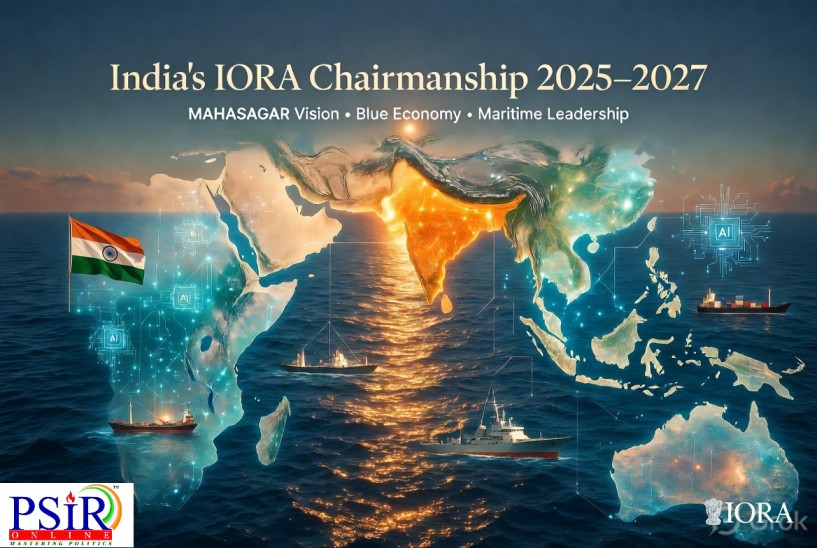
India assumed the Chairship of the Indian Ocean Rim Association (IORA) in November 2025 for a standard two-year term (2025–2027). This is India’s second stint as Chair (the first was 2011–2013). As of April 2026, India has been leading the organisation for roughly five months, providing an early window to assess its approach, priorities, and potential impact.
BACKGROUND ON IORA AND INDIA’S HISTORICAL ROLE
IORA, established in 1997 in Mauritius, is a 23-member regional forum (plus 12 Dialogue Partners) focused on economic cooperation, sustainable development, and non-political issues in the Indian Ocean Region (IOR). It operates on consensus and works through six core priority areas adopted in 2011 (during India’s previous chairmanship):
· Maritime Safety & Security
· Trade & Investment Facilitation
· Fisheries Management
· Disaster Risk Management
· Academic, Science & Technology Cooperation
· Tourism & Cultural Exchanges
Cross-cutting themes include the Blue Economy, Women’s Economic Empowerment, and (more recently) Climate Change. The current guiding document is the IORA Action Plan 2022–2027.
India has been a founding member and consistent driver of IORA. Its geographic centrality in the Indian Ocean (which carries ~80% of global oil trade and 50% of container cargo) makes the forum strategically vital. Previous Indian engagement included hosting key working groups and pushing the Blue Economy agenda. India also served as Vice-Chair (and part of the Troika) immediately before taking the Chair in 2025.

TRANSITION AND EARLY LEADERSHIP (NOVEMBER 2025–APRIL 2026)
The hand-over occurred smoothly from Sri Lanka (Chair 2023–2025). India participated actively in the 24th Council of Ministers (COM) meeting in May 2025 under Sri Lanka, where it was already signalling priorities for its upcoming term.
Notable early developments under India’s Chair:
· Institutional continuity: India built on its Vice-Chair contributions (e.g., introducing an e-office system at the Secretariat).
· 10th Indian Ocean Dialogue (IOD): The theme “Indian Ocean in a Transforming World” was endorsed earlier and is being hosted/led by India.
· IORA Day 2026 and related events: Commemorations and webinars on disaster risk management took place in March 2026.
· Indian Ocean Conference (IOC) 2026 (April 2026 in Mauritius): Though not an official IORA event, India Foundation and the Government of India co-hosted it under the theme “Collective Stewardship for Indian Ocean Governance,” with strong IORA Secretary-General participation.
India’s diplomat Sanjiv Ranjan serves as IORA Secretary-General (appointed 2025), giving New Delhi dual influence (Chair + Secretariat leadership) — a rare and advantageous position.
INDIA’S DECLARED AND EMERGING PRIORITIES
India has not issued a single formal “theme” document yet, but expert analyses, MEA statements, and pre-assumption briefings point to three core focus areas (widely reported as India’s governance-strengthening agenda):
· Institutional Strengthening & Financial Sustainability
Create a dedicated development fund or diversify funding beyond voluntary contributions (e.g., engaging private sector like shipping majors, ports, and energy firms).
Leverage technology (AI-driven marine data analytics, data management systems) for better policy analysis and coordination.
· Maritime Security & Domain Awareness
Expand the role of India’s Information Fusion Centre – Indian Ocean Region (IFC-IOR) in Gurugram.
Focus on non-traditional threats: piracy, IUU fishing, drug/human trafficking, oil spills, and search-and-rescue.
Promote voluntary norms and guidelines (building on recent adoptions like IUU Fishing Guidelines and Climate Change Strategic Agenda).
· Blue Economy & Sustainable Development
Operationalise India’s MAHASAGAR vision (Mutual and Holistic Advancement for Security and Growth Across Regions) — the evolved, expanded version of the earlier SAGAR doctrine announced by PM Modi in 2025. MAHASAGAR broadens focus from regional maritime security to holistic economic, strategic, and Global South-oriented cooperation.
Additional emphases include maritime education/skills development (new courses via Indian institutions like IIT-Madras and NIOT) and mainstreaming climate resilience across all priority areas.
STRATEGIC SIGNIFICANCE FOR INDIA
· Geopolitical: The IOR is increasingly contested (China’s growing naval and research-vessel presence, dual-use infrastructure). IORA offers India a multilateral, inclusive platform to shape norms without direct confrontation. It complements Quad, Indo-Pacific Oceans Initiative (IPOI), and other minilateral efforts.
· Economic: Boosting trade, investment, fisheries, tourism, and Blue Economy aligns with India’s growth agenda and SAGAR/MAHASAGAR.
· Leadership Projection: Hosting a potential Leaders’ Summit in late 2026 (to mark IORA’s 30th anniversary in 2027) would be a major diplomatic win — the first summit in over a decade and the first under Indian leadership.
· Global South Voice: Positions India as a bridge between developed Dialogue Partners and littoral developing states.
CHALLENGES AHEAD
· Institutional Weaknesses: IORA has historically suffered from limited funding, slow decision-making, and low visibility compared to ASEAN or other forums.
· Geopolitical Sensitivities: Consensus-based nature means China (a Dialogue Partner) and other actors can dilute ambitious security agendas.
· Implementation Gap: Many Action Plan items remain aspirational; translating priorities into measurable outcomes (e.g., binding guidelines, joint projects) will be the real test.
· External Disruptions: Red Sea crises, climate events, and great-power competition in the IOR could divert attention.
OUTLOOK AND ASSESSMENT (AS OF APRIL 2026)
India’s chairmanship is still in its early phase, but the trajectory is promising. The combination of Chair + Indian Secretary-General gives New Delhi unusual leverage to drive reforms. Success will be measured by:
· Progress on funding and digital tools.
· Tangible outcomes from working groups (especially Maritime Safety & Blue Economy).
· Whether the proposed Leaders’ Summit materialises and delivers a substantive outcome document.
If executed well, this term could revitalise IORA, elevate the Blue Economy and maritime governance agendas, and reinforce India’s image as the natural leader of the Indian Ocean. It also provides a concrete vehicle to operationalise the MAHASAGAR vision across the Global South.
In short, India’s 2025–2027 IORA Chairmanship represents both an opportunity and a responsibility — to move the organisation from a talk-shop to a more effective platform for cooperative governance in one of the world’s most vital maritime spaces. Early signals are positive, but the coming 18 months will determine whether it delivers lasting impact.
INDIA’S STRATEGIC USE OF IORA CHAIRMANSHIP (2025–2027) IN ADVANCING ITS INDO-PACIFIC STRATEGY
India’s current chairmanship of the Indian Ocean Rim Association (IORA) offers a powerful, ready-made multilateral platform to operationalise and expand its broader Indo-Pacific strategy. While the Indo-Pacific is a vast construct spanning two oceans, the Indian Ocean forms its strategic western anchor and economic lifeline (handling ~80% of global oil trade and 50% of container traffic). IORA, as the only pan-Indian Ocean forum with 23 member states, allows India to build a solid, consensus-driven foundation in its “home” maritime space before projecting influence eastward through the Indo-Pacific Oceans Initiative (IPOI), Quad, and other mechanisms.
This chairmanship coincides with the evolution of India’s maritime doctrine from SAGAR (Security and Growth for All in the Region, 2015) to MAHASAGAR (Mutual and Holistic Advancement for Security and Growth Across Regions, announced by PM Modi in Mauritius in March 2025). MAHASAGAR broadens the focus from IOR-centric security to holistic economic, technological, and Global South-oriented cooperation across the Indo-Pacific.
1. Institutional and Normative Foundation
IORA’s 2023 Outlook on the Indo-Pacific (IOIP)—adopted under Bangladesh’s chairmanship—already aligns the forum with an inclusive, rules-based, and development-focused vision of the Indo-Pacific. This explicitly prioritises Maritime Safety & Security as the top agenda item in the IORA Action Plan 2022–2027.
How India can leverage this:
· Use the Chair + Indian Secretary-General (Sanjiv Ranjan) position for dual influence to drive institutional reforms: strengthen the Secretariat, introduce digital tools (e-governance, AI-driven marine data analytics), and create sustainable funding mechanisms (e.g., private-sector partnerships or a dedicated development fund).
· Propose measurable outcomes under each of IORA’s six priority areas that directly feed into the seven pillars of IPOI (Maritime Security, Ecology, Resources, Capacity Building, Disaster Risk Reduction, Science & Technology, Trade & Connectivity).
· Host an IORA Leaders’ Summit in 2026–2027 to mark the organisation’s 30th anniversary—the first in over a decade. This would elevate IORA’s political visibility and deliver a high-level outcome document reinforcing MAHASAGAR principles.
2. Maritime Security & Domain Awareness: The Core Strategic Lever
The Indian Ocean is increasingly contested (China’s dual-use research vessels, port investments, and naval presence). IORA allows India to shape norms without direct confrontation, focusing on non-traditional threats that affect all members equally: IUU fishing, piracy, drug/human trafficking, oil spills, and climate-induced disasters.
Strategic actions India can take:
· Expand the role of its Information Fusion Centre – Indian Ocean Region (IFC-IOR) in Gurugram as a regional hub for Maritime Domain Awareness (MDA), offering real-time data-sharing to smaller IORA members (island states and African littorals).
· Institutionalise voluntary guidelines on IUU fishing, search-and-rescue, and maritime safety already under discussion.
· Link IORA working groups with Indian Ocean Naval Symposium (IONS) (which India also influences) and bilateral naval exercises to create layered security cooperation.
· Position IORA as the western pillar of the Indo-Pacific security architecture, complementing the more Pacific-oriented Quad and IPOI.
This creates a “security-public goods” narrative: India as the preferred net security provider for the Global South, building trust where hard-power minilaterals might raise suspicions.
3. Blue Economy & Sustainable Development: Economic Statecraft
The Blue Economy is a cross-cutting IORA theme and one of IPOI’s core pillars. India’s vast coastline, EEZ, and expertise in marine science, shipbuilding, and renewable energy give it natural leadership.
Leverage opportunities:
· Launch joint capacity-building programmes (e.g., marine biotechnology centres of excellence in collaboration with Australia, France, Singapore).
· Promote ocean accounting, marine spatial planning, blue carbon projects, and sustainable fisheries—directly supporting IORA’s fisheries management and disaster risk priorities.
· Develop skilling initiatives through Indian institutions (IIT-Madras, NIOT) for coastal communities across IORA members, creating economic interdependencies.
· Facilitate trade and investment corridors linking IOR ports with Indo-Pacific supply chains (e.g., India–Africa–Southeast Asia connectivity).
This translates MAHASAGAR’s “holistic advancement” into tangible projects, reducing dependence on external powers and positioning India as a development partner of choice.
4. Diplomatic and Geopolitical Multipliers
· Bridge to Dialogue Partners: Engage the US, EU, Australia, Japan, and others (now including potential new partners) within IORA’s inclusive framework. This broadens India’s coalition without alienating members sensitive to great-power rivalry.
· Synergies with other forums: Operationalise the recent IORA–BIMSTEC MoU; link IORA outcomes to ASEAN Outlook on the Indo-Pacific (AOIP); use IORA as a testing ground for Quad maritime initiatives.
· Global South Leadership: IORA’s 23 members (many Global South states) allow India to project MAHASAGAR as a non-Western-led alternative to more securitised frameworks, reinforcing its role at forums like the Voice of Global South Summit.
5. Challenges and Practical Roadmap
Potential hurdles:
· Consensus-based decision-making and chronic under-funding.
· Divergent threat perceptions among members regarding China.
· Implementation gaps between policy and practice.
India’s 18-month action plan (2026–mid-2027):
1. Short term (2026): Convene high-level working groups on MDA and Blue Economy; pilot digital platforms.
2. Medium term: Secure commitments for joint projects and funding at the proposed Leaders’ Summit.
3. Long term: Institutionalise IORA–IPOI synergy so that IORA deliverables automatically advance India’s wider Indo-Pacific goals.
FROM REGIONAL ANCHOR TO INDO-PACIFIC LEADERSHIP
IORA under Indian chairmanship is not merely a “talk shop” but a strategic multiplier. By strengthening the Indian Ocean’s governance architecture through MAHASAGAR-aligned initiatives, India creates a resilient, inclusive base that:
· Counters unilateral influence in its maritime backyard.
· Builds habits of cooperation among littoral states.
· Projects credible, non-coercive leadership across the entire Indo-Pacific.
If executed with the same pragmatism India has shown in Quad and IPOI, this chairmanship could transform IORA into a cornerstone of a free, open, and prosperous Indo-Pacific—one where India is seen as the indispensable convenor rather than just a participant. The next 18 months represent a rare window of structural advantage that New Delhi must seize decisively.
PRACTISE QUESTIONS FOR GS 2 MAINS
1. "India’s move from SAGAR to MAHASAGAR represents a paradigm shift in its maritime diplomacy." In the context of India’s current IORA chairmanship, discuss how this evolved doctrine aims to provide security and economic public goods to the Global South.
2. Evaluate the role of IORA as a vehicle for India to shape regional norms without direct geopolitical confrontation. How does India’s dual influence (as Chair and Secretariat leader) help in addressing non-traditional security threats like IUU fishing and climate change?
3. "Institutional weaknesses and funding constraints have historically hindered IORA’s effectiveness." Analyze the specific administrative and digital reforms India is introducing during its 2025–2027 term to ensure the association’s long-term sustainability.
4. Discuss the strategic significance of the Indian Ocean Region (IOR) as the western anchor of the Indo-Pacific. How does India’s leadership in IORA complement its engagements in other minilateral groupings like the Quad and the Indo-Pacific Oceans Initiative (IPOI)?
PRACTICE QUESTIONS FOR PSIR OPTIONAL
1. "The IORA offers a unique multilateral platform for India to operationalize its 'Indo-Pacific' vision through a consensus-driven approach." Critically examine this statement in light of the 'IORA Outlook on the Indo-Pacific' and India’s leadership role.
2. Analyze the "Security-Public Goods" narrative in India's foreign policy. How is India utilizing the Information Fusion Centre – Indian Ocean Region (IFC-IOR) and IORA working groups to project itself as a 'preferred net security provider' in the maritime domain?
3. Examine the impact of "Great Power Competition" on consensus-based regional organizations. To what extent can India’s IORA chairmanship mitigate the influence of external powers while maintaining the forum's inclusive and non-political character?
4. "Economic statecraft is a central pillar of India’s maritime strategy." Discuss how India is leveraging the Blue Economy and the MAHASAGAR vision to build economic interdependencies with African and Island littoral states within the IORA framework.