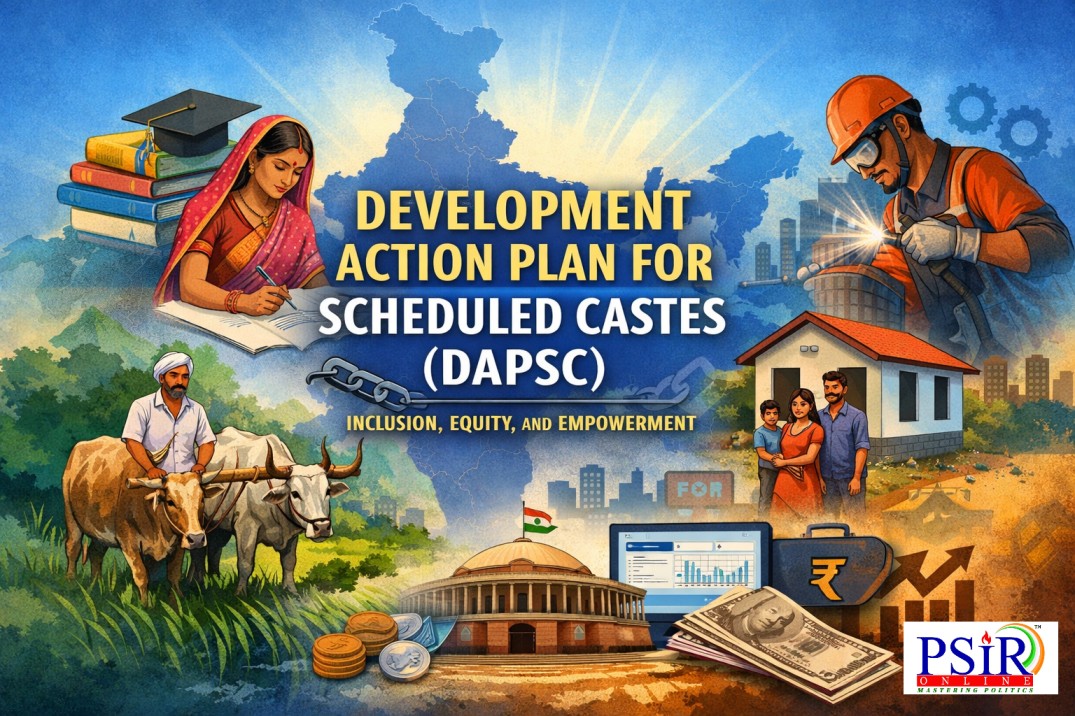
The Development Action Plan for Scheduled Castes (DAPSC) is the renamed and re‑framed version of the erstwhile Scheduled Caste Sub‑Plan (SCSP) / Allocation for Welfare of Scheduled Castes (AWSC) at the central and state levels in India. It is not a single new scheme, but a framework under which all major schemes of Union Ministries, Departments, and States earmark a specified share of funds exclusively for the benefit of Scheduled Castes (SCs).
What DAPSC Means
· Conceptually, DAPSC is a centralized, cross‑sectoral mechanism to ensure that a proportionate share of the public budget (roughly corresponding to the SC population share) is set aside within existing schemes—such as education, health, housing, agriculture, and employment—for SC beneficiaries.
· It replaces the older Scheduled Caste Sub‑Plan (SCSP) label but follows the same core principle: “earmarked allocations plus separate monitoring” so that SCs actually receive targeted physical and financial benefits.
How DAPSC Works
· Earmarking of funds: Each Ministry/Department and State Government earmarks a certain percentage of its budget for DAPSC‑linked schemes, and the SC‑component funds cannot be re‑appropriated to non‑SC heads.
· Monitoring and reporting: The Department of Social Justice & Empowerment monitors the physical and financial outcomes of DAPSC‑linked schemes across about 40+ central Ministries/Departments and several States, using a dedicated E‑Utthaan portal that shows real‑time expenditure and progress.
Relationship with Earlier SCSP / AWSC
· DAPSC carries forward the model of SC‑specific budgeting developed under Scheduled Caste Sub‑Plan (SCSP) and Allocation for Welfare of Scheduled Castes (AWSC), which were earlier used to track SC‑focused spending.
· The NITI Aayog‑era guidelines (2017) recommended renaming SCSP/TSP as DAPSC (for SCs) and DAPST (for STs), while keeping the earmarking, planning, and monitoring architecture intact.
States and DAPSC (e.g., Tamil Nadu)
· States like Tamil Nadu have enacted legislation (e.g., Tamil Nadu Development Action Plan for the Scheduled Castes and the Scheduled Tribes Act) to institutionalize planning, approval, and monitoring of DAPSC‑type plans, with a minimum earmarking of funds for SCs and STs as per their population share.
· State‑level DAPSC typically involves an Empowered Committee and a State Council that approve annual action plans, oversee implementation, and ensure funds are not diverted away from SC‑targeted schemes.
DAPSC SCHEMES AND PROGRAMMES IN UNION BUDGET 2026-27
The Development Action Plan for Scheduled Castes (DAPSC), formerly known as the Scheduled Caste Sub Plan (SCSP), remains a critical component of the Union Budget 2026–27. For this fiscal year, the government has earmarked a total of ₹1,96,400.37 crore under the DAPSC framework.
This funding is distributed across approximately 39 Ministries and Departments to implement schemes that specifically benefit Scheduled Caste (SC) communities.
Key Financial Highlights (2026–27)
· Total DAPSC Allocation: ₹1,96,400.37 crore.
· Targeted vs. Generic Schemes: Analysts note that while the headline figure is high, only about ₹75,077 crore is allocated to "target-focused" schemes (those directly impacting SC welfare), while the remainder is absorbed into broader generic schemes (like fertilizer subsidies or infrastructure maintenance) that include an SC component.
· Department of Social Justice and Empowerment (DoSJE): The primary department for these initiatives received an allocation of ₹13,687.59 crore, a marginal increase of 0.56% from the 2025–26 Budget Estimate.
Major Schemes and Program Updates
The following specific schemes received notable updates or funding shifts in the 2026–27 budget:
|
Sector / Ministry |
Key DAPSC‑linked scheme/programme (2026–27) |
|
Social Justice & Empowerment |
Pre‑Matric and Post‑Matric Scholarship for SCs, National Overseas Scholarship for SCs, Swami Vivekananda Scholarship for skill development, Stand‑Up India‑linked SC entrepreneurship support. |
|
Education |
Earmarked SC components in centrally sponsored schemes such as Samagra Shiksha, setting aside a share for SC students in access, retention, and quality‑enhancement programmes. |
|
Housing & Urban Development |
Pradhan Mantri Awas Yojana – Urban (PMAY‑U) and PMAY‑Gramin, where a defined portion is earmarked for SC beneficiaries under DAPSC‑compliant guidelines. |
|
Rural Development & Panchayati Raj |
Mahatma Gandhi NREGA, Deendayal Antyodaya Yojana – National Rural Livelihoods Mission (DAY‑NRLM), and other rural‑poverty schemes that earmark a share for SC‑beneficiaries as per DAPSC. |
|
Agriculture & Farmers Welfare |
Crop‑insurance (PMFBY), and other agriculture‑related schemes that allocate a proportionate share for SC farmers based on their population share. |
|
Health |
Ayushman Bharat‑PMJAY, and related health schemes, under which DAPSC guidelines require earmarking a share of benefits for SC households. |
|
Skill Development & Employment |
Scheme components under Ministry of Skill Development & Entrepreneurship and employment‑linked schemes that earmark a share for SC youth, including industry‑linked skilling and placement programmes. |
How to Track DAPSC Schemes in 2026–27
· Development Action Plan for Scheduled Castes (DAPSC) is reflected in the Union Budget’s annual financial statement under Statement 10A: “Allocation for Welfare of Scheduled Castes” (in ₹ crores)
· E‑Utthaan portal: The Department of Social Justice & Empowerment publishes a “Scheme‑wise Financial Summary” for each year (including 2025–26 and 2026–27) that lists individual schemes, their total allocation, and DAPSC‑specific allocation (in crore ₹) for all contributing ministries.
· Ministry‑wise DAPSC statements: Each of the 38 obligatory ministries files DAPSC‑compliant documents with the Ministry of Social Justice & Empowerment, which are summarized in the Budget‑related Parliamentary replies and PIB notes
HOW DAPSC ENHANCES DALIT EMPOWERMENT?
DAPSC (Development Action Plan for Scheduled Castes) enhances Dalit empowerment by institutionalising earmarked, visible, and monitored public‑sector spending for Scheduled Castes across multiple ministries and schemes, rather than treating Dalits only as passive “welfare” recipients. It tries to convert constitutional equality and affirmative‑action guarantees into concrete budgetary entitlements flowing into education, employment, housing, and entrepreneurship.
1. Financial inclusion and entitlement
· Under DAPSC, each obligated Ministry/Department earmarks a share of its budget for identified SC‑targeted components; this money cannot be re‑appropriated to non‑SC heads, which strengthens Dalits’ claim as rights‑holders, not mere beneficiaries.
· Because earmarking is linked to schemes (Samagra Shiksha, PMAY‑U, NREGA, scholarship schemes, etc.), Dalit households can access education, housing, livelihood, and health outcomes that directly affect their long‑term mobility.
2. Expanded access to education and skills
· DAPSC routes funds into SC‑earmarked scholarships (pre‑matric, post‑matric, overseas) and skill‑development components, which help Dalit youth move beyond traditional low‑status occupations and enter higher education, formal‑sector jobs, and entrepreneurship.
· By tying SC‑specific allocations to national education and skilling missions, DAPSC widens the pipeline from school to college to employment, reducing the risk that Dalit youth are excluded at critical transition points.
3. Economic and livelihood empowerment
· Earmarked components in rural livelihoods (NRLM), MGNREGA, and credit‑linked schemes (Stand‑Up India, MUDRA) under DAPSC help Dalit‑owned SHGs, micro‑enterprises, and self‑employed households access capital, market linkages, and business support, moving them toward asset‑building rather than only wage‑labour.
· Some state‑level SC‑focused funds (like SC Development Funds) follow a similar “earmarked” logic and are reported to improve income, asset‑ownership, and housing quality among Dalit beneficiaries, showing that targeted budgeting can translate into tangible economic uplift.
4. Institutionalisation and accountability
· DAPSC is not a single scheme but a framework under which 30+ central ministries and many states systematically report SC‑earmarked allocations, making it harder for governments to quietly dilute Dalit‑focused spending.
· The E‑Utthaan portal and Statement 10A bring transparency and monitoring, allowing civil society, researchers, and Parliamentary bodies to track whether promised Dalit‑benefit allocations are actually spent, thereby strengthening accountability and claim‑making power.
5. Symbolic and political recognition
· Framing SC‑focused spending as DAPSC (not just “welfare”) signals that Dalit development is central to the national budget architecture, nudging other ministries to treat Dalits as core constituents of their programmes.
· When Dalits (and their organisations) can quote specific DAPSC‑linked figures and schemes, they gain stronger discursive and legal‑administrative tools to demand better implementation, challenge discrimination, and negotiate for more inclusive local‑level planning.
DIMENSIONS OF DALIT UPLIFTMENT

DAPSC tries to make changes across multiple interlinked dimensions of Scheduled Castes’ (Dalits’) lives—economic, educational, social/security, spatial (habitat), and political‑inclusion—by embedding earmarked resources into mainstream schemes rather than restricting support to a few “SC‑only” projects.
1. Economic and livelihood dimension
· DAPSC earmarks portions of large schemes like MGNREGA, PM‑AYUSHMAN‑Yojana‑linked livelihoods, and rural livelihood missions (DAY‑NRLM) to ensure that SC‑dominated villages and households get priority access to employment, asset‑creation, and micro‑enterprise support.
· It also funds SC‑specific financial institutions (like the National Scheduled Castes Finance and Development Corporation) and micro‑credit‑linked schemes so SC entrepreneurs and SHGs can access capital, tools, and markets, moving them beyond casual wage‑labour.
2. Education, skill, and human‑capital dimension
· A major share of DAPSC is routed into education and skilling: pre‑matric and post‑matric scholarships, free coaching for SC/OBC students, and components of national skilling missions target SC youth to raise enrolment, completion, and transition into formal‑sector jobs.
· By linking SC‑earmarked funds to national teacher‑training, digital‑education, and placement‑linked skilling programmes, DAPSC aims to upgrade collective human‑capital assets of SC communities, not just individual “welfare” cases.
3. Housing, health, and basic‑needs dimension
· Components of Pradhan Mantri Awas Yojana (PMAY‑U and PMAY‑G), Swachh Bharat, and Ayushman Bharat under DAPSC direct a share of housing, sanitation, and health‑insurance resources to SC‑households, aiming to reduce cardinal poverty indicators (homelessness, open‑defecation, catastrophic health‑expenditure).
· This improves material quality of life and reduces the correlation between being SC and living in unhygienic, insecure, or informal settlements.
4. Social security and protection dimension
· Some DAPSC‑linked funds support social‑security and protective legislations (e.g., schemes administered by the Ministry of Social Justice & Empowerment that interface with Atrocity‑prevention mechanisms and welfare for Pwds in SC communities).
· Through earmarked components in legal‑aid and awareness‑generation schemes, DAPSC tries to strengthen SCs’ capacity to claim rights and resist discrimination, even if implementation gaps remain.
5. Spatial and village‑level development
· In many states, DAPSC logic is mirrored in SC/ST‑concentration‑village development plans, where habitations with high SC population get road connectivity, drinking‑water, electricity, and school‑infrastructure upgrades funded through earmarked envelopes.
· This aims to reduce geographic and infrastructural isolation, breaking the vicious cycle where SC‑majority hamlets are last to receive public services.
6. Political‑inclusion and claim‑making power
· By making SC‑allocated funds visible in Statement 10A and E‑Utthaan, DAPSC turns Dalit development into a quantifiable, auditable part of the budget, strengthening the political and statutory basis for demanding compliance.
· When civil‑society actors and SC‑led organisations can cite scheme‑wise DAPSC allocations, they can negotiate more effectively with local‑level bureaucracies, thereby enhancing voice, representation, and bargaining power within the state.
MAJOR CRITICISMS OF DAPSC

The Development Action Plan for Scheduled Castes (DAPSC) in the 2026–27 Union Budget has faced significant pushback from opposition parties, civil society organizations like the NCDHR (National Campaign on Dalit Human Rights), and academic scholars.
The criticisms generally fall into four "structural" categories:
1. The "Accounting Trick" (Notional vs. Targeted)
The most frequent criticism is that the ₹1.96 lakh crore figure is "bookkeeping magic" rather than actual welfare.
· Generic Diversion: Analysts point out that nearly 60% of the DAPSC budget is "notional." For example, if the government builds a highway, a percentage of that cost is mathematically attributed to the SC budget based on population share, even though a highway doesn't offer a targeted benefit to marginalized communities.
· Irrelevant Schemes: Political parties (notably the INC and CPI(M)) argue that including items like fertilizer subsidies or infrastructure maintenance under DAPSC is misleading. Since most SC households are landless laborers rather than land-owning farmers, they do not directly benefit from these massive outlays.
2. Chronic Under-allocation Relative to Population
Scholars emphasize that despite the "record" high numbers, the budget still violates NITI Aayog's own guidelines.
· Population Gap: While SCs make up roughly 16.6% of the population, the actual "targeted" allocation in 2026–27 remains significantly lower (around 11.8% of the eligible central scheme funding).
· The "Targeted" Reality: Of the total DAPSC allocation, only about ₹75,077 crore is earmarked for schemes specifically designed for SC welfare. The rest is absorbed into general schemes.
3. Under-utilization and "Fund Parking"
Critics highlight a gap between what is promised (Budget Estimate) and what is actually spent.
· Declining Utilization: Data from the last five fiscal years suggests that actual spending under SC schemes has been declining or stagnant.
· Administrative Bottlenecks: Scholars argue that complex digital systems (like the SNA - Single Nodal Agency) and staffing gaps in the Ministry of Social Justice prevent funds from reaching the ground level.
4. Neglect of Existential Issues (Manual Scavenging & Higher Ed)
Specific "survival" schemes have been called out for being "starved" of funds:
· Manual Scavenging: While the NAMASTE scheme (mechanization of sewer cleaning) received ₹110 crore, the NSKFDC (National Safai Karamcharis Finance and Development Corporation) received a token allocation of only ₹0.01 crore, which activists describe as a "shameful" dismissal of the community's needs.
· Education Stagnation: While the Post-Matric Scholarship saw a ₹360 crore increase, scholars argue this doesn't keep pace with inflation or the rising cost of private higher education, effectively pricing out Dalit students from "Top Class" institutes (allocated only ₹120 crore).
SUGGESTIONS TO IMPROVE DAPSC
To help Dalits at large, DAPSC can be strengthened by embedding the principles of non‑lapsable, non‑divertible, and transparent social‑justice‑oriented funding into its core design and practice.
1. Make DAPSC funds non‑lapsable and non‑divertible
a. Ensure SC‑earmarked funds do not lapse at year‑end; instead, carry forward unspent balances under SC‑specific heads.
b. Legally prohibit re‑appropriation of DAPSC funds to non‑SC schemes or budgets, so earmarked allocations are treated as inalienable entitlements for Dalits.
2. Institutionalize a Social‑Justice “white‑paper” framework
a. Publish an annual DAPSC‑Social‑Justice White Paper showing ministry‑wise earmarking vs. SC population share, actual physical outcomes (housing, jobs, enrolment, skill‑placement), and audit‑findings on diversion, delay, and exclusion.
b. Maintain open‑data dashboards (E‑Utthaan + district‑level portals) and conduct participatory audits led by SC‑panchayats and civil‑society actors so Dalit communities can verify whether earmarked funds reach them.
3. Link DAPSC to outcome‑based planning and incentives
a. Redistribute unused DAPSC envelopes within SC‑specific schemes according to outcome‑gap analysis (e.g., more for housing where backlogs are high; more for scholarships where disbursement‑lag is detected).
b. Introduce a penalty‑plus‑incentive architecture: reduce future allocations for Ministries/States that chronically under‑utilise or divert DAPSC funds, while rewarding high‑performing ones with additional non‑lapsable DAPSC envelopes.
4. Deepen spatial, social, and asset‑based inclusion
a. Give priority to SC‑concentration villages and Dalit‑dominated habitations under DAPSC‑linked schemes (roads, water, electricity, school‑hostels, health‑outreach) so infrastructure and services are no longer left to the end.
b. Combine cash, credit, and assets (land, housing, tools, SHG‑capital) through DAPSC‑financed livelihood missions, housing programmes, and agriculture‑support schemes to reduce multi‑dimension dblended deprivation.
5. Strengthen legal‑aid and enforceability of entitlements
a. Establish SC‑welfare‑specific legal‑aid and grievance‑handling cells at the district level that can detect and challenge diversion or non‑spending of DAPSC funds.
b. Use this institutional layer to transform the non‑divertibility norm into an enforceable right, supported by audit‑reports, white‑paper findings, and community‑based monitoring.
PRACTISE QUESTIONS FOR GS 2 MAINS
1. “Development Action Plan for Scheduled Castes (DAPSC) represents a shift from welfare to rights-based budgeting.” Critically examine.
2. Discuss how the DAPSC framework attempts to institutionalize social justice within the Union Budget. What are its key limitations in achieving substantive Dalit empowerment?
3. “The effectiveness of targeted budgeting depends not only on allocation but also on utilization and accountability.” Evaluate this statement in the context of DAPSC.
4. Analyze the major criticisms of the DAPSC in recent Union Budgets. How do these criticisms reflect deeper structural issues in India’s social justice policy framework?
5. Suggest reforms to strengthen the Development Action Plan for Scheduled Castes (DAPSC) as an instrument of inclusive development and social transformation.