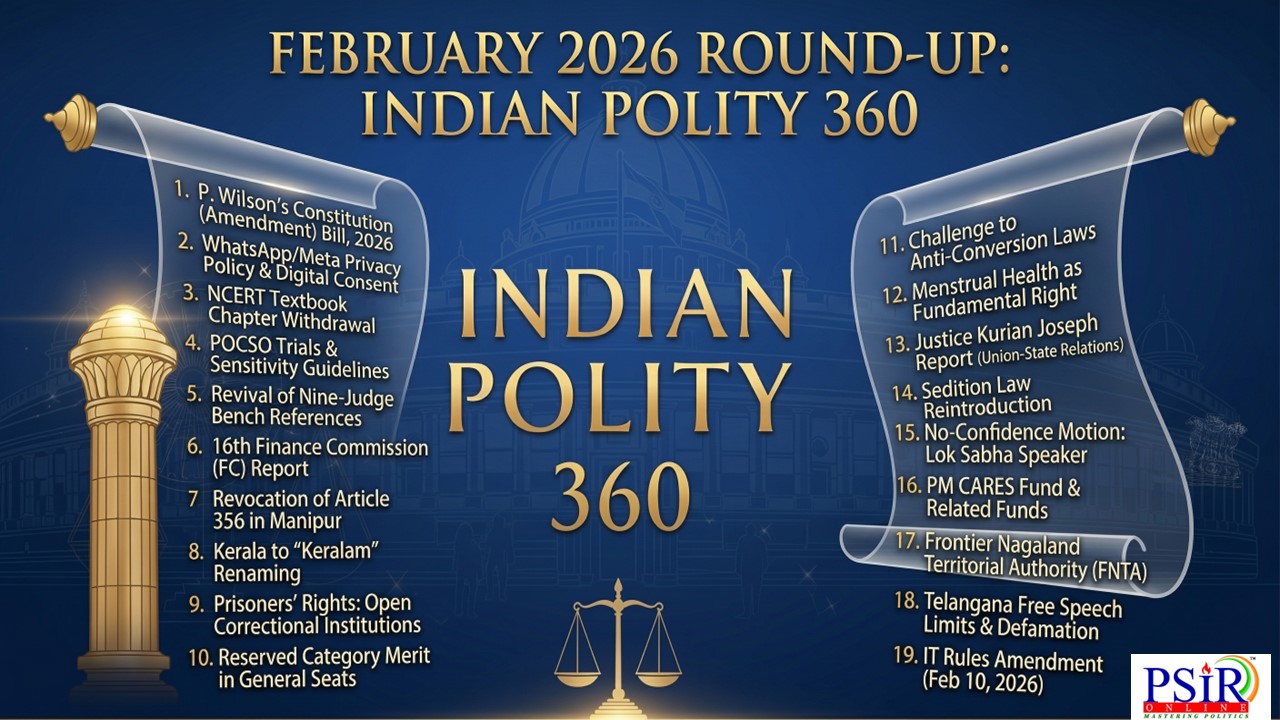
|
1 |
Constitution (Amendment) Bill, 2026 (P. Wilson) · DMK Rajya Sabha MP P. Wilson introduced a Constitution (Amendment) Bill, 2026 in February, proposing wide‑ranging structural and representational changes. · Key proposals include:
1. Reservation in judicial appointments: SC, ST, OBC, religious minorities and women to be represented proportionate to population in Supreme Court and High Courts (amending Articles 124, 217, 224). 2. Regional benches of the Supreme Court and enhanced retirement age for High Court judges. 3. Clarification empowering States to conduct caste‑based census and using that data for affirmative‑action policy. This is a major private‑member‑bill‑style push on representation, federalism (data‑making powers), and judicial structure, useful for questions on “critique of collegium” and “social diversity in judiciary”.
|
|
2 |
WhatsApp/Meta privacy‑policy and digital consent · A Bench of CJI Surya Kant and Justices Bagchi and Pancholi strongly questioned WhatsApp‑Meta’s “take‑it‑or‑leave‑it” privacy policy, stressing that consent cannot be genuine if continued access to the platform depends on blanket agreement. · The Court held that privacy of Indian users cannot be “played with” in the name of data sharing and directed WhatsApp/Meta to comply with NCLAT directions and file a compliance affidavit before the Competition Commission. For polity, this is material for fundamental‑rights‑based critique of platform‑governance, and role of SC in checking corporate‑digital power.
|
|
3 |
NCERT “corruption in the judiciary” textbook chapter · A three‑judge Bench led by CJI Surya Kant ordered withdrawal of a Class 8 NCERT Social Science chapter that discussed “Corruption in the Judiciary” and judicial backlog. · The Court directed seizure of physical copies, removal of digital versions, and barred republication via alternate titles or electronic media, calling the chapter part of a “deep‑rooted, well‑orchestrated conspiracy” to malign the judiciary.
This episode is rich for “independence vs. public criticism of judiciary”, judicial contempt of public discourse, and role of education in constitutional‑culture debates.
|
|
4 |
POCSO trials and sensitivity‑guidelines · In a POCSO‑related case, the Supreme Court restored charges of attempt to commit rape (over High Court’s downgrading to “assault with intent to disrobe”) and emphasised that allegations amounted to “attempt”, not mere preparation. · The Court asked the National Judicial Academy, Bhopal to constitute an expert committee chaired by Justice Aniruddha Bose to frame guidelines on sensitivity and consistency in handling sexual‑offence trials.
Polity‑angle here is on judicial‑guideline‑making power, gender‑sensitive adjudication, and role of judicial academies.
|
|
5 |
Revival of nine‑judge bench references · In mid‑February the Court revived two long‑pending nine‑judge references: o Definition of “industry” under Section 2(j) of the Industrial Disputes Act, 1947 (arguments scheduled from March). o Sabarimala review (supporters and opponents to argue in April; composition of nine‑judge Bench not yet notified). · The Court also scheduled final hearings in the batch of petitions challenging the CAA, 2019, indicating that pan‑India concerns will be taken first, followed by state‑specific matters (Assam, Tripura). These developments are directly relevant for constitutional‑law‑oriented polity and evolution of judicial review on contentious social‑constitutional issues.
|
|
6 |
Acceptance of the 16th Finance Commission (FC) Report · Context: On February 1, 2026, the Union Government accepted the 16th FC’s recommendation to retain the vertical devolution of taxes to States at 41% for the 2026–31 period. · New Devolution Formula: The 16th FC introduced a significant shift by replacing the "tax and fiscal effort" parameter with a "Contribution to GDP" criterion (weighted by the square root of GSDP). It also redefined "Demographic Performance" based on population changes between 1971 and 2011.
This is a pivotal case study in Fiscal Federalism. The shift towards "GDP Contribution" sparks debates on whether the formula rewards developed states at the expense of equity for laggard states, impacting the "Union-State financial relations" discourse.
|
|
7 |
Revocation of Article 356 in Manipur · Context: On February 4, 2026, the President formally revoked the proclamation of President’s Rule in Manipur (which had been in place since Feb 13, 2025) following the swearing-in of a new government led by Y. Khemchand Singh.
In case of PSIR, this is relevant for the study of Emergency Provisions (Article 356). It highlights the transition from "direct central rule" back to "representative democracy" in a sensitive border state, emphasizing the role of the Governor and the "Floor Test" doctrine.
|
|
8 |
Kerala to "Keralam": Constitutional Process of Renaming · Context: In February 2026, the Kerala Legislative Assembly's resolution to rename the state as "Keralam" moved through the constitutional process. · Legal Framework: This involves Article 3 of the Constitution, requiring a Bill to be introduced in Parliament on the recommendation of the President, after the state legislature has expressed its views.
In case of PSIR, it is useful to understand Intersection of linguistic identity and the indestructible Union of destructible States.
|
|
9 |
Rights of Prisoners: Expansion of "Open Correctional Institutions" · Judgment: In Suhas Chakma v. Union of India (Feb 2026), the SC issued directions for the uniform governance of Open Prisons. · Constitutional Link: The Court ruled under Article 21 that "trust and graded liberty" are essential for meaningful reform, making open prisons a constitutional promise rather than a mere administrative policy. In case of PSIR, this relates to evolution of Judicial Activism and the "Rights of the Incarcerated" within the Indian human rights framework.
|
|
10 |
Reserved Category Merit in General Seats · Judgment: The SC reaffirmed that Reserved Category candidates who qualify on their own merit are entitled to seats in the General/Unreserved category (AAI v. Sham Krishna B)
In case of PSIR, this relates to the study of Equality (Article 14-16) and the "creamy layer" vs. "merit" debates in Indian affirmative action.
|
|
11 |
Challenge to Anti-Conversion Laws
The Supreme Court issued notices to Union and multiple states on a PIL challenging state anti-conversion laws. · Raises issues of: 1. Freedom of religion (Articles 25–28) 2. Right to privacy and autonomy (Article 21)
· Covers states like UP, MP, Gujarat, etc. From this, you can understand that personal liberty vs state regulation of religion is emerging again as a major constitutional battleground.
|
|
12 |
Menstrual Health Recognized as Fundamental Right:
· The Supreme Court delivered the judgment in Dr. Jaya Thakur v. Union of India (2026 INSC 97) on 30 January 2026. · It declared menstrual health and Menstrual Hygiene Management (MHH) as an integral part of the right to life and dignity under Article 21, and also linked it to Article 21A (right to education) and Article 14 (equality/substantive equality). · The Court then directed the Union and all States/UTs to provide free sanitary pads, gender‑segregated toilets with proper disposal facilities, and MHM‑friendly infrastructure in schools, especially for girls in Classes 6–12, as part of constitutional obligations.
|
|
13 |
Justice Kurian Joseph Report · The Tamil Nadu High‑Level Committee on Union–State Relations, chaired by former Supreme Court Justice Kurian Joseph, submitted Part‑I of its first report to Chief Minister M. K. Stalin on 16 February 2026 (Monday) at the Secretariat in Chennai.
· The report is titled Part‑I of the “Union–State Relations” committee report and calls for a recalibration of Centre–State powers to enhance state autonomy, strengthen balanced federalism, and restore the federal balance within the constitutional framework.
|
|
14 |
Sedition Law Reintroduction:
· On 26 February 2026, a Bench of the Supreme Court (CJI Surya Kant and Justice Joymalya Bagchi) was hearing challenges to Section 152 of the Bharatiya Nyaya Sanhita (BNS), which replicates the old sedition‑like offence. · Petitioners argued that the Centre had earlier (in 2022) given an undertaking before the Court that it would “review” and effectively move away from the sedition law under IPC Section 124A, and therefore Parliament should not be allowed to reintroduce a similar provision in the BNS.
The Court held that: · An undertaking by the Union Government before the Court does not bind Parliament, because Parliament is the sovereign law‑making organ and has an absolute prerogative to enact any law. · In other words, the executive’s earlier promise to “review” sedition cannot be treated as a constitutional bar on Parliament enacting a similar offence in the new criminal code
At the same time, the Court did not immediately strike down the BNS provision. Instead, it: · Allowed the contested law (Section 152 BNS) to operate, · But kept open the possibility of future judicial review; if the provision is later found unconstitutional, it can be struck down then
|
|
15 |
No-Confidence Motion Against Lok Sabha Speaker:
The Opposition moved a no-confidence motion against Speaker Om Birla on February 10, 2026, highlighting tensions in parliamentary functioning and accountability.
|
|
16 |
PM CARES Fund and Related Funds:
· The Prime Minister’s Office (PMO) wrote to the Lok Sabha Secretariat (reportedly on 30 January 2026, with the direction becoming public in early February) stating that questions and other parliamentary matters regarding: 1. PM CARES Fund, 2. Prime Minister’s National Relief Fund (PMNRF), and 3. National Defence Fund (NDF) · The reason given was that these funds are financed entirely by voluntary public contributions and do not draw money from the Consolidated Fund of India, so they are not “Government money” under the regular parliamentary‑question‑framework.
|
|
17 |
Frontier Nagaland Territorial Authority (FNTA):
On February 5, 2026, a tripartite agreement between the Centre, Nagaland Government, and Eastern Nagaland Peoples’ Organisation (ENPO) created the FNTA, granting devolutionary autonomy to eastern Nagaland under special constitutional provisions (relevant to Article 371A and similar frameworks).
|
|
18 |
Telangana social‑media defamation case and free‑speech limits · The Supreme Court dismissed a special‑leave petition by the State of Telangana challenging the Telangana High Court’s quashing of FIRs against a political activist for criticising the government on social media. · The HC had laid down guidelines on locus standi and threshold of incitement before registering speech‑related offences; SC did not disturb this, though left open questions on distinction between criticism and defamation and chilling effect of prosecution.
Suitable for Article 19(1)(a) vs. defamation and use of sedition/Incitement‑type provisions against political speech.
|
|
19 |
IT Rules Amendment (Feb 10, 2026)
· The amendment inserts a statutory definition of SGI into Rule 2(1)(wa) of the IT Rules, 2021. · SGI means audio, visual, or audiovisual content that is artificially or algorithmically created/modified using a computer resource, in a way that appears real or authentic to a reasonable person (deepfakes, AI voice clones, realistic fake videos, etc.). · Routine edits (filters, colour correction, accessibility tools, educational illustrations) are specifically excluded to protect legitimate digital creativity and innovation.
Key legal changes in the 2026 Amendment
· The Information Technology (Intermediary Guidelines and Digital Media Ethics Code) Amendment Rules, 2026 were notified by MeitY on 10 February 2026 and came into force on 20 February 2026. · SGI is now treated as “information” wherever unlawful information is mentioned in the Rules, meaning all existing due‑diligence obligations (blocking, takedown, reporting) now clearly extend to deepfakes and similar content. · The framework applies most stringently to Significant Social Media Intermediaries (SSMIs)—large platforms like Meta, YouTube, X, etc.—which now face enhanced obligations and risk loss of safe‑harbour under section 79 IT Act if they fail to comply.
New obligations on platforms (Big Tech)
· Mandatory SGI labelling: When content is confirmed as SGI (through user declaration or technical tools), platforms must clearly and prominently mark it as synthetic/AI‑generated and embed metadata or unique identifiers (provenance) so that its origin and modification can be traced. · Proactive technical measures: Intermediaries must deploy AI filters and similar tools to prevent uploading and circulation of unlawful SGI, such as deepfake pornography (CSAM/NCII), impersonation of high officials, scam/fraud content, or material threatening public order and national security. · Compressed takedown timelines: For certain categories such as CSAM, non‑consensual intimate imagery and some high‑risk content, the takedown window is reduced to 3 hours from knowledge/complaint, replacing the earlier longer timelines (e.g., 36 hours). · Grievance redressal: Complaint‑handling timelines are tightened (e.g., to 7 days) and intermediaries must maintain logs, publish transparency reports, and cooperate with law‑enforcement and government agencies more robustly. · Safe‑harbour clarification: Automated removal or disabling of content in good‑faith compliance with the Rules does not itself cause loss of safe‑harbour; safe‑harbour is threatened when platforms knowingly permit or fail to act against unlawful SGI.
|