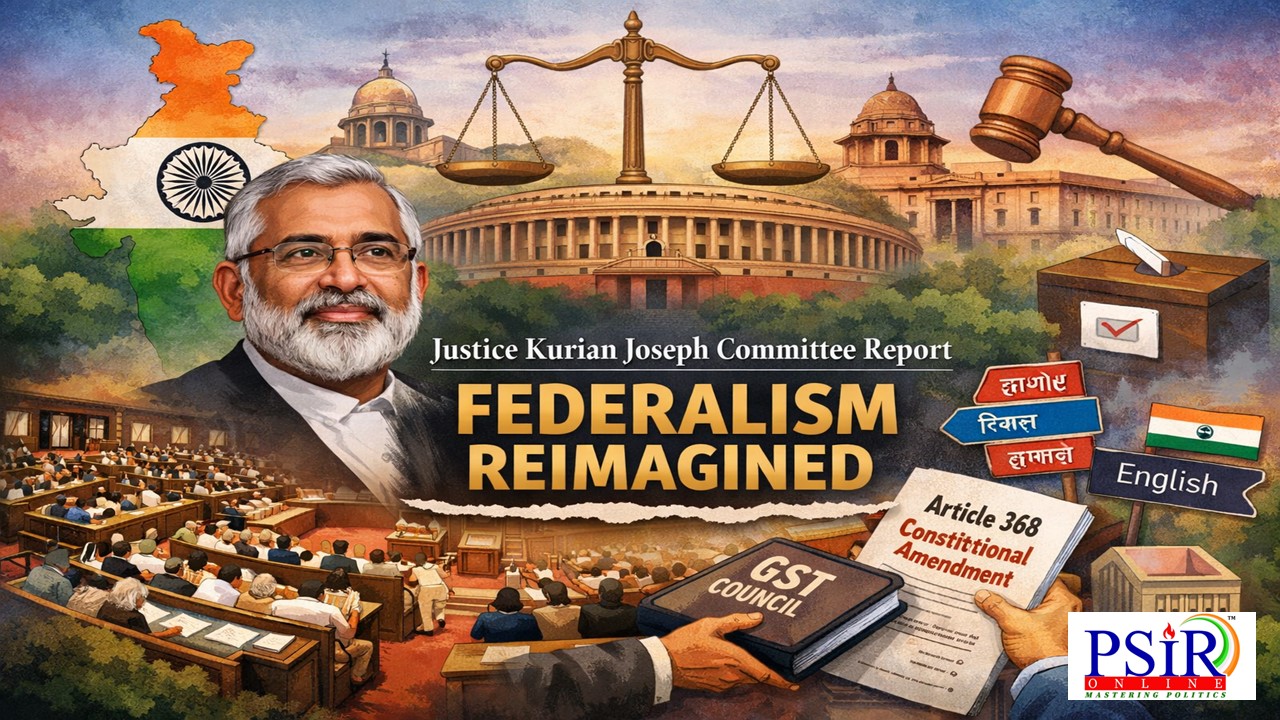
FEDERALISM REIMAGINED: Justice Kurian Joseph Committee Report
The Justice Kurian Joseph Report refers to Part I of the report submitted on 16 February 2026 by the High-Level Committee on Union-State Relations, chaired by retired Supreme Court Judge Justice Kurian Joseph. The Tamil Nadu government constituted the committee on 15 April 2025 to examine growing centralisation of power and recommend ways to restore genuine cooperative federalism and State autonomy within the constitutional framework.
The three-member panel (Justice Kurian Joseph as Chairman, with K. Ashok Vardhan Shetty, IAS (Retd.), and Dr. M. Naganathan as members) submitted this first part (covering ten chapters on key federal issues).Two more parts are expected later. The report argues that Indian federalism needs a “structural reset” comparable in ambition to the 1991 economic reforms, to reverse decades of centralisation while keeping the Union strong by focusing it on national responsibilities.
CORE PHILOSOPHY
The report advances 11 foundational arguments—7 for decentralisation (liberty, strategic focus, democracy, resilience, innovation, social justice, probity) and 4 debunking "centralisation fallacies" (incapacity, control, equalisation, uniformity). It argues that a Union distracted by state-level functions risks neglecting genuinely national challenges.
MAJOR RECOMMENDATIONS BY THEME:
APPOINTMENT, TERM AND REMOVAL OF GOVERNORS (ARTICLES 155 & 156)
1. The President must appoint a Governor from a panel of three names approved by a majority of the total membership of the State Legislative Assembly.
2. Single, fixed, non-renewable 5-year term.
3. Removal only by a resolution passed by a majority of the State Legislative Assembly.
4. Ineligibility for any further constitutional office except President or Vice-President.
TIMELINES AND LIMITS ON GOVERNORS’ POWERS (ARTICLES 200 & 201)
1. Governors must act on State Bills within 15 days.
2. If the State Legislature re-passes a returned Bill, the Governor must grant assent within a further 15 days.
3. Deemed assent applies automatically if these timelines are breached.
4. Reservation of Bills for the President’s consideration is restricted to limited cases involving repugnancy only.
5. Before reserving any Bill, the Governor must obtain a written legal opinion and communicate reasons within 60 days.
6. Neither the Governor nor the President should function as an “executive veto” over duly passed State legislation.
7. Introduce a new Thirteenth Schedule (“Instrument of Instructions for Governors”) with binding limits on discretion.
8. Mandatory floor tests within 7 days of government formation claims; prohibition on delaying or manipulating Assembly sessions.
9. Delete Article 176 (Governor’s special address to the Assembly).
10. Remove Governors as Chancellors of State universities.
CONSTITUTIONAL AMENDMENT PROCESS (ARTICLE 368)
- Every constitutional amendment Bill must secure not less than two-thirds majority of the total membership of each House of Parliament.
- Almost all amendments (except a few minor ones) must be ratified by not less than two-thirds of State Legislatures representing at least two-thirds of India’s population (double-majority rule).
- Two-thirds of States (representing two-thirds of population) can initiate constitutional amendments, compelling Parliament to consider them.
- Three-month public consultation period before introducing any amendment Bill.
- Cooling-off period: No final voting in the same session in which the Bill is introduced.
- Codify the Basic Structure doctrine explicitly.
- Reduce the list of provisions amendable by simple majority to very limited items (e.g., Article 2, Article 11, UT administration).
LANGUAGE POLICY – REJECTION OF “ONE NATION, ONE LANGUAGE”
- Amend Article 343 to make English a permanent official language of the Union.
- Delete references to Hindi in Article 345 and omit Article 347 entirely.
- Recognise all Eighth Schedule languages as official Union languages alongside English.
- Expand the Eighth Schedule to include every language with over one million native speakers, plus vulnerable tribal languages, Pali, Prakrit, and English.
- Replace the three-language formula with a two-language formula (English + regional/mother tongue).
- Amend Article 351 to promote preservation of all Indian languages, not just Hindi.
- Replace the Special Officer for Linguistic Minorities with a National Language Commission.
- Correct census misclassification of 53 independent languages as “dialects of Hindi”
GST COUNCIL REFORMS (ARTICLE 279A)
- Recalibrate voting: Reduce Union’s vote share (currently one-third) and increase States’ collective weight (options include “one member, one vote” or raising quorum).
- Explicitly clarify that GST Council recommendations are advisory only (reaffirming the 2022 Supreme Court ruling in Mohit Minerals).
- Establish an independent GST Council Secretariat and a statutory GST Dispute Settlement Authority (chaired by a retired Supreme Court judge).
- Allow States limited flexibility to vary SGST rates within a band (+/-2%)
- Annual GST rate calendar and “one product, one rate” principle.
- Postpone inclusion of petroleum products until structural reforms are done.
DELIMITATION AND PARLIAMENTARY REPRESENTATION
- Freeze inter-State seat allocation in Lok Sabha based on the 1971 Census until 2126 (or until Total Fertility Rates of all States converge).
- Delimitation orders must undergo legislative scrutiny before implementation.
- Equal representation in Rajya Sabha: Six seats per State (to end current disparity from 1 to 31 seats).
- Decadal rotation of SC-reserved constituencies; domicile requirement for Rajya Sabha membership; abolish nominated members.
ELECTIONS AND ANTI-DEFECTION
- Confine the Election Commission of India to Union elections only; create independent State Election Commissions for State Legislature polls.
- Strongly oppose “One Nation, One Election” (129th Amendment Bill, 2024) as it harms federal balance.
- Anti-defection reforms: Six-year disqualification for defectors; delete merger exception; treat strategic resignations as defection; shift adjudication from Speaker to High Courts with strict timelines; criminalise inducements.
TERRITORIAL REORGANISATION (ARTICLE 3)
- All reorganisation must require consent of affected States (treated as State-specific constitutional amendments).
- If consent is withheld, hold a referendum in the affected area (two-thirds approval required).
- New Article 3A: Prohibit creation of new Union Territories; mandate periodic referendums for existing ones (except Delhi).
EDUCATION AND HEALTH
- Reverse the 42nd Amendment shift: Move education (including medical education) back to the State List.
- Abolish NEET and NExT; disband National Testing Agency.
- Confine Union’s role (Entry 66) to academic standards only.
- Union must bear at least 80% cost of Centrally Sponsored Schemes in health or provide untied block grants.
OVERALL OBJECTIVE
The committee emphasises that these changes do not weaken the Union but “right-size” it, enabling States to exercise real autonomy in areas best handled locally. The Tamil Nadu government has tabled the report in the Assembly and made it public (in English and Tamil) to spark national debate.
This is the most comprehensive set of federalism reform proposals since the Sarkaria and Punchhi Commissions. Implementation would require major constitutional amendments, but the report is already being viewed as a blueprint for opposition-ruled States to push for greater State rights.
HISTORICAL CONTEXT
This is the fourth major review of Union-State relations. The other three were
- Rajamannar Committee (1969) – Tamil Nadu's early plea to abolish Concurrent List
- Sarkaria Commission (1983) – Strengthened Inter-State Council
- Punchhi Commission (2007) – Suggested Governor removal by State Assembly
COMPARISON OF MAJOR COMMISSIONS FOR UNION-STATE RELATIONS
|
Commission
|
Year/ Appointed By
|
Primary Philosophy
|
|
Rajamannar
|
1969/ Tamil Nadu
|
State Autonomy: Radical shift of power to states.
|
|
Sarkaria
|
1983/ Union Govt
|
Cooperative Federalism: Balanced, stable Union.
|
|
Punchhi
|
2007/ Union Govt
|
Functional Federalism: Responding to new global/security challenges.
|
|
Kurian Joseph
|
2025/ Tamil Nadu
|
Structural Reset: Countering modern "centralization" trends.
|
CRITICAL ANALYSIS: KURIAN JOSEPH COMMITTEE RECOMMENDATIONS
POSITIVE ASPECTS FOR STABLE UNION & COOPERATIVE FEDERALISM
1. Depoliticising the Governor's Office
- Fixed 5-year non-renewable term with removal only via State Legislature resolution eliminates the "agent of Centre" perception, ensuring Governors act as neutral constitutional arbiters rather than political tools.
- 15-day deadline with deemed assent prevents legislative paralysis caused by prolonged bill withholding, ensuring smooth governance continuity.
- Stability gain: Removes incentive for Governors to destabilise elected governments for partisan ends, strengthening democratic legitimacy.
2. Institutionalising Cooperative Federalism
- Rotating GST Council chairmanship and independent Secretariat transform the Council from a Centre-dominated body into a true forum of equals, fostering collaborative fiscal decision-making.
- Binding Instrument of Instructions (13th Schedule) codifies Centre-State expectations, reducing ambiguity and ad-hoc conflicts.
- Stability gain: Replaces personality-dependent cooperation with rule-based coordination, ensuring continuity across political cycles.
3. Enhancing Democratic Accountability
- Stricter anti-defection rules (6-year disqualification, High Court adjudication within 60 days) curb horse-trading and government instability, ensuring elected mandates are respected.
- Right to Vote as Fundamental Right strengthens citizen-State connect, deepening democratic legitimacy.
- Stability gain: Reduces political volatility caused by floor-crossing and ensures governments complete their terms.
4. Context-Sensitive Governance
- Returning Education & Health to State List allows curricula and health policies to reflect local epidemiology, language, and service needs (e.g., Tamil Nadu's public health model vs. Bihar's challenges).
- Stability gain: Enables States to design policies matching local realities, reducing one-size-fits-all failures that breed resentment.
5. One-nation one election principle
The union government and state governments come to the public only during the elections. Making them as one nation, one election practically bars the politicians to reach the public before the end of their term, that is, five years.
Stability gain: It enables the states to get more federal balance.
NEGATIVE ASPECTS FOR STABLE UNION & COOPERATIVE FEDERALISM
1. Risk of Constitutional Fragmentation
- Requiring 2/3 States + 2/3 population for amendments creates an extremely high threshold that could paralyse necessary constitutional evolution (e.g., urgent reforms during crises).
- Allowing 2/3 States to initiate amendments could enable regional blocs to push divisive agendas against national interest.
- Stability risk: Makes the Constitution too rigid to adapt to emerging challenges (climate change, digital governance, national security).
2. Undermining Territorial Integrity
- Mandating State consent + referendum for Article 3 changes effectively gives States veto over boundary adjustments, complicating responses to separatist demands or administrative reorganisation needs.
- 10-year referendums for UTs could fuel secessionist sentiments (e.g., Puducherry, Ladakh) and destabilise border regions.
- Stability risk: Empowers regional forces to block legitimate territorial adjustments, potentially encouraging fragmentation.
3. Fiscal Fragmentation & Economic Inefficiency
- Removing Union veto in GST Council + ±2% State rate flexibility could resurrect the pre-GST "tax war" scenario, undermining the common market and revenue stability.
- Keeping petroleum outside GST perpetuates cascading taxes and inflation, harming national economic integration.
- Stability risk: States may engage in competitive tax cuts to attract businesses, eroding the tax base and triggering fiscal crises.
4. Weakening National Standards & Equity
- Abolishing NEET/NTA without robust alternatives could revive capitation fee corruption and reduce merit-based mobility across States.
- State-only control over medical admissions may entrench regional parochialism, reducing doctor mobility to underserved areas.
- Stability risk: Creates unequal healthcare/education quality across States, fueling migration pressures and inter-State resentment.
5. Electoral Fragmentation
- State Election Commissions handling Assembly polls could lead to partisan ECs in States ruled by authoritarian regimes, undermining free elections (e.g., Manipur, Delhi experiences).
- Stability risk: It might cause policy paralysis and governance fatigue.
6. Delimitation Freeze Perpetuates Malapportionment
- Extending freeze to 2126 locks in current seat distribution, giving disproportionate power to low-population-growth States (mostly South) over high-growth States (mostly North).
- Stability risk: The lock in period is too high for comfort. The extension period for 100 years undermines the democracy of multiple generations.
7. Language Policy
Recognising all Eighth Schedule languages as official Union languages alongside English is impractical. It means that all Union communications must be given in all languages and it takes a lot of effort and time.
Two language policy is the product of the past. It creates citizens only rooted in their local culture and have struggled to create cosmopolitans. Even though the committee’s stand against Hindi imposition is justified, the two-language policy can never be a solution to counter Hindi imposition in the current globalised world.
Stability Risk: The ideas will be very time consuming for minimal success. The suggested language policy might create governance paralysis.
8. Appointment of Governor
Appointing governor from among the panel of three people suggested by the chief minister will in practise allow a second line politician subservient to the CM become the governor.
Stability Risk: This might undermine the worth of the constitutional post and would enlarge the autocratic governance if the elected CM is anti-democratic.
PRACTISE QUESTIONS FOR GS PAPER 2
1. “Indian federalism requires a structural reset rather than incremental reform.”
Critically examine this statement in the context of the Justice Kurian Joseph Committee recommendations.
2. Discuss the proposed reforms relating to the office of the Governor. How far do they address the issue of politicisation of the post?
3. Evaluate the implications of the suggested changes to the constitutional amendment process under Article 368 on India’s democratic and federal structure.
4. The report argues against “One Nation, One Election” on federal grounds. Analyse the validity of this argument in the Indian context.
PRACTISE QUESTIONS FOR PSIR OPTIONAL
1. “Centralisation weakens both democracy and governance capacity.”
Analyse this claim using the Justice Kurian Joseph Committee’s critique of Indian federalism.
2. Compare the Justice Kurian Joseph Committee with the Rajamannar, Sarkaria, and Punchhi Commissions in terms of their philosophy of federalism.
3. Examine the tensions between cooperative federalism and competitive federalism in light of the proposed GST Council reforms.
4. The recommendations on language policy challenge the idea of cultural homogenisation in India. Critically analyse their political and administrative implications.