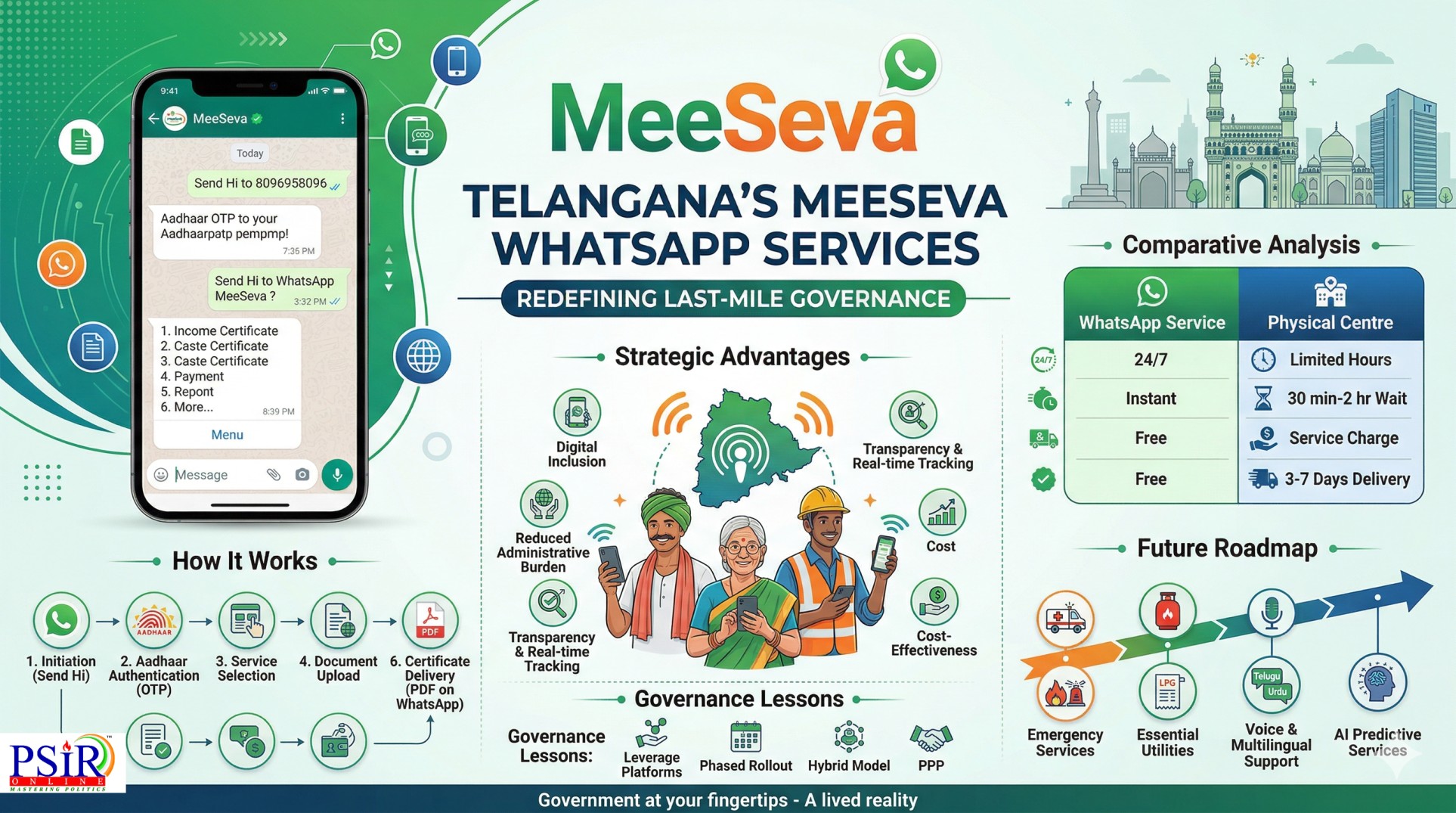
In an era where digital governance must balance accessibility with efficiency, Telangana’s MeeSeva WhatsApp Services stand out as a model of citizen-centric innovation. Launched on 18 November 2025 by IT and Industries Minister Shri D. Sridhar Babu, this initiative integrates the state’s flagship MeeSeva (Meaning: “Your Service”) platform with WhatsApp, enabling over 580 Government-to-Citizen (G2C) services from nearly 40 departments to be accessed through a simple, AI-driven chatbot.
By February 2026, the service had already catered to 3.25 lakh citizens, demonstrating how conversational AI can democratize access to public services—especially for rural, elderly, and digitally marginalized populations.
ARCHITECTURAL FRAMEWORK AND OPERATIONAL MECHANISM
The MeeSeva WhatsApp service functions as a layer over existing e-governance infrastructure, leveraging WhatsApp’s ubiquitous reach while maintaining backend integration with state databases.
How It Works:
1. Initiation: Citizens send “Hi” to the official number 8096958096.
2. Authentication: Secure Aadhaar OTP-based e-KYC verifies identity.
3. Service Selection: A menu-driven chatbot guides users through available services.
4. Document Upload: Users can directly upload scanned documents or photos via WhatsApp.
5. Payment Integration: Supports UPI, cards, and net banking for fee payments.
6. Real-Time Tracking: Application status updates are pushed automatically.
7. Certificate Delivery: Approved documents (e.g., caste, income, residence certificates) are delivered as PDFs directly on WhatsApp.
Technical Stack:
· Frontend: WhatsApp Business API (Meta partnership).
· Backend: Integrated with Telangana State Data Centre, e-Pragati (state e-governance mission), and departmental databases.
· AI Layer: NLP-based chatbot understands Telugu, Urdu, and English, with voice-command support under rollout.
STRATEGIC ADVANTAGES AND GOVERNANCE BENEFITS
1. Enhanced Accessibility and Digital Inclusion
Eliminates the digital divide by using a platform (WhatsApp) with over 90% smartphone penetration in Telangana.
Particularly benefits:
· Rural populations lacking digital literacy.
· Senior citizens (70+ years) who find web portals complex.
· Migrant workers who can access services remotely without visiting hometowns.
2. Reduction in Administrative Burden
· Decongests 5,000+ physical MeeSeva centres, reducing queues and wait times.
· Frees up MeeSeva entrepreneurs to focus on complex, non-digitizable services.
· Cuts down paperwork and manual data entry errors through automated form-filling.
3. Transparency and Accountability
· Real-time tracking ensures citizens know exactly where their application stands—reducing scope for bribery or delays.
· Digital audit trails enable better monitoring by supervisory officers.
· Automated notifications prevent “file missing” or “officer unavailable” excuses.
4. Cost-Effectiveness and Scalability
· Leverages existing WhatsApp infrastructure, avoiding costly app development and maintenance.
· Zero learning curve for citizens—no new app download or tutorial needed.
· Easily scalable to add new services or departments without major architectural changes.
5. Alignment with National Digital Governance Goals
· Supports Digital India’s vision of “Minimum Government, Maximum Governance.”
· Complements JAM Trinity (Jan Dhan-Aadhaar-Mobile) for direct, leak-proof service delivery.
· Acts as a state-level prototype for the proposed National WhatsApp Governance Framework under MeitY.
CRITICAL CHALLENGES AND LIMITATIONS
Despite its success, the initiative faces structural and operational hurdles that must be addressed for long-term sustainability.
1. Digital Divide and Connectivity Gaps
· Smartphone penetration in remote tribal areas (e.g., Adilabad, Bhadradri Kothagudem) remains below 60%.
· Unreliable internet connectivity in rural pockets disrupts document uploads and OTP verification.
· Feature phone users (approx. 25% of rural population) remain excluded unless IVR integration is added.
2. Data Privacy and Security Concerns
· Sharing Aadhaar details and sensitive documents over a third-party platform (Meta-owned WhatsApp) raises data sovereignty questions.
· Lack of clarity on data storage, encryption standards, and retention policies.
· Potential vulnerability to phishing scams using fake MeeSeva WhatsApp numbers.
3. AI Limitations and Error Handling
· NLP models may misinterpret dialectal variations in Telugu or code-mixed conversations (Telugu-English).
· Complex queries (e.g., land dispute resolutions) still require human intervention, leading to chatbot handover delays.
· Risk of over-reliance on automation without adequate grievance redressal mechanisms.
4. Exclusion of Non-WhatsApp Users
· Approximately 15–20% of citizens (especially elderly without smartphones) remain dependent on physical centres.
· No parallel SMS-based or IVR-based alternative currently exists for feature phone users.
5. Private Platform Dependency
Reliance on Meta’s WhatsApp API introduces risks of:
· Service disruption due to policy changes or API pricing revisions.
· Vendor lock-in, limiting future migration to indigenous platforms (e.g., Sandes, Koo).
COMPARATIVE ANALYSIS: MEESEVA WHATSAPP VS. TRADITIONAL MEESEVA CENTRES
|
Parameter |
WhatsApp Service |
Physical MeeSeva Centre |
|
Access Time |
24/7, anytime-anywhere |
Limited to working hours (10 AM–6 PM) |
|
Wait Time |
Zero (instant chatbot response) |
30 mins to 2 hours (queue-based) |
|
Cost to Citizen |
Free (except internet data) |
₹20–₹50 service charge per transaction |
|
Document Delivery |
Instant PDF on WhatsApp |
3–7 days (physical collection) |
|
Human Intervention |
Minimal (AI-driven) |
Required for all steps |
|
Best For |
Simple certificates, bill payments |
Complex services, grievance filing |
FUTURE EXPANSION ROADMAP (ANNOUNCED FEBRUARY 2026)
The Telangana government outlined an ambitious expansion plan to transform MeeSeva WhatsApp into a one-stop emergency and utility hub:
· Emergency Services Integration:
o 108 Ambulance and 102 Patient Transport booking via chatbot.
o 101 Fire Services alert and location sharing.
· Essential Utilities:
o LPG cylinder booking (Indane, BharatGas) with home delivery tracking.
o Electricity and water bill disconnection/reconnection requests.
· Multilingual and Voice Enhancements:
o Full voice-command support in Telugu and Urdu for illiterate users.
o Integration with Bhashini for real-time translation into Hindi and Tamil for migrant workers.
· AI-Powered Predictive Services:
o Proactive alerts for certificate renewals (e.g., caste validity, income updates).
o Chatbot-driven eligibility checks for welfare schemes (e.g., Rythu Bharosa, Aasara Pensions).
GOVERNANCE LESSONS AND REPLICABILITY
Key Takeaways for Other States:
1. Leverage Existing Platforms: Instead of building new apps, integrate with widely used platforms (WhatsApp, Telegram) for faster adoption.
2. Phased Rollout: Start with high-volume, low-complexity services (certificates, bill payments) before expanding to critical services.
3. Hybrid Model: Maintain physical centres for complex cases while pushing routine services to digital channels.
4. Public-Private Partnership (PPP): Collaborate with tech giants (Meta, Google) for AI/ML capabilities while retaining data control.
Potential for National Scaling:
· Could serve as a blueprint for MyGov WhatsApp or UMANG WhatsApp integration.
· Aligns with MeitY’s National AI Strategy for governance automation.
· Offers a template for Aspirational Districts to leapfrog infrastructure gaps.
A PARADIGM SHIFT IN LAST-MILE DELIVERY
Telangana’s MeeSeva WhatsApp Services exemplify how technology, when designed with citizens in mind, can transform governance from a bureaucratic hurdle into a seamless conversation. By meeting people where they already are—on WhatsApp—the state has not only improved service delivery metrics but also restored trust in government efficiency.
However, to ensure inclusive, secure, and sustainable growth, the initiative must address data privacy concerns, bridge connectivity gaps, and maintain a human-in-the-loop for complex grievances. If successfully scaled, this model could redefine federated digital governance in India, making “government at your fingertips” a lived reality for 1.4 billion citizens.
PRACTISE QUESTIONS FOR GS 2 MAINS
1. “Conversational AI is redefining last-mile governance in India.” Examine this statement with reference to Telangana’s MeeSeva WhatsApp services.
2. Discuss how integration of widely used digital platforms like WhatsApp with governance systems can enhance service delivery and citizen engagement. What are the associated risks?
3. Evaluate the role of digital governance initiatives in bridging the gap between state and citizens. To what extent does MeeSeva WhatsApp address issues of accessibility and inclusivity?
4. Critically analyze the challenges of data privacy, platform dependency, and digital exclusion in AI-enabled governance systems like MeeSeva WhatsApp. Suggest measures to overcome them.