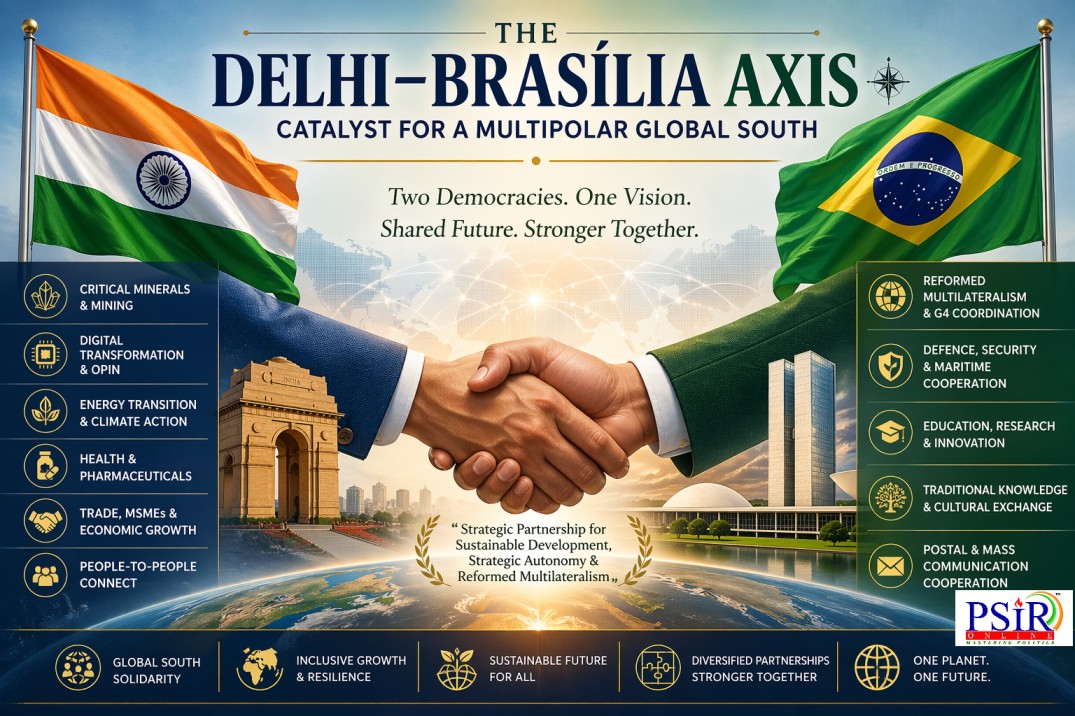
The 2026 State Visit of Brazilian President Luiz Inácio Lula da Silva to India marked a turning point in India–Brazil relations, combining a large ministerial delegation, a strong business presence, and a dense package of agreements that moved the relationship from symbolism to institutional cooperation. In an era of intensifying great-power competition, this high-level engagement between two leading middle powers of the Global South demonstrated a shared commitment to strategic autonomy, sustainable development, and reformed multilateralism.
FACTUAL DESCRIPTION OF THE VISIT
President Lula arrived in New Delhi on 18 February 2026 for a state visit from 18–22 February. He was accompanied by 11–14 Cabinet Ministers (covering key portfolios including Foreign Affairs, Finance, Environment & Climate Change, Agriculture, Health, Science & Technology, and others) and Brazil’s largest-ever business delegation — over 300 business leaders and CEOs. This Whole-of-Government and Whole-of-Economy approach underscored the seriousness of the engagement.
President Lula participated in the 2nd India AI Impact Summit (19–20 February), delivered a keynote address, and held substantive bilateral talks with Prime Minister Narendra Modi on 21 February at Hyderabad House. Ceremonial highlights included a ceremonial welcome at Rashtrapati Bhavan, a guard of honour, homage at Rajghat, and a state banquet hosted by President Droupadi Murmu. The visit built on Prime Minister Modi’s state visit to Brazil in July 2025 and reaffirmed the India-Brazil Strategic Partnership established in 2006. Both sides set an ambitious bilateral trade target, aiming for significant growth (with references to USD 20 billion in the near term).
KEY AGREEMENTS AND INSTRUMENTS SIGNED
The visit yielded ten agreements/MoUs, exchanged in the presence of the two leaders. These were grouped sector-wise for focused implementation:
Critical Minerals & Mining
· MoU on Cooperation in Critical Minerals and Rare Earths (full value chain: exploration, mining, processing, recycling, refining).
· MoU on Mining for the Steel Supply Chain.
Digital Transformation & Technology
· Joint Declaration on Digital Partnership for the Future.
· Launch of the Open Planetary Intelligence Network (OPIN) — leveraging Digital Public Infrastructure (DPI) and AI for sustainable development and climate action.
Energy, Climate & Environment
· Reaffirmation of cooperation under the Global Biofuel Alliance and Belém 4x Pledge (sustainable fuels).
· Enhanced collaboration on Sustainable Aviation Fuel (SAF) corridors, green hydrogen, ethanol blending, biomass, and renewables.
· Alignment with CDRI (Coalition for Disaster Resilient Infrastructure) principles for climate resilience.
Health & Pharmaceuticals
· MoU between ANVISA (Brazil) and CDSCO (India) for regulatory cooperation.
· Pharmaceutical collaborations (e.g., Fiocruz with Indian firms like Biocon and Lupin) for R&D, technology transfer, and affordable medicines for socially determined diseases.
Trade, MSMEs & Facilitation
· MoU on Electronic Certificates of Origin for trade facilitation.
· Efforts to expand the India-MERCOSUR Preferential Trade Agreement (PTA).
· Dedicated MoU on MSMEs and Entrepreneurship (including handicrafts).
Other Sectors
· Sharing of Traditional Knowledge (access to India’s TKDL for Brazil’s INPI).
· Cooperation in Mass Communication, Postal Services, Education, and Academic linkages (e.g., IIIT-Bangalore and Brazilian institutions).
· People-to-people initiatives covering visas, cultural exchanges, and tourism promotion.
STRATEGIC IMPACT
These agreements translate into tangible geostrategic leverage across multiple domains:
· Digital Sovereignty: OPIN positions India and Brazil as architects of a “Third Way” in digital governance — open-source, inclusive DPI that allows Global South nations to leapfrog infrastructure while protecting data sovereignty. It contrasts with US private-sector dominance and Chinese state-controlled models, turning digital and climate data into “planetary intelligence” for sustainable development.
· Energy Transition & Environmental Governance: Joint leadership in biofuels, SAF corridors, and critical minerals secures resilient supply chains for green technologies. This enables both countries to shape green economy standards aligned with Global South priorities rather than EU-style carbon border taxes (CBAM), advancing decarbonisation as a tool of strategic autonomy.
· Trade & Economic Resilience: Enhanced trade facilitation, MSME cooperation, and minerals pacts diversify supply chains, reduce dependencies, and support India’s steel and clean-tech needs while boosting Brazilian exports.
· Health Diplomacy: Regulatory harmonisation and pharma collaborations strengthen pandemic preparedness and access to affordable medicines, building long-term resilience.
· People-to-People Ties: Expanded visas, education linkages, cultural exchanges, and academic partnerships deepen societal connections between the two large democracies.
· Reformed Multilateralism: Strong reaffirmation of G4 coordination (India, Brazil, Germany, Japan) for text-based negotiations on UN Security Council reform. Both sides committed to amplifying the Global South’s voice in global governance, climate justice, and institutions like BRICS (with India chairing in 2026).
· Defence & Security: Continued momentum in strategic dialogue, joint exercises, maritime security, cyber cooperation, and UN peacekeeping.
ADVANTAGES FOR INDIA FROM THE AGREEMENTS SIGNED WITH BRAZIL
The agreements provide India with tangible strategic, economic, and diplomatic gains, especially in diversifying supply chains and asserting Global South leadership.
1. Critical Minerals & Rare Earths Security (Biggest Strategic Win)
· Diversification from China: India reduces heavy dependence on China (which controls ~80-90% of global rare earth processing). Brazil holds the world’s second-largest reserves.
· Resilient Supply Chains: Full value-chain cooperation (exploration, mining, processing, recycling, refining) supports India’s EV, renewable energy, electronics, semiconductors, and defence sectors.
· Steel & Manufacturing Boost: Complementary MoU on mining for steel supply chain helps meet India’s growing domestic demand and capacity expansion.
2. Energy Transition & Green Economy Leadership
· Access to Brazilian expertise in biofuels, ethanol blending, Sustainable Aviation Fuel (SAF), and green hydrogen.
· Strengthens India’s Global Biofuel Alliance role and helps shape Global South-friendly green standards (avoiding EU CBAM penalties).
· Supports India’s net-zero goals and energy security with diversified, sustainable sources.
3. Digital Sovereignty & Technological Edge
· Open Planetary Intelligence Network (OPIN) and Joint Digital Partnership promote open-source Digital Public Infrastructure (DPI) and AI collaboration.
· Positions India as a leader of the “Third Way” in digital governance — neither fully US private-sector nor Chinese state-controlled — enhancing its global tech influence.
· Opportunities for joint AI development, data sharing for climate action, and technology transfer.
4. Trade, Investment & Economic Growth
· Ambitious targets to raise bilateral trade to USD 20–30 billion by 2030 (from ~USD 15 billion in 2025).
· Easier market access for Indian pharma, IT, automobiles, and MSMEs in Latin America via expanded India-MERCOSUR PTA.
· Electronic Certificates of Origin improve trade facilitation and reduce costs.
5. Health & Pharma Resilience
· Regulatory cooperation between ANVISA (Brazil) and CDSCO (India) speeds up approvals.
· Collaborations (e.g., Fiocruz with Indian firms) for affordable medicines, vaccines, and R&D on tropical/socially determined diseases — useful for future pandemic preparedness and exports.
6. Multilateral & Geopolitical Leverage
· Stronger G4 coordination for UNSC reform (text-based negotiations).
· Enhanced voice in BRICS (India chairing in 2026) and Global South forums.
· Defence, maritime, and cyber cooperation add layers of strategic partnership.
7. People-to-People & Soft Power
· Expanded visas, education links, cultural exchanges, and traditional knowledge sharing deepen long-term ties.
DISADVANTAGES / POTENTIAL RISKS FOR INDIA
While benefits outweigh risks, there are some challenges:
· Implementation Gaps: Many are MoUs (non-binding). Actual investment, technology transfer, and mining projects may face delays due to Brazil’s environmental regulations, bureaucratic hurdles, or domestic politics under Lula’s leftist government.
· Competition in Markets: Brazilian agricultural exports (soy, sugar, beef) could compete with Indian interests in some sectors. Increased Brazilian pharma or ethanol in Indian markets might pressure local players if not managed carefully.
· Investment Outflows: India may need to invest in Brazilian mining/processing infrastructure, diverting capital from domestic priorities.
· Geopolitical Balancing: Closer ties with Brazil (a BRICS partner but with strong Russia/China links) require careful navigation, especially amid US-China tensions. Over-alignment on certain Global South issues could complicate relations with the West.
· Environmental & Social Risks: Mining critical minerals in Brazil could invite criticism over deforestation/Amazon issues, potentially affecting India’s global image.
· Asymmetric Benefits: Brazil gains easier access to India’s large market and tech expertise; India must ensure reciprocal gains in minerals and energy are realised quickly.
IS THIS A CATALYST FOR GREATER INDIA – LATIN AMERICA TIES?
India’s ties with Latin America can improve through Brazil because Brazil is the region’s biggest diplomatic and economic bridge to India, and it already anchors cooperation in BRICS, IBSA, G20, and now a deeper strategic agenda. When India strengthens its relationship with Brazil, it also gains a stronger platform to engage the wider region through trade, technology, health, energy, and multilateral diplomacy.
Why Brazil matters for the region?
Brazil matters because it is India’s largest trade partner in Latin America and the most politically connected partner in the region. The two countries already have a strategic partnership, and Brazil’s outreach gives India credibility in the broader Latin American neighborhood, especially where countries look for diversified partners beyond the US and China.
India–Brazil ties also have a demonstration effect. When India and Brazil cooperate on critical minerals, digital public infrastructure, biofuels, pharmaceuticals, and trade facilitation, other Latin American states can see India as a reliable partner in development, technology, and supply-chain resilience rather than as a distant Asian power.
Spillover to Latin America
The partnership can create regional spillovers in three ways. First, it can open pathways into MERCOSUR and wider Latin American markets, especially through trade facilitation and tariff-reduction mechanisms. Second, it can help India build sectoral cooperation with countries such as Argentina, Chile, Peru, Mexico, and Colombia in minerals, energy, IT, and pharmaceuticals. Third, it can strengthen India’s engagement with regional groupings like CELAC and other Latin American frameworks through Brazil’s influence.
This matters because Latin America is not only a trade destination; it is also a strategic source of lithium, rare earths, food products, energy resources, and agricultural cooperation. By deepening ties with Brazil, India improves its access to these wider regional value chains and reduces overdependence on a narrow set of suppliers.
Political and strategic effects
Brazil can act as India’s gateway for building trust across Latin America because it is a leading voice in South-South cooperation and a respected member of global forums. India’s stronger relationship with Brazil also supports its image as a power that can engage the Global South on equal terms, which is attractive to many Latin American countries seeking strategic autonomy.
There is also a multilateral benefit. India and Brazil already cooperate in BRICS, IBSA, and G4, so their partnership can translate into common positions on global governance, development finance, digital sovereignty, and UN reform. That shared agenda gives India a stronger diplomatic presence in Latin America because the region increasingly values partners that speak for reform rather than domination.
What this means for India
For India, better relations with Latin America through Brazil mean more than trade expansion. It means a broader diplomatic footprint, stronger access to strategic resources, more room for digital and health cooperation, and a better chance to shape the norms of a multipolar world from the perspective of the Global South.
In simple terms, Brazil helps India turn Latin America from a distant region into a practical extension of its economic and strategic outreach. That is why the Delhi–Brasília relationship can become the central pillar of a much wider India–Latin America partnership.
The Delhi–Brasília partnership now represents more than bilateral goodwill; it is an emerging axis of middle-power cooperation that links digital sovereignty, green transition, strategic industry, and multilateral reform in the service of a more multipolar Global South. By anchoring Brazil firmly within its digital, energy, minerals, health, and governance frameworks, India is demonstrating that Global South leadership extends beyond hosting summits to building durable bilateral networks. This visit stands as a model of proactive, values-based diplomacy — equally relevant for UPSC Prelims (facts on agreements and delegation) and Mains (analysis of middle-power diplomacy, South-South cooperation, and multipolarity).
PRACTISE QUESTIONS FOR GS 2 MAINS
1. “India–Brazil relations are transitioning from symbolic diplomacy to institutional strategic partnership.” Examine in the context of recent agreements and their impact on India’s foreign policy.
2. Discuss how India–Brazil cooperation in critical minerals and energy transition contributes to India’s economic security and climate commitments.
3. Analyze the significance of Digital Public Infrastructure (DPI) and the Open Planetary Intelligence Network (OPIN) in shaping a “Third Way” in global digital governance.
4. Evaluate the role of India–Brazil relations in strengthening Global South cooperation and reforming multilateral institutions.
PRACTISE QUESTIONS FOR PSIR OPTIONAL