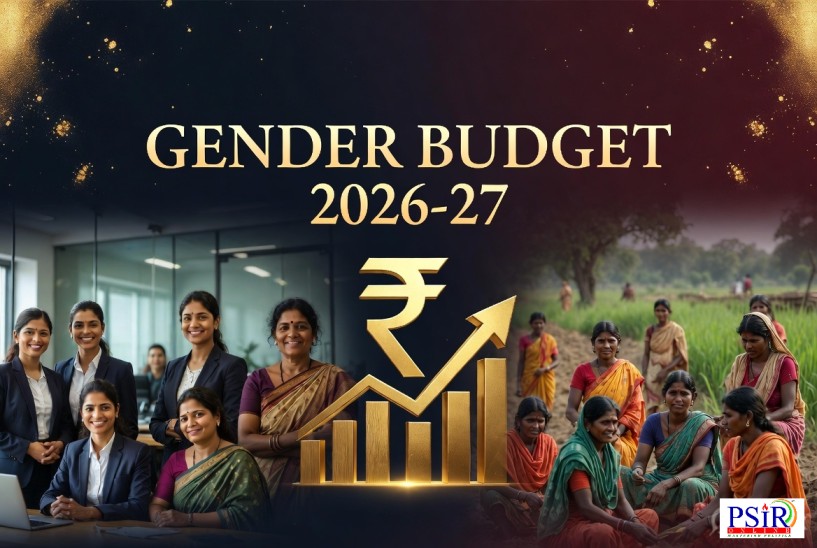
In India, the Gender Budget (also called Gender Budget Statement or Gender Budgeting) is not a separate budget for women. Instead, it is a fiscal policy tool and an analytical exercise that examines government budgets through a gender lens to assess their differential impact on women and men, and to promote gender equality and women's empowerment.
OFFICIAL EXPLANATION FROM GOVERNMENT DOCUMENTS
According to the Ministry of Finance (as stated in past Gender Budget Statements, e.g., 2016-17 and similar editions):
“Gender Budgeting in its simplest connotation is ‘Gender Analysis’ of the budget aimed at examining the budgetary allocation through a gender lens. The purpose of gender budgeting is to monitor expenditure and public service delivery from a gender perspective, as a means of mainstreaming women's concerns in all activities and improving their access to public resources.”
It is described as a continuous process of integrating a gender perspective into:
· Policy and programme formulation,
· Implementation,
· Review, and
· Budget allocation.
The Ministry of Women and Child Development (Mission Shakti) defines it as:
· An approach that integrates gender equality into government’s planning and budgeting processes.
· A fiscal strategy for translating the Government’s commitments towards Gender Equality and Women’s Empowerment (GEWE) across various sectors into budgetary commitments.
· It involves analysing budgets to establish gender-differential impacts, prioritise commitments, and ensure adequate allocations for gender equality.
Key Features of India's Gender Budget
· Not additional spending — It is a reclassification and dissection of the existing Union Budget to highlight portions that benefit women and girls.
· Gender Budget Statement (GBS) — Presented annually as Statement 13 in the Expenditure Profile document of the Union Budget.
· Classification into Parts (based on proportion of benefits to women/girls):
o Part A: Schemes with 100% provision exclusively for women and girls (fully women-specific).
o Part B: Schemes where allocations for women constitute 30% to 99% of the provision (substantial benefit to women).
o Part C (introduced in recent years, e.g., from 2024-25 onwards): Schemes where the benefit to women is less than 30%.
· This statement is compiled based on information provided by various Ministries/Departments, many of which have set up Gender Budgeting Cells.
Core Objective
The Gender Budget aims to:
· Make visible the gender-differential impacts of budgetary policies.
· Translate government commitments on gender equality into actual budgetary allocations.
· Promote gender mainstreaming across all sectors (not just women-specific ministries).
· Improve women's access to resources, reduce gender gaps, and support women-led development.
In simple terms: The Gender Budget shows how much of the total government spending is expected to benefit women and girls, either fully or substantially, and encourages ministries to design and implement schemes with gender sensitivity.
This framework has been in use since the first Gender Budget Statement was introduced in the Union Budget 2005-06.
GENDER BUDGET FY 2026-27
India's Union Gender Budget for FY 2026-27 stands at ₹5.01 lakh crore (approximately ₹5,00,878 crore in some reports), marking a record high. This reflects an 11.55% increase from ₹4.49 lakh crore in FY 2025-26.
It accounts for 9.37% of the total Union Budget, up from 8.86% the previous year. This allocation supports women and girls across livelihoods, health, food security, education, safety, and infrastructure, aligning with the government's focus on "women-led development."
Breakdown by Parts (Gender Budget Statement)
The Gender Budget Statement (Statement 13 in the Expenditure Profile) divides allocations into three parts based on the proportion benefiting women and girls:
· Part A (100% women-specific schemes): ₹1,07,688.42 crore (≈21.50% of total Gender Budget). This includes fully targeted programs like Mission Shakti, Prime Minister's Girls' Hostels, safety schemes, and certain housing/LPG initiatives.
· Part B (30-99% allocation for women): ₹3,63,412.37 crore (≈72.54%). This covers mainstream schemes with significant women beneficiaries, such as rural development programs, Jal Jeevan Mission, health initiatives, and food security.
· Part C (below 30% allocation for women): ₹29,777.94 crore (≈5.95%). This captures smaller proportional benefits in broader programs.
Grand Total: ₹5,01,000+ crore (figures rounded across official sources).
Key Highlights and Major Schemes
1. New Schemes for Women in 2026–27
The Budget introduced three major new initiatives focused on transitioning women from beneficiaries to owners and addressing "time poverty":
· SHE-Marts (Self-Help Entrepreneur Marts): A flagship new scheme to help 10 crore women in Self-Help Groups (SHGs) transition from credit-led livelihoods to owning enterprises. It provides digital marketplaces and innovative financial instruments to bridge the marketing gap for rural women.
· Revamped Stand-Up India Scheme (often cited as Enhanced Support for SC/ST/Women Entrepreneurs). Target: 5 lakh (500,000) first-time entrepreneurs from SC, ST, and Women categories. Financial Support: Composite term loans up to ₹2 crore per beneficiary (significant hike from the earlier ₹10 lakh–₹1 crore limit).
· Girls' Hostels in Every District: A new infrastructure commitment to establish hostels in all districts (specifically targeting Tier-2 and Tier-3 cities) to enable women's participation in STEM (Science, Technology, Engineering, Math) education by reducing commuting barriers.
· Care Economy Expansion (1.5 Lakh Caregivers): While building on existing schemes, the Budget formally launched a major push to train 1.5 lakh multi-skilled caregivers for geriatric, child, and allied care services, creating dignified employment for women while alleviating their unpaid care burden.
2. Other Major Schemes of Category A (100% Women-Specific)
These are schemes where 100% of the allocation is for women-specific interventions:
|
Scheme |
Key Focus |
|
Mission Shakti |
Umbrella scheme for safety (Sambal) and empowerment (Samarthya), including One Stop Centres (OSCs) and Beti Bachao Beti Padhao. |
|
Lakhpati Didi Scheme |
Part of DAY-NRLM; aims to create 3 crore women entrepreneurs in SHGs with annual income >₹1 lakh |
|
Pradhan Mantri Ujjwala Yojana (PMUY) |
Revived with ₹9,200 crore (after zero allocation in 2025) to provide free LPG refills and new connections |
|
Pradhan Mantri Awas Yojana (Gramin & Urban) |
Housing schemes where the house is mandated to be in the name of the woman (sole/joint ownership). |
|
Palna (Crèche) Scheme |
Provides daycare for children (0–6 years) to reduce women's time poverty |
3. Other Major Schemes of Category B & C (With Revamp/Focus)
These are schemes where 30–99% (Part B) or <30% (Part C) of beneficiaries are women, but they have received significant budget hikes or strategic revamps for 2026–27:
Category B (Majoritarian Impact)
|
Scheme |
New Revamp / Focus in 2026–27 |
|
Jal Jeevan Mission (JJM) |
Allocation increased by ₹12,500 crore. Focus is on resolving "dry tap" issues and ensuring convergence with PMAY so women don't face water scarcity in new homes |
|
Viksit Bharat-Guarantee for Rozgar & Ajeevika (VB-GRAM G) |
Formerly MGNREGA. Now focuses on quality of assets and expanding guaranteed days (100 to 125). Women remain >50% of beneficiaries; focus on work near home and on-site crèches |
|
Saksham Anganwadi & POSHAN 2.0 |
Upgrading Anganwadis to act as full-day creches (not just feeding centres) to support working mothers |
|
Pradhan Mantri Garib Kalyan Anna Yojana (PMGKAY) |
Continues as the largest component by volume, ensuring food security for women-headed households |
|
Fisheries & Blue Economy |
New focus on promoting women-led groups in the fisheries value chain and developing 500 reservoirs for women's collectives |
Category C (Fringe Benefits)
· Rural Roads (PMGSY): Now explicitly evaluated for female mobility and safety, ensuring roads connect women to markets and reduce isolation.
· Urban Infrastructure: Increased focus on last-mile connectivity and lighting in urban projects to improve safety for working women.
HOW DOES THIS GENDER BUDGETING HELPS IN WOMEN EMPOWERMENT?

Gender Budgeting in FY 2026–27 moves beyond mere "welfare allocation" to become a structural tool for empowerment by directly addressing the root causes of gender inequality: lack of assets, time poverty, and limited market access.
Here is how the specific allocations in the 2026–27 Budget translate into tangible empowerment outcomes:
1. From "Beneficiaries" to "Owners" (Economic Agency)
Traditional budgets treated women as recipients of aid. The 2026–27 budget uses financial allocation to transfer asset ownership and capital control to women.
· Mechanism: The ₹2 crore loan limit in the revamped Stand-Up India and the SHE-Marts initiative provide women with direct control over capital and market channels.
· Empowerment Outcome: This shifts women from being laborers (working for wages) to entrepreneurs (owning the means of production). Ownership of assets (like houses under PMAY mandated in the woman’s name) significantly improves her bargaining power within the household and access to formal credit.
2. Tackling "Time Poverty" (Social Liberation)
Women in India spend ~3.5 hours daily on unpaid care work, which restricts their participation in the workforce. The budget explicitly targets this "time poverty."
· Mechanism: The push for 1.5 lakh trained caregivers and the upgrade of Anganwadis into full-day crèches (Saksham Anganwadi) directly socialize care work. Additionally, Girls' Hostels in every district reduce commuting time for STEM students.
· Empowerment Outcome: By reducing the burden of unpaid care, women gain the time dividend necessary to pursue education, skilling, and formal employment, thereby increasing their Female Labour Force Participation Rate (FLFPR).
3. Enhancing Safety and Mobility (Public Sphere Access)
Empowerment is impossible if women cannot safely access public spaces. The budget links infrastructure spending to gender safety.
· Mechanism: Category B/C allocations now mandate safety audits for Jal Jeevan Mission (water near home reduces vulnerability) and PMGSY (rural roads with lighting). The marginal increase in Mission Sambal funds One Stop Centres (OSCs) for crisis support.
· Empowerment Outcome: Safe mobility allows women to access markets, workplaces, and educational institutions without fear, effectively expanding their geographic and economic footprint.
4. Financial Inclusion via Collectivization (Bargaining Power)
The budget leverages the scale of Self-Help Groups (SHGs) to create a counter-vailing force against market exploitation.
· Mechanism: The Lakhpati Didi scheme (targeting 3 crore women) and SHE-Marts aggregate rural women into large producer collectives, giving them bargaining power against middlemen.
· Empowerment Outcome: Collectivization transforms isolated rural women into a negotiating bloc, ensuring better price realization for their products and reducing dependency on predatory local moneylenders.
MAJOR CRITICISMS OF GENDER BUDGETING OF INDIA

Despite India being a pioneer in Gender Budgeting (GB) since 2005–06, the exercise faces sustained criticism from economists, parliamentary committees (like the Standing Committee on WCD), and civil society. The critiques generally fall into structural, methodological, and outcome-based flaws.
Here are the major criticisms:
1. The "Labeling" Trap (Misclassification of Schemes)
The most persistent criticism is that ministries often relabel existing general schemes as "women-specific" to inflate the Gender Budget without creating new benefits.
· The Issue: Schemes like PMAY-Gramin or Jal Jeevan Mission are counted in Part A or B simply because a woman’s name is on the asset or she is a primary beneficiary. However, the design, implementation, and control often remain male-dominated.
· Impact: This creates an illusion of progress. The budget appears to grow (e.g., the jump to ₹5.01 lakh crore in 2026–27), but the actual incremental allocation for women’s unique needs is far smaller.
2. Chronic Underfunding of "Safety" (Mission Sambal)
There is a severe skew in priority: the budget heavily favors "productive" economic schemes (livelihoods, housing) while neglecting "protective" schemes (safety, legal aid).
· The Issue: In 2026–27, while livelihood schemes saw double-digit hikes, Mission Sambal (covering One Stop Centres, Beti Bachao Beti Padhao, and women’s shelters) saw a marginal increase of only ~₹50 crore despite rising crimes against women.
· Impact: This reflects a policy bias that views women primarily as economic units rather than citizens requiring physical security. Without safety, economic gains are precarious.
3. The "Part C" Black Box (Lack of Transparency)
Part C of the Gender Budget Statement (schemes where <30% of funds benefit women) is often criticized as a dumping ground with no accountability.
· The Issue: Ministries include massive infrastructure projects (roads, urban development) in Part C with vague justifications like "women benefit from better connectivity." There is no mandatory gender audit to verify if these funds actually reach women or improve their safety.
· Impact: It allows ministries to claim they are "gender-sensitive" without committing to specific, measurable outcomes for women.
4. Supply-Side Bias vs. Demand-Side Reality
The budget focuses on supplying services (building hostels, giving loans) but ignores the demand-side barriers that prevent women from accessing them.
· The Issue:
o Credit: While Stand-Up India offers loans, women often lack collateral (land titles are mostly in men’s names) or face social restrictions on mobility that prevent them from visiting banks.
o Infrastructure: Hostels are built, but without safety audits or female wardens, parents refuse to send girls.
· Impact: High fund utilization gaps. Money is allocated, but women cannot access it due to patriarchal social norms that the budget fails to address.
5. Absence of Outcome-Based Monitoring
The Gender Budget Statement is essentially an accounting document, not a performance report.
· The Issue: It tracks financial outlays (how much was spent) but rarely tracks outcomes (how many women actually escaped poverty, how many felt safer). The Standing Committee on WCD has repeatedly flagged the lack of Gender Impact Assessments (GIA) before schemes are launched.
· Impact: Policymakers cannot distinguish between effective and ineffective schemes, leading to the continuation of "zombie schemes" that consume resources but deliver little empowerment.
6. Federal Disconnect (State-Level Apathy)
While the Centre publishes a robust Gender Budget, most State Governments treat it as a mere formality.
· The Issue: Only a few states (e.g., Kerala, Karnataka, Assam) produce meaningful Gender Budgets. In most states, the GB Statement is a copy-paste of central schemes with no state-specific innovation.
· Impact: Since health, police, and agriculture are State subjects, the Centre’s gender budget cannot achieve its goals without synchronized state spending.
Summary Table: Criticism vs. Reality
|
Criticism |
Reality in 2026–27 Budget |
|
Inflation of Numbers |
Record ₹5.01 lakh crore, but largely driven by general schemes (PMGKAY, PMAY) |
|
Safety Neglect |
Mission Sambal allocation remains stagnant relative to rising crime stats. |
|
Lack of Audits |
No independent gender audit of Part C schemes (roads, urban infra) |
|
Access Barriers |
Loans increased, but collateral requirements for women remain unchanged |
SUGGESTIONS FOR IMPROVEMENT
To transform India’s Gender Budget from an accounting exercise into a transformative tool for empowerment, the following forward-looking (FW) suggestions are critical. These address the structural, methodological, and implementation gaps identified in the 2026–27 cycle.
1. Institutional & Structural Reforms
· Mandatory Gender Impact Assessment (GIA): Just as Environmental Impact Assessments (EIA) are mandatory for large projects, a GIA should be compulsory for all major central schemes before budget approval. This would force ministries to predict and mitigate negative gender outcomes (e.g., displacement, increased care burden) at the design stage.
· Statutory Status for GB: Elevate Gender Budgeting from an executive statement to a statutory requirement under the FRBM Act. This would mandate parliamentary debate and voting on gender-specific allocations, increasing accountability.
· Federal Capacity Building: The Centre must institutionalize a Gender Budgeting Cell in every state finance department (currently only ~15 states do this meaningfully). Tie a portion of tax devolution or central grants to the quality of state-level gender budgets.
2. Methodological Overhaul (Fixing the Data)
· Abolish/Restructure Part C: Part C (<30% women benefit) is currently a "black box." It should either be abolished or subjected to a strict Gender Audit by the CAG. Only schemes with verified, quantifiable gender outcomes should remain.
· Shift from Outlay to Outcome: The Gender Budget Statement (Statement 13) must include a Performance Dashboard alongside financial data. Columns should track:
o Utilization Rate (vs. Allocation)
o Beneficiary Satisfaction (via third-party surveys)
o Empowerment Metrics (e.g., % of women with land titles, % reduction in unpaid care hours).
· Time-Use Survey Integration: Budget allocations for the Care Economy should be directly indexed to the National Time-Use Survey data. If women’s unpaid care work hasn’t decreased by X%, the care budget should automatically scale up.
3. Thematic Re-prioritization
· Ring-Fence Safety Funds: Create a non-lapsable "Nirbhaya Corpus" that is strictly separate from livelihood schemes. Funding for Mission Sambal (One Stop Centres, fast-track courts, police sensitization) should be indexed to crime statistics (NCRB data), ensuring it grows automatically when crimes against women rise.
· Asset Titling Push: Link all housing and land allocation schemes (PMAY, Jal Jeevan) to a "Title First" policy. Benefits should be released only after the asset is legally registered in the woman’s name (sole ownership), not just joint names, to ensure actual economic agency.
· Gender-Responsive Public Procurement: Mandate that 3–5% of all government procurement (tenders for goods/services) must be sourced from women-led enterprises (beyond just SHGs). This creates a guaranteed market, far more effective than soft loans.
4. Implementation & Accountability
· Participatory Budgeting: Institutionalize Mahila Sabhas (Women’s Gram Sabhas) at the Panchayat level to identify local priorities before budgets are finalized in Delhi. This ensures the budget addresses ground realities (e.g., need for a creche vs. a road).
· Independent Gender Audit: Empower the Comptroller and Auditor General (CAG) to conduct annual, binding Gender Performance Audits of key ministries (WCD, Health, Rural Development), with findings tabled in Parliament.
· Digital Public Infrastructure for Women: Leverage DPI (Aadhaar, UPI, ONDC) to create a "Women’s Entrepreneur Stack":
o Unified ID for all women entrepreneurs.
o Direct Benefit Transfer for market subsidies (bypassing middlemen).
o ONDC Integration for SHE-Marts to ensure national market access
PRACTISE QUESTIONS FOR GS-2 MAINS
1. “Gender Budgeting in India is more an accounting exercise than a transformative policy tool.” Critically examine in the context of the Gender Budget 2026–27.
2. Discuss how Gender Budgeting can act as an instrument for women-led development in India. Illustrate your answer with recent policy initiatives.
3. Examine the structural and methodological challenges in the implementation of Gender Budgeting in India. Suggest measures for improving its effectiveness.
4. To what extent does the Gender Budget 2026–27 address issues of time poverty, economic agency, and safety of women? Critically evaluate.