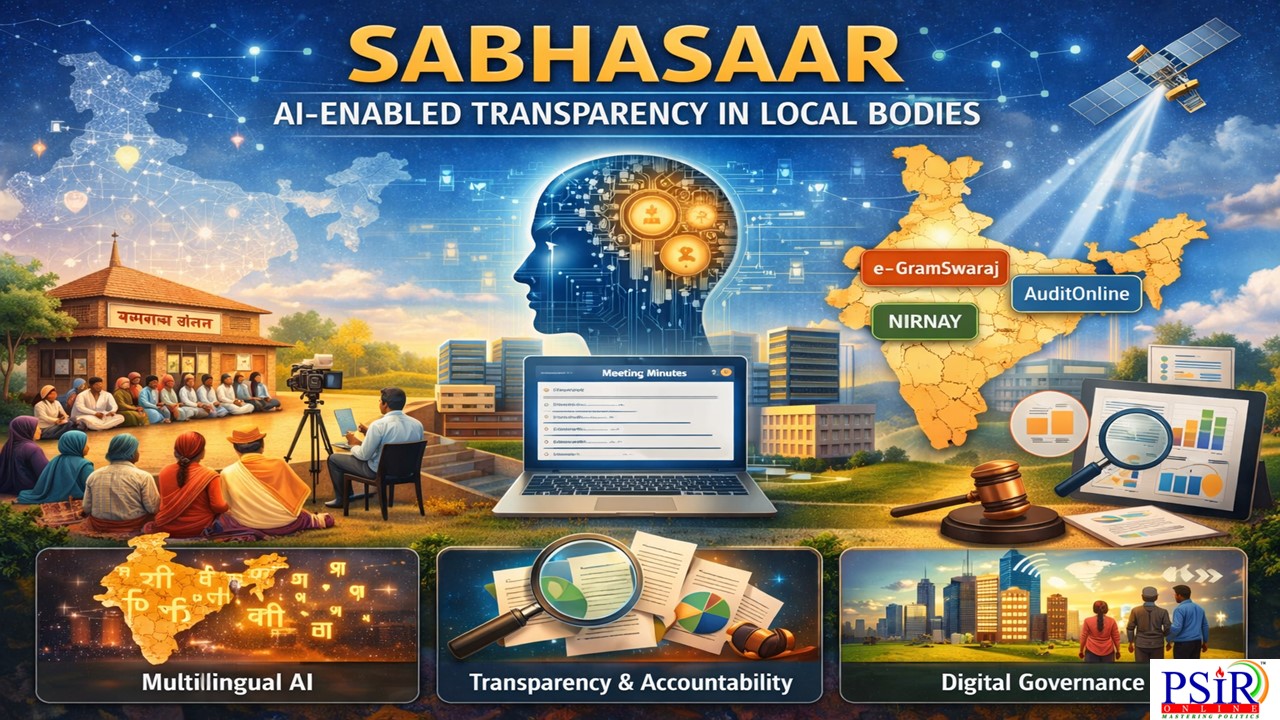
SabhaSaar is an AI tool launched by India's Ministry of Panchayati Raj in August 2025 (with major rollout updates noted around February 2026) to simplify Gram Sabha meetings—village assemblies where locals discuss budgets, projects, and welfare. This tool automatically generates structured minutes of Gram Sabha meetings from audio/video in 14 languages.
In India’s journey toward smarter, transparent local governance, SabhaSaar stands out as a groundbreaking digital innovation. Developed by the Ministry of Panchayati Raj, SabhaSaar is an AI-powered web-based service integrated within the government’s existing e‑GramSwaraj portal. It is not a separate mobile app but a dedicated tab and functionality accessible to authorized users—primarily Panchayat Secretaries, Sarpanches, and Block‑level officials—through their secure e‑GramSwaraj login credentials.
SabhaSaar allows users to upload audio or video recordings of Gram Sabha meetings directly from a computer, smartphone, or tablet connected to the portal. Once uploaded, the tool uses speech recognition and Natural Language Processing (NLP) to generate structured, multilingual minutes of the meeting automatically. Citizens need not install any external software—the service functions entirely online, hosted on the national e‑governance platform for Panchayati Raj Institutions.
Connected seamlessly with other government systems such as AuditOnline, NIRNAY, and Gram Manchitra, SabhaSaar enhances data flow and transparency across village governance activities. In essence, it is the official AI‑driven documentation wing of India’s Panchayat administration—enabling every Gram Sabha’s voice to be captured, translated, and turned into verified records with a few clicks.
CORE FUNCTION AND TECHNOLOGY ARCHITECTURE
SabhaSaar works as an integrated tool within the e-GramSwaraj ecosystem. Its main function is to automate the creation of minutes of Gram Sabha meetings, which are legally and administratively significant for local governance.
How It Works:
1. Recording and Upload: Panchayat officials upload audio or video recordings of Gram Sabha meetings via their e-GramSwaraj login.
2. AI Processing: Using advanced speech-to-text and NLP models, the system transcribes ongoing discussions.
3. Intelligence Extraction: It identifies action points, resolutions, financial decisions, and responsible functionaries—summarizing them in an orderly format.
4. Multilingual Support: Through integration with Bhashini, the government’s AI-based language translation platform, SabhaSaar supports 23 Indian languages, including Hindi, Tamil, Telugu, Bengali, Marathi, and Odia.
5. User Validation: Panchayat secretaries or officials can review, edit, and approve the generated minutes before storing them as official records.
INTEGRATION WITH DIGITAL GOVERNANCE PLATFORMS
SabhaSaar is designed not as a standalone app but as part of a broader digital governance network, ensuring seamless linkage and transparency across administrative layers:
· e-GramSwaraj Portal: Main platform hosting meeting data, budgets, and project details.
· AuditOnline: Automatically retrieves Gram Sabha approvals for relevant financial audits.
· NIRNAY Platform: Integrates resolutions and decisions for time-bound monitoring of implementation outcomes.
· Gram Manchitra: Geospatial mapping for visualizing community projects discussed in Sabha meetings.
This ecosystem-wide integration promotes data consistency, reduces duplication, and enhances traceability of village-level decisions.
ADOPTION AND IMPLEMENTATION STATUS
By February 2026, SabhaSaar had been adopted by over 1.15 lakh Gram Panchayats across India.
Notably:
· Tamil Nadu and Odisha achieved almost 99% functional usage, owing to strong digital literacy drives under State Rural Development Departments.
· Tripura, Madhya Pradesh, and Gujarat displayed growing uptake due to concurrent e-governance reforms.
· Many Panchayats report drastic reductions in administrative workload, enabling officers to focus on implementation rather than documentation.
KEY BENEFITS AND IMPACTS
1. Transparency and Accountability
· Converts oral deliberations into authentic, timestamped digital minutes, minimizing manipulation or after-meeting alterations.
· Creates publicly searchable archives that can be cross-verified during audits and social reviews.
· Reduces “he said/she said” disputes by maintaining factual records traceable to audio/video evidence.
2. Efficiency and Time-Saving
· Traditional minute-writing took several hours per meeting; SabhaSaar reduces it to a few minutes.
· Automates repetitive tasks like attendance logging, item numbering, and resolution formatting.
3. Inclusivity and Linguistic Accessibility
· Through Bhashini integration, ensures equitable participation by recognizing regional dialects and minority languages.
· Facilitates inter-state understanding by auto-translating key resolutions into Hindi and English when required for higher-level reporting.
4. Governance Quality and Policy Monitoring
· Ensures continuity in documentation even with frequent staff transfers.
· Provides verifiable datasets for evaluating the effectiveness of flagship schemes like MGNREGS, PMAY-G, and Jal Jeevan Mission.
· Strengthens evidence-based governance, linking deliberations directly to project outcomes.
5. Reducing Administrative Disputes
· Uniform templates reduce discrepancies during inspections or audits.
· Offers panchayats a reliable digital trail that can defend their decisions in inquiries or RTI requests.
EXAMPLE IN ACTION: TRIPURA CASE STUDY
In a Tripura Gram Sabha meeting (2025 pilot batch), villagers debated a rural water supply project. The discussion occurred in a mix of Bengali and Hindi, creating difficulty for manual documentation earlier.
This prevented later confusion regarding fund allocation and accountability—demonstrating the system’s governance value.
CHALLENGES AND WAY FORWARD
Despite remarkable progress, certain challenges persist:
· Rural Connectivity: Reliable internet and power supply remain preconditions for smooth uploads.
· Capacity Building: Panchayat functionaries need sustained training in operating AI-integrated platforms.
· Data Privacy & Security: Ensuring protection of public discussions from misuse or manipulation is crucial.
· Dialectal Variance: Continuous machine learning is required to improve accuracy in under-represented dialects.
FUTURE DIRECTIONS:
· Integration with mobile-based SabhaSaar Lite for offline usage.
· Inclusion of voice biometrics for identifying speakers during deliberations.
· Linking AI-generated data analytics with Jan Bhagidari dashboards for scheme performance visualization.
PRACTISE QUESTIONS FOR GS 2 MAINS
1. “Digital technologies are transforming grassroots governance in India.” Examine the role of AI-enabled tools like SabhaSaar in strengthening transparency and accountability in Panchayati Raj institutions.
2. Discuss how integration of platforms such as e-GramSwaraj, AuditOnline, and SabhaSaar contributes to improving governance outcomes at the local level. What are the associated challenges?
3. Evaluate the role of multilingual AI systems in promoting inclusivity in rural governance. In this context, analyze the significance of Bhashini integration in SabhaSaar.
4. Despite technological advancements, rural governance in India faces structural challenges. Critically examine the limitations in the implementation of AI-based governance tools like SabhaSaar and suggest measures for improvement.