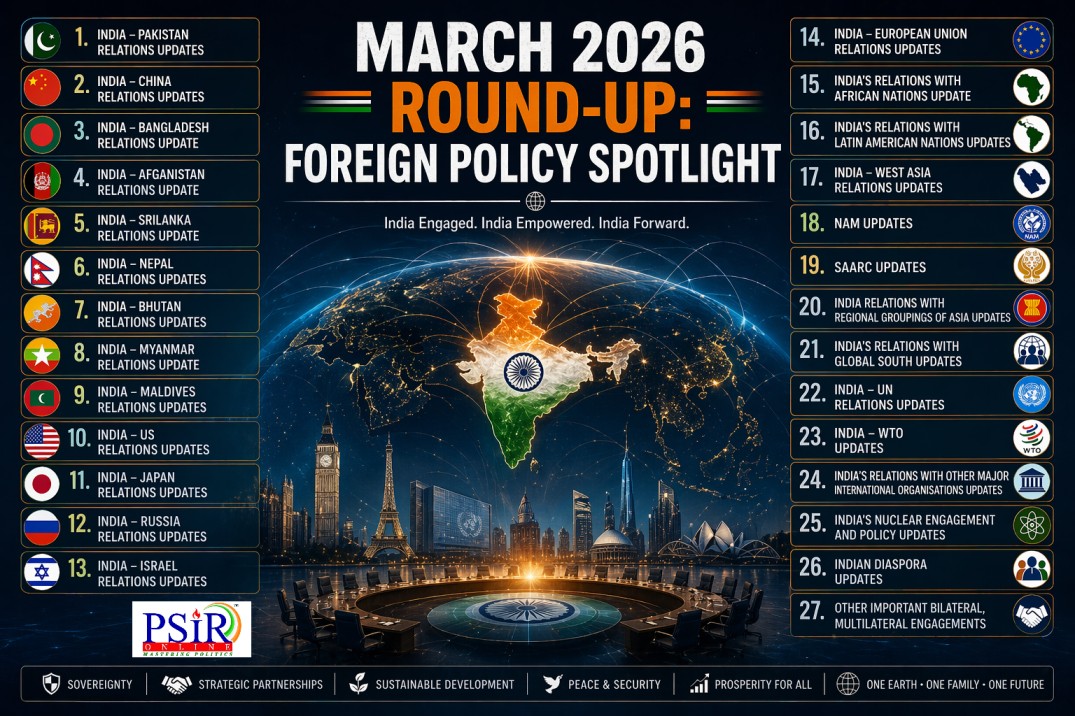
|
1 |
INDIA – PAKISTAN RELATIONS UPDATES
Tense but No Major Escalation or Direct Talks Relations remained strained with no resumption of formal bilateral dialogue. The focus stayed on lingering effects from the May 2025 Pahalgam terror attack and India’s subsequent Operation Sindoor (a brief military standoff). Both sides continued trading accusations, but there was no fresh large-scale border conflict in March.
Key Events and Statements in March 2026 · Early March (around March 1–3): Pakistani President Asif Ali Zardari claimed that India was “preparing for another war.” Speaking in parliament, he urged New Delhi to move from a “war theatre” to “meaningful negotiations” for regional security. He also criticised India’s suspension of the Indus Waters Treaty, calling it “hydro terrorism.” India did not engage directly on these remarks.
· March 1: Indian Army thwarted multiple Pakistani drone intrusion attempts along the Line of Control (LoC) in the Poonch sector of Jammu & Kashmir. Troops fired to repel the quadcopters, which retreated into Pakistan-occupied Kashmir. This was the second such incident in a few days.
· March 18–19: The US Intelligence Community’s Annual Threat Assessment (presented to the US Senate) stated that India-Pakistan relations remain a risk for nuclear conflict, citing terrorism as a persistent trigger and the danger of escalation. India responded by highlighting Pakistan’s “clandestine history of nuclear proliferation.” Pakistan’s expanding missile capabilities and terror links were also flagged in related US reports.
· Mid-to-Late March: a. Continued low-level anti-militancy operations in Jammu & Kashmir, with occasional encounters involving alleged Pakistani militants. b. Protests erupted in Kashmir following the killing of Iran’s Supreme Leader (linked to broader regional tensions), leading to clashes, internet curbs, and arrests. c. Both countries continued sparring over the Indus Waters Treaty at the United Nations and in public statements. India maintained the treaty would stay in abeyance until Pakistan credibly ends support for terrorism.
· Broader Diplomatic Context: Pakistan actively positioned itself as a mediator in the US-Iran crisis (offering to host talks and relaying proposals), which drew commentary about India appearing somewhat sidelined in that specific diplomatic track. However, this did not lead to any direct India-Pakistan engagement. India dismissed Pakistan’s mediation role in strong terms.
|
|
2 |
INDIA – CHINA RELATIONS UPDATES
Overall Trend: Cautious Improvement and Fragile Re-engagement Relations continued on a path of gradual stabilization following the 2020 Galwan standoff and subsequent disengagement agreements (largely completed by late 2024). Both sides emphasized that ties were on the "correct path" of improvement, with shared interests outweighing differences. However, deep mistrust persisted, and progress remained pragmatic rather than transformative. No major border incidents or breakthroughs on the Line of Actual Control (LAC) were reported in March itself.
Key Events and Statements in March 2026 · March 8, 2026: Chinese Foreign Minister Wang Yi spoke positively about bilateral ties during a press conference on the sidelines of China’s National People’s Congress. He highlighted the successful Modi-Xi meetings in 2024 (Kazan BRICS) and 2025 (Tianjin SCO), saying relations had seen “further improvement.”
· March 10–11, 2026: India approved easing of investment norms for Chinese entities in select sectors (electronics, capital goods, solar cells). Investors with up to 10% Chinese ownership could now invest under the automatic route in certain cases. This marked a significant step to end six years of strict scrutiny on Chinese FDI post-2020, aimed at addressing capital needs and rebuilding economic ties.
· March 26, 2026: Wang Yi met outgoing Indian Ambassador to China Pradeep Kumar Rawat in Beijing. Wang reiterated that India-China relations had “embarked on a correct path of improvement” under the guidance of the two leaders. He stressed that the two countries should view each other as “development opportunities rather than threats, and partners rather than rivals.” He called for expanded cooperation in various fields, safeguarding Global South interests, and strengthening BRICS collaboration (India was chairing BRICS in 2026).
· Trade and Economic Developments: China overtook the US as India’s largest trading partner in FY 2025-26 (data covering the period including March). Bilateral trade reached high levels, but India’s trade deficit with China widened significantly (crossing $100–112 billion range in recent periods), driven by strong imports of electronics, machinery, and components. India’s March exports overall saw some dip, partly due to global factors.
· Other Signals: Preparatory activities for people-to-people and business exchanges continued quietly. An Indian business delegation (focused on EVs, batteries, renewables) visited China at the very end of March/early April, described as the first such major group in over five years — indicating thawing economic engagement. Discussions also touched on BRICS coordination, with India hosting the summit later in 2026.
Border/LAC Situation The LAC remained largely quiet in March 2026, with no fresh tensions reported. Earlier disengagement and patrolling agreements from 2024–2025 continued to hold, providing temporary stability. However, analysts described the overall situation as “fragile re-engagement,” with India maintaining high vigilance and troop deployments.
Broader Context · Both countries continued to balance bilateral stabilization with strategic competition. India pursued “competitive” policies toward China while engaging pragmatically.
· Multilateral forums like BRICS (under Indian chairmanship) offered areas of limited cooperation.
· Occasional friction points (e.g., naming issues in Arunachal Pradesh) surfaced around this period, but China reiterated that its policy to improve ties with India remained “unchanged.”
|
|
3 |
INDIA – BANGLADESH RELATIONS UPDATE
Overall Trend: Cautious Reset and Pragmatic Engagement Following the February 2026 general elections in Bangladesh, where the Bangladesh Nationalist Party (BNP) led by Tarique Rahman secured a landslide victory and formed the new government, both sides showed signs of a tentative thaw after strains during the previous interim period under Muhammad Yunus. India adopted a pragmatic “neighbourhood-driven” approach, emphasizing constructive engagement, mutual benefit, and people-to-people ties while addressing core concerns like security and energy. Progress remained cautious, with practical cooperation in energy and visas, but deeper issues (water sharing, trade imbalance) were only touched upon lightly.
Key Events and Statements in March 2026 · Early March (March 1–7): Indian High Commissioner Pranay Verma held multiple meetings with Bangladeshi ministers (including Commerce and Local Government ministers). He reiterated India’s keen interest in working closely with the new government to make bilateral cooperation “more extensive and dynamic,” focusing on trade, economic ties, and mutual benefit. On March 7, Verma highlighted shared history and cultural bonds at a Ramadan iftar event, stating that the two countries stand at the “threshold of a promising future.”
· March 5: Indian authorities arrested two Bangladeshi suspects in connection with a murder case, seen as a small positive signal in security cooperation.
· Mid-March (March 16–20): o Energy Cooperation: India supplied around 5,000 tons of diesel to Bangladesh via the Bangladesh–India Friendship Pipeline (part of an annual commitment of ~180,000 tons from Numaligarh refinery). Bangladesh sought additional supplies amid regional energy disruptions (linked to West Asia/Iran tensions), and India was considering the request. This was viewed as a practical goodwill gesture. o Bangladesh High Commissioner Riaz Hamidullah called on External Affairs Minister S. Jaishankar and Commerce & Industry Minister Piyush Goyal in New Delhi (around March 20). Discussions focused on advancing bilateral ties, with India stressing continued high-level exchanges under institutional mechanisms. The envoy called for amicable resolution of “sensitive” and “difficult” issues (trade, security, natural resources) with sincerity.
· Late March: Opinion pieces and analyses (e.g., The Diplomat on March 16 titled “Is the Ice Finally Breaking?” and others around March 25–30) noted emerging “green shoots” of rapprochement, including restoration of visa services. Bangladesh had resumed full visa services in India in late February; India indicated phased resumption of medical, tourist, and student visas. A Bangladesh National Day reception in Delhi (March 26) featured cultural gestures and statements on forward-looking partnership.
Broader Context and Pending Issues · Visa and People-to-People Ties: Gradual easing of restrictions was a key early confidence-building step.
· Water Sharing: The 1996 Ganges Water Sharing Treaty was approaching expiry (December 2026), prompting quiet discussions. The long-pending Teesta agreement remained unresolved, with no major breakthrough in March.
· Security and Minorities: India continued to watch developments closely, including minority safety and cross-border issues.
· Economic/Trade: Focus on deepening trade and investment, though the deficit remained a point of discussion.
· No high-level visits by ministers or PMs occurred in March itself (those picked up in early April).
|
|
4 |
INDIA – AFGANISTAN RELATIONS UPDATE
Overall Trend: Pragmatic Engagement Continues Amid Regional Turmoil India maintained its policy of "engagement without formal recognition" of the Taliban regime. Focus remained on humanitarian assistance, people-centric development, trade facilitation, and capacity-building, while leveraging the Taliban’s growing tensions with Pakistan. No high-level ministerial visits occurred in March, but India actively used multilateral forums to highlight Afghan issues.
Key Events and Statements in March 2026 · March 10, 2026: At a United Nations Security Council (UNSC) briefing on Afghanistan, India’s Permanent Representative Ambassador Harish Parvathaneni raised concerns over: o Humanitarian challenges in Afghanistan o Cross-border violence (including airstrikes and civilian casualties) o Trade restrictions affecting the landlocked country He reiterated India’s longstanding commitment to the Afghan people through development projects (over 500 across 34 provinces), healthcare, education, food security, and sports. India continues cooperating with UN agencies and local institutions.
· Mid-to-Late March: India expressed strong condemnation of Pakistan’s airstrikes on Afghan territory (which caused civilian deaths, including women and children, and damaged infrastructure). These strikes were part of escalating border clashes between Pakistan and the Taliban-led Afghanistan. India’s Ministry of External Affairs (MEA) statements highlighted the civilian toll, especially during the holy month of Ramadan.
· Humanitarian and Medical Aid: Around March 21, 2026, India dispatched medical and humanitarian assistance to Afghanistan (following similar aid to Iran a few days earlier). This aligned with India’s ongoing support amid Afghanistan’s economic difficulties and natural disaster risks.
Broader Context
· The Taliban-appointed Chargé d’Affaires (Noor Ahmad Noor) continued operating from the Afghan Embassy in New Delhi (a milestone from early 2026).
· India’s increased development aid allocation (₹150 crore in the 2026–27 Union Budget, announced in February) supported ongoing projects.
· Bilateral trade had reached around USD $1 billion in 2025, with efforts to expand air freight corridors and explore investment in mining, pharmaceuticals, and agriculture.
· India’s approach balanced strategic interests (countering Pakistani influence, securing regional stability) with humanitarian priorities, without endorsing the Taliban’s governance model or women’s rights restrictions.
|
|
5 |
INDIA – SRILANKA RELATIONS UPDATE
Overall Trend: Strong Momentum and High Trust Bilateral ties remained at a historic high with broad political consensus in Sri Lanka (across government and opposition) supporting closer partnership with India. Trust and goodwill were repeatedly described as “at an all-time high,” driven by India’s consistent support during Sri Lanka’s economic crisis, disaster relief, and ongoing development projects. Cooperation focused on energy security, capacity building, economic integration, and people-to-people ties.
Key Events and Statements in March 2026 · March 5–7: Sri Lankan Foreign Minister Vijitha Herath visited New Delhi to participate in the Raisina Dialogue 2026. He held warm and constructive bilateral meetings with External Affairs Minister S. Jaishankar, focusing on strengthening ties under the shared vision of “Fostering Partnerships for a Shared Future.” Herath also met Prime Minister Narendra Modi on the sidelines. Discussions covered bilateral cooperation and regional issues.
· March 24: Prime Minister Narendra Modi and Sri Lankan President Anura Kumara Dissanayake held a telephone conversation to discuss the escalating West Asia crisis and its impact on global energy security. This call underscored the strategic importance of the partnership in times of regional instability.
· March 28–29: Following the Modi-Dissanayake call, a shipment of 38,000 MT of petroleum (20,000 MT diesel + 18,000 MT petrol) arrived in Colombo. This was presented as a direct outcome of the leaders’ discussion and a practical demonstration of India’s support for Sri Lanka’s energy needs.
· Throughout March: India expanded its development and capacity-building partnership through multiple training programmes. Over 140 Sri Lankan parliamentarians, civil servants, engineers, and local government officials participated in specialised courses in Indian institutions. A notable 15-member Sri Lankan parliamentary delegation (led by S.M. Marikkar) visited Delhi and Mumbai to study India’s infrastructure governance, interacting with Lok Sabha Speaker Om Birla and visiting key bodies like the National Highways Authority of India and Delhi Metro.
· Economic and Tech Cooperation: Discussions continued on deeper economic resilience, technological integration, and investment. Sri Lankan leaders (including PM Harini Amarasuriya in related events) highlighted the need for stronger ties in these areas. One opposition voice noted it was “almost unreal” that the Economic and Technology Cooperation Agreement (ETCA) had not yet been signed, reflecting strong interest in advancing trade integration.
Broader Context · No major friction points (e.g., fisheries disputes around Katchatheevu or Tamil issues) dominated headlines in March; the tone remained overwhelmingly positive and forward-looking.
· High-level exchanges built on previous momentum from 2024–2025 visits and agreements in energy, connectivity, and defence cooperation.
· Sri Lanka continued to view India as its most reliable regional partner, with emphasis on shared civilizational bonds, energy connectivity (including pipeline discussions), and development projects like housing and infrastructure.
|
|
6 |
INDIA – NEPAL RELATIONS UPDATES
Overall Trend: Political Reset and Cautious Optimism March 2026 was dominated by Nepal’s general elections (held on March 5) and the subsequent formation of a new government. The Rastriya Swatantra Party (RSP), led by young leaders including Balendra “Balen” Shah (a rapper-turned-politician), secured a landslide victory, ending the long dominance of traditional parties like those led by K.P. Sharma Oli. This “Gen Z” mandate created a significant opportunity for India to reset and strengthen ties with a more pragmatic, youth-oriented government in Kathmandu. India welcomed the outcome and expressed readiness to work closely for mutual prosperity. Analysts described it as a strategic window for New Delhi to move beyond past irritants (e.g., border disputes, perceived “big brother” attitudes) toward deeper cooperation in energy, connectivity, trade, and people-to-people ties.
Key Events and Statements in March 2026 · March 5: Nepal held general elections. RSP’s strong performance shifted the political landscape dramatically.
· March 9–10: Prime Minister Narendra Modi held telephone conversations with RSP leaders Rabi Lamichhane and Balendra Shah. Modi congratulated them on the victory and conveyed India’s commitment to deepening bilateral relations for the well-being of both peoples. Balen Shah responded positively, expressing confidence that historical and close ties would become “stronger, deeper, and more result-oriented.”
· March 23: Nepal’s electricity authority indicated plans to nearly quadruple hydropower exports to India in the coming period (aiming for significant increases to meet India’s summer demand). This built on the existing long-term power trade agreement.
· March 22–23: Renewed tensions surfaced over the Lipulekh Pass (part of the Kalapani-Lipulekh-Limpiyadhura dispute). Reports emerged that India and China planned to resume border trade via Lipulekh after a six-year gap. Nepal strongly objected, reiterating its claim over the territory and expressing concerns that it was not consulted. This issue tested the incoming government’s diplomatic stance.
· March 27: Balendra Shah was sworn in as Nepal’s youngest-ever Prime Minister. PM Modi promptly greeted him, and Shah reiterated his eagerness to work closely with India.
· Throughout March: Opinion pieces and editorials (in Indian and Nepali media) highlighted the need for a “new partnership,” focusing on hydropower exports, cross-border infrastructure (rail, roads, petroleum pipelines), digital connectivity, and addressing pending issues like the 1950 Treaty review and border management. A Nepal-India Tech Forum (held end of February but with follow-up in March) underscored growing interest in digital and infrastructure collaboration.
Broader Context and Pending Issues · Positive Areas: Energy cooperation (hydropower exports), trade (India remains Nepal’s largest partner), development projects, and open borders continued as strengths.
· Challenges: The Kalapani/Lipulekh dispute lingered; past issues like Agnipath scheme concerns and treaty revisions were mentioned but not escalated in March.
· No major high-level visits occurred in March itself, but groundwork began for future engagements (including an expected visit by the new PM to India).
|
|
7 |
INDIA – BHUTAN RELATIONS UPDATES
Overall Trend: Steady Development Partnership with Strong Trust India-Bhutan relations continued to be exceptionally warm and stable, often described as a model of mutual trust and goodwill. Cooperation remained focused on development assistance under Bhutan’s 13th Five Year Plan (FYP), energy/hydropower, connectivity, and new areas like postal services. No major political irritants or border issues surfaced in March. India’s consistent support for Bhutan’s socio-economic priorities was evident through timely funding releases and institutional collaboration.
Key Events and Statements in March 2026 · March 3–5: The 16th Monthly Coordination Meeting between the Embassy of India in Thimphu and Bhutan’s Ministry of Finance was held. India released Nu 1.24 billion (₹124 crore) as part of its commitment to Bhutan’s 13th FYP. Key allocations included: o Nu 469 million for infrastructure development at the Royal University of Bhutan (covering eight colleges — new buildings, renovations, labs, hostels, green energy, and sports facilities). o Funds for other projects like infrastructure strengthening. This was part of India’s broader pledge of ₹10,000 crore for the 13th FYP.
· March 19–22: Secretary (Posts), Department of Posts, Government of India, visited Bhutan. An MoU on Postal Cooperation was signed with Bhutan’s Ministry of Infrastructure and Transport. The agreement aims to strengthen connectivity, improve service delivery, and enhance institutional collaboration between India Post and Bhutan Post.
· March 4: India’s MEA Spokesperson Randhir Jaiswal highlighted that the partnership between India and Bhutan is built on “deep mutual trust and goodwill.”
· Throughout March: Routine coordination continued on development projects, including high-impact community development initiatives. A bridge project (Khuru-Kuenphen) under Indian assistance was progressing, with related funding mentioned in reports.
Broader Context · Hydropower and Energy: While no new major agreements were signed in March (significant energy-related developments, including new agreements and visits, occurred in April 2026), the foundation laid in previous years (including the 2024 Joint Vision Document on Energy Partnership) continued to guide cooperation. Hydropower remains the cornerstone of the bilateral relationship.
· Development Focus: India is Bhutan’s largest development partner. Support covers education, infrastructure, health, and capacity building, aligning with Bhutan’s Gross National Happiness goals and India’s “Neighbourhood First” policy.
· No high-level political visits by ministers or PMs were reported in March itself; the relationship operated smoothly through institutional and embassy-level mechanisms.
|
|
8 |
INDIA – MYANMAR RELATIONS UPDATE
Overall Trend: Continued Pragmatic Engagement with the Junta India maintained its calibrated policy of engagement with Myanmar’s military-backed authorities while emphasizing a “Myanmar-led and Myanmar-owned” peace process. Ties focused on strategic interests (border security, Act East Policy connectivity), trade, development assistance, and cultural links. No major breakthroughs occurred, but India signaled willingness to support development and dialogue amid Myanmar’s ongoing internal conflict and the junta’s efforts to consolidate power post-elections (held late 2025–early 2026).
Key Events and Statements in March 2026 · March 4, 2026: External Affairs Minister Dr. S. Jaishankar inaugurated the Sarsobeikman Literary Centre Building in Myanmar (virtually or through a representative event). In his remarks, he highlighted centuries-old bonds of spirituality, kinship, and geography between the two countries. He reiterated India’s support for an inclusive, Myanmar-led and Myanmar-owned peace process that delivers lasting peace and development. He also stressed people-centric development cooperation.
· March 13, 2026: The ASEAN-India Business Meet 2026 and Glory Excellence Awards was held at the Myanmar Embassy in New Delhi. It was attended by Indian Minister of State Ramdas Athawale and around 200 participants, including diplomats and business leaders. The event aimed to boost economic and business ties.
· March 16, 2026: Myanmar’s parliament (dominated by the military-backed USDP) convened for the first time since the 2021 coup. This was part of the junta’s efforts to formalize its control. India observed the process but continued to advocate for inclusive and transparent mechanisms.
· March 30, 2026: Myanmar’s Ambassador to India, Zaw Oo, met the Chief of Protocol in India’s Ministry of External Affairs. They discussed diplomatic privileges, the embassy construction project, administrative matters, and recent developments in Myanmar.
· Throughout March: o India continued to monitor border security closely, with concerns over militancy, narcotics trafficking, and spillover effects from Myanmar’s civil conflict into India’s Northeast. o Bilateral trade remained steady (around $2.1–2.15 billion in recent FY data), with pulses (especially urad and tur) forming a major part of Myanmar’s exports to India (duty-free imports extended till March 2026). o No new high-level political visits or major agreements were reported in March itself.
Broader Context and Ongoing Issues · Border and Security: The 1,643-km shared border remained a priority. India focused on managing cross-border movement, counter-insurgency, and projects like the Kaladan Multi-Modal Transit Transport Project. Discussions around the Free Movement Regime (FMR) and potential fencing continued in the background due to security concerns.
· Humanitarian Situation: Myanmar faced escalating conflict, displacement (over 3.6 million IDPs), and humanitarian needs. India’s approach emphasized dialogue and development support rather than direct large-scale aid announcements in March.
· Strategic Calculus: India balanced engagement with the de facto authorities for stability and connectivity while keeping limited channels open with other stakeholders near the border.
|
|
9 |
INDIA – MALDIVES RELATIONS UPDATES
Overall Trend: Steady Consolidation and Economic Deepening Relations continued on a positive trajectory of reset and pragmatic cooperation, building on the thaw that began in mid-2025. Focus remained on economic integration, infrastructure support, and people-centric projects. Tensions from the earlier “India Out” phase had largely subsided, with both sides emphasizing mutual benefit and regional stability in the Indian Ocean. No major political friction or defence-related controversies were reported in March.
Key Events and Statements in March 2026 · March 16, 2026: India and the Maldives signed the Terms of Reference (ToR) to formally kickstart negotiations for a bilateral Free Trade Agreement (FTA). This was a significant step toward deeper economic integration, covering trade in goods, services, and investment. The move was announced by India’s Ministry of Commerce and Industry and welcomed in Malé as a way to boost bilateral commerce and reduce dependence on third countries.
· Mid-to-Late March: The High Commission of India in Malé released its Monthly Digest for March 2026, highlighting ongoing development cooperation, cultural exchanges, and community outreach activities. This included updates on Indian-assisted infrastructure projects and capacity-building initiatives.
· Throughout March: o Continued implementation of earlier commitments, including infrastructure projects (such as progress on connectivity initiatives like the Greater Malé Connectivity Project/bridge network). o Discussions on expanded export quotas for essential commodities from India to the Maldives for FY 2026–27. o Low-key diplomatic engagement on tourism, health, and digital cooperation (building on UPI and other initiatives from 2025).
Broader Context · Economic & Development Cooperation: India remained a key development partner, with ongoing projects in housing, health, education, and connectivity. Earlier lines of credit and debt relief measures (from 2025) continued to support Maldives’ economic stability.
· Strategic Dimension: Defence and security ties were stable, with occasional high-level military-to-military interactions focused on Indian Ocean security (though no major announcements in March).
· Political Atmosphere: Under President Mohamed Muizzu, the relationship had moved from earlier strains to a more balanced and cooperative phase, driven by economic realities and mutual interests.
|
|
10 |
INDIA – US RELATIONS UPDATES
Overall Trend: Diplomatic Engagement Amid a Fragile Reset Relations remained in a phase of cautious consolidation following the February 2026 Interim Trade Agreement framework (which reduced US tariffs on many Indian goods and addressed issues linked to Russian oil purchases). Both sides emphasized strategic partnership, defence cooperation, and economic ties, but analysts noted that a full “reset” remained elusive due to lingering transactional elements under the Trump administration and India’s continued strategic autonomy. High-level visits and a leaders’ phone call kept momentum alive, particularly on West Asia developments.
Key Events in March 2026 · Early March (March 1–6): US Assistant Secretary of State for South and Central Asian Affairs S. Paul Kapur visited India. US Deputy Secretary of State Christopher Landau travelled to New Delhi (March 3–6) to lead the US delegation at the Raisina Dialogue 2026. He held meetings on defence, critical minerals, counternarcotics, and economic ties. Landau highlighted India’s “unlimited potential” and the bright commercial outlook, while stressing reciprocity and learning from past US-China trade experiences. He described the bilateral relationship as crucial for the Indo-Pacific.
· March 25, 2026: The 18th India–US Defence Policy Group (DPG) meeting was held in New Delhi. Co-chaired by India’s Defence Secretary Rajesh Kumar Singh and US Under Secretary of Defense for Policy Elbridge Colby, the meeting reaffirmed commitment to expanding strategic cooperation, reviewed regional security (including West Asia), and discussed ways to deepen defence industrial ties.
· Mid-to-Late March: PM Narendra Modi and President Donald Trump held a telephone conversation (the first since the escalation of West Asia/Iran-related hostilities). They exchanged views on the regional situation and its global implications. Trump later described Modi and himself as “two people that get things done” and expressed confidence that India-US ties would grow stronger.
· March 27: Commerce Minister Piyush Goyal held a “very productive” meeting with US Trade Representative Jamieson Greer to discuss next steps in the Bilateral Trade Agreement (BTA) negotiations and ways to deepen economic cooperation.
Broader Context · Trade: Focus remained on implementing the February Interim Agreement and advancing full BTA talks. India continued to balance diversification of energy imports while addressing US concerns.
· Defence & Technology: Steady progress in defence policy dialogue and initiatives like iCET/TRUST and Pax Silica (technology and supply chain cooperation).
· Geopolitical Angle: Discussions often touched on West Asia stability, Indo-Pacific strategy, and countering common challenges, with India maintaining strategic hedging.
|
|
11 |
INDIA – JAPAN RELATIONS UPDATES
Overall Trend: Strong Momentum in Economic and Strategic Cooperation India-Japan ties continued to deepen under the Special Strategic and Global Partnership, with a balanced focus on economic security, trade/investment, defence, and Indo-Pacific cooperation. The relationship was described as entering a “New Golden Chapter” ahead of the 75th anniversary of diplomatic relations. Activity in March was implementation-oriented, with emphasis on reviewing the CEPA, business exchanges, and shared Indo-Pacific goals. No summit-level meeting occurred that month, but high-level dialogues and visits sustained steady progress.
Key Events in March 2026 · March 2–5 (Tokyo): The 7th Joint Committee Meeting (JCM) under the India–Japan Comprehensive Economic Partnership Agreement (CEPA) was held. Co-chaired by Indian Commerce Secretary Rajesh Agrawal and Japan’s Senior Deputy Minister, the meeting reviewed CEPA implementation and discussed ways to expand trade, narrow the trade deficit (around $10.8 billion), and boost cooperation in pharmaceuticals, EVs, semiconductors, agriculture, and symmetric trade flows.
· March 6: Special Advisor to the Japanese Prime Minister OUE visited India for high-level consultations.
· March 5: A delegation of Indian Parliament members made a courtesy call on Japan’s State Minister for Foreign Affairs KUNIMITSU.
· March 9–13: A FICCI business delegation visited Japan alongside the 49th India–Japan Business Cooperation Committee Meeting, focusing on strengthening private-sector ties and investment opportunities.
· March 13: A delegation from the Japan-India Business Co-operation Committees paid a courtesy call on Japan’s State Minister for Foreign Affairs HORII.
· March 24 (New Delhi): The International Conference on ‘India-Japan Cooperation in the Indo-Pacific: Enhancing Security and Stability’ was held, coinciding with the 10th anniversary of Japan’s Free and Open Indo-Pacific (FOIP) vision. Japanese Ambassador to India ONO Keiichi delivered the keynote, describing bilateral ties as entering a “New Golden Chapter.” Discussions focused on strategic depth, resilient supply chains, maritime security, and a rules-based Indo-Pacific order.
· Throughout March: o Renewal of the $75 billion Bilateral Currency Swap Agreement between the RBI and Bank of Japan provided macroeconomic stability and a financial safety net. o Japan announced plans (formalized shortly after) to create a dedicated Japan-India Economic Affairs Division in its Ministry of Foreign Affairs to boost private-sector investment and economic security cooperation. o Cultural and people-to-people activities continued, including events like the “Chado – Way of Tea” demonstration later in the month. o Defence cooperation remained steady, with the Dharma Guardian 2026 joint military exercise having concluded in early March (focusing on counter-terrorism and interoperability).
Broader Context · Economic Focus: Japan continued to prioritize investment in India (with long-term targets of ¥10 trillion in private investment). Key sectors included semiconductors, critical minerals, EVs, high-speed rail (Mumbai-Ahmedabad project), and green energy.
· Strategic/Indo-Pacific: Shared vision for a Free and Open Indo-Pacific, Quad coordination, and supply chain resilience featured prominently.
· ODA and Development: Japan remained a major development partner, with ongoing commitments in urban transport, health, agriculture, and infrastructure.
|
|
12 |
INDIA – RUSSIA RELATIONS UPDATES
Overall Trend: Steady Consolidation of the Special and Privileged Strategic Partnership Bilateral ties remained strong and resilient, with emphasis on maintaining the long-standing partnership amid global uncertainties, particularly the escalating West Asia (Iran-related) crisis and energy supply disruptions. Both sides focused on reviewing the full spectrum of cooperation, preparing for future high-level contacts, and deepening economic ties (especially energy). Russia continued to view the relationship as a key stabilizing factor in Eurasia. Trade and energy cooperation gained renewed attention due to the Hormuz Strait disruptions, leading India to significantly ramp up Russian crude imports.
Key Events and Statements in March 2026 · March 11: External Affairs Minister S. Jaishankar held a telephonic conversation with Russian Foreign Minister Sergey Lavrov. They discussed the situation in West Asia and reviewed progress in bilateral cooperation. · March 12: Russian Ambassador to India Denis Alipov gave an interview to RT India, describing India-Russia relations as a stabilizing factor for peace and security on the Eurasian continent. He highlighted historical ties, the 25th anniversary of the special strategic partnership (marked in 2025), and readiness to supply LNG to India. · March 19: Russia’s First Deputy Minister of Energy Pavel Sorokin met India’s Minister of Petroleum and Natural Gas Hardeep Singh Puri in New Delhi to discuss energy cooperation. · March 23: The Second International Conference “Russia and India: Towards a New Agenda for Bilateral Relations” was held in Moscow. · External Affairs Minister S. Jaishankar delivered virtual remarks, emphasizing the partnership rooted in trust and mutual respect. · Russian Foreign Minister Sergey Lavrov addressed the conference via video, lauding India as a “great power of the 21st century” and a distinct civilization. He reaffirmed that the partnership is a key priority for Russia and stated that Moscow looks forward to welcoming Prime Minister Narendra Modi to Russia later in 2026. A related press conference summarizing the outcomes was held on March 24. · March 30: Foreign Office Consultations (FOC) were held in New Delhi, co-chaired by Indian Foreign Secretary Vikram Misri and Russian Deputy Foreign Minister Andrey Rudenko. · Both sides reviewed the entire gamut of the Special and Privileged Strategic Partnership. · They exchanged views on bilateral, regional, and global issues of mutual interest, including the schedule of upcoming high-level contacts. Deputy Foreign Minister Rudenko also met EAM Jaishankar during his visit.
Energy and Trade Highlights · Due to disruptions in West Asia (including the Strait of Hormuz blockade), India significantly increased Russian crude oil imports in March 2026 (reaching approximately 2–2.25 million barrels per day, nearly doubling from previous levels and making Russia India’s top supplier again). This was part of a broader energy security response, supported by a US sanctions waiver. · Bilateral trade continued to grow, with both sides aiming for the $100 billion target by 2030. Discussions focused on energy, technology, logistics, and diversifying beyond traditional defence ties.
Broader Context · Defence and military cooperation remained steady but low-profile in March (following renewed exercises in 2025).
· Russia strongly supported India’s BRICS Chairship in 2026.
· The relationship continued to reflect India’s strategic autonomy — maintaining deep historical ties with Russia while managing relations with the US and others.
|
|
13 |
INDIA – ISRAEL RELATIONS UPDATES
Overall Trend: Consolidation After Elevation to "Special Strategic Partnership" The relationship continued to build on the significant upgrade that occurred during Prime Minister Narendra Modi’s state visit to Israel on 25–26 February 2026, when ties were formally elevated from a “Strategic Partnership” to a “Special Strategic Partnership for Peace, Innovation and Prosperity”. In March 2026, the focus shifted to implementation and crisis management amid the escalating West Asia conflict (involving US-Israel actions against Iran). No new high-level visits or major agreements were signed in March, but the partnership remained robust in defence, technology, and strategic coordination. India maintained strong ties with Israel while balancing its broader regional interests and diaspora safety concerns.
Key Developments in March 2026 March 19, 2026: External Affairs Minister Dr. S. Jaishankar held a telephone conversation with Israeli Foreign Minister Gideon Sa’ar. · Sa’ar briefed Jaishankar on the latest developments in Israel’s operations against Iran. · The two ministers discussed the broader West Asia situation, its regional repercussions, and the need for de-escalation. · Jaishankar reiterated India’s consistent position: concern over escalation, protection of civilians, freedom of navigation, and the safety of Indian nationals in the region.
March 9, 2026: In a Suo Motu statement in the Rajya Sabha on the situation in West Asia, EAM Jaishankar highlighted Israel’s past support to India during critical times and described defence and technology cooperation with Israel as “vital” for India’s security needs. He also clarified India’s balanced approach to the ongoing conflict.
Throughout March: · Implementation of agreements signed during the February visit continued quietly (covering defence co-production, critical & emerging technologies, AI, cybersecurity, agriculture, labour mobility — including plans for up to 50,000 Indian workers in Israel over five years — and cultural/education exchanges).
· Preparations advanced for the next round of Free Trade Agreement (FTA) negotiations, scheduled for May 2026. The first round had concluded successfully just before or during the February visit.
· India continued to benefit from Israeli expertise in agriculture, water management, and defence technology, while strategic coordination on counter-terrorism and Indo-Pacific/Middle East security issues persisted.
Broader Context Defence and technology cooperation remained the strongest pillar, supported by the November 2025 MoU on joint development and production of military equipment. India’s approach in March reflected strategic autonomy: maintaining close defence and innovation ties with Israel while avoiding blanket alignment in the wider West Asia conflict and continuing engagement with Gulf states and Iran where possible. Analysts noted that the elevation to “Special Strategic Partnership” gave the relationship greater institutional depth, but the ongoing regional conflict tested India’s balancing act.
|
|
14 |
INDIA – EUROPEAN UNION RELATIONS UPDATES
Overall Trend: Post-FTA Consolidation and Strategic Deepening Relations maintained strong positive momentum following the landmark India-EU Free Trade Agreement (FTA) concluded in January 2026 (announced at the 16th EU-India Summit in New Delhi). March focused on implementation groundwork, legal processes, and high-level diplomatic engagement rather than new breakthroughs. Both sides emphasized trade, technology, security, mobility, and cooperation amid global uncertainties (particularly West Asia/Iran tensions and energy security). Analysts described the partnership as entering a more mature, strategic phase.
Key Events in March 2026 · March 15–16: External Affairs Minister Dr. S. Jaishankar visited Brussels for an official engagement. He participated in the EU Foreign Affairs Council (informal lunch discussion with EU Foreign Ministers) and held bilateral meetings with EU High Representative Kaja Kallas and several member-state counterparts. Discussions covered: o Implementation of the India-EU Strategic Partnership agenda
o Trade and technology cooperation
o Security and defence issues
o Regional developments, especially the situation in West Asia and energy security The visit was seen as reinforcing the post-summit momentum.
· Mid-March (around March 11–20): Several analyses and briefings (e.g., East Asia Forum on March 20 and GMF’s Europe-India Briefing) highlighted the FTA’s significance and next steps. Legal scrubbing of the FTA text was progressing, with expectations of completion by June 2026 and formal signing possibly before Diwali (November). The agreement was widely referred to as the “mother of all deals,” with potential to significantly boost two-way trade (EU is India’s largest trading partner).
· Ongoing throughout March: o Preparatory work on the EU-India Trade and Technology Council (TTC) continued, with discussions on a possible “TTC 2.0” focusing on advanced technologies (semiconductors, biotech, quantum).
o Think-tank and official commentary stressed stronger India-EU convergence on supply chain resilience, green transition, and strategic autonomy in a multipolar world.
o First Consultative Committee meeting of 2026 on India-EU relations (held earlier but with follow-up discussions) reviewed momentum across trade, technology, security, and mobility.
Broader Context · FTA Implementation: The deal covers goods, services, and regulatory issues (excluding a standalone investment chapter). Ratification processes were underway on both sides, with the agreement expected to enter into force around early 2027.
· Security & Defence: Building on the Security and Defence Partnership launched in January, discussions touched on maritime security, counterterrorism, and hybrid threats.
· Challenges: Differences over Russia-related issues and global trade dynamics persisted but did not derail engagement. West Asia developments featured prominently in March dialogues.
· No major new agreements or summits occurred in March; focus remained on translating the January summit outcomes into concrete action.
|
|
15 |
INDIA’S RELATIONS WITH AFRICAN NATIONS UPDATE
Overall Trend: Focus on Energy, Trade, and Preparations for Major Summit India-Africa ties continued to deepen with a strong emphasis on practical, sector-specific cooperation (especially energy and infrastructure) and steady groundwork for the long-pending 4th India-Africa Forum Summit (IAFS-IV), expected in May 2026 in New Delhi. Bilateral trade had already crossed $100 billion, with both sides targeting further growth. Engagement highlighted South-South cooperation, capacity building, renewable energy, and critical minerals amid a changing global order.
Key Events in March 2026 · March 21, 2026: An India-Africa Strategic Partnership Meet was held in New Delhi on the sidelines of the Bharat Electricity Summit 2026. o Chaired by Union Minister for Power Shri Manohar Lal.
o Attended by ministers from several African countries (including Dr Jean Mathanga, Minister of Energy and Mining, Malawi), African Union representatives, CEO of Africa50 (Alain Ebobissé), ambassadors, and industry leaders.
o Focus areas: Electrification, renewable energy, grid modernization, energy storage, infrastructure, and capacity building. The meeting aimed to build a collaborative framework leveraging India’s experience to support Africa’s sustainable growth.
· March 29, 2026: India and African nations held discussions on bolstering trade and investment ties. Talks reaffirmed historical and civilizational links while exploring ways to enhance commerce and economic cooperation.
· March 31, 2026: The Observer Research Foundation (ORF) published an expert piece titled "The Compelling Case for the 4th India–Africa Forum Summit", urging India to convene the summit soon to institutionalize strategic convergence, especially in a geopolitically uncertain world. It stressed opportunities for co-leadership in the Global South.
· Throughout March: o Preparatory momentum built for IAFS-IV (tentatively late May 2026), with discussions on development initiatives, education, skilling, digital growth, green partnerships, defence, and critical minerals.
o India continued Lines of Credit (LoC), grants, and capacity-building programmes in education, skilling, and infrastructure across African countries.
o Think-tank and diplomatic commentary emphasized evolving ties from “solidarity” to “strategic co-development” in areas like renewable energy, agriculture, and technology.
Broader Context · Energy and Infrastructure: Remained a flagship area, with India positioning itself as a reliable partner for Africa’s electrification and green transition.
· Trade and Investment: Steady progress toward doubling trade volumes, with focus on value-added manufacturing and MSMEs.
· Multilateral Angle: Cooperation in forums like BRICS, G20, UN, and AU on climate, peace & security, and development financing.
· No major bilateral state visits by heads of government occurred in March, but institutional and sectoral engagements were active.
|
|
16 |
INDIA’S RELATIONS WITH LATIN AMERICAN NATIONS UPDATES
Overall Trend: Steady Business and Academic Engagement with Focus on Economic Potential
India-Latin America ties remained in a consolidation phase following the significant diplomatic and economic push in 2025 (including high-level visits and strategic partnerships with Brazil, Argentina, and Chile). Activity in March 2026 was primarily at the business, academic, and people-to-people level, with emphasis on trade expansion, investment opportunities, and Global South cooperation. No major ministerial or head-of-state bilateral visits occurred in March itself, but groundwork continued for deeper economic integration amid global supply chain shifts.
Key Events and Activities in March 2026 · March 6, 2026: The Global India Business Forum (GIBF) organized the BRICS+ Business Conclave 2026 in Pune. The event included participation and discussions involving Latin American business leaders, highlighting opportunities in trade, investment, and cooperation within the expanded BRICS framework (which includes Brazil as a key Latin American member).
· March 13, 2026: IIM Ranchi hosted an academic event titled “Reframing Internationalization from the Global South: India & Latin America in Conversation”. This brought together scholars and experts to discuss higher education collaboration, knowledge exchange, and broader South-South partnerships between India and Latin American countries.
· March 17, 2026: The India–Argentina Business Council (IABC) held its annual meeting at the Bolsa de Cereales in Argentina. o Attended by Governor Carlos Sadir (Jujuy), Secretary Fernando Brun (International Economic Relations), and Indian Ambassador Ajaneesh Kumar. o Discussions focused on strengthening bilateral economic ties, with bilateral trade noted at around USD 6–7 billion but with significant untapped potential. o Key sectors highlighted: chemicals, pharmaceuticals, infrastructure, defence, and digital technologies. Calls were made for a more ambitious India–MERCOSUR trade framework.
· March 23, 2026: The High Commission of India in Trinidad and Tobago organized a Panel Discussion on India–Caribbean relations, engaging with local officials from the Ministry of Foreign & CARICOM Affairs. This reflected continued outreach to Caribbean nations under the broader LAC framework.
Broader Context · Trade Snapshot: Bilateral trade with Latin America continued to grow steadily. In the first nine months of FY 2025-26 (April–December 2025), total trade stood at approximately US$17.98 billion (exports ~$7.08 billion, imports ~$10.90 billion), driven by sectors like energy, critical minerals, agriculture, and pharmaceuticals.
· Strategic Focus: Engagement emphasized diversification of supply chains, critical minerals (especially with countries like Argentina and Chile), renewable energy, and digital/public infrastructure exports. India positioned these ties within its broader Global South leadership and BRICS chairship priorities.
· Institutional Mechanisms: Momentum from earlier platforms (India-CELAC, India-MERCOSUR preferences, India-CARICOM dialogues) continued quietly, with business conclaves serving as key drivers.
· Preparations were underway for larger business events later in 2026, including the 3rd India–Latin America and the Caribbean Business Conclave scheduled for June 2026 in Indore.
|
|
17 |
INDIA – WEST ASIA RELATIONS UPDATES
Overall Trend: Crisis Management Amid Escalating West Asia Conflict March 2026 was dominated by India’s multi-pronged diplomatic and economic response to the ongoing West Asia conflict (which escalated significantly after late February 2026 developments involving US-Israel actions against Iran, including strikes and the killing of Iran’s Supreme Leader). India adopted a balanced, pragmatic approach — prioritizing the safety of its large diaspora (around 9–10 million Indians in the region), energy security, freedom of navigation in the Strait of Hormuz, and supply chain stability — while maintaining engagement with all major actors (Gulf states, Iran, and Israel). The policy was widely described as evolving from reactive to multi-dimensional strategic engagement, with India walking a tightrope between its strong ties with Gulf monarchies and Israel on one side and historical links with Iran on the other.
Key Events and Statements in March 2026 · Early March (March 1–5): India expressed “great anxiety” over the conflict and its impact on the Gulf region. The Ministry of External Affairs (MEA) issued statements stressing that the safety of Indian nationals was the “utmost priority.” PM Narendra Modi and EAM S. Jaishankar held urgent calls with leaders from UAE, Qatar, Saudi Arabia, Kuwait, Bahrain, Oman, Jordan, and Israel. India firmly opposed attacks on merchant shipping and disruptions to trade/energy routes.
· March 3: Official Spokesperson issued a detailed statement on the ongoing conflict, urging restraint and dialogue.
· March 11–12: o India condemned an attack on the India-bound commercial vessel Mayuree Naree. o PM Modi held a telephone conversation with Iranian President Masoud Pezeshkian, discussing the regional situation and the need for de-escalation. Modi condemned attacks on critical infrastructure and emphasized safeguarding freedom of navigation.
· March 16: EAM Jaishankar spoke with his counterparts in Saudi Arabia and UAE on the latest developments, reiterating calls for dialogue.
· March 24: EAM Jaishankar met Iran’s Ambassador to India, Mohammad Fathali, in New Delhi for discussions on the crisis.
· March 24–25: An Inter-Ministerial Briefing on West Asia was held, focusing on contingency planning for energy security, diaspora evacuation, and economic impacts.
· Throughout March: o India activated contingency plans for potential large-scale evacuation of Indians (some reports mentioned “epic rescue” scale if the situation worsened).
o Medical and humanitarian aid shipments were sent to Iran.
o India ramped up diversified energy sourcing (including significantly higher Russian crude imports) and strengthened strategic petroleum reserves to mitigate disruptions from the Strait of Hormuz.
Economic Impact The conflict severely affected trade: · India’s exports to West Asia declined by ~58% in March 2026 (a drop of about $3.5 billion).
· Imports from the region also fell sharply (~52%, or $8.7 billion), largely due to energy and shipping disruptions. This pulled down India’s overall export performance for the month and raised concerns about higher energy costs, wider trade deficits, and slower economic growth.
Broader Strategic Context · India maintained strategic autonomy — engaging all parties without taking sides, while quietly preferring a weakened but stable Iran over full regime change (to avoid greater instability or Pakistani influence).
· Ties with Gulf states (especially UAE and Saudi Arabia) remained robust, with ongoing focus on energy, investment, and the India-GCC FTA process.
· Relations with Israel stayed strong following the February 2026 elevation to a “special strategic partnership,” though the conflict tested balancing acts.
· Analysts noted India’s shift toward proactive diplomacy, including using platforms like BRICS (under Indian chairship) for potential mediation calls, though consensus was difficult due to divisions within the grouping.
|
|
18 |
NAM UPDATES
March 2026 was relatively quiet for official NAM activities. The focus remained on ongoing chairmanship under Uganda, with some intellectual/opinion discourse on the relevance (or evolution) of non-alignment in a multipolar world. The next notable NAM-linked gathering is the Parliamentary Network conference in mid-April.
|
|
19 |
SAARC UPDATES
Overall Trend: Continued Stagnation with Limited Activity and Revival Calls SAARC remained largely inactive at the political summit level, with no summit held since the 18th Summit in Kathmandu in November 2014. The organization continued to function at a low level through the Secretariat in Kathmandu, specialized centres, and some technical/cultural activities. India’s position stayed firm: meaningful revival requires an end to cross-border terrorism (primarily linked to Pakistan). Other members, especially Bangladesh under the new BNP-led government, actively pushed for revival as a foreign policy priority. No major breakthrough or high-level political meeting (e.g., Council of Ministers or Standing Committee) occurred in March.
Key Events and Statements in March 2026
· March 10, 2026: The Embassy of Japan and SAARC signed an Addendum to the Renewed Memorandum on the SAARC–Japan Special Fund in Kathmandu. This supports the implementation of the JENESYS 2025 Phase II programme (youth and cultural exchange initiative).
· March 17, 2026: SAARC Secretary-General Ambassador Md. Golam Sarwar (Bangladesh) addressed the 70th Session of the Commission on the Status of Women (CSW) at the United Nations Headquarters in New York (during the 9–19 March session). He highlighted regional gender-related issues and announced that SAARC, in collaboration with UN Women, would host a future regional dialogue titled “TransformCare”.
· Throughout March: o Bangladesh’s new Foreign Minister Dr. Khalilur Rahman and other officials repeatedly underscored reviving SAARC as a key foreign policy goal of Prime Minister Tarique Rahman. They emphasized strengthening regional cooperation for peace, integration, and addressing global challenges, recalling the founding role of Ziaur Rahman.
o The SAARC Cultural Centre (Sri Lanka) promoted the first session of the SAARC Talk Series 2026 (focused on cinema and popular culture), with events planned or announced around this period.
o Civil society and think-tank discussions (including opinion pieces) continued calling for dialogue over deadlock, warning that prolonged stagnation deepens regional asymmetries.
Broader Context · Revival Efforts: Bangladesh emerged as the most vocal proponent of reactivation, seeking to shift focus toward economic and people-centric cooperation. Pakistan supported revival, while India maintained a cautious stance.
· Institutional Continuity: The Secretariat continued routine work (budgeting, programming for specialized bodies). Earlier programming committee sessions (from late 2025/February 2026) had set the calendar for 2026 activities.
· Challenges: Bilateral tensions (especially India-Pakistan) continued to block summit-level progress. Intra-regional trade remained low, and many observers described SAARC as “dormant” or questioned its relevance in 2026.
· No major trade, energy, or connectivity breakthroughs were reported under the SAARC framework in March.
|
|
20 |
INDIA RELATIONS WITH REGIONAL GROUPINGS OF ASIA UPDATES
1. BIMSTEC (Bay of Bengal Initiative for Multi-Sectoral Technical and Economic Cooperation) March 2026 saw active momentum in BIMSTEC, with India playing a leading role in people-to-people and business initiatives. Bangladesh held the chairmanship. · March 9–15: India hosted the 1st BIMSTEC Young Professionals Exchange Programme (in partnership with the Ministry of External Affairs), bringing together young leaders from member states to foster regional engagement.
· March 17–23: The BIMSTEC Youth Cultural Heritage and Sustainability Immersion Programme was held in Madhya Pradesh, India, involving over 80 young participants focused on cultural understanding and sustainability.
· March 20: BIMSTEC Secretary-General Indra Mani Pandey (from India) delivered a keynote at the conference “Relooking BIMSTEC 2025” in Kolkata.
· March 23: In New Delhi, the Secretary-General participated in the ASSOCHAM launch of the new India Leadership for the BIMSTEC Business Council. This aimed to boost intra-regional trade, connectivity, MSMEs, and digital cooperation — especially relevant amid West Asia supply chain disruptions. Overall, March emphasized youth, cultural, and business tracks as India prepared for BIMSTEC’s 30th anniversary.
2. BRICS India assumed the BRICS Chairship on January 1, 2026 (its fourth time) under the theme “Building for Resilience, Innovation, Cooperation and Sustainability”. Preparatory activities intensified in March. · March 5–6: The BRICS International School: New Generation was held in New Delhi (at the Russian House), targeting young leaders, diplomats, and experts from BRICS nations for discussions on global issues.
· March 23–24: The First virtual meeting of the BRICS Committee of Senior Energy Officials (under India’s presidency) and the first meeting of the Contact Group on Climate Change & Sustainable Development were held, focusing on energy cooperation and climate resilience.
· Other Sherpa-level and working-group engagements continued throughout the month to prepare for the upcoming 18th BRICS Summit (planned for September 2026 in New Delhi). India positioned its chairship as people-centric, with emphasis on Global South priorities, digital public infrastructure, clean energy, and multilateral reforms.
3. ASEAN (Association of Southeast Asian Nations) No major high-level events occurred in March itself, but groundwork continued for the ASEAN-India Year of Maritime Cooperation 2026 (declared earlier by PM Modi). · Preparatory discussions and implementation of the ASEAN-India Plan of Action (2026–2030) under the Comprehensive Strategic Partnership advanced quietly.
· Focus areas included connectivity, digital cooperation, maritime security, blue economy, HADR (Humanitarian Assistance and Disaster Relief), and people-to-people ties.
· The 28th ASEAN-India Senior Officials’ Meeting (reviewing the partnership) took place in early April in Manila, indicating steady progress from March groundwork. ASEAN remained central to India’s Act East Policy.
4. IORA (Indian Ocean Rim Association) India held the Chair of IORA (from late 2025 onward). · March 10: The IORA Secretariat (in Mauritius) commemorated IORA Day 2026 with a reception, highlighting 29 years of regional cooperation for sustainable development in the Indian Ocean.
· Discussions continued on strengthening trade, investment, and blue economy initiatives.
· India signaled interest in hosting a Leaders’ Summit later in 2026 to mark IORA’s 30th anniversary. Activity remained low-profile but steady, with emphasis on collective stewardship of the Indian Ocean.
5. SCO (Shanghai Cooperation Organisation) Engagement was limited and mostly preparatory in March. No major India-specific SCO events were reported that month. Bilateral India-China consultations on SCO matters and broader coordination picked up noticeably in April 2026. India continued to use the SCO platform for counter-terrorism, connectivity, and regional security discussions.
6. Other Groupings (e.g., Mekong-Ganga Cooperation – MGC) No prominent MGC-specific events or announcements were reported in March 2026. Cooperation under this India + 5 Mekong countries (Cambodia, Laos, Myanmar, Thailand, Vietnam) framework continued at a technical level, aligned with broader ASEAN and Act East priorities.
|
|
21 |
INDIA’S RELATIONS WITH GLOBAL SOUTH UPDATES
Overall Trend: Steady Leadership Through Multilateral Platforms and New Initiatives India continued to position itself as a confident and credible voice of the Global South, emphasizing inclusive growth, technological equity, climate resilience, and reform of global institutions. With India holding the BRICS Chairship in 2026 (under the theme “Building for Resilience, Innovation, Cooperation and Sustainability”), the focus remained on people-centric approaches, digital public infrastructure, clean energy, and amplifying developing countries’ concerns amid global uncertainties (e.g., West Asia tensions, trade disruptions, and multilateral strains). Activity in March was more preparatory and discursive than headline-grabbing summits, building on the momentum from India’s AI Impact Summit 2026 (held in February, the first major global AI event hosted in the Global South).
Key Events and Statements in March 2026 · March 12, 2026: Publication of “Global South Watch | March 2026” by India’s World, which reviewed developments including BRICS after expansion, securing the Indian Ocean Rim (with new members like Seychelles), and broader Global South priorities. It highlighted India’s role in coordinating platforms for the Global South without replacing existing institutions.
· March 12, 2026: The Research and Information System for Developing Countries (RIS) hosted an Interactive Session on International Cooperation and Global South in New Delhi. Discussions focused on strengthening South-South cooperation, development finance, and global governance reform.
· March 18–20, 2026: The UNU-WIDER Development Conference was held in New Delhi (in partnership with ISID). It addressed critical challenges for the Global South: pursuing green industrialization and inclusive growth in a fractured world marked by geopolitical instability, energy volatility, and strained multilateral cooperation. Policymakers and researchers explored governance and geopolitics in this context.
· Throughout March: o BRICS Chairship activities: Preparatory Sherpa-level and working-group meetings continued (building on February’s first Sherpa meeting). India pushed a people-centric agenda, focusing on resilience, innovation, and sustainability for developing nations.
o AI and Technology Leadership: Follow-up discussions from the February AI Impact Summit emphasized India’s push for human-centric AI tailored to Global South needs (agriculture, health, public services), positioning New Delhi as a bridge for equitable technology adoption and standards.
o Diplomatic commentary (including at events like the Raisina Dialogue) reiterated External Affairs Minister S. Jaishankar’s framing of the “Global South” as a “vibe” — a shared aspiration rather than a rigid bloc.
o India’s ongoing advocacy for multilateral reforms (UNSC, IMF, WTO) and support for African and other developing countries’ priorities remained consistent.
Broader Context · India balanced its Global South leadership with pragmatic engagement in other forums (e.g., G20 under US presidency, Quad, and bilateral ties).
· Key themes included South-South cooperation, digital and AI equity, climate action tailored to developing nations, and navigating great-power competition without alignment.
· No new “Voice of the Global South Summit” was held in March (the second edition was in 2023), but India continued this spirit through BRICS and other platforms.
|
|
22 |
INDIA – UN RELATIONS UPDATES
Overall Trend: Active Multilateral Engagement with Focus on Reform and Crisis Response India continued to play a proactive role at the United Nations, emphasizing UN Security Council (UNSC) reform, Global South priorities, and responses to ongoing global conflicts (particularly the West Asia crisis). As a member of the UN Human Rights Council (2026–2028 term), India participated in the 61st session. No major new initiatives were launched, but India used UN platforms to advocate for reformed multilateralism, peace, and development-oriented outcomes.
Key Events and Statements in March 2026 · March 3: India’s Official Spokesperson issued a statement expressing deep concern over the escalating conflict in West Asia (Iran-Gulf region) that began in late February. India called for restraint, protection of civilians, and respect for international law.
· March 11–12: India joined nearly 30 other UN member states in expressing deep alarm over the escalating conflict in Lebanon and condemned related violence.
· March 17: The 7th round of India-Russia Consultations on UN Matters was held in New Delhi. The Indian side was led by Sibi George (Additional Secretary, UN & International Organizations). Both sides coordinated positions on key UN agenda items, including UNSC reform, peacekeeping, and global issues.
· Throughout March (UNSC Open Debate): India’s Permanent Representative to the UN, Ambassador Harish Parvathaneni, strongly condemned Pakistan’s airstrikes on Afghan territory during a UNSC open debate. He highlighted civilian casualties (including women and children during Ramadan), violations of international law and the UN Charter, and supported the UN Secretary-General’s call for compliance with international humanitarian law. India reiterated its commitment to an Afghan-led, Afghan-owned peace process.
· March (61st Session of the UN Human Rights Council, Geneva): India actively participated in the ongoing session (running February–March). Indian representatives intervened on various agenda items, including human rights situations in different countries.
· Ongoing Advocacy: India continued to push for comprehensive UNSC reform, including expansion of both permanent and non-permanent categories and addressing the outdated veto system. Support for India’s permanent seat bid was voiced by leaders such as Finland’s President Alexander Stubb (around early March).
Broader Context · India maintained its traditional balanced positions on global issues while sharpening calls for reformed multilateralism to reflect contemporary realities.
· Focus areas included: protection of civilians in conflict zones, peacekeeping contributions, development priorities for the Global South, and institutional reforms.
· The West Asia crisis dominated much of India’s UN-related diplomacy in March, with emphasis on energy security, humanitarian concerns, and freedom of navigation.
|
|
23 |
INDIA – WTO UPDATES
Dominant Event: 14th WTO Ministerial Conference (MC14) in Yaoundé, Cameroon (26–29 March 2026) The 14th Ministerial Conference (MC14) was the central focus of India-WTO engagement in March. Union Minister of Commerce and Industry Piyush Goyal led the Indian delegation. Discussions revolved around WTO reform, dispute settlement, e-commerce, investment facilitation, and fisheries subsidies. The conference ended on 30 March without full consensus on several key issues.
Key Positions and Developments · E-commerce Moratorium (Customs Duties on Electronic Transmissions): The moratorium was due to expire at the end of March. India initially expressed concerns over potential revenue loss and called for “careful reconsideration.” During MC14, India signalled openness to a two-year extension as a compromise (while the US pushed for a permanent or longer extension). No final consensus was reached, and the issue remained unresolved at the close of the conference.
· Investment Facilitation for Development (IFD) Agreement: India stood firm (and largely alone after Türkiye dropped its opposition) against incorporating the China-backed plurilateral IFD Agreement into the WTO framework as an Annex 4 agreement. Piyush Goyal stated that India drew inspiration from Gandhian principles of “truth over conformity” and opposed it because plurilateral deals risk eroding the WTO’s foundational principles of consensus and multilateralism. India maintained that such agreements should not bypass full membership approval.
· Fisheries Subsidies (Phase II Negotiations): India took a constructive yet firm stance protecting small-scale and artisanal fishers (who support millions of livelihoods). Key demands included: o A 25-year transition period for developing countries.
o Stronger disciplines on distant-water industrial fishing fleets (seen as the main drivers of overcapacity and overfishing).
o Permanent carve-out/safeguards for small-scale fishers. India supported the draft ministerial decision to continue negotiations and stressed that special and differential treatment must remain integral.
· WTO Reform and Dispute Settlement: India repeatedly highlighted the urgent need to restore a fully functional dispute settlement mechanism (especially reviving the Appellate Body). It warned that without proper adjudication, global trade rules risk losing enforceability, disproportionately affecting smaller economies. India also cautioned against misusing transparency provisions for trade retaliation and called for capacity-building support.
· Other Areas: India continued to advocate for preserving policy space for developing countries, protecting the development agenda, food security, and balanced approaches to digital trade.
Broader Context in March 2026 · WTO Global Trade Outlook Report (released 10 March): Noted slowing trade growth in 2026 amid geopolitical tensions, with references to India’s exposure in certain sectors (e.g., urea imports).
· Routine SPS (Sanitary and Phytosanitary) and market access committee meetings continued, with some specific trade concerns raised against Indian measures (e.g., by the EU).
· India’s overall approach remained development-oriented, defending the interests of the Global South while engaging pragmatically on reforms.
|
|
24 |
INDIA’S RELATIONS WITH OTHER MAJOR INTERNATIONAL ORGANISATIONS UPDATES
1. G20 · Under the US Presidency (which began in December 2025), India actively prepared for the upcoming G20 Leaders’ Summit scheduled for December 2026 in Miami.
· On March 27, 2026, India publicly stated it was “looking forward to participating” in the summit and expressed readiness to engage on global economic issues, innovation, and partnerships.
· No major India-specific G20 events or ministerial meetings occurred in March itself, but routine Sherpa-level and working-group coordination continued quietly.
2. Commonwealth March 2026 saw notable activity related to the Commonwealth of Nations: · March 9, 2026: Commonwealth Day was observed globally under the theme “Unlocking opportunities together for a prosperous Commonwealth.” India participated in related events and highlighted its role in promoting democracy, inclusive growth, and development cooperation.
· Early March (around March 9): Minister of State for External Affairs Kirti Vardhan Singh attended the Commonwealth Foreign Affairs Ministers Meeting (CFAMM) in London. He held bilateral discussions with UK counterparts and stressed the need for a “future-ready Commonwealth” that delivers tangible benefits, advances reforms for greater relevance and efficiency, and strengthens partnerships. He also discussed collaboration on the Commonwealth Games 2026 (Glasgow) and India’s planned hosting role in future editions.
· India continued preparations to host the first-ever Commonwealth Kho Kho Championship (scheduled for March 9–14, 2026, though some preparatory activities overlapped into early March).
3. IMF and World Bank · Routine engagement continued through the organisations’ regular economic monitoring and reporting cycles.
· The World Bank and IMF released or referenced updates on India’s economy in March (with fuller reports and Spring Meetings follow-ups appearing in April). Both institutions projected India as remaining among the fastest-growing major economies, though they noted headwinds from the West Asia conflict (energy prices and supply disruptions). India’s strong macroeconomic buffers, forex reserves, and policy space were highlighted positively.
4. OECD · The OECD Economic Outlook, Interim Report (released in late March 2026) included analysis of India’s economic resilience, competitiveness foundations, and growth outlook amid global uncertainties.
· Discussions around OECD Services Trade Restrictiveness Index and related economic surveys for India continued at a technical level.
5. FATF (Financial Action Task Force) · India maintained a strong compliance record and was not placed under any increased monitoring or high-risk categories in the FATF’s February 2026 Plenary outcomes (which carried into March).
· No specific India-focused FATF events were reported in March, but India continued to share good practices in areas like asset recovery and countering financial crimes.
6. Other Notable International Organisations / Initiatives · International Solar Alliance (ISA) and Global Biofuels Alliance: Canada announced (during PM Mark Carney’s visit to India in early March) its intention to join the ISA as a full member and upgrade its status in the Global Biofuels Alliance — reflecting India’s leadership in these India-initiated platforms.
· No major new developments were reported for other organisations such as the ILO, WHO (beyond routine health cooperation), or smaller forums.
|
|
25 |
INDIA’S NUCLEAR ENGAGEMENT AND POLICY UPDATES
Key Practical Developments in March 2026 · Civil Nuclear Energy & International Cooperation: o The highlight was the landmark India-Canada uranium supply agreement signed on March 2, 2026, during Canadian PM Mark Carney’s visit to New Delhi. § Valued at approximately C$2.6 billion (~$1.9 billion), the long-term deal (covering 2027–2035) involves Canada’s Cameco supplying around 10,000 tonnes of uranium for India’s civilian nuclear programme. § Both countries also agreed to collaborate on small modular reactors (SMRs) and advanced reactor technologies. This deal strengthened India’s fuel security for its expanding civil nuclear programme and was part of a broader reset in bilateral ties.
· Domestic Nuclear Energy Push: o Discussions continued on implementing the Nuclear Energy Mission (announced in the 2025–26 Budget) aimed at scaling up nuclear capacity toward the ambitious 100 GW target by 2047. o The SHANTI Act, 2025 (Sustainable Harnessing and Advancement of Nuclear Technology for Transforming India) enabled greater private sector participation and foreign investment (up to 49% in joint ventures) while keeping sensitive fuel-cycle activities under government control. o Focus remained on expanding indigenous Pressurised Heavy Water Reactors (PHWRs), Kudankulam units, and advancing the three-stage nuclear programme (with emphasis on thorium utilisation in the long term).
· West Asia Crisis Context: o The escalating conflict in West Asia (involving disruptions in the Strait of Hormuz) reinforced India’s push for energy diversification, including greater reliance on nuclear power as a stable, low-carbon base-load source. o No direct nuclear policy shifts were announced, but the crisis accelerated contingency planning for energy security, highlighting nuclear energy’s strategic importance.
Position on Nuclear Proliferation · India maintained its consistent stance as a responsible nuclear power outside the NPT: o It continued to advocate for non-discriminatory global nuclear governance and reforms in export control regimes.
o India remained the only non-NPT country to have received a 2008 NSG waiver, allowing civil nuclear trade.
o No new proliferation-related incidents or controversies involving India were reported in March 2026.
o India’s estimated nuclear arsenal stood at around 178–190 warheads (per independent assessments around that period), with ongoing focus on survivability and second-strike capabilities (e.g., progress on the nuclear triad via SSBNs).
|
|
26 |
INDIAN DIASPORA UPDATES
1. Know India Programme (KIP) – 88th Edition The most prominent official government programme in March was the 88th edition of the Know India Programme (KIP), a flagship initiative of the Ministry of External Affairs (MEA). · Dates: 8 March – 27 March 2026
· Target group: Young Persons of Indian Origin (PIOs/OCI card holders), aged 21–35 years (NRIs not eligible).
· Focus: Reconnecting diaspora youth with their Indian roots through a 3-week orientation programme covering Indian culture, heritage, contemporary developments, governance, economy, science & technology, and startups.
· Indian missions worldwide (including in the US, Europe, and Africa) actively promoted applications and selected participants. Preference was given to youth from Girmitiya countries in some editions.
This programme ran throughout March and served as a key tool for long-term cultural and emotional connect with the younger diaspora generation.
2. Consular and Community Outreach (Open Houses) Indian missions and consulates continued regular grassroots engagement: · March 13, 2026: The Consulate General of India in Chicago organised an Open House for the Indian diaspora to address consular grievances, suggestions, and issues related to passports, OCI cards, and other services.
· Similar open houses and community forums were held by other consulates (e.g., Atlanta hosted the Annual Indian Community Association Forum on March 8).
· In Sri Lanka and other missions, weekly open houses continued for OCI holders and Indian nationals.
These events focused on problem-solving and strengthening direct communication between the government and overseas Indians.
3. Diaspora Philanthropy and Knowledge Initiatives · India Giving Day 2026 (organised by India Philanthropy Alliance) saw active diaspora participation, raising around $5.6 million for 51 nonprofits in India through events and digital campaigns across the US and globally (activities peaked around mid-to-late March).
4. Major Diaspora-Led Forum with Government Interest (Indiaspora Forum 2026) · March 22–25, 2026: The Indiaspora Forum 2026 was held in Bengaluru (JW Marriott Prestige Golfshire). · This high-profile gathering brought together global Indian diaspora leaders, policymakers, and changemakers. · Key highlight: Release of the major report “India and its Diaspora: Partners in Progress” on March 23. · The report examined the diaspora’s growing role in business, philanthropy, innovation, culture, and geopolitics, and recommended stronger OCI card rights and deeper policy engagement to harness the ~35-million-strong community for India’s development goals (Viksit Bharat @2047). · Sessions covered AI, climate, sustainability, trade, and diaspora contributions. While primarily diaspora-driven, the event received attention from Indian policymakers and aligned with the government’s push to treat the diaspora as a strategic asset.
5. West Asia Crisis – Diaspora Safety & Repatriation (Major Official Focus) Due to the escalating conflict in West Asia (Iran-Gulf region) in March 2026, the Government of India’s engagement shifted heavily toward protection and welfare of the large Indian diaspora in the Gulf (estimated 9–10 million): · MEA operated round-the-clock helplines and control rooms. · Coordinated special flights and alternative routes for evacuation/return of stranded Indians. · Inter-ministerial briefings and advisories were issued regularly. · Indian missions in Gulf countries maintained close contact with community associations and provided consular support. This was one of the most intensive official diaspora welfare operations in recent years.
|
|
27 |
OTHER IMPORTANT BILATERAL, MULTILATERAL ENGAGEMENTS
1. Know India Programme (KIP) – 88th Edition The most prominent official government programme in March was the 88th edition of the Know India Programme (KIP), a flagship initiative of the Ministry of External Affairs (MEA). · Dates: 8 March – 27 March 2026
· Target group: Young Persons of Indian Origin (PIOs/OCI card holders), aged 21–35 years (NRIs not eligible).
· Focus: Reconnecting diaspora youth with their Indian roots through a 3-week orientation programme covering Indian culture, heritage, contemporary developments, governance, economy, science & technology, and startups.
· Indian missions worldwide (including in the US, Europe, and Africa) actively promoted applications and selected participants. Preference was given to youth from Girmitiya countries in some editions.
This programme ran throughout March and served as a key tool for long-term cultural and emotional connect with the younger diaspora generation.
2. Consular and Community Outreach (Open Houses) Indian missions and consulates continued regular grassroots engagement: · March 13, 2026: The Consulate General of India in Chicago organised an Open House for the Indian diaspora to address consular grievances, suggestions, and issues related to passports, OCI cards, and other services.
· Similar open houses and community forums were held by other consulates (e.g., Atlanta hosted the Annual Indian Community Association Forum on March 8).
· In Sri Lanka and other missions, weekly open houses continued for OCI holders and Indian nationals. These events focused on problem-solving and strengthening direct communication between the government and overseas Indians.
3. Diaspora Philanthropy and Knowledge Initiatives · India Giving Day 2026 (organised by India Philanthropy Alliance) saw active diaspora participation, raising around $5.6 million for 51 nonprofits in India through events and digital campaigns across the US and globally (activities peaked around mid-to-late March).
4. Major Diaspora-Led Forum with Government Interest (Indiaspora Forum 2026) · March 22–25, 2026: The Indiaspora Forum 2026 was held in Bengaluru (JW Marriott Prestige Golfshire). · This high-profile gathering brought together global Indian diaspora leaders, policymakers, and changemakers. · Key highlight: Release of the major report “India and its Diaspora: Partners in Progress” on March 23. · The report examined the diaspora’s growing role in business, philanthropy, innovation, culture, and geopolitics, and recommended stronger OCI card rights and deeper policy engagement to harness the ~35-million-strong community for India’s development goals (Viksit Bharat @2047). · Sessions covered AI, climate, sustainability, trade, and diaspora contributions. While primarily diaspora-driven, the event received attention from Indian policymakers and aligned with the government’s push to treat the diaspora as a strategic asset.
5. West Asia Crisis – Diaspora Safety & Repatriation (Major Official Focus) Due to the escalating conflict in West Asia (Iran-Gulf region) in March 2026, the Government of India’s engagement shifted heavily toward protection and welfare of the large Indian diaspora in the Gulf (estimated 9–10 million): · MEA operated round-the-clock helplines and control rooms.
· Coordinated special flights and alternative routes for evacuation/return of stranded Indians.
· Inter-ministerial briefings and advisories were issued regularly.
· Indian missions in Gulf countries maintained close contact with community associations and provided consular support. This was one of the most intensive official diaspora welfare operations in recent years.
6. India – Canada relations PM Narendra Modi and PM Mark Carney held bilateral talks at Hyderabad House. They issued a Joint Leaders’ Statement and released a detailed List of Outcomes. Key highlights included: · Launch of negotiations for a Comprehensive Economic Partnership Agreement (CEPA) with an ambitious target to conclude it by the end of 2026.
· A landmark civil nuclear/energy deal: A long-term commercial agreement (valued at approximately CAD 2.6 billion / ~$1.9 billion) for Canadian uranium supply (via Cameco) to support India’s civilian nuclear program and clean energy goals.
· Multiple MoUs and agreements covering critical minerals, renewable/clean energy cooperation, agriculture, space, talent/innovation (including 13 new university partnerships), and cultural exchanges.
· Commitment to enhance economic security and reduce over-reliance on other markets amid global uncertainties.
7. India UK relations
Relations remained strong and forward-looking, centered on the India-UK Comprehensive Economic and Trade Agreement (CETA / FTA), which was signed in July 2025. March 2026 was a key month for completing UK parliamentary scrutiny and preparing for the agreement’s entry into force (targeted for April–May 2026). Both sides focused on practical implementation, economic benefits, and broader strategic cooperation in trade, technology, security, and mobility. The partnership was described as mutually beneficial, with growing emphasis on investment, jobs, and people-to-people ties.
|