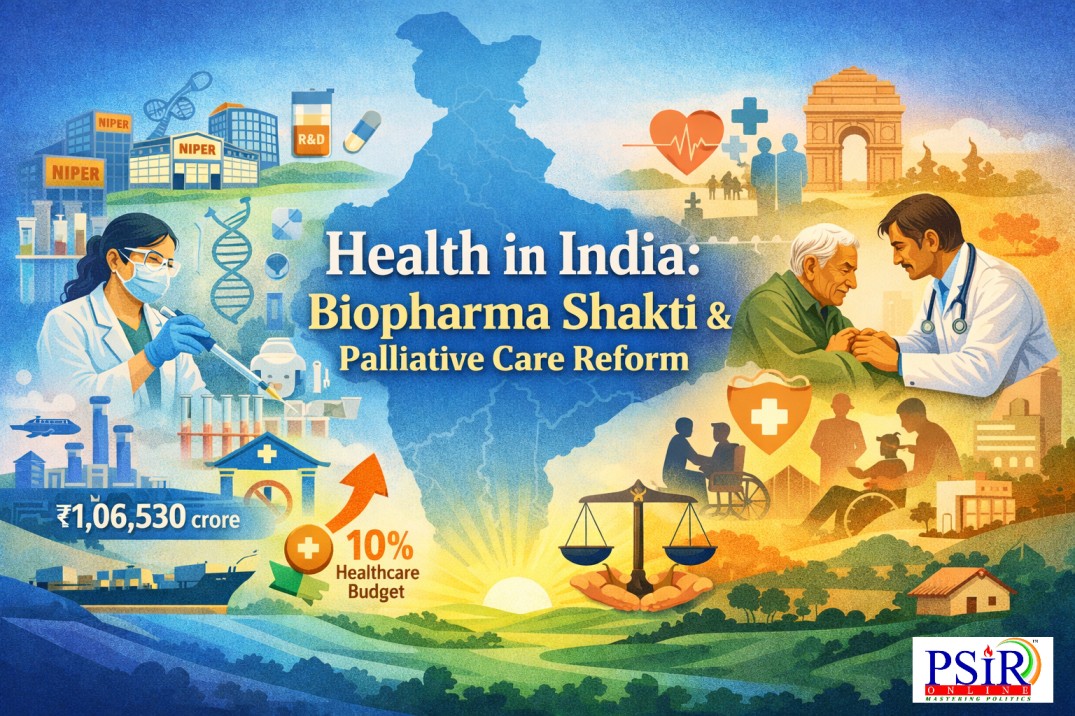
The Union Budget 2026–27 allocated ₹1,06,530 crore to the Ministry of Health and Family Welfare, marking a 10% hike over the previous year. This sustained rise in health expenditure reflects not only the government’s post‑pandemic commitment to healthcare but also the evolving orientation of Indian health policy: combining industrial innovation with humanistic ethics.
Two major February 2026 developments—launch of Biopharma Shakti and policy advocacy for palliative care inclusion in medical training—illustrate this dual approach. The former seeks to create a robust, globally competitive biopharma ecosystem; the latter aims to embed compassion and rights consciousness in frontline healthcare delivery.
BIOPHARMA SHAKTI: A STRATEGIC‑INDUSTRIAL HEALTH POLICY
The Biopharma Shakti initiative—formally Strategy for Healthcare Advancement through Knowledge, Technology and Innovation—represents India’s most ambitious industrial‑health project yet. The scheme, with a ₹10,000‑crore outlay over five years, strives to position India as a global hub for biologics, biosimilars, and advanced pharmaceutical R&D.
Key Features
· Expansion of NIPERs: The plan will set up three new NIPERs (National Institutes of Pharmaceutical Education and Research) and upgrade seven existing ones, creating a pan‑Indian network of excellence in biopharma education and innovation.
· Clinical‑trial ecosystem: Establishment of around 1,000 accredited clinical‑trial sites nationwide aims to enhance speed, transparency, and global collaboration in drug development.
· Regulatory reform: Strengthening of the Central Drugs Standard Control Organisation (CDSCO) through a dedicated scientific review cadre and alignment of approval norms with international standards will ensure a more agile and credible regulatory environment.
Broader Significance
This marks the evolution of a “health‑industrial policy”—a blend of industrial strategy and health security. By investing in biomedical innovation and supply‑chain autonomy, India seeks to reduce dependence on imported active pharmaceutical ingredients (APIs), enhance pandemic preparedness, and expand export competitiveness in high‑value health technology sectors.
The initiative also aligns with the Make in India and Atmanirbhar Bharat frameworks, anchoring health sovereignty within a global R&D vision—a model akin to South Korea’s pharmaceutical industrialisation or China’s biopharma missions.
PALLIATIVE CARE PUSH: AN ETHICAL AND RIGHTS‑BASED IMPERATIVE
In February 2026, health advocacy networks underscored a persistent gap in India’s healthcare system—less than 4% of Indians have access to effective palliative care, despite an estimated 7–10 million people needing pain relief and end‑of‑life support annually.
Recognising this humanitarian deficit, NGOs and professional bodies urged the National Medical Commission (NMC) to institutionalise palliative care in the MBBS curriculum, ensuring that future doctors receive structured training in pain management, empathy, and holistic treatment of chronic and terminal illnesses.
Policy and Ethical Dimensions
This movement situates palliative care not merely as a clinical service but as a human‑rights issue, consistent with WHO’s definition of health as complete physical, mental, and social well‑being. Integrating palliative education would help medical graduates approach health as a continuum—not just the absence of disease but the presence of dignity, comfort, and compassion.
Broader Implications
From a governance standpoint, this shift signals a growing normative orientation in India’s health policy, paralleling global frameworks such as the UN Sustainable Development Goal 3 (Good Health and Well‑Being). It also complements the government’s high‑tech biopharma thrust—acknowledging that health progress must be both technologically dynamic and ethically inclusive.
HOW BIOPHARMA SHAKTI & PALLIATIVE CARE REFORM ADVANCE HEALTH JUSTICE IN INDIA

Health justice in India is no longer merely a question of service delivery; it is increasingly a matter of structural equity, dignity, and democratic rights. While the Union Budget 2026–27 reinforced fiscal commitment to health with a 10% hike (₹1,06,530 crore), two complementary policy shifts—Biopharma Shakti and the push for palliative care in medical education—signal a deeper transformation: from a welfare-based to a justice-based health paradigm.
Health justice, as a normative framework, demands not only equal access to healthcare but also the dismantling of structural subordination—economic, geographic, and epistemic—that produces health inequities. These two initiatives address both the material and moral dimensions of that injustice.
A. Biopharma Shakti
· Affordability: Promotes domestic production of biologics/biosimilars, cutting costs of cancer, diabetes, and autoimmune drugs currently imported at high prices.
· Access Equity: Sets up 1,000+ clinical-trial sites across Tier-2/3 cities, decentralizing access to advanced therapies beyond metros.
· Supply Sovereignty: Reduces import dependence (currently >60% for biologics), ensuring uninterrupted supply during global crises.
· Regulatory Justice: Strengthens CDSCO with scientific cadres for faster, transparent, and ethical drug approvals, reducing delays in affordable medicine availability.
· Epistemic Inclusion: Generates India-specific clinical data, moving away from Western-centric drug trials.
B. Palliative Care Push
· Right to Dignity: Frames pain relief and end-of-life care as a fundamental right under Article 21 (right to die with dignity).
· Universal Competency: Inclusion in MBBS curriculum ensures every doctor can manage pain, not just specialists.
· Geographic Equity: Reduces concentration of palliative services (currently 90% in Kerala, Delhi, Goa) by training doctors for PHCs and rural centers.
· Social Inclusion: Addresses disproportionate suffering of women, elderly, and poor who lack access to chronic pain management.
· Humanistic Shift: Counters technocratic medical training by embedding empathy and holistic care in mainstream education.
C. Combined Impact (Holistic Health Justice)
· Dual Justice Model: Biopharma Shakti ensures material equity (affordable drugs); palliative care ensures moral inclusion (dignified care).
· Constitutional Alignment: Links Article 47 (state duty to improve health) with Article 21 (right to life with dignity).
· SDG Synergy: Advances SDG 3.8 (universal health coverage) and SDG 3.4 (well-being for NCDs) simultaneously.
· Federal Cooperation: Requires state participation in NIPER expansions, clinical-trial networks, and curriculum implementation for true pan-India impact.
Bottom line: Together, these steps transform India’s health system from curative welfare to justice-based healthcare—ensuring both affordable innovation and compassionate dignity for all citizens.
CHALLENGES IN IMPLEMENTING BIOPHARMA SHAKTI & PALLIATIVE CARE REFORM
A. Biopharma Shakti: Structural & Operational Hurdles
1. Regulatory Bottlenecks:
a. CDSCO Capacity Deficit: Currently understaffed (~600 drug inspectors for entire India); adding a "scientific review cadre" requires massive recruitment and training lag.
b. Ethical Oversight Gaps: History of unethical clinical trials (e.g., 2013 Supreme Court ban) raises risks if rapid approvals compromise patient safety monitoring.
2. Infrastructure & Skilling Mismatch:
a. NIPER Expansion Limits: Setting up 3 new NIPERs requires high-end lab infrastructure and faculty, which are scarce; risk of "degree mills" without quality research output.
b. Clinical Trial Sites: Accrediting 1,000 sites needs standardized SOPs; many district hospitals lack Good Clinical Practice (GCP) certification and data management systems.
3. Market & Investment Risks:
a. High R&D Costs: Biologics R&D is capital-intensive (₹500–800 crore per drug); private players may hesitate without strong IP protection and guaranteed public procurement.
b. Global Competition: India faces stiff competition from China (APIs) and South Korea (biosimilars) in global markets.
4. Federal Coordination:
a. Health is a State Subject; land acquisition for new NIPERs and trial sites requires state cooperation, which may vary due to fiscal constraints or political priorities.
B. Palliative Care Push: Cultural & Systemic Barriers
1. Curricular Resistance:
a. Overloaded MBBS Syllabus: Medical colleges already struggle with curriculum load; palliative care may be treated as a "token" subject without practical rotations or evaluation weightage.
b. Faculty Shortage: Only ~500 doctors in India have formal palliative care training; insufficient mentors to teach undergraduates nationwide.
2. Opioid Access Restrictions:
a. NDPS Act Hurdles: Strict narcotics laws make morphine access difficult; only 3 states (Kerala, Delhi, Goa) have simplified rules, leaving others with severe pain-relief shortages.
b. Phobia of Addiction: Doctors and families often avoid opioids due to stigma, leading to untreated suffering even when drugs are available.
3. Infrastructure & Funding Gaps:
a. No Dedicated Budget: Unlike NHM, there is no National Palliative Care Mission; funding relies on NGOs (e.g., Pallium India) and state whims.
b. Urban Bias: Existing centers are metro-centric; rural PHCs lack basic palliative kits and counseling spaces.
4. Socio-Cultural Stigma:
a. Death Taboo: Discussing prognosis and end-of-life care is culturally sensitive; families often demand "curative" treatment until the end, hindering palliative intervention.
b. Gender Disparity: Women caregivers bear the burden of home-based care without training or respite support.
C. Cross-Cutting Challenges
1. Data Deficit: Lack of disaggregated data on disease burden, drug access, and pain prevalence hampers evidence-based policy tuning.
2. Monitoring Mechanism: No independent body to track Biopharma Shakti’s affordability outcomes or palliative care’s curriculum implementation.
3. Public-Private Asymmetry: Private sector dominates biopharma R&D but ignores palliative care (low profitability); public sector lacks innovation capacity.
THE DARK SIDE OF PALLIATIVE CARE EXPANSION: RISK OF OPIOID DIVERSION & ADDICTION

1. The Core Challenge: Diversion of Medical Opioids
· From Pain Relief to Recreation: Morphine, fentanyl, and tramadol—essential for palliative care—are potent psychoactive substances. Widespread availability increases the risk of diversion (leakage from medical supply chains to the black market).
· Injection Culture Risk: As you noted, the shift from oral to injectable forms (preferred in palliative care for rapid relief) creates a dangerous parallel with illicit drug injection practices. Youngsters may exploit medical prescriptions or steal supplies to feed addiction, normalizing intravenous drug use (IDU).
· The "OTC" Loophole: While opioids are technically Schedule X drugs (prescription-only), weak enforcement in rural chemists often leads to de facto Over-The-Counter (OTC) sales, especially where doctors are scarce or complicit.
2. Specific Implementation Risks
· Prescription Fraud & "Doctor Shopping":
o Addicts may visit multiple clinics to collect prescriptions ("doctor shopping") or forge documents to obtain morphine tablets/injections.
o Risk: Without a centralized digital tracking system (like the US PDMP), tracking cumulative dosage per patient is impossible.
· Supply Chain Leakage:
o Hospital Pilferage: Unaccounted vials from hospital pharmacies can be siphoned off to local drug networks.
o Home Stockpiling: Families often hoard unused opioids after a patient’s death; these unreturned stocks become a ready source for community abuse.
· Public Health Fallout:
o Rise in IDU: Increased availability of injectable morphine could fuel needle-sharing cultures, spiking risks of HIV, Hepatitis B/C, and bacterial infections (abscesses, endocarditis).
o Overdose Deaths: Lack of public awareness on opioid tolerance could lead to accidental fatal overdoses, especially among first-time users.
3. Comparative Lesson: The US Opioid Epidemic
· The US crisis began with aggressive promotion of prescription opioids for chronic pain, leading to 500,000+ overdose deaths (1999–2019).
· Key Failure: Regulatory focus was on access without parallel investment in surveillance and addiction treatment infrastructure. India must avoid this trajectory.
MITIGATION STRATEGIES: BALANCING ACCESS WITH CONTROL
To prevent palliative care expansion from becoming a public health hazard, the following safeguards are non-negotiable:
1. Digital "Opioid Ledger" (Blockchain/DCT):
a. Implement a real-time, pan-India digital tracking system for every milligram of opioid manufactured, dispensed, and consumed.
b. Link prescriptions to Aadhaar to prevent duplicate sourcing and "doctor shopping."
2. Strict "Return & Destroy" Protocols:
a. Mandate that unused opioids from home care must be returned to designated health centers for safe destruction.
b. Make caregivers legally accountable for missing stocks.
3. Formulation Controls:
a. Prioritize abuse-deterrent formulations (ADFs) (e.g., morphine tablets that turn into gel when crushed/injected) for general distribution.
b. Restrict injectable opioids to hospital-administered use only, barring home injections except under strict nursing supervision.
4. Integrated De-addiction Linkage:
a. Every palliative care center must be linked with a De-addiction Clinic to screen for diversion signs and offer immediate support if abuse is detected.
b. Train doctors to spot "red flags" (e.g., lost prescriptions, requests for specific brands).
5. Community Surveillance:
a. Empower Pharmacy Councils and local police to audit chemist shops for unauthorized opioid sales.
b. Launch public awareness campaigns: "Pain Relief is a Right; Misuse is a Crime."
HOW BIOPHARMA SHAKTI & PALLIATIVE CARE PUSH ENHANCE INDIA’S HEALTH DIPLOMACY
A. Biopharma Shakti: From "Pharmacy of the World" to "Biopharma Superpower"
This initiative shifts India’s global role from a supplier of cheap generics to a partner in high-end biological innovation, strengthening strategic leverage.
1. Strategic Autonomy for the Global South:
a. Biosimilar Leadership: By mastering biologics (cancer, diabetes drugs), India can supply affordable versions to Africa, Latin America, and ASEAN, breaking the Western monopoly on patented drugs. This positions India as the guarantor of health security for the Global South.
b. Supply Chain Resilience: Post-pandemic, nations seek diversified supply chains. A robust domestic biopharma ecosystem makes India a trusted alternative to China for Active Pharmaceutical Ingredients (APIs) and finished biologics.
2. Regulatory Soft Power:
a. CDSCO as a Global Reference: Strengthening India’s regulatory body to global standards (USFDA/EMA aligned) allows Indian drug approvals to be recognized internationally. This reduces export barriers and gives India a voice in global health norm-setting (e.g., at WHO, ICH).
b. Clinical Trial Hub: Creating 1,000+ accredited trial sites attracts global R&D investment. India becomes a data generator for tropical diseases, giving it leverage in negotiating vaccine/drug pricing and IP waivers at the WTO.
3. "Vaccine Maitri 2.0":
a. Just as India supplied vaccines during COVID, Biopharma Shakti enables the export of next-gen biologics (e.g., monoclonal antibodies) during future health crises, deepening diplomatic ties with neighbors and Indo-Pacific partners.
B. Palliative Care Push: Exporting the "Model of Compassion"
While Biopharma builds hard power, the Palliative Care push builds normative soft power, showcasing India’s ethical leadership in human rights.
1. Setting the Global Standard for the Global South:
a. Most developing nations face the same dilemma: high pain burden + strict opioid laws. By successfully integrating palliative care into MBBS while preventing abuse (via digital tracking), India creates a replicable model for Asia and Africa.
b. This allows India to lead WHO technical working groups on pain management and opioid policy, shifting the narrative from "restriction" to "balanced access."
2. Medical Tourism & Training Hub:
a. A formalized palliative curriculum makes India a destination for medical professionals from SAARC and African nations seeking training in low-cost, high-dignity end-of-life care.
b. This fosters people-to-people connectivity and creates a network of foreign doctors trained in Indian ethical frameworks.
3. Human Rights Diplomacy:
a. Championing the Right to Die with Dignity aligns India with progressive global norms (SDG 3.8). It counters the narrative that India is only a "low-cost factory" and rebrands it as a thought leader in health ethics.
C. Synergistic Impact: A Dual-Track Diplomacy
|
Dimension |
Biopharma Shakti (Hard Power) |
Palliative Care Push (Soft Power) |
|
Diplomatic Asset |
Affordable Innovation: Supplying cheap biosimilars to the Global South. |
Ethical Model: Exporting a framework for dignified care. |
|
Strategic Leverage |
Reduces Global South’s dependence on Western Big Pharma. |
Positions India as a moral voice at WHO & UN Human Rights Council. |
|
Target Audience |
Governments, Health Ministries, Global Funders. |
Medical Associations, Civil Society, Human Rights Bodies. |
|
Brand Image |
"The Lab of the World" (Competence) |
"The Healer of the World" (Compassion) |
D. Challenges to Diplomatic Gains
· IP Conflicts: Aggressive biosimilar production may trigger trade disputes with the US/EU (e.g., at WTO TRIPS Council).
· Opioid Stigma: If India fails to control diversion/abuse domestically, its moral authority to lead global palliative policy will be undermined.
· Quality Perception: Global trust depends on maintaining zero-defect quality in biologics; any major safety scandal could damage the "Made in India" health brand.
PRACTISE QUESTIONS FOR GS – 2 MAINS
1. The Union Budget 2026–27 reflects a shift in India’s health policy from a welfare approach to a justice-based framework. Examine in the context of recent health initiatives.
2. Discuss the significance of the Biopharma Shakti initiative in strengthening India’s health security, industrial capacity, and global health diplomacy.
3. Palliative care in India remains severely underdeveloped despite rising healthcare needs. Analyze the challenges in its implementation and suggest measures for mainstreaming it within the public health system.
4. Expanding access to opioids for palliative care raises concerns about misuse and public health risks. Critically examine the balance between accessibility and regulation in this context.