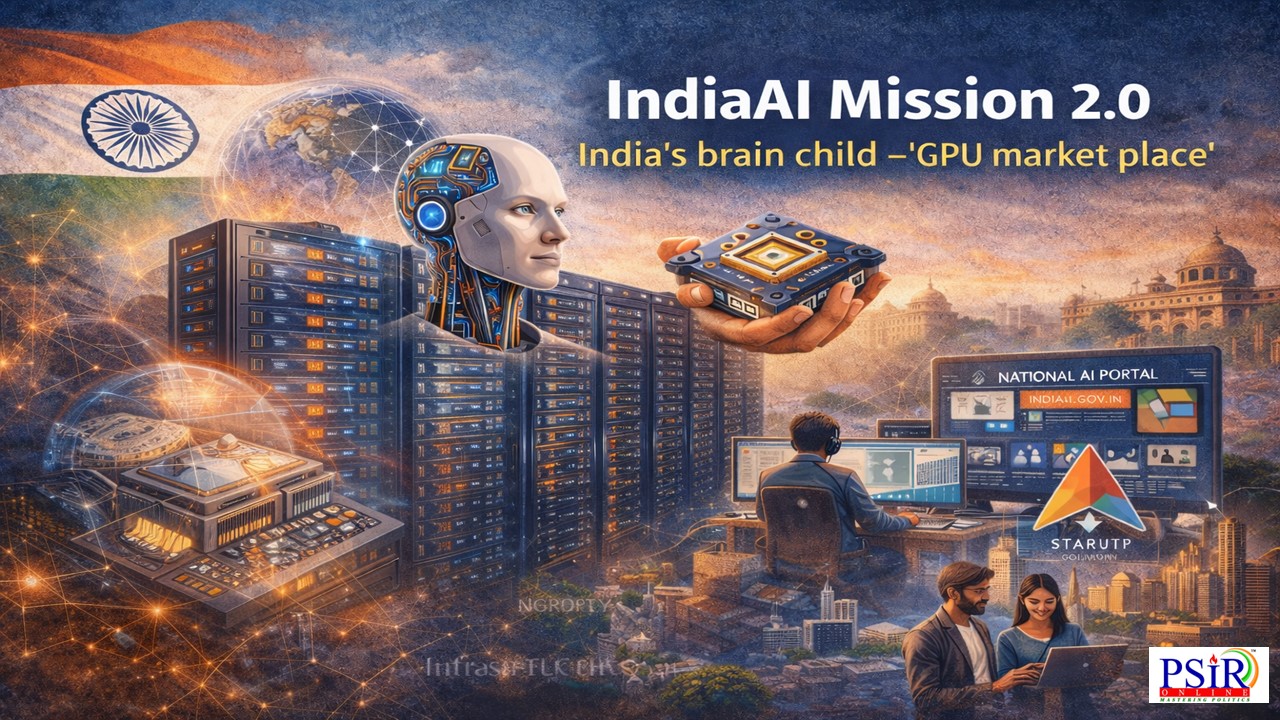
On February 17, 2026, at the IndiaAI Impact Summit, the Government of India announced a landmark expansion of its national computing infrastructure. Union Minister for Electronics and Information Technology, Ashwini Vaishnaw, unveiled plans to add 20,000 high-end GPUs (Graphics Processing Unit) to the national pool, catapulting India’s total public AI capacity to 58,000 GPUs.
This expansion signals a shift into "IndiaAI Mission 2.0," a phase where AI compute is no longer viewed as a luxury for Big Tech, but as critical public infrastructure essential for national sovereignty and citizen welfare.
WHAT IS INDIA- AI MISSION?
The IndiaAI Mission is a national-scale project designed to make India a global leader in Artificial Intelligence by treating AI resources like public utilities (like water or electricity).
Launched officially in March 2024 and significantly expanded in February 2026, it aims to "Democratize AI"—ensuring that a student or a startup in a city like Tirunelveli has the same computing power as a giant tech company.
THE 7 PILLARS OF INDIA-AI MISSION
The mission is organized into seven "Chakras" (pillars), each solving a different piece of the AI puzzle:
1. IndiaAI Compute Pillar: The "National GPU Pool." It provides subsidized access to over 58,000 GPUs (targeting 100,000) for just ₹65/hour.
2. IndiaAI Innovation Centre: Focuses on building indigenous Large Multimodal Models (LMMs) like BharatGen, tailored for Indian languages and culture.
3. IndiaAI Datasets Platform (AIKosh): A massive central library containing over 10,000+ high-quality Indian datasets (weather, health, agriculture) for training AI.
4. IndiaAI Application Development Initiative: Targets "AI for Social Good." It funds projects in 15+ priority sectors like healthcare, farming, and governance.
5. IndiaAI FutureSkills: A massive talent hunt and training program. It supports 500 PhDs, 5,000 PGs, and 8,000 UG students with fellowships.
6. IndiaAI Startup Financing: A dedicated fund to provide "Risk Capital" to deep-tech AI startups that might not get easy bank loans.
7. Safe & Trusted AI: Focuses on the ethics of AI—ensuring the technology doesn't have bias and is used safely for citizens.
THE NATIONAL AI PORTAL (INDIAAI.GOV.IN)
If the Mission is the "Engine," the National AI Portal is the "Dashboard." It is a joint initiative by MeitY (Ministry of Electronics and IT) and NASSCOM.
1. What is its purpose?
It acts as the One-Stop Shop for everything related to AI in India. Instead of searching 50 different websites, a creator goes here to find resources, funding, and tools.
2. Key Features of the Portal
· The Marketplace: A section where you can see which Indian AI companies are building what. It’s like a "Yellow Pages" for AI.
· Learning & Resources: It hosts the "AI for All" free course and regularly publishes research reports, case studies, and policy whitepapers.
· Startup Gateway: This is where you apply for the IndiaAI Innovation Challenges. If you win, you can get grants up to ₹2.50 crore for your AI project.
· The AIKosh Integration: This is arguably the most important part for you. Through the portal, you can access AIKosh, which gives you:
o GPU-enabled Jupyter Notebooks: You can literally start coding AI in your browser using government GPUs.
o Sectoral Data: Access to curated data from the Ministry of Mines, Agriculture, and Health to train your specific models.
3. How to use it as a Business Owner?
For example, if someone is running an educational training academy for public administration, first they have to
|
Summary: The National AI Portal is essentially the Digital Front Door to India's supercomputing power. It turns the complex world of AI into a usable service for any Indian citizen with a good idea. |
|
SIMPLE EXPLANATION FOR COMMON MAN
1. What exactly is a GPU?
Think of your computer's brain (the CPU) as a brilliant professor. He can solve any complex problem, but he does it one step at a time.
A GPU (Graphics Processing Unit) is more like a stadium full of 5,000 smart school kids. Individually, they aren't as smart as the professor, but they can all do simple math at the exact same time. · AI needs the kids: To "train" an AI (like teaching it to recognize a face or translate Tamil to Hindi), you have to do billions of tiny math problems at once. The professor (CPU) would take years; the stadium of kids (GPU) can do it in minutes.
2. How is your laptop GPU different?
Your laptop has a tiny "classroom" of maybe 500 or 1,000 of these "kids." It’s enough to play a video game or edit a photo. The IndiaAI National Pool uses "Industrial Grade" GPUs (like the Nvidia H100). One of these is about 100 to 500 times more powerful than the one in your laptop. When the government says "58,000 GPUs," they are talking about massive, specialized machines stored in giant warehouses called Data Centers.
3. What is this "National Pool"?
You don't go to a physical "computer center" in your neighborhood to use these. It works exactly like Cloud Storage (like Google Drive or iCloud).
· The Physical Setup: These 58,000 GPUs are sitting in high-tech server rooms (mostly in cities like Bengaluru, Mumbai, or Hyderabad). · The "Pool" Logic: Instead of one company owning them all, the government has created a "Digital Tap." · How it's "Added": The government buys these machines and hooks them up to a high-speed internet network. They then "pool" their power together so a researcher can "rent" 100 GPUs for an hour, use them, and then "return" them to the pool for the next person to use.
4. How does the public access it?
You won't use this to browse Facebook or write an email. This is for builders.
· The Portal: If you are a student, a startup founder, or a professor with a big idea (e.g., "I want to build an AI that predicts crop diseases in Tirunelveli"), you log into a National AI Portal. · The "Rent": You apply for "compute time." Because the government subsidizes it, you pay just ₹65/hour. Usually, a private company would charge you ₹300–₹500 for the same power. · Remote Control: You sit at your own modest laptop at home, connect to the National Pool via the internet, and "send" your heavy math problems to those massive GPUs. They do the work and send the answer back to your screen.
5. Why should a "Common Man" care?
Even if you never log into the portal, you benefit from the results:
1. Cheaper Services: When a local startup uses cheap government GPUs to build a medical app, they can offer that service to you for ₹50 instead of ₹500. 2. Language Power: This pool is being used to build Bhashini, which allows a farmer to speak into a phone in his local dialect and get an instant response from a government department. 3. Governance: State governments use this power to analyze satellite images of your town to plan better roads or fix water issues faster.
In short: The government is building a "Super-Powerful Brain" in the cloud and letting any Indian citizen rent a "piece" of that brain for the price of a cup of coffee.
|
IS NATIONAL AI PORTAL THE SAME AS GEMINI, CHATGPT OR GROK?
No, it’s exactly the opposite!
While Gemini, Grok, and ChatGPT use massive amounts of GPUs to run, they are like a private transport company. The IndiaAI Mission is like the Government Roadways (Bus) service.
Here is the clear difference:
1. The "Owner" vs. The "User"
· Gemini/ChatGPT: These are Private Kitchens. Google and OpenAI own the GPUs (the stoves). They cook the "food" (AI answers) and sell it to you. You can eat the food, but you aren't allowed to enter their kitchen or use their stoves to cook your own secret recipe.
· IndiaAI Mission: This is a Community Kitchen. The government is buying the "stoves" (GPUs) and saying to the public, "Here are the tools. You come in, bring your own ingredients (data), and cook whatever you want (build your own AI)."
2. How the "Access" differs
The way you interact with them is totally different:
|
Feature |
Gemini / ChatGPT / Grok |
IndiaAI Mission Pool |
|
What you get |
A finished product (a chatbot). |
Raw power (the GPU chip itself). |
|
Who uses it |
Anyone who can type a question. |
Developers, students, and startups. |
|
The Goal |
To answer your specific question. |
To help you build a new app for others. |
|
Control |
They decide what the AI can or cannot say. |
You have 100% control over the AI you build. |
3. Let's use an example you'll relate to
Imagine you want to start a specialized IAS Coaching AI for your academy.
Because you used the government's cheap "pool," your cost to build this is very low. You don't have to buy a ₹30 lakh server; you just "rent" the government's server for a few days via the internet.
4. So, can "Common People" use it?
Technically, yes, but practically, it’s for creators. If you just want to ask "What is the capital of France?", you go to Gemini. If you want to build the "Next Google" or a "Hindi-speaking AI for Farmers," you go to the IndiaAI National Pool.
Summary: Google and ChatGPT give you the fruit. The IndiaAI Mission gives you the land and the tractor so you can grow your own orchard.
WHICH COUNTRY STARTED THIS FIRST?
India is actually a global pioneer in this specific "Public GPU Pool" model.
· The US and China: They have the most GPUs, but they are almost entirely owned by private giants (Google, Microsoft, Alibaba). A common man or a small startup in those countries cannot easily access them at subsidized rates.
· The EU: They started "EuroHPC" (High-Performance Computing) earlier, but it was mostly for top-secret scientific research, not for the general public or small startups.
· India’s Unique Twist: India is arguably the first country to create a "GPU Marketplace" specifically designed to give cheap, sovereign compute power to the "common" innovator.
WHEN DID IT COME TO INDIA?
The timeline of the mission’s birth is quite recent:
· Initial Spark (2020): The national AI portal (indiaai.gov.in) was launched.
· The Foundation (March 2024): The Cabinet officially approved the IndiaAI Mission with the massive ₹10,372 crore funding.
· The "Big Bang" (February 2026): At the IndiaAI Impact Summit, the government announced the expansion to 58,000 GPUs, making it one of the largest public-access AI infrastructures in the world.
SUMMARY OF THE "INDIA MODEL"
In other countries, AI is a "Black Box" owned by billionaires. In India, it is being built as a "Public Square" where the government provides the land (GPUs) and the seeds (Data), and people like you—educators, entrepreneurs, and dreamers—grow the crop.
It’s a bold experiment to ensure India doesn't just "use" AI, but "owns" its own intelligence
PRACTICE QUESTIONS FOR GS 2 MAINS
1. Artificial Intelligence infrastructure is emerging as a new form of public good.”
Discuss in the context of the IndiaAI Mission 2.0.
2. Examine how the IndiaAI Mission seeks to democratize access to technology in India. What challenges could hinder its effectiveness?
3. Discuss the role of state-led digital infrastructure in promoting inclusive governance. Illustrate with reference to the IndiaAI Mission.
4. “Technological sovereignty is becoming central to national power in the 21st century.”
Analyse this statement with reference to India’s AI strategy.