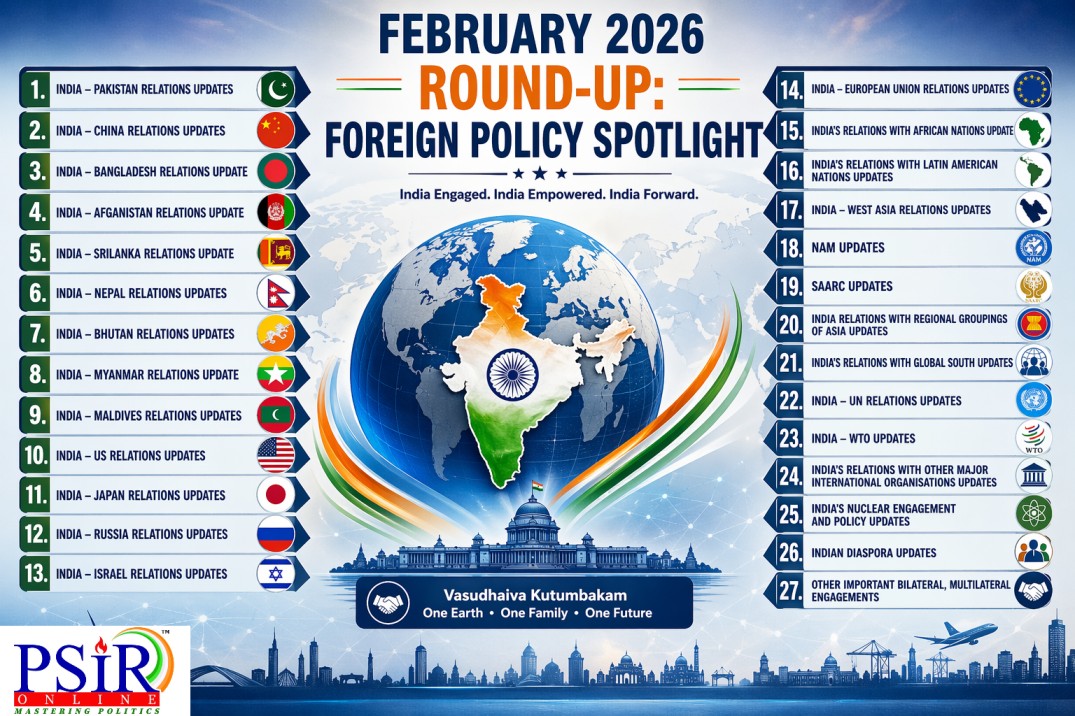
FEBRUARY 2026: ROUND-UP
FOREIGN POLICY
1. INDIA – PAKISTAN RELATIONS UPDATES
Overall Bilateral Ties
· Official relations remained largely frozen and frosty, with no major diplomatic breakthroughs or high-level talks. India continued to prioritize concerns over cross-border terrorism (linked to groups like Lashkar-e-Taiba and Jaish-e-Mohammed operating from Pakistan), following earlier incidents such as the 2025 Pahalgam attack and India's Operation Sindoor.
· Analysts noted a shift in India's approach toward strategic indifference rather than active rivalry. With China as the primary security focus, Pakistan was no longer the central driver of Indian foreign policy. The emphasis was on deterrence and disengagement instead of sustained negotiations.
Track 2 / Back-Channel Diplomacy
· Informal Track 2 talks (non-official dialogues involving experts, retired officials, and academics) took place between Indians and Pakistanis in Doha, Qatar, in February 2026. This was part of ongoing behind-the-scenes efforts to keep communication channels open despite the official freeze. Discussions reportedly focused on confidence-building measures and stabilizing ties amid tensions.
· These were described as one of multiple such engagements (up to four rounds reported in broader 2025–early 2026 period) in neutral venues like Doha, but they did not lead to any formal policy changes.
Diplomatic Statements and Incidents
· On February 1, 2026, India rejected Pakistan's allegations of Indian involvement in unrest in Balochistan, calling them baseless and a tactic to deflect from Pakistan's internal issues.
· On February 22, 2026, India strongly condemned Pakistan's airstrikes on Afghan territory (which caused civilian casualties), describing them as an attempt to "externalise its internal failures" and reaffirming support for Afghanistan's sovereignty.
Cricket Diplomacy (High-Profile Event)
· A notable bright spot was the India vs Pakistan match in the ICC Men's T20 World Cup 2026 on February 15, 2026, held in Colombo, Sri Lanka.
o There was brief tension when Pakistan's government initially considered boycotting the match, but it reversed the decision after talks with the ICC and other boards. The match went ahead as scheduled.
o India won convincingly by 61 runs, with strong performances helping them advance to the Super 8 stage. The game drew massive global viewership (record digital reach).
· This sporting encounter generated significant public and media attention but did not translate into broader political thawing.
Broader Context Entering/Leaving February
· No ceasefire violations or major border escalations were prominently reported in February itself. Tensions from 2025 (including the brief May 2025 skirmishes) had de-escalated, but underlying issues like terrorism, Kashmir, and nuclear risks persisted.
· U.S. assessments around this period continued to flag India-Pakistan ties as a potential flashpoint for crisis, though no immediate conflict was underway
2. INDIA – CHINA RELATIONS UPDATES
Diplomatic Engagement
On February 10, 2026, India and China held a new round of the China-India Strategic Dialogue in New Delhi. Indian Foreign Secretary Vikram Misri met Chinese Executive Vice Foreign Minister Ma Zhaoxu. The talks were described as friendly, candid, and in-depth, covering:
· International and regional issues
· Bilateral relations
· LAC stability and peace & tranquillity along the border (emphasized as essential for overall progress)
· Trade concerns and imbalances
· People-to-people contacts, visa facilitation, air services agreement, and resumption/expansion of Kailash Mansarovar Yatra
· Support for each other’s BRICS chairship (India in 2026, China in 2027)
· Multilateralism, Global South cooperation, and a multipolar world
China conveyed that it “understands and respects” India’s aspirations for a permanent seat in the UN Security Council (though without explicit endorsement).
· The dialogue was held on the sidelines of the BRICS Sherpa Meeting (Feb 8–10) and was seen as a continuation of the cautious thaw in ties that began after the 2024–2025 disengagement process along the LAC.
Border / LAC Situation
· No major new incidents or escalations were reported in February 2026. The focus remained on maintaining stability following the phased disengagement and patrolling agreements reached in late 2024/early 2025 (particularly in Depsang, Demchok, and other friction points in eastern Ladakh).
· Both sides continued to stress that peace and tranquillity along the LAC is a prerequisite for broader bilateral improvement.
· India kept a significant troop presence (tens of thousands) along the border as a precautionary measure amid lingering trust deficit, while China was reported to be rapidly developing infrastructure on its side (including “vibrant villages” equivalent).
Economic & Trade Aspects
· Bilateral trade continued to grow strongly. In 2025, it had already hit a record $155.6 billion (up over 12% YoY), with India’s exports to China also rising. The large trade deficit (crossing $100 billion mark around this period) remained a key Indian concern raised in the Strategic Dialogue.
· In February 2026, India began easing some restrictions on Chinese equipment imports (particularly for state-run power and coal projects) to address project delays and shortages — an early sign of pragmatic economic re-engagement after years of tighter scrutiny
3. INDIA – BANGLADESH RELATIONS UPDATE
Major Political Development: Bangladesh General Elections
· On February 12, 2026, Bangladesh held its general elections, marking the end of the 18-month interim government led by Muhammad Yunus.
· The Bangladesh Nationalist Party (BNP), led by Tarique Rahman, secured a landslide victory with a two-thirds majority (around 209–212 seats out of 299). This ended the transitional period following the 2024 student-led uprising that ousted Sheikh Hasina.
· Tarique Rahman was sworn in as Prime Minister on February 17, 2026. India quickly recognized the new elected government and signaled a desire for a reset in bilateral ties, which had deteriorated significantly under the interim regime.
High-Level Engagement and Reset Signals
· Indian Prime Minister Narendra Modi personally congratulated Tarique Rahman on the victory via a public statement and a direct phone call, emphasizing the “deep-rooted historical and cultural ties” and India’s commitment to peace, progress, and prosperity in both countries.
· India sent a high-level delegation to the swearing-in ceremony, including Lok Sabha Speaker Om Birla and Foreign Secretary Vikram Misri, who conveyed India’s wishes and reaffirmed the “deep and enduring friendship.”
· Both sides expressed willingness to rebuild relations based on mutual respect and mutual interests. The BNP indicated a softened stance toward India and a desire to move beyond single issues (such as the presence of Sheikh Hasina in India).
· Analysts described the post-election period as an opportunity for a cautious reset, moving away from the low point in ties seen during the Yunus interim government.
Practical Steps: Visa Normalization
· In late February, Bangladesh began restoring visa services for Indians.
o On February 24, 2026, Bangladesh’s missions in India (New Delhi, Agartala, and Siliguri) resumed issuing tourist visas, ending a suspension that had been in place since December 2025 due to protests.
· India indicated it would soon resume various categories of visas for Bangladeshis (medical, tourist, student) in phases. This was seen as an early confidence-building measure.
Broader Context and Lingering Issues
· Relations had been strained since Sheikh Hasina’s ouster in August 2024, with issues including border security, trade restrictions, and demands related to Hasina’s extradition. The new BNP-led government offered a window to address these pragmatically.
· Water sharing (especially the upcoming expiration of the 1996 Ganga Water Treaty in December 2026 and the long-pending Teesta dispute) remained on the agenda but saw no major breakthroughs in February itself—discussions gained momentum in subsequent months.
· Trade, connectivity projects, border management, and security cooperation were highlighted as priority areas for re-engagement.
· India expressed hope that the elected government would help stabilize ties, though experts noted challenges from identity politics and lingering anti-India sentiments in parts of Bangladesh.
4. INDIA – AFGANISTAN RELATIONS UPDATE
Continued Pragmatic Engagement (Without Formal Recognition)
India maintained its policy of cautious, functional engagement with the Taliban-led government in Afghanistan. This approach focused on humanitarian aid, trade facilitation, and limited diplomatic normalization, while avoiding any endorsement of the Taliban's governance model.
· Bilateral trade had already reached around USD 1 billion in 2025 (up from previous years but still below pre-2021 peaks), supported by initiatives like the proposed Air Freight Corridor (Kabul-Delhi and Kabul-Amritsar routes) and institutionalization of a Joint Chamber of Commerce. Discussions on expanding cooperation in health, pharmaceuticals, agriculture, and mining continued into early 2026.
Budget Announcement: Increased Development Aid
· On February 1, 2026, as part of the Union Budget 2026–27, India announced an increase in development assistance to Afghanistan from ₹100 crore (previous year) to ₹150 crore — a 50% hike. This was welcomed by Afghan officials as a positive signal for strengthening ties. The aid emphasized people-centric support, including humanitarian projects, infrastructure maintenance, and capacity building.
Diplomatic Milestones Building Momentum
· The appointment of the first Taliban-nominated Chargé d’Affaires (Noor Ahmad Noor / Mufti Noor Ahmad Noor) at the Afghan Embassy in New Delhi (which took effect in January 2026) continued to facilitate consular and bilateral interactions in February. This was viewed as a significant step in structured engagement.
· India’s earlier upgrade of its Technical Mission in Kabul to a full Embassy (announced in late 2025) allowed smoother operations on the ground.
India’s Response to Pakistan-Afghanistan Escalation
· In late February 2026, tensions between Pakistan and the Taliban escalated into Pakistani airstrikes on Afghan territory (starting around February 21–22 in provinces like Nangarhar, Paktika, and Khost), followed by retaliatory actions and broader border clashes. Pakistan described the strikes as targeting militant hideouts; Afghanistan reported civilian casualties.
· On February 22, 2026, India’s Ministry of External Affairs strongly condemned Pakistan’s airstrikes, highlighting civilian casualties (including women and children) and calling the action an attempt by Pakistan to “externalise its internal failures.” India explicitly reiterated its support for Afghanistan’s sovereignty, territorial integrity, and independence.
This stance aligned with India’s broader regional interests and was noted amid Pakistan’s accusations linking the Taliban’s actions to growing India-Afghanistan ties.
Overall Tone and Context
February 2026 reflected a steady consolidation of India’s pragmatic recalibration toward Taliban-administered Afghanistan. Key drivers included:
· Countering Chinese influence in the region
· Leveraging strains in Pakistan-Taliban relations
· Protecting India’s historical investments (over $3 billion in projects)
· Maintaining soft power through aid and trade
No major new high-level ministerial visits occurred in February itself (following senior Taliban visits in late 2025), but the budget increase and India’s supportive statement during the Pakistan-Afghanistan flare-up underscored continued momentum.
5. INDIA – SRILANKA RELATIONS UPDATE
High-Level Bilateral Meeting
On February 20, 2026, Indian Prime Minister Narendra Modi met Sri Lankan President Anura Kumara Dissanayake on the sidelines of the India AI Impact Summit 2026 in New Delhi. The leaders reviewed progress in bilateral ties since Dissanayake’s state visit to India in December 2024 and Modi’s visit to Sri Lanka in April 2025. Discussions focused on deepening cooperation in:
· Trade and economy
· Energy and connectivity
· Infrastructure
· Healthcare and skilling
· Culture
· Blue economy
· Digital collaboration (including responsible AI)
Both sides reaffirmed commitment to advancing sustainable development partnership and described the relationship as strong and multidimensional.
Cultural and Religious Ties
· February 4–10/11, 2026: India organized the international exposition of the sacred Devnimori Buddha Relics (from Vadodara, Gujarat) at the Gangaramaya Temple in Colombo. A high-level Indian delegation led by the Governor of Gujarat and Deputy Chief Minister of Gujarat accompanied the relics. This event highlighted deep civilizational and spiritual bonds between the two countries and drew large public participation for veneration.
· On February 4, 2026, the Sri Lankan High Commission in New Delhi hosted a grand reception to mark Sri Lanka’s 78th Independence Day. Indian Minister of State for External Affairs Kirti Vardhan Singh attended as chief guest, symbolizing strong support for the bilateral partnership.
Cricket Co-Hosting and People-to-People Connect
· India and Sri Lanka were co-hosts of the ICC Men’s T20 World Cup 2026 (February–March 2026). Several matches, including group stages and Super 8 games, were held in Colombo and Kandy (Sri Lanka), alongside venues in India. The tournament boosted visibility and goodwill between the two nations.
Other Practical Cooperation
· Late February saw capacity-building initiatives, including a training program for Sri Lankan officials on Public-Private Partnership (PPP) models (23–27 February) and a visit by Sri Lanka’s Minister of Environment.
Overall Context
February 2026 reflected a steady consolidation of warm and multifaceted ties. India continued to be viewed as Sri Lanka’s key partner in economic recovery, crisis response (following earlier support during Cyclone Ditwah), and regional stability. Analysts described Sri Lanka as one of India’s closest and most reliable friends in South Asia amid shifting regional dynamics.
The month featured a balanced mix of high-level political engagement, cultural diplomacy, and practical cooperation, with no major irritants reported.
6. INDIA – NEPAL RELATIONS UPDATES
Environmental Cooperation: Key MoU Signed
· On February 25, 2026, India and Nepal signed a significant Memorandum of Understanding (MoU) in New Delhi on cooperation in forests, wildlife, environment, biodiversity conservation, and climate change.
· The MoU was signed by India’s Union Minister for Environment, Forest and Climate Change Bhupender Yadav and Nepal’s Cabinet Minister for Forests and Environment Madhav Prasad Chaulagain (with Nepal’s Ambassador to India also participating).
· It focuses on transboundary ecosystem management, restoring wildlife corridors, joint conservation efforts, and climate action — marking a step toward “ecological diplomacy” between the two countries.
Economic & Technology Engagement
· February 27, 2026: The “Nepal-India Tech Forum 2026” was organized in New Delhi by the PHD Chamber of Commerce and Industry (PHDCCI), in association with the Embassy of Nepal in India and Genese Solution. The forum aimed at enhancing bilateral cooperation in digital innovation, infrastructure, investment, AI, cybersecurity, and cross-border digital corridors. Nepal’s Ambassador to India Dr. Shankar Prasad Sharma was the chief guest and keynote speaker, while India’s Additional Secretary (North) in the MEA, Munu Mahawar, highlighted the government’s commitment to tech-driven ties.
· February 20–22, 2026: The 2nd Indo-Nepal Trade Festival 2026 was held in New Delhi (PHD House, Hauz Khas), focusing on trade, tourism, culture, and business networking between the two countries.
People-to-People and Youth Exchanges
· A delegation of two officers and 16 NCC cadets from India visited Nepal from February 6–17, 2026, for an educational and cultural exchange program.
· On February 12, 2026, India handed over the third tranche of election-related assistance to Nepal, reinforcing support for Nepal’s democratic processes.
Think Tank and Policy Discussions
· On February 10, 2026, the Nepal Institute of International Cooperation and Engagement (NIICE) hosted the Nepal-India Think Tank Forum on Regional Resilience. Experts from both sides discussed policy coordination, defence cooperation, youth involvement, and security ties.
Broader Context
· Trade continued steadily (India remained Nepal’s largest trading partner). No major border disputes or political irritants (such as Kalapani or citizenship issues) dominated headlines in February.
· Relations were described as stable and focused on practical cooperation in environment, technology, trade, and connectivity. High-level political visits were limited in February, with momentum building toward later months (especially after political changes in Nepal in March 2026).
7. INDIA – BHUTAN RELATIONS UPDATES
High-Level Political Meeting
On February 18, 2026, Indian Prime Minister Narendra Modi met Bhutanese Prime Minister Tshering Tobgay in New Delhi on the sidelines of the India AI Impact Summit 2026. The two leaders reviewed progress in bilateral cooperation across key areas, including:
· Energy (hydropower)
· Connectivity
· Development partnership
· People-to-people ties
They also discussed harnessing Artificial Intelligence (AI) for inclusive and human-centric development and agreed to strengthen cooperation in AI and digital technologies. PM Tobgay thanked India for its support to Bhutan’s 13th Five Year Plan and the Gelephu Mindfulness City project. The meeting reaffirmed the deep trust, goodwill, and mutual respect anchoring the special India-Bhutan partnership.
Hydropower and Energy Cooperation
On February 3, 2026, Bhutan’s Minister of Energy and Natural Resources Lyonpo Gem Tshering held high-level talks in India with Union Power Minister Manohar Lal and Minister of State for Power Shripad Naik. Discussions focused on strengthening long-term energy partnership, including:
· Commercial optimisation of power from the 1,020 MW Punatsangchhu-II Hydroelectric Project
· Early commissioning of Punatsangchhu-I (1,200 MW)
· Roadmap for the Sankosh Hydropower Project
· Cross-border electricity transmission planning up to 2040
Both sides reiterated commitment to expanding clean energy cooperation. Later in the month (February 24–27, 2026), a senior Indian delegation led by Shri V.L. Kantha Rao, Secretary, Department of Water Resources, visited Bhutan. They reviewed progress on major hydropower projects and agreed to enhance cooperation on trans-boundary rivers, flood forecasting, hydro-meteorological data sharing, and climate resilience measures.
Overall Context
February 2026 was a productive month for India-Bhutan ties, characterized by steady, high-trust engagement. The relationship remained one of the most stable and warmest in India’s neighbourhood, built on strong civilizational links, mutual security interests, and extensive development cooperation (especially in hydropower, where India is Bhutan’s largest partner and beneficiary of clean power exports).
No major irritants or disputes were reported. The focus stayed on practical collaboration in energy, emerging technologies (AI), and sustainable development.
8. INDIA – MYANMAR RELATIONS UPDATE
Cautious Engagement Amid Myanmar’s Political Situation
· Myanmar held military-scripted general elections in early 2026 (phased voting). India maintained a calibrated and cautious stance, reiterating support for a free, fair, and inclusive democratic process involving all stakeholders. New Delhi avoided any move that could be seen as legitimizing the junta while continuing limited functional engagement to protect strategic interests under its Act East Policy and regional connectivity goals.
· Analysts described India’s approach as pragmatic: balancing security concerns (porous border, insurgency links, refugee flows) with the need to counter growing Chinese influence in Myanmar.
Kaladan Multi-Modal Transit Transport Project (KMMTTP)
· This flagship connectivity project remained a major focus. In February 2026, questions persisted about whether the project would meet its targeted 2027 operational deadline. Key challenges included ongoing civil conflict in Myanmar, with significant stretches of the road component (especially Paletwa to Zorinpui in Mizoram) under the control of the Arakan Army (AA). Earthwork and clearing had progressed on parts of the route, but full construction and black-topping faced disruptions. Sittwe Port and the Paletwa Inland Jetty continued under Indian operational oversight.
· Discussions highlighted the strategic importance of the project for linking Kolkata to India’s Northeast via sea-river-road routes, but instability in Rakhine and Chin states posed risks.
Trade and Economic Ties
· Bilateral trade continued to grow steadily. In February 2026, India exported approximately $67 million to Myanmar (up 38% from February 2025), while importing around $71 million. Pulses remained a major import from Myanmar, benefiting from India’s extended duty-free policy on urad and tur (valid till March 2026). Overall trade had reached about $2.1–2.15 billion in FY 2024-25, with India as Myanmar’s fourth-largest trading partner.
· Focus areas included border commerce, agriculture, pharmaceuticals, and capacity building.
Development Cooperation
· On February 9, 2026, an MoU was signed for the supply of laboratory equipment and apparatus to the Naypyitaw State Academy, as part of India’s ongoing development assistance to Myanmar.
Broader Context
· India continued to emphasize a “Myanmar-led, Myanmar-owned” peace process (a stance reiterated in subsequent months).
· Security dynamics along the 1,643 km shared border, including issues related to ethnic armed groups, refugee movements (especially in Mizoram-Chin areas), and the Free Movement Regime, remained sensitive but saw no major new escalations reported in February itself.
· No high-level ministerial visits were prominently reported in February; engagement stayed at working and technical levels.
9. INDIA – MALDIVES RELATIONS UPDATES
Financial Assistance and Development Support
· On February 3, 2026, India allocated USD 69 million in financial assistance to the Maldives for the year 2026. This maintained the consistent level of support provided in previous years, focusing on development projects, infrastructure, and capacity building.
· The High Commission of India in Malé released an updated Bilateral Relations brief on February 3, 2026, highlighting ongoing cooperation, including the implementation of the earlier INR 4,850 crore (USD 565 million) Line of Credit and various infrastructure initiatives.
Positive Public Statements on Ties
· On February 27, 2026, Maldives’ Minister of State for Tourism and Environment, Muaviyath Mohamed, publicly emphasized the strength of bilateral relations during a visit or interaction in India. He stated: “This relationship is not new, it has been strong for long time.” The minister highlighted the long-standing and close friendship between the two countries, reflecting a positive tone amid ongoing normalization.
Broader Context and Low-Profile Engagement
· Relations continued in a stable and pragmatic phase following the significant reset and multiple agreements signed in 2025 (including debt relief, Line of Credit in rupees, UPI/RuPay integration, fisheries, health, and progress toward a Free Trade Agreement).
· No major high-level political visits or new agreements were prominently reported in February 2026 itself. Engagement remained focused on implementation of existing commitments, economic cooperation, and people-to-people ties.
· India continued to be a key partner for the Maldives in areas such as essential commodity supplies, maritime security, tourism recovery support, and development projects. Trade and connectivity initiatives progressed steadily without reported friction.
10. INDIA – US RELATIONS UPDATES
Major Trade Breakthrough: Interim Agreement
The most significant development in February 2026 was the announcement of a framework for an Interim Agreement on reciprocal and mutually beneficial trade.
· Following a phone call between Prime Minister Narendra Modi and President Donald Trump on February 2, 2026, both sides reached this framework.
· The US agreed to reduce reciprocal tariffs on Indian goods from 25% (with some effective rates higher) to 18%, effective immediately in many cases. This also involved removing an additional 25% tariff previously linked to India's purchase of Russian crude oil.
· In exchange, India committed to lowering tariffs on several US industrial goods and agricultural products, while increasing purchases of US energy (petroleum), defence equipment, aircraft, technology, and other goods (with long-term commitments mentioned up to $500 billion in some sectors).
· The deal was framed as a step toward a broader Bilateral Trade Agreement (BTA), with emphasis on supply chain resilience, addressing non-tariff barriers, and opening India's market. Both leaders described it as a “historic milestone” for balanced and reciprocal trade.
· On February 6–7, 2026, a formal Joint Statement was issued outlining the interim framework. Implementation discussions followed, though some uncertainties arose later in the month due to a US Supreme Court ruling on tariff authority (February 20).
Defence and Technology Cooperation
· February 3–4, 2026: The 24th India-US Joint Technical Group (JTG) plenary meeting was hosted by DRDO in New Delhi. It focused on advancing defence science, technology, and collaborative innovation.
· India continued momentum in defence industrial cooperation, including progress on jet engine co-production (GE F414 for Tejas Mk2) and other platforms. US defence trade with India had already grown substantially (reaching around $20 billion in recent years).
· February 20, 2026: India joined the US-led Pax Silica initiative to build secure technology supply chains (semiconductors, advanced manufacturing, and critical technologies) among strategic partners. This move underscored alignment in countering non-market practices and enhancing resilience.
Space and Critical Minerals Cooperation
· February 9–13, 2026: A US-India Space Trade Mission took place in Bengaluru and New Delhi, with 23 executives from 14 American space companies visiting. A US-India Space Business Forum was held in Bengaluru (February 10–11), attended by over 200 participants. India’s Secretary, Department of Space, delivered the keynote.
· External Affairs Minister S. Jaishankar visited Washington D.C. (around early February) for the US-led Critical Minerals Ministerial, with additional bilateral meetings on economic and strategic issues.
Other Engagements
· US INDOPACOM Commander Admiral John Paparo visited India in February, engaging with military leadership in New Delhi, Bengaluru, and the Western Army Command.
· Discussions continued under the broader COMPACT (Catalyzing Opportunities for Military Partnership, Accelerated Commerce & Technology) framework launched in 2025.
· Energy aspects featured prominently, with India showing willingness to diversify crude oil sourcing (including potential increases in US and other non-Russian supplies) as part of the trade understanding.
Overall Context
February 2026 marked a pragmatic reset in India-US ties after periods of tariff tensions in 2025. The trade deal provided immediate economic relief and political momentum, while defence, technology, and supply chain initiatives reflected deepening strategic convergence (especially in the Indo-Pacific context).
Analysts noted the deal helped restore some trust, though challenges remained around full implementation, agricultural sensitivities, and broader geopolitical factors (e.g., Russia-Ukraine energy dynamics). The relationship was described as driven by mutual interests in trade balance, technology collaboration, and regional stability.
11. INDIA – JAPAN RELATIONS UPDATES
Artificial Intelligence (AI) Cooperation
· India hosted the India AI Impact Summit on 19–20 February 2026 in New Delhi. Japan actively participated and contributed to the summit’s success. This built directly on the Japan–India AI Cooperation Initiative announced during the 2025 Annual Summit. Discussions advanced the planned Japan–India AI Strategic Dialogue, focusing on joint research, innovation, governance, Large Language Models (LLMs), industry-academia exchanges, data centers, and startup support. Japan’s specially designated IP & AI Strategy Minister attended the event.
Subnational and Regional Cooperation
· On 13 February 2026, Maharashtra Chief Minister Devendra Fadnavis met Wakayama Governor Izumi Miyazaki to discuss investment, infrastructure, and business ties between the Indian state and Japanese prefecture.
· On 16 February 2026, the India–Japan Governors’ Network was formally launched at the Indian Embassy in Tokyo. This new framework aims to deepen structured cooperation at the subnational level, covering trade, talent flows, investment, and regional partnerships.
Economic Security and Financial Cooperation
· On 28 February 2026, India and Japan renewed the Bilateral Swap Arrangement (BSA), maintaining the maximum swap size at USD 75 billion. This move reinforced financial stability and economic cooperation between the two countries.
Broader Strategic and Economic Context
Momentum from the 18th India–Japan Foreign Ministers’ Strategic Dialogue (held in January 2026) carried into February. Key follow-ups included:
· Progress on the Japan–India Private Sector Dialogue on Economic Security (focusing on semiconductors, critical minerals, clean energy, ICT, and pharmaceuticals).
· Joint Working Group on critical minerals (rare earths and supply chain resilience).
Japan’s deep-sea retrieval of rare-earth mud in February 2026 opened new avenues for bilateral collaboration in critical mineral diversification and economic security.
Discussions continued on infrastructure projects, including the Smart Islands framework in the Andaman and Nicobar Islands, and overall Free and Open Indo-Pacific (FOIP) cooperation.
Overall Tone
February 2026 was a productive month focused on technology-driven and economic security cooperation, particularly in AI, semiconductors, and critical minerals. The relationship continued its steady upward trajectory under the Special Strategic and Global Partnership, with growing emphasis on resilient supply chains, innovation, and subnational ties. No major irritants were reported.
The partnership remained one of India’s strongest and most trust-based in the Indo-Pacific, with both sides preparing for the 75th anniversary of diplomatic relations in 2027.
12. INDIA – RUSSIA RELATIONS UPDATES
Energy Trade and Oil Imports
February 2026 marked a transitional phase in energy cooperation amid external pressures:
· Indian refiners continued importing Russian crude, but volumes declined compared to previous peaks. Imports averaged around 1.06–1.16 million barrels per day (bpd), down from higher levels in 2025. Russia remained one of India's top crude suppliers (often the largest or second-largest, with Iraq close behind in some data).
· This moderation followed U.S. tariff pressures and India's interim trade framework with the US (announced in early February). Refiners diversified sources, increasing purchases from the Middle East, Africa, and elsewhere.
· Despite the dip, the structural shift in bilateral energy ties (forged after 2022) remained intact. India continued to view discounted Russian oil as important for energy security, with rupee-ruble or alternative payment mechanisms (including increased use of yuan in some transactions) still in play.
Defence Cooperation
· Progress continued on existing contracts, including the delivery schedule for the S-400 air defence systems. In February, the Defence Acquisition Council (DAC) cleared proposals related to additional Russian-origin systems and munitions to replenish stocks (some decisions linked to earlier operational needs).
· The Reciprocal Exchange of Logistics Agreement (RELOS), signed earlier, saw ongoing implementation discussions, though full operationalization gained more visibility in subsequent months.
· No major new defence deals were announced in February, but technical-level military-to-military engagement remained steady.
Diplomatic and Political Engagement
· The relationship stayed rooted in the Special and Privileged Strategic Partnership. Russian Ambassador to India Denis Alipov gave an interview on February 12–13, 2026, highlighting the multifaceted and resilient nature of ties despite global geopolitical shifts.
· No high-level bilateral summit or ministerial visit occurred in February. Momentum from the 23rd Annual Summit (December 2025, where President Putin visited New Delhi) carried forward, with both sides preparing for future engagements, including the planned 24th Summit in Russia later in 2026.
· Discussions on diversifying cooperation (beyond defence and energy) into areas like trade, technology, and connectivity continued at working levels, though concrete outcomes were limited in this month.
Broader Context
· India balanced its long-standing partnership with Russia while advancing ties with the US and other Quad partners. Analysts described February as a period of pragmatic management rather than expansion, influenced by U.S. sanctions/tariff dynamics and India's efforts to secure an interim trade deal with Washington.
· Trade overall remained significant (energy-dominant), but non-oil sectors saw slower progress toward a preferential trade agreement.
· No major irritants or disruptions were reported on the bilateral front.
13. INDIA – ISRAEL RELATIONS UPDATES
Historic State Visit by Prime Minister Narendra Modi
The standout event was Prime Minister Narendra Modi’s two-day state visit to Israel on 25–26 February 2026 (his second visit to the country). He was invited by Israeli Prime Minister Benjamin Netanyahu.
· February 25: Modi arrived in Tel Aviv, received with full ceremonial honours. He became the first Indian Prime Minister to address the Israeli Parliament (Knesset), where he highlighted the deep civilizational and strategic bonds between the two nations.
· February 26: In Jerusalem, Modi held extensive bilateral talks with Netanyahu, followed by a joint press conference.
Elevation to “Special Strategic Partnership”
During the visit, India and Israel formally elevated their bilateral ties to a “Special Strategic Partnership for Peace, Innovation and Prosperity”. This upgrade reflected growing trust and a shift toward deeper integration beyond traditional buyer-seller defence ties.
Major Agreements and Outcomes
The two sides concluded 16–17 bilateral agreements/MoUs and announced around 27 major outcomes. Key areas included:
· Defence Cooperation: Enhanced focus on joint development, co-production, and technology transfer. Discussions advanced on systems such as Iron Dome, Iron Beam, David’s Sling, Arrow missiles, drones (Hermes, Heron), and other precision munitions. Potential defence deals worth $8–10 billion were under negotiation.
· Trade and Economy: Strong commitment to conclude a Free Trade Agreement (FTA) at the earliest. The first round of FTA negotiations was held in New Delhi (23–26 February 2026), coinciding with the visit. Emphasis on increasing bilateral trade and investment.
· Technology and Innovation: Deeper collaboration in Artificial Intelligence (AI), cybersecurity, space exploration, and critical minerals (using advanced geophysical and AI technologies).
· Other Sectors: Agreements/MoUs on agriculture, education, investment, economic cooperation, labour mobility (Israel agreed to allow another 50,000 Indian workers over the next five years), and digital payments (UPI extension to Israel).
· Regional Connectivity: Continued support for initiatives like IMEC (India-Middle East-Europe Economic Corridor) and I2U2.
Both leaders described the outcomes as giving “new direction and greater momentum” to the partnership.
Overall Context
February 2026 represented a significant qualitative leap in India-Israel relations — moving from a strong defence and technology partnership to a more comprehensive “special strategic” framework. The visit occurred amid regional tensions in West Asia, yet both sides focused on forward-looking cooperation in innovation, security, and prosperity.
No major irritants were reported, and the relationship continued to enjoy strong bipartisan support in both countries.
14. INDIA – EUROPEAN UNION RELATIONS UPDATES
Follow-up to the Historic FTA Announcement
The major highlight of February 2026 was the implementation and consultation phase following the conclusion of negotiations for the India-EU Free Trade Agreement (FTA) at the 16th EU-India Summit on 27 January 2026. The deal was widely described as the “mother of all deals” by European Commission President Ursula von der Leyen.
· February 18, 2026: The European Commission held a Civil Society Dialogue on trade relations with India (via Webex and in Brussels). The meeting focused on briefing and discussing with civil society stakeholders the key features of the newly announced EU-India FTA. This was an important step toward transparency and building domestic support in the EU for ratification and implementation.
· Early February saw continued analysis and commentary on the FTA’s implications, including its potential to double EU goods exports to India by 2032, save around €4 billion annually in duties, and provide India with zero-duty or concessional access on over 93–96% of its exports to the EU market. The agreement covers goods, services, investment, and rules of origin, and is expected to significantly boost bilateral trade (already over €180 billion in goods and services).
India-EU Forum (Track 1.5)
· February 6–7, 2026: The India-EU Forum took place as a premier Track 1.5 platform. It brought together senior policymakers, industry leaders, experts, and think tanks from all 27 EU Member States and India. The forum aimed to build trust and translate the summit outcomes (including the FTA and the new Joint India-European Union Comprehensive Strategic Agenda towards 2030) into concrete initiatives in trade, strategic cooperation, technology, and security.
AI and Technology Cooperation
· The India AI Impact Summit (19–20 February 2026) in New Delhi received explicit welcome and support in the January summit joint statement. In February, both sides advanced discussions on responsible AI, digital trade, and technology collaboration as part of the broader strategic partnership.
Broader Strategic Context
Relations were in a highly positive and forward-looking phase following the January summit. Key areas of focus in February included:
· Preparations for the next Trade and Technology Council (TTC) ministerial meeting (planned for Brussels later in 2026).
· Deepening cooperation in security and defence, education/skills dialogue, clean energy, and critical minerals.
· Addressing implementation challenges of the FTA, such as regulatory alignment, market access sensitivities (e.g., automobiles, agriculture, wines/spirits), and rules of origin.
No major new agreements were signed in February itself, as the momentum remained centered on consolidating the landmark FTA and the Comprehensive Strategic Agenda endorsed in January.
15. INDIA’S RELATIONS WITH AFRICAN NATIONS UPDATE
Major Think Tank Conference on Strategic Partnership
On 23 February 2026, a high-profile conference titled “India–Africa Partnership in a Changing Global Order” was held in New Delhi, organized by the Chintan Research Foundation (CRF) in collaboration with the Usanas Foundation. The event brought together ambassadors, policymakers, scholars, diplomats, and industry experts from India and several African countries. Key themes discussed included:
· Deepening trade and technology cooperation
· Climate action, critical minerals, and sustainable development
· Advancing South-South cooperation and a more equitable multipolar global order
· Aligning with the upcoming India-Africa Forum Summit (IAFS) 2026
Speakers described India-Africa ties as entering a new strategic phase, moving beyond traditional aid-based models toward multi-sectoral and system-level partnerships. Bilateral trade had already crossed $100 billion (with a target of $200 billion by 2030), and emphasis was placed on agriculture innovation, capacity building, renewable energy, and infrastructure.
Bilateral and Sectoral Engagements
· India-Kenya: The 4th Joint Defence Cooperation Committee (JDCC) meeting concluded in early February, with both sides proposing a five-year defence roadmap. Discussions covered multiple domains of defence collaboration. Additionally, India and Kenya signed an Implementation Framework Agreement for a DigiLocker pilot project in Kenya on the sidelines of the India AI Impact Summit.
· India-Mauritius: On 20 February 2026, Prime Minister Narendra Modi met Mauritius Prime Minister Navinchandra Ramgoolam on the sidelines of the India AI Impact Summit in New Delhi. They reviewed the overall strategic partnership.
· Sustainable Cooling & Energy: A South-South Learning Exchange on sustainable cooling (involving African delegates from countries like Kenya and Ghana) continued to yield follow-up outcomes in February, focusing on energy efficiency and climate-friendly technologies.
· Broader diplomatic efforts included Foreign Office Consultations with countries like Kenya and Egypt earlier in the month, and continued focus on development cooperation.
Broader Strategic Context
· February 2026 saw active preparations and discourse around the 4th India-Africa Forum Summit (IAFS 2026), expected later in the year (around May-end). Analysts highlighted a shift from project-based aid to co-development architectures — including industrial ecosystems, digital public infrastructure, human capital development, green transitions, and alignment between Africa’s Agenda 2063 and India’s Viksit Bharat 2047 vision.
· India continued its diplomatic push in Africa ahead of its BRICS chairship in 2026, with emphasis on expanding economic footprints, Lines of Credit, critical minerals access, and countering non-transparent debt models from other players.
· No major new Lines of Credit or large infrastructure announcements were reported in February itself, but momentum was building through Track 1.5/Track 2 engagements and sector-specific pilots (AI, digital, defence, and energy).
16. INDIA’S RELATIONS WITH LATIN AMERICAN NATIONS UPDATES
High-Level State Visit: India-Brazil Strategic Partnership
The most prominent development was the state visit of Brazilian President Luiz Inácio Lula da Silva to India from February 18–22, 2026 (with core bilateral engagements on 19–21 February). This was accompanied by a large delegation of 11 Cabinet ministers and over 300 business leaders — one of the largest Brazilian business missions to India.
Key Outcomes:
· Signing of a major MoU on cooperation in Rare Earth Minerals and Critical Minerals (including iron ore for steel and other strategic minerals). Both leaders described it as a “pioneering agreement” to build resilient supply chains and reduce dependence on single sources. Lula called it central to cooperation in renewable energy and critical minerals.
· Commitment to expand bilateral trade (which reached USD 15.21 billion in 2025, up 25% YoY) beyond USD 20 billion in the next five years. Brazil remains India’s largest trading partner in Latin America.
· Discussions on expanding the India-MERCOSUR Trade Agreement.
· Progress in defence, aerospace (including potential Adani-Embraer collaboration), renewable energy, and technology.
· President Lula participated in the India AI Impact Summit 2026 (held alongside the visit), adding momentum to cooperation in AI and digital technologies.
A joint press statement and policy dialogue on “India–Brazil Relations in the Global South” (organized by RIS) highlighted shared goals in multilateral forums, South-South cooperation, BRICS, IBSA, G20, and global governance reform.
This visit was seen as a significant boost to the India-Brazil Strategic Partnership (established in 2006) and aligned with India’s BRICS Chairship in 2026.
Other Engagements Across Latin America
· India-Cuba Digital Cooperation: On 21 February 2026, India and Cuba launched the India–Cuba IT Council in Bengaluru. This initiative aimed to strengthen bilateral ties in information technology, digital innovation, and capacity building.
· Track 1.5 / Business Initiatives:
o The launch of the “India–Latin America: The Unexplored Partnership” series (early February 2026) involved ambassadors from multiple Latin American countries (Uruguay, Ecuador, Cuba, Chile, Guatemala, Paraguay, and Argentina). It focused on economic diplomacy, innovation, natural resource synergy, and sustainable partnerships.
· Broader discussions continued on critical minerals partnerships with countries like Chile and Peru (building on ongoing FTA negotiations with dedicated minerals chapters), though no major new breakthroughs were announced in February itself.
Broader Context
February 2026 reflected India’s push for deeper economic and strategic engagement with Latin America, driven by:
· Diversification of supply chains (especially critical minerals and rare earths)
· Expansion of trade and investment
· Alignment on Global South issues under India’s BRICS Chairship
· Technology and innovation cooperation (AI, digital public goods)
Relations remained pragmatic and multi-dimensional, with Brazil as the clear anchor in the region. No major irritants or setbacks were reported.
17. INDIA – WEST ASIA RELATIONS UPDATES
GCC and Broader Arab Engagement
· On 5 February 2026, India and the Gulf Cooperation Council (GCC) formally launched negotiations for a Free Trade Agreement (FTA) by signing the Terms of Reference in New Delhi. This aimed to boost trade (already substantial) and economic cooperation with key partners like UAE, Saudi Arabia, and others.
· India continued high-level outreach, including NSA Ajit Doval’s visit to Saudi Arabia (early February) and MoS Defence’s participation in the World Defence Show in Riyadh.
· Preparations and discussions around IMEC continued, though the project faced challenges due to regional volatility.
Escalation in West Asia (Late February)
· On 28 February 2026, the region saw a major escalation when the United States and Israel launched coordinated airstrikes on Iranian targets. This marked the beginning of what became known as the 2026 Iran War, triggering Iranian retaliatory missile and drone attacks on Israel and several Gulf countries (including targets in UAE, Saudi Arabia, Bahrain, Qatar, and Kuwait).
· India responded swiftly with a statement expressing deep concern, urging all sides to exercise restraint, avoid escalation, protect civilians, and respect sovereignty and territorial integrity. India emphasized freedom of navigation and the safety of its large diaspora (nearly 9–10 million Indians, mostly in the Gulf).
· Prime Minister Modi and the MEA engaged in intensive diplomacy, with calls to leaders across the region (Gulf states, Israel, and later Iran) to de-escalate and ensure safety of Indian nationals and energy supply chains.
· Early signs of impact included concerns over potential disruptions to oil imports (India relies heavily on Gulf and regional energy) and maritime routes like the Strait of Hormuz. India activated contingency plans for its diaspora.
Overall Context
February 2026 highlighted India’s multi-alignment strategy in West Asia:
· Deepening strategic and defence ties with Israel
· Expanding economic and trade partnerships with Gulf countries (UAE, Saudi Arabia, etc.)
· Maintaining functional engagement with Iran (e.g., Chabahar Port) while navigating tensions
18. NAM UPDATES
Diplomatic and Coordination Activities
· February 5, 2026: A NAM Ambassadorial meeting was held at the Palais des Nations in Geneva, Switzerland. This was a routine coordination meeting among NAM member states' ambassadors, focusing on common positions ahead of UN-related discussions.
· February 3–4, 2026: The Non-Aligned Movement issued a special communiqué calling for an immediate end to the U.S. blockade against Cuba and condemning new U.S. sanctions. The statement reaffirmed NAM’s long-standing solidarity with Cuba and opposition to unilateral coercive measures.
NAM Parliamentary Network (NAM PN)
· On February 11, 2026, Ms. Sahiba Gafarova (Speaker of the Milli Majlis of Azerbaijan and Chairperson of the NAM Parliamentary Network) met with Mr. Mohammed Ahmed Al-Yamahi, President of the Arab Parliament, during his visit to Azerbaijan. The meeting discussed parliamentary cooperation within the NAM framework and broader South-South collaboration.
No major full-scale ministerial or summit-level meeting of the core NAM (under Uganda’s chairmanship since the 19th Summit in 2024) took place in February 2026. The movement continued its work through ambassadorial-level coordination, issue-specific statements, and parliamentary networking.
Broader Context
· NAM remained active in advocating for Global South priorities, multipolarity, reform of global institutions (especially the UN), and opposition to unilateral sanctions.
· Discussions around South-South cooperation and decolonization principles continued in various forums. India, as a founding member, continued to position itself as a leading voice of the Global South (often linking NAM principles with its BRICS chairship in 2026 and initiatives like the Voice of Global South).
· Preparations were underway for future events, including the 5th Conference of the NAM Parliamentary Network scheduled for April 15, 2026, in Istanbul, Türkiye.
19. SAARC UPDATES
62nd Session of the SAARC Programming Committee
The most concrete activity in February 2026 was the 62nd Session of the SAARC Programming Committee, held on 11–12 February 2026 at the SAARC Secretariat in Kathmandu, Nepal.
· The meeting was chaired by Nepal and attended by National Focal Points and delegates from all member states: Bangladesh, Bhutan, India, Maldives, Nepal, Pakistan, and Sri Lanka.
· Key outcomes included:
o Approval of the SAARC Secretariat’s budget and programmes for 2026.
o Finalization of the SAARC Calendar of Activities for the year.
o Discussions on administrative and programmatic matters to keep the organization functional.
· Nepal’s Foreign Secretary Amrit Bahadur Rai (Chairperson of the SAARC Standing Committee) emphasized the importance of regional cooperation for bridging national priorities with international processes and ensuring mutual benefits and stability in South Asia.
· SAARC Secretary-General Md. Golam Sarwar (from Bangladesh) urged member states to move from “aspirations to concrete action,” describing the Programming Committee as the “lifeline” of SAARC amid the long hiatus in higher-level summits.
This technical-level meeting demonstrated that routine institutional work continues despite the political stagnation at the summit level (last SAARC Summit was held in 2014).
Calls for Revitalization of SAARC
· Bangladesh was particularly vocal in February 2026 about reviving SAARC:
o On 23 February 2026, Bangladesh’s State Minister for Foreign Affairs Shama Obaed Islam reaffirmed Dhaka’s strong support for revitalizing the SAARC process during a meeting with Secretary-General Md. Golam Sarwar.
o On 24 February 2026, Foreign Minister Dr. Khalilur Rahman held discussions with the SAARC Secretary-General, seeking ways to enhance Bangladesh’s role and revitalize the organization.
· Pakistan’s spokesperson also commented positively on working with Bangladesh to revive the SAARC process.
· Analysts and commentators continued to debate the future of SAARC, with some suggesting the need for a “SAARC 2.0” focused more on flexible economic and connectivity cooperation, while acknowledging that India-Pakistan tensions remain the primary obstacle to holding a full summit.
Broader Context
· No high-level meetings (such as Foreign Ministers’ or Heads of Government Summit) took place in February 2026.
· SAARC continued to function at the secretariat and technical levels, but remained largely paralyzed at the political level due to longstanding bilateral issues (primarily between India and Pakistan).
· The organization marked its 40th anniversary in December 2025, and discussions around renewal gained some momentum following political changes in Bangladesh (BNP-led government after the February 2026 elections).
20. INDIA RELATIONS WITH REGIONAL GROUPINGS OF ASIA UPDATES
1. BIMSTEC (Bay of Bengal Initiative for Multi-Sectoral Technical and Economic Cooperation)
February 2026 saw steady, practical engagement with BIMSTEC, reflecting India’s continued push to strengthen this platform as an alternative to SAARC for Bay of Bengal cooperation.
Capacity-building and sectoral activities:
· A virtual Training Workshop on Laboratory Biosafety and Biosecurity for managing transboundary animal diseases and zoonotic pathogens was organized by India’s ICAR-National Institute of High Security Animal Disease (17–21 February 2026).
· A Workshop on Best Practices in Maintenance of Power Transmission Systems was held in Bhopal (around mid-February).
· The Fourth Meeting of the BIMSTEC Expert Group on Cultural Cooperation (BEGCC) took place on 27 February 2026.
High-level participation:
§ BIMSTEC Secretary-General Indra Mani Pandey addressed the Silver Jubilee edition of the World Sustainable Development Summit (WSDS) in New Delhi (25–27 February), highlighting BIMSTEC as a model of regional multilateralism and stressing South-South cooperation in clean energy.
§ The Secretary-General also participated in the Sixth Edition of the India-Japan Intellectual Conclave “Kizuna” in Shillong (26–27 February), discussing Japan’s Free and Open Indo-Pacific (FOIP) and potential collaborations in the Bay of Bengal.
These events underscored India’s leadership in sectors such as security, disaster management, energy, and agriculture within BIMSTEC.
2. ASEAN (Association of Southeast Asian Nations)
Relations remained strong and forward-looking, with focus on implementing the ASEAN-India Comprehensive Strategic Partnership (CSP) and the Plan of Action (2026–2030).
· On 13 February 2026, the 26th Meeting of the ASEAN-India Joint Cooperation Committee (AIJCC) was held at the ASEAN Secretariat in Jakarta. Both sides reviewed progress, reaffirmed commitment to the CSP, and emphasized sustained cooperation in connectivity, digital public infrastructure, trade, and people-to-people ties. India reiterated that ASEAN is the cornerstone of its Act East Policy and expressed support for ASEAN centrality.
· Preparations advanced for designating 2026 as the ASEAN-India Year of Maritime Cooperation (announced earlier but actively promoted in February), focusing on maritime security, blue economy, and humanitarian assistance.
· A session on “The India–ASEAN Convergence in a Changing Indo-Pacific” was held during the Rising Bharat Summit (late February), highlighting growing strategic alignment in connectivity, trade, and regional stability.
No major new agreements were signed in February, but implementation of existing frameworks gained momentum.
3. IORA (Indian Ocean Rim Association)
India held the chairmanship of IORA (from late 2025), and February 2026 featured active working-level engagement.
· On 23 February 2026, the IORA Secretary-General and Directors hosted officials from the United States Department of State for a courtesy visit at the IORA Secretariat in Mauritius. Discussions focused on regional cooperation and sustainable development in the Indian Ocean.
· Webinars and technical events continued, including topics on resilient housing and lessons from earthquakes/disaster management (around mid-to-late February).
· Broader discussions on reinvigorating IORA (including potential future leaders’ summit) were underway, though no high-level summit occurred in February.
4. SCO (Shanghai Cooperation Organisation)
No major SCO-specific events or ministerial meetings involving India were reported in February 2026. Activity remained at the working level, with preparations continuing for future engagements under the rotating chairmanship (Kyrgyzstan held the chair in 2025–2026). India’s focus stayed on security, counter-terrorism, and connectivity within the SCO framework.
Summary
February 2026 was a month of practical and technical-level engagement rather than headline summits for India’s ties with Asian regional groupings outside SAARC:
· BIMSTEC stood out with multiple capacity-building workshops and high-visibility participation by its Secretary-General in Indian events.
· ASEAN saw steady implementation of the Comprehensive Strategic Partnership through the Joint Cooperation Committee meeting.
· IORA maintained momentum under India’s chairmanship with diplomatic outreach and technical webinars.
These activities aligned with India’s broader priorities: Act East Policy, maritime cooperation, sustainable development, and connectivity in the Indo-Pacific and Indian Ocean Region. No major breakthroughs or disruptions were reported, but the month helped build groundwork for higher-level engagements later in 2026.
21. INDIA’S RELATIONS WITH GLOBAL SOUTH UPDATES
India Positions Itself as a Leading Voice of the Global South
Prime Minister Narendra Modi repeatedly highlighted India’s evolving role as a confident and credible voice of the Global South. In a message read out at the Global Economic Cooperation (GEC) 2026 forum in Mumbai (inaugurated on 19 February by External Affairs Minister S. Jaishankar), PM Modi stated that India is shaping global conversations, driving inclusive growth, green transition, and contributing to a more balanced and inclusive world order.
This narrative was reinforced throughout the month, with India presenting itself as a bridge between developed and developing nations, emphasizing South-South cooperation, sustainable development, and reform of global institutions.
India AI Impact Summit 2026: A Landmark Global South Event
The standout development was the India AI Impact Summit 2026 (16–20 February 2026) in New Delhi — the first major global AI summit hosted in the Global South.
· It attracted over 20 Heads of State/Government, 60 Ministers, and 500 global AI leaders, with strong participation from Africa, Latin America, Asia, and other developing regions.
· The summit focused on human-centric and inclusive AI, development-oriented applications (healthcare, agriculture, education), equitable governance, and capacity building for the Global South.
· Leaders and ministers from countries like Brazil, Cuba, and others praised India’s leadership. Cuba’s Communications Minister described it as positioning India at the forefront of a “human-centric artificial intelligence movement for the Global South.”
· Side events included South-South AI policy workshops, research symposiums with submissions from Africa/Asia/Latin America, and discussions on AI for sustainable development.
· India used the platform to advance digital public infrastructure and responsible AI frameworks tailored to developing economies.
This event significantly boosted India’s soft power and convening ability in emerging technologies for the Global South.
BRICS Chairship Momentum (Global South Focus)
India, which assumed the BRICS Chairship on 1 January 2026, held the first Sherpas/Sous-Sherpas meeting under its presidency on 9–10 February 2026 in New Delhi.
· The chairship theme — “Building for Resilience, Innovation, Cooperation, and Sustainability” — was framed with a strong Global South orientation, emphasizing people-centric development, reform of multilateral institutions, and inclusive growth.
· Preparations highlighted BRICS as a platform representing the Global South (now an expanded 11-member bloc).
Bilateral and Regional Engagements with Global South Partners
· 21 February 2026: A high-level Policy Dialogue on “India–Brazil Relations in the Global South” was organized by the Research and Information System for Developing Countries (RIS). PM Modi noted that “when India and Brazil work together, the voice of the Global South becomes stronger.” Discussions covered South-South cooperation, critical minerals, technology, and global governance reform. Brazilian President Lula da Silva’s visit overlapped with the AI Summit.
· 23 February 2026: A major conference on “India–Africa Partnership in a Changing Global Order” in New Delhi discussed moving ties into a more strategic phase, focusing on agriculture innovation, renewable energy, critical minerals, skills, and capacity building ahead of the India-Africa Forum Summit.
· Continued outreach through forums like IBSA and engagements with Arab countries (building on the early February India-Arab Foreign Ministers’ Meeting).
Overall Context
February 2026 was a highly active month for India’s Global South diplomacy, dominated by:
· Technological leadership via the AI Impact Summit (positioning India as a convener for inclusive innovation).
· Strengthening traditional partnerships (Africa, Latin America/Brazil).
· Multilateral positioning through the early BRICS chairship activities.
India consistently projected a “Humanity First” and people-centric approach, balancing strategic autonomy with deeper South-South ties while engaging major powers.
No major new financial commitments or crises disrupted the positive momentum, though broader global tensions (including in West Asia) were noted in some discussions.
22. INDIA – UN RELATIONS UPDATES
UN Secretary-General’s Visit to India for AI Impact Summit
The highlight of the month was the high-level engagement during the India AI Impact Summit 2026 (16–20 February 2026) in New Delhi.
· UN Secretary-General António Guterres visited India from 18–22 February 2026 at the invitation of the Indian government. He participated actively in the summit, addressing the opening ceremony on 19 February alongside Prime Minister Narendra Modi and French President Emmanuel Macron.
· Guterres emphasized that AI governance cannot be decided by a handful of countries or a few billionaires. He called for a global fund of $3 billion to help developing countries (especially in the Global South) access AI technologies, build capacity, and ensure inclusive benefits. He linked the summit to the UN’s Global Digital Compact.
· The UN Office for Digital and Emerging Technologies (ODET) organized multiple high-level side events during the summit, focusing on democratizing AI, responsible governance, and applications for sustainable development.
· Bilateral meetings took place between Guterres and PM Modi, as well as with President Droupadi Murmu. Discussions covered AI for humanity, multilateralism, and global challenges.
This event significantly elevated India’s profile as a convener on emerging technologies within the UN framework.
Push for UN Security Council (UNSC) Reform
· On 20 February 2026, India sharpened its demand for comprehensive UNSC reform during the latest round of Intergovernmental Negotiations (IGN) in New York.
· India’s Deputy Permanent Representative Yojna Patel stated that “global patience has run out” and criticized the Council for failing to fulfill its core responsibilities on peace and security.
· India firmly opposed any “two-tier” permanent membership model and reiterated the need for expansion in both permanent and non-permanent categories, including representation for developing countries and major contributors like the G4 nations (India, Brazil, Germany, Japan).
This reflected India’s consistent and increasingly assertive stance on multilateral reform.
Other Notable Positions and Activities
· 24 February 2026: India abstained (along with 50 other countries) on a UN General Assembly draft resolution marking the 4th anniversary of the Russia-Ukraine war. The resolution called for an immediate, full, and unconditional ceasefire. India maintained its balanced position on the conflict.
· India continued active participation in UN forums, including ongoing contributions to peacekeeping operations (as one of the largest troop contributors) and the Peacebuilding Commission (where India was serving its term for 2025–2026).
Overall Context
February 2026 showcased India’s growing role at the UN in two key areas:
· Leadership on emerging technologies (AI governance and inclusive digital transformation for the Global South)
· Advocacy for multilateral reform, particularly UNSC restructuring
The relationship remained constructive, with India positioning itself as a bridge between developed nations and the Global South while maintaining strategic autonomy on geopolitical issues.
No major disputes or setbacks were reported in bilateral India-UN ties during the month.
23. INDIA – WTO UPDATES
Dispute Settlement Activity
· 24 February 2026: The WTO Dispute Settlement Body (DSB) agreed to establish a panel at China’s request to review certain Indian measures in the automotive and renewable energy sectors. The dispute concerns India’s incentive schemes for advanced chemistry cell (ACC) batteries, automobiles, auto components, and electric vehicles (EVs). China alleged that these measures unfairly discriminate against foreign companies and violate WTO rules (including national treatment and subsidy disciplines). India maintained that its schemes comply with WTO obligations and defended them as supportive of green transition and domestic manufacturing (PLI scheme elements). This was China’s second request for a panel after the first was blocked earlier.
Preparations for WTO MC14
· India actively engaged in preparatory meetings in Geneva ahead of the 14th WTO Ministerial Conference (MC14) scheduled for 26–29 March 2026 in Yaoundé, Cameroon.
· On 12 February 2026, Commerce Secretary Rajesh Agrawal held extensive discussions with WTO Director-General Ngozi Okonjo-Iweala and various member groups on the state of play for MC14. Key topics included WTO reform, dispute settlement restoration, e-commerce moratorium, investment facilitation, and development issues.
· India continued to emphasize protecting policy space for developing countries, food security (public stockholding), special and differential treatment (S&DT), and a balanced approach to digital trade and fisheries subsidies.
Bilateral Trade Deals and WTO Implications
· In late February, the draft India-EU Free Trade Agreement text (released around 27 February) included provisions to “lock in WTO guardrails”:
§ Both sides committed not to impose new import/export restrictions beyond existing WTO rules.
§ They agreed on deepened cooperation on digital trade.
§ The draft also included mutual Most Favoured Nation (MFN) treatment for five years after the deal takes effect.
· Analysts noted that India’s flurry of bilateral and mini-lateral trade deals (including the recent India-US interim framework) raised questions about the future relevance of multilateralism at the WTO, though India continued to affirm support for a strong, rules-based multilateral trading system.
Other Technical Engagements
· 9 February 2026: India’s Ministry of Textiles invited industry inputs for the upcoming WTO Committee on Technical Barriers to Trade (TBT) meeting, reflecting routine engagement on standards and non-tariff barriers.
· India maintained its traditional developing-country stance on issues such as the e-commerce moratorium (opposing a permanent extension without careful review) and investment facilitation plurilateral agreements.
Overall Context
February 2026 was largely a preparatory and defensive month for India at the WTO:
· Focus remained on defending domestic industrial policies (especially PLI-linked incentives) amid rising disputes.
· India balanced its bilateral trade activism (US interim deal, EU FTA progress) with continued advocacy for multilateral reforms and development priorities ahead of MC14.
· No major breakthroughs occurred in February; the real test for India’s positions was expected at MC14 in March.
24. INDIA’S RELATIONS WITH OTHER MAJOR INTERNATIONAL ORGANISATIONS UPDATES
BRICS (Under India’s 2026 Chairship)
· India assumed the BRICS Chairship on 1 January 2026 and actively began implementation in February.
· 9–10 February 2026: The first BRICS Sherpas/Sous-Sherpas Meeting was held in New Delhi. It launched preparations under the Indian theme “Building for Resilience, Innovation, Cooperation, and Sustainability”, with a strong “Humanity First” and people-centric approach.
· On 2 February 2026, India formally joined the UNIDO BRICS Centre for Industrial Competencies (BCIC) in Delhi. This move strengthened practical industrial cooperation, SME capacity-building, and technology-driven partnerships within BRICS, in preparation for India’s presidency activities.
· Early youth and thematic engagements also began, setting the stage for a busy year of BRICS summits and ministerial meetings later in 2026.
OECD (Organisation for Economic Co-operation and Development)
· The OECD actively participated in the India AI Impact Summit 2026 (16–20 February 2026) in New Delhi.
· OECD officials and the OECD.AI Observatory organised sessions and contributed to discussions on responsible AI governance, policy priorities, and inclusive AI frameworks. This highlighted growing India-OECD collaboration on digital economy, emerging technologies, and data governance.
World Bank & IMF
· No major high-level India-specific events with the World Bank or IMF were reported in February 2026 itself.
· Routine technical engagements continued, including discussions on India’s macroeconomic outlook, fiscal consolidation, and development priorities. (Note: The IMF-World Bank Spring Meetings occurred later in April 2026.)
Other Notable Engagements
· Commonwealth: No prominent Commonwealth-specific events involving India were highlighted in February 2026.
· G7/G8-related or other plurilateral forums: Limited direct activity; India continued selective engagement on issues like critical minerals and technology through bilateral or minilateral channels (e.g., Pax Silica Declaration with the US and partners on 20 February, focusing on secure AI and technology supply chains).
Overall Context
February 2026 was a preparatory and technology-focused month for India’s engagement with global organisations outside the excluded categories. The emphasis was on:
· BRICS chairship rollout (Sherpas meeting and UNIDO BCIC accession) — positioning India as a key driver of Global South-oriented cooperation in industry, innovation, and resilience.
· AI governance and digital cooperation through the India AI Impact Summit, where organisations like the OECD contributed meaningfully.
India continued to balance its roles in plurilateral groupings (BRICS for Global South voice) and selective engagement with developed-country forums (OECD on standards and AI), while leveraging its convening power on emerging technologies.
The month laid strong groundwork for higher-profile activities later in 2026, including further BRICS deliverables and potential G20-related coordination (with the US holding the G20 presidency that year).
25. INDIA’S NUCLEAR ENGAGEMENT AND POLICY UPDATES
Nuclear Policy and Doctrine
India continued to maintain its long-standing nuclear doctrine of Credible Minimum Deterrence with a No First Use (NFU) policy and non-use against non-nuclear weapon states. No official changes or revisions to the doctrine were announced in February 2026.
· A research paper published around early February 2026 analysed the commitment and credibility of India’s NFU policy, reaffirming its roots in the 1999 draft doctrine and the 2003 official doctrine. It described nuclear weapons primarily as political deterrents rather than war-fighting tools.
· India’s position remained consistent: nuclear weapons are for deterrence only, with massive retaliation promised if deterrence fails.
Disarmament and Non-Proliferation Engagements
· 24 February 2026: India delivered statements at the Conference on Disarmament (CD) in Geneva, including in the High-Level Segment and Subsidiary Body 1 on “Cessation of the Nuclear Arms Race and Nuclear Disarmament.” India reiterated its traditional positions: support for complete, verifiable, and irreversible nuclear disarmament; the need for a multilateral approach; and emphasis on the Fissile Material Cut-off Treaty (FMCT) negotiations (where India has long advocated for a verifiable treaty covering existing stocks)..
· In the broader context of global non-proliferation challenges (including the expiry of the New START treaty on 5 February 2026 between the US and Russia), India maintained its stance as a responsible nuclear power outside the Nuclear Non-Proliferation Treaty (NPT). It continued to highlight its impeccable non-proliferation record since the 2008 NSG waiver.
No new developments were reported regarding India’s bid for full membership in the Nuclear Suppliers Group (NSG) or any shifts on the Comprehensive Test Ban Treaty (CTBT) in February.
Civil Nuclear Energy and International Cooperation
· Civil nuclear energy expansion remained a priority under India’s three-stage nuclear programme. Discussions continued on achieving long-term goals (including the target of 100 GW nuclear capacity), with emphasis on indigenous technology, small modular reactors (SMRs), and public-private partnerships.
· No major new bilateral civil nuclear agreements or reactor deals were announced in February 2026. Routine technical-level cooperation with existing partners (US, Russia, France, etc.) continued, building on the 2008 Indo-US Civil Nuclear Agreement and subsequent arrangements.
· India maintained its position on the right to peaceful use of nuclear energy while upholding strict separation between civilian and strategic programmes.
Broader Context
February 2026 was a relatively quiet month for high-profile nuclear announcements from India. Global attention was more focused on rising proliferation risks (e.g., concerns over Iran) and the weakening of arms control architecture (New START expiry). India positioned itself as a responsible actor advocating for balanced disarmament, while quietly advancing its civil nuclear programme and strategic deterrence capabilities.
26. INDIAN DIASPORA UPDATES
1. Know India Programme (KIP) – 88th Edition
The Ministry of External Affairs (MEA) actively promoted the 88th edition of the Know India Programme (KIP) throughout February 2026.
· This flagship programme invites young diaspora youth (Persons of Indian Origin, aged 21–35) to visit India for a 3-week immersive experience covering Indian culture, heritage, contemporary developments, and people-to-people connect.
· The 88th KIP was scheduled for 8–27 March 2026.
· Application deadlines fell in mid-to-late February:
o Many Indian Missions/Consulates set deadlines of 19 February 2026 or 20 February 2026.
· Embassies and Consulates in countries such as the USA, South Africa, Brazil, Reunion, and others issued public calls for applications and guidelines.
This reflects the government’s continued focus on engaging the second and third-generation diaspora youth.
2. Pravasi Bharatiya Samman Awards (PBSA) 2027 – Nomination Drive
February 2026 saw an intensive nomination campaign for the Pravasi Bharatiya Samman Awards (PBSA) 2027, the highest honour conferred by the President of India on distinguished overseas Indians (NRIs, PIOs, or diaspora organisations).
· Multiple Indian Missions worldwide issued notices urging the diaspora to submit nominations by late February 2026 (deadlines varied: 6 Feb, 27 Feb, 28 Feb depending on the jurisdiction).
· Nominations were invited for contributions in fields such as community service, education, healthcare, business, science & technology, arts & culture, and India’s development.
· The awards will be presented during the 19th Pravasi Bharatiya Divas (PBD) Convention expected in January 2027.
This was a major official outreach effort across embassies in Europe, Africa, North America, and the Gulf.
3. Diaspora Day / Community Engagements by Missions
Several Indian Missions organised Diaspora Day or themed community events in February 2026:
· 26 February 2026: The High Commission of India in Malawi organised a diaspora engagement event themed “Role of Indian Diaspora in Amrit Kaal”. It focused on the diaspora’s contribution to India’s development vision.
· 27 February 2026: The Embassy of India in Berne (Switzerland) celebrated Diaspora Day 2026 with cultural performances (sitar, classical dance, Bollywood), interactive activities, and community bonding.
These events are part of routine but consistent efforts by Indian Missions to maintain close ties with overseas Indian communities.
4. Diaspora Interaction during High-Level Visits
· During Prime Minister Narendra Modi’s official visit to Malaysia (7–8 February 2026), PM Modi addressed and interacted with the Indian diaspora and People of Indian Origin (PIOs) in Kuala Lumpur. He witnessed a large cultural performance by nearly 800 diaspora dancers and highlighted the role of the diaspora as cultural and economic bridges.
Broader Context
· No large-scale Pravasi Bharatiya Divas (PBD) convention was held in February 2026 (the main biennial event was in January 2025, with the next expected in 2027).
· The focus remained on youth engagement (via KIP), recognition of achievements (PBSA nominations), and regular community outreach by Indian Missions abroad.
· Themes emphasised included the diaspora’s role in Viksit Bharat @2047, knowledge transfer, investment, and cultural diplomacy.
27. OTHER IMPORTANT BILATERAL, MULTILATERAL ENGAGEMENTS
France
· 17–19 February 2026: French President Emmanuel Macron paid an official visit to India and actively participated in the India AI Impact Summit 2026 in New Delhi. A Joint Statement was issued on 17 February, focusing on deepening cooperation in AI governance, emerging technologies, defence, clean energy, and strategic partnership. Macron’s presence alongside UN Secretary-General Guterres and other leaders added high-profile international weight to India’s AI initiative.
United Kingdom
The India-UK Comprehensive Economic and Trade Agreement (CETA/FTA), signed in July 2025, moved into the parliamentary ratification and implementation phase in February 2026.
a. The UK House of Commons debated the deal on 9 February 2026, and the House of Lords held discussions later in the month.
b. Preparations advanced for the agreement to come into force (eventually targeted around May 2026), with expectations of significant tariff reductions, boosted bilateral trade (already £47+ billion), and cooperation in technology, defence, and green corridors. UK leaders (including Deputy PM David Lammy and AI Minister) participated in the India AI Impact Summit. Discussions also progressed on the India-UK-Europe Green Corridor for industrial decarbonisation.
Canada
Relations showed signs of a cautious reset after earlier tensions.
a. Early February 2026: India’s National Security Advisor Ajit Doval visited Canada, strengthening security and intelligence cooperation (including on transnational crime, cyber threats, and law enforcement).
b. Canadian AI Minister participated in the India AI Impact Summit.
c. Preparations began for a high-level visit by Canadian PM Mark Carney (which took place 27 Feb – 2 March 2026), with early signals of progress toward launching FTA negotiations and deeper ties in education, critical minerals, and nuclear energy.
South Korea
· 12–13 February 2026: The Sixth India-Republic of Korea Foreign Policy and Security Dialogue was held in Seoul. Both sides reaffirmed commitment to advancing the Special Strategic Partnership, with focus on economic security, critical minerals, semiconductors, defence, and supply chain resilience. They agreed to expand cooperation through regular ministerial engagements in 2026.
Australia
· Discussions and analyses in February highlighted the steady deepening of the Comprehensive Strategic Partnership, with emphasis on operationalising defence agreements, interoperability, and cooperation in the Indian Ocean Region. Australia continued to view India as a key partner in the Indo-Pacific, with growing focus on practical military exercises and economic integration following the full implementation of tariff reductions under the Economic Cooperation and Trade Agreement (ECTA).
Multilateral / Other Notable Developments
· Maritime Diplomacy: India hosted major naval events at Visakhapatnam from 15–25 February 2026, including the International Fleet Review (IFR) 2026, Exercise MILAN 2026, and the Indian Ocean Naval Symposium (IONS) Conclave of Chiefs. These events strengthened maritime cooperation with multiple partners.
· Quad: Discussions continued on the future of the Quad amid the US-India trade reset. No leaders’ summit occurred in February, but momentum was building for potential engagements later in 2026.
· India-Arab Cooperation: The Second India–Arab Foreign Ministers’ Meeting (early February) resulted in the Delhi Declaration 2026, pushing for a more structured strategic partnership in renewable energy, infrastructure, digital technologies, and people-to-people ties (with trade already exceeding $240 billion).
Overall Tone in February 2026
The month was heavily focused on technology diplomacy (especially the AI Impact Summit hosting multiple leaders) and economic/security rebalancing. India balanced deepening ties with traditional partners (France, UK, Australia, South Korea) while managing reset efforts (Canada) and navigating global uncertainties. No major new crises emerged in these relationships during February itself.
These developments complemented the high-profile events we discussed earlier (e.g., AI Summit, Israel visit, BRICS Sherpas meeting).